Oratorio della Crocetta: A Pilgrimage Chapel near Cento, Italy
Site at a Glance
- Popularity
- Very Low
- Country
- Italy
- Primary era
- Medieval
- Eras represented
- Medieval, Early Modern, Modern
- Civilizations
- Duchy of Ferrara, Italian, Papal States
- Site type
- Religious
- Remains
- Chapel
On this page14 sections
History
Oratorio della Crocetta is a small Catholic place of worship in Penzale, Italy, near Cento. Its origins probably predate the 14th century, while its present architectural form is attributed to that century. The chapel is dedicated to the Holy Cross, the Blessed Virgin Mary, and Saint Anthony Abbot. It belongs to the Roman Catholic Archdiocese of Bologna, the church territory governed by an archbishop.
Early worship and pilgrimage
In 1371, a cemetery for plague victims was established where an earlier oratory had stood. The earliest surviving references to the chapel appear in indulgence registers from 1388 to 1390. In Catholic teaching, an indulgence remits temporal punishment for sins whose guilt has been forgiven. A document from 1390 refers to an enlargement, and another enlargement followed in 1395. A further building was erected after that work and was later destroyed.
Tradition identifies the site as the ancient court of Cento, where a public official responsible for collecting dues lived. Despite its dedication to the Holy Cross, the chapel’s name refers to its position at a crossroads. Routes linking Bologna and Ferrara, and the Brenner region with Lucca by way of Verona and Modena, met nearby. The oratory served as a stopping place for pilgrims and a destination for penitential processions by flagellants, people who whipped themselves as an act of religious devotion.
From the 14th century, members of a confraternity, a religious association for shared devotional or charitable activity, made Saturday processions from Cento to the chapel, praying and singing on the way. A procession from Cento is also recorded in 1495. The Crocetta was closely associated with the Oratorio di Santa Maria di Corporeno. The two chapels may have shared roles in pilgrimage and care connected with a hospital, although why the Crocetta became a processional destination remains uncertain.
Confraternity and later use
The Confraternity of the Holy Cross took possession of the oratory in 1454. In 1613, Alessandro Ludovisi, then archbishop of Bologna, visited it while inspecting churches and chapels in the outskirts of the archdiocese. He later became Pope Gregory XV in 1621.
By the late 18th century, the confraternity had relinquished the building and it was privately owned. Its owners used the chapel for the recitation of the Rosary in May.
Restoration and renewed use
Changes in Penzale and heavy traffic threatened the building. In 2001, its last private owner donated it to the Parish of Penzale, and a nonprofit association was formed to support restoration. Work was completed in autumn 2004, and the chapel resumed its liturgical use.
Remains
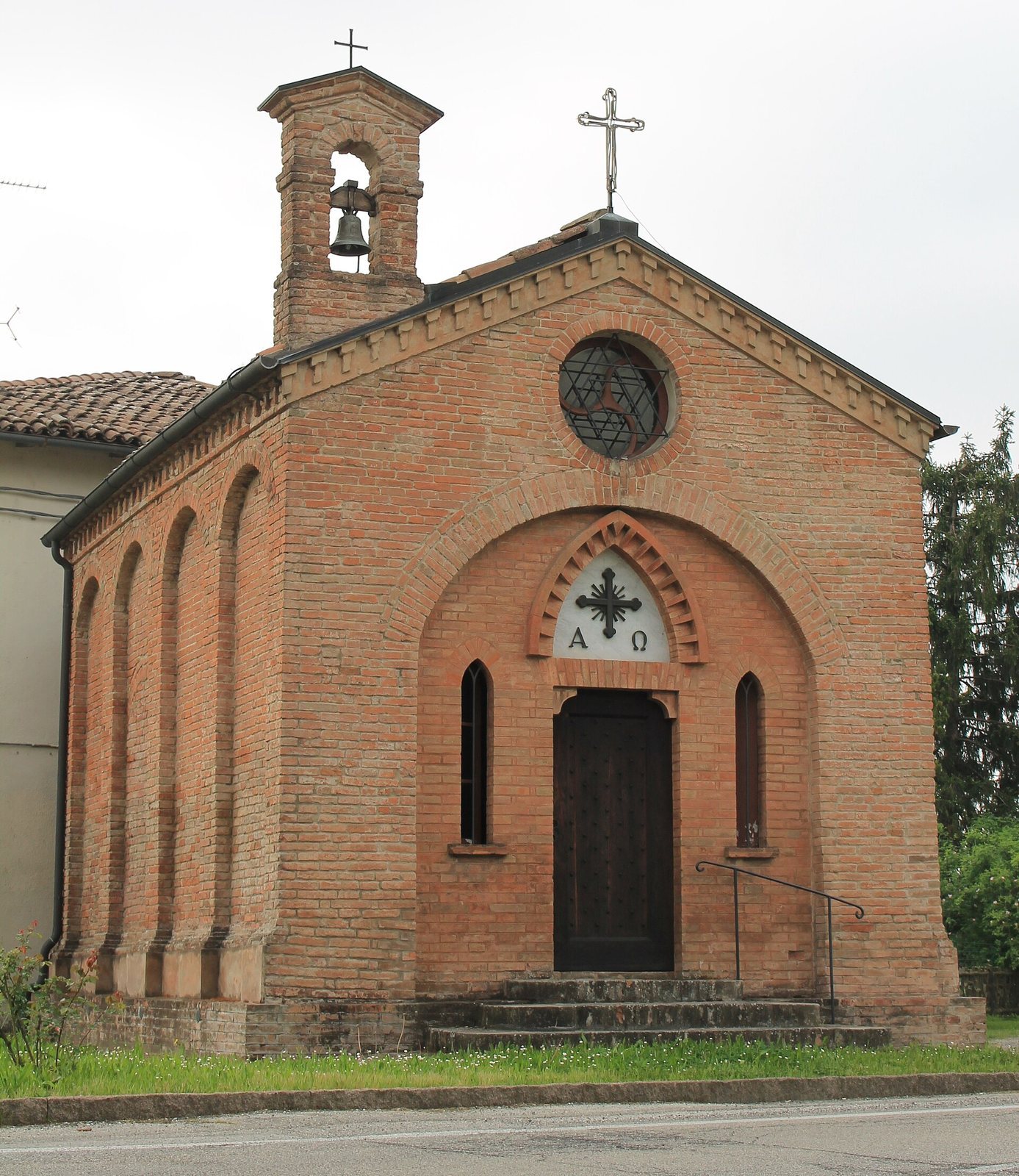
The compact brick chapel is aligned east to west. Its rectangular worship space ends in a polygonal apse, the sanctuary end of the building, within a pentagonal overall outline. The surviving structure combines this arrangement with traces of a different earlier footprint.
Building and foundations
Present chapel
The exterior has round arches set into the wall surface and a roof with two sloping sides. The façade was altered between the late 19th and 20th centuries. The arrangement of the walls beside the altar also reflects change: archaeological evidence indicates that the left wall was repositioned in relation to the earlier foundations.
Earlier building phase
Restoration exposed four brick bases and wall foundations whose perimeter differs from the chapel’s present outline. Traces of openings in the sides suggest that an earlier phase may have been a partly open, shrine-like structure, later enclosed and modified.
Frescoes and wall paintings
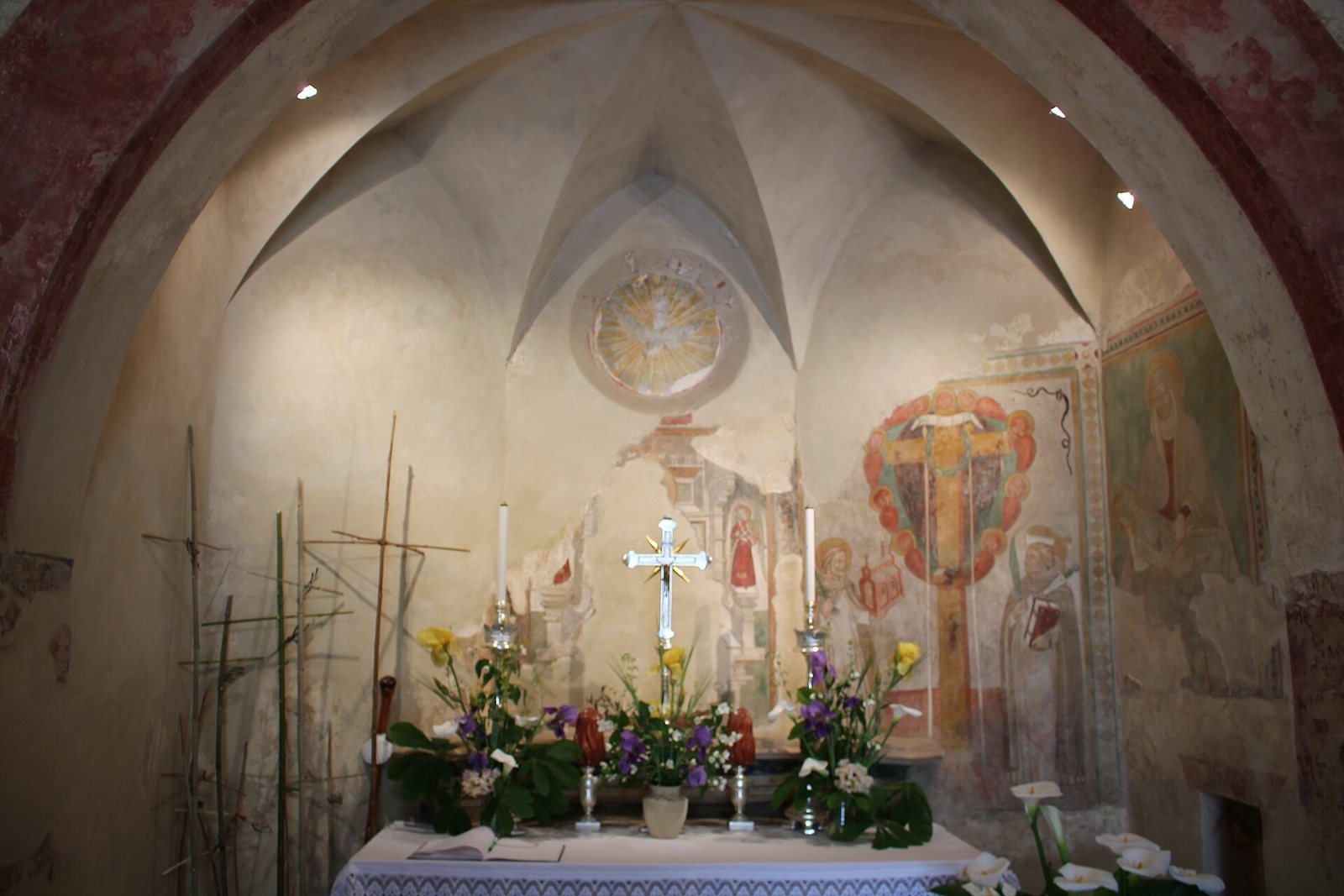
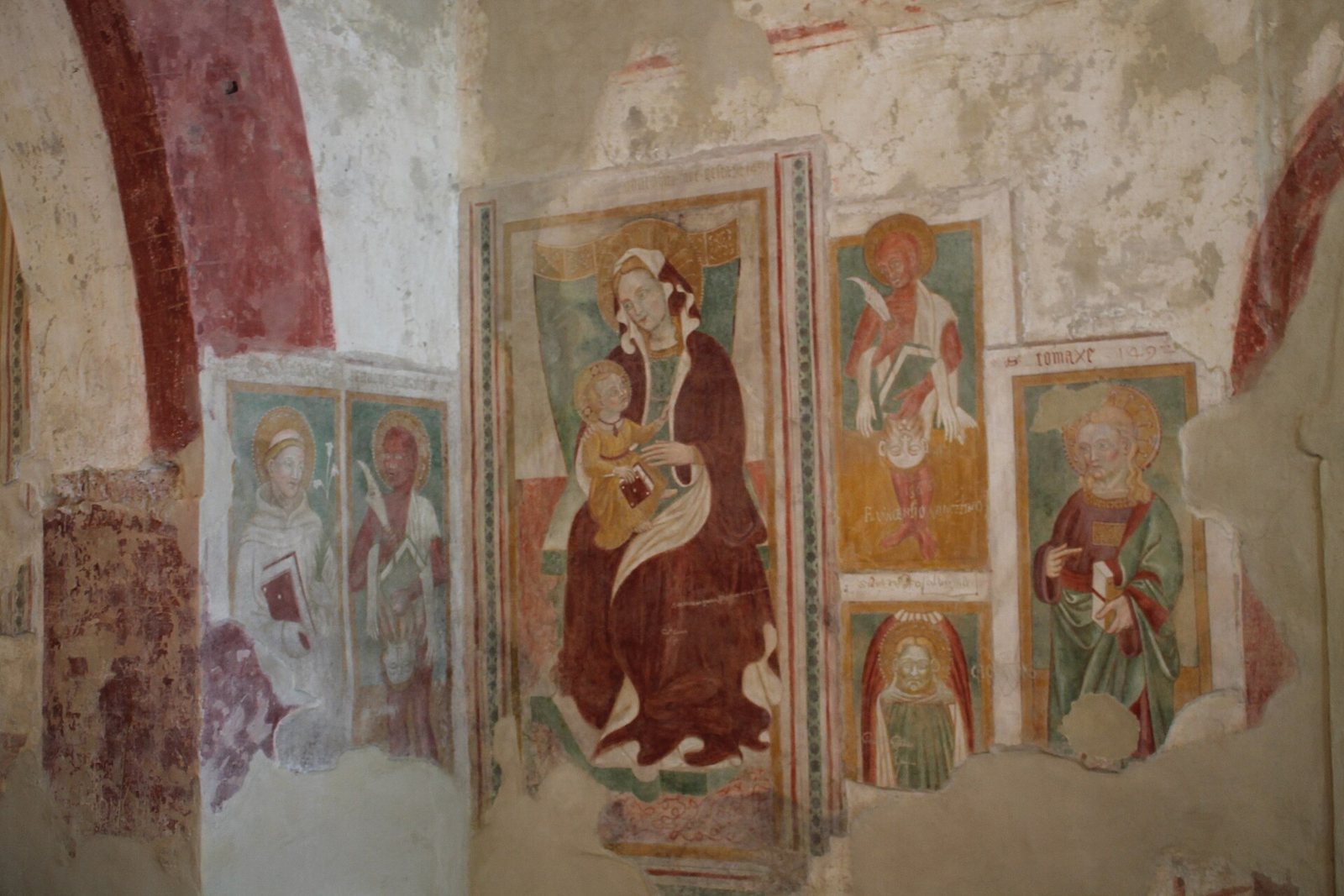
Fragments of painted human figures and garments survive inside the chapel, and some may belong to images of saints. The paintings are examples of figurative art between Bologna and Ferrara in the 15th and 16th centuries, reflecting both traditions. Saints are generally shown standing within simple rectangular frames, with identifying objects. Inscriptions on some frames name a saint or commissioner and give a date. The painters used buon fresco, applying pigments to wet plaster so the image became part of the wall. Many paintings were votive offerings, commissioned as lasting prayers for protection or healing. Restoration cleaned and consolidated the frescoes, making them clearer and reconnecting them with their architectural setting.
Right side of the entrance
The paintings on the wall to the right of the entrance form a broken sequence of at least three superimposed layers, probably produced within a relatively short period. Saint Martin of Tours, a fourth-century bishop associated with soldiers, appears with a sword, horse, and cloak. Saint Francis of Assisi, the medieval friar who founded the Franciscan movement, wears a habit and knotted cord and carries a cross and book; the wounds resembling Christ’s crucifixion wounds, known as the stigmata, are also shown. Job, the biblical figure famed for enduring suffering, appears as a protector associated with illness. Below them, Saint James holds a pilgrim’s staff and book. The image does not establish whether he is James the Greater, traditionally linked with Santiago de Compostela, or the distinct apostle James the Lesser.
On the other side of a blocked arch, Saint Thomas wears a tunic, holds a Gospel book, and points to his side. Thomas was an apostle remembered for doubting the Resurrection before accepting it. Below the images of Francis and Job, Saint Donnino, a Christian martyr venerated in Italy, holds his severed head. Saint Bartholomew, an apostle traditionally believed to have been killed by flaying, is shown with his skin over one arm; the same artist painted both figures. A Madonna and Child, an image of Mary with Jesus as a child, overlaps the edges of older paintings on the right wall.
Altar walls
Two images of Saint Anthony stand symmetrically beside the altar. He is shown as a young man in a Franciscan robe, with a book and lily. Moisture badly damaged these paintings and the nearby image of Saint Bartholomew, but restoration saved them. On the wall to the left of the altar, a Madonna holds a goldfinch tied with a cord. The bird was associated with Christ’s death and resurrection. The image also reflects medieval and Renaissance interest in the natural world and human affection.
Apse paintings
The apse contains a fresco of the Holy Cross between Saint Dominic, founder of the Dominican Order, and Saint Peter Martyr, a 13th-century Dominican friar venerated as a martyr. The painting may date to 1491, based on its Dominican subject and a similar scroll-like floor pattern in the Madonna and Child image. An enthroned Madonna once formed the central focus of the chapel’s decoration, but the image is now almost entirely lost; a vertical crack appears to have detached its plaster.
Excavation and restoration suggest that Saint Anthony Abbot, an early Christian ascetic associated with the beginnings of monasticism, may have been painted on the left apse wall. A small fragment of a habit remains there, while fragments thought to represent the saint’s face, beard, and staff were recovered from the ground.
Pilgrim graffiti
Graffiti on several interior painted layers date from the 16th to the 20th centuries. Some depict Calvary, the place of Jesus’s crucifixion, and the Cross. Others refer to pilgrims’ journeys, including travel to the Holy Land and along the route to Santiago de Compostela. Pilgrims also left signatures on the exterior left façade. The chapel’s painted saints include figures associated with pilgrimage and healing, and the images have been interpreted as suggesting that people also valued the oratory for healing.
Burial
A single burial was found inside the oratory during an enlargement. Coins and rings recovered with the deceased date to the first half of 1376. The person was estimated to have been a man about 50 to 55 years old.