Church of the Transfiguration in Preobrazhenskoye: A Russian Orthodox Church in Moscow
Site at a Glance
- Popularity
- High
- Country
- Russia
- Primary era
- Early Modern
- Eras represented
- Early Modern, Modern
- Civilizations
- Russian
- Site type
- Religious
- Remains
- Church
On this page12 sections
History
The Church of the Transfiguration in Preobrazhenskoye is a Russian Orthodox church in Moscow, Russia. Its stone building was erected in 1765–1768 in a settlement associated with the formation of two Russian Guards regiments. The church is part of the Moscow Diocese and Resurrection Deanery, a local grouping of parishes. Its dedication refers to the Gospel episode in which Jesus was revealed in glory to his disciples.
From village church to stone building
Preobrazhenskoye was mentioned in the seventeenth century, when Tsar Alexei Mikhailovich ordered a summer palace built there. The young Peter I had play soldiers based in the village; in 1687, these forces became the Preobrazhensky and Semenovsky regiments, two of Russia’s Guards regiments.
In 1747, a sergeant of the Preobrazhensky Regiment acquired an old wooden church in neighboring Semenovskoye and moved it to the regiment’s yard in Preobrazhenskoye. It replaced a temporary church made of canvas and was consecrated on July 19 in honor of the apostles Peter and Paul. Parishioners decided to build a stone church in 1763, began collecting donations, and completed construction in 1768. A Peter and Paul chapel and bell tower followed in 1781. The altar dedicated to the Transfiguration, later the church’s main altar, was consecrated in 1800.
Parish life and imperial visits
The church escaped the Moscow fire of 1812, and services continued during the French army’s occupation of the city. In 1815, priest Ivan Timofeyevich Zercheninov arrived from nearby Golyanovo. His son-in-law, Ivan Polikarpovich Orlinsky, succeeded him and served until his death in 1865. Orlinsky was followed by another son-in-law, Ivan Nikolayevich Strakhov, who had studied at the Moscow Seminary.
From 1830, the church underwent improvements and its resources grew with the involvement of the merchant Kotov, who had been elected churchwarden. Emperor Alexander III visited in 1883 before celebrations marking the Preobrazhensky Regiment’s 200th anniversary. An Alexander Nevsky chapel was added after the visit.
Survival, demolition, and rebuilding
The church remained open after the Revolution. Parishioners protected its valuables, including its bells, and took in icons from churches closed during the mass closures of the period. During the Second World War, they collected donations for the front. From 1944, the church housed the office of Metropolitan Nikolai Yarushevich of Krutitsy and Kolomna, a senior bishop. By the early 1960s, its congregation was among the largest in Moscow. Priest Dmitry Dudko served there from 1961 to 1964.
In 1963, Moscow’s city executive committee ordered the church’s demolition, citing metro construction. Parishioners collected more than 2,500 signatures to oppose the decision, but the building was blown up at about 4 a.m. on July 18, 1964. The planned metro station was built elsewhere, and a garden square occupied the church site. The claim that this was the last Moscow church demolished by explosion is incorrect: another church near Kaluga Gate was destroyed in the same way in April 1972.
A renewed congregation began campaigning for reconstruction in 1996 and placed a wooden memorial cross on the site the following year. The parish was officially registered in 1999. On July 17, 2009, the Moscow government approved rebuilding the church on its former site, and work continued from 2009 to 2015. Article 47 of Russia’s cultural heritage law permits reconstruction of a lost heritage site when it is especially important and adequate scholarly information is available. The Center for Traditional Russian Culture “Preobrazhenskoye” assembled the project documentation, and successive church leaders Alexy II and Kirill supported the effort.
Patriarch Kirill consecrated the reconstructed church on May 8, 2015. On October 1 of that year, it became the principal church of the Russian Ground Forces in a ceremony led by Archbishop Arseny of Istra.
Remains
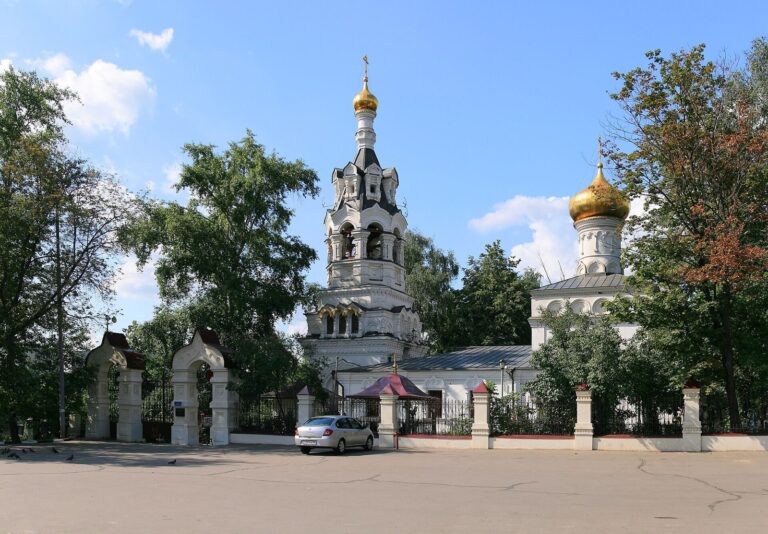
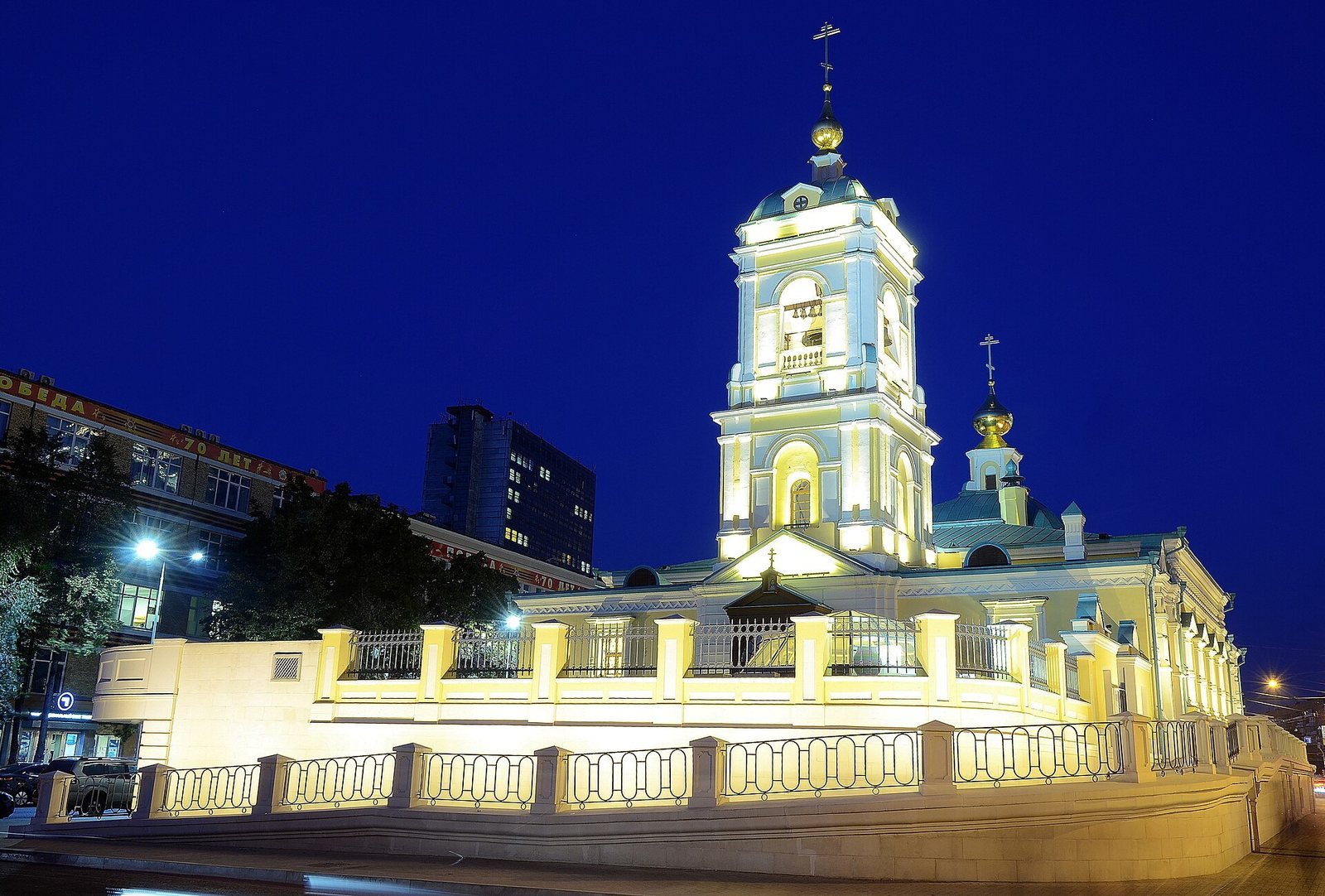
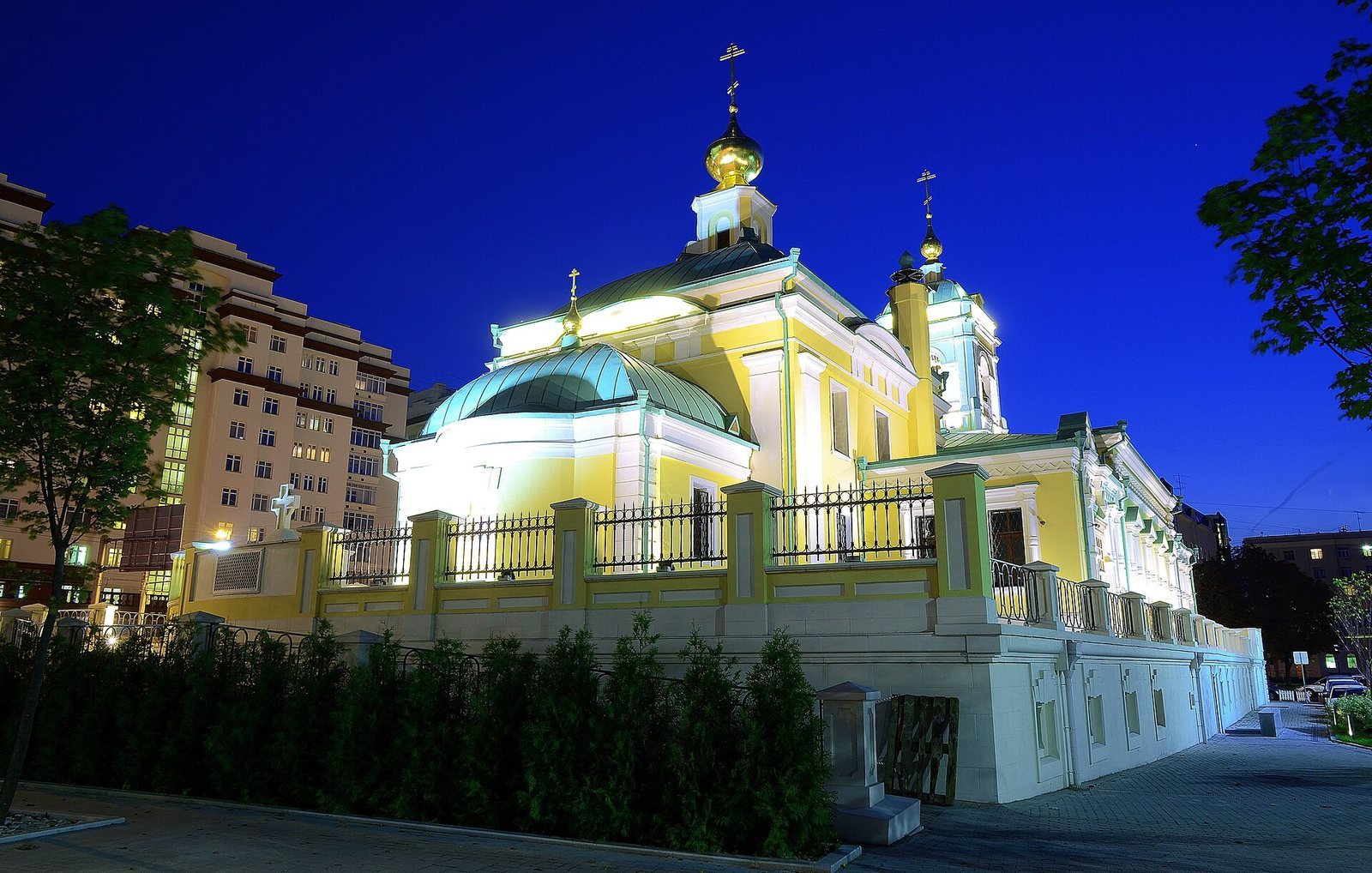
The reconstructed brick church stands on the original site at Preobrazhenskaya Square. Its design draws on 1883 drawings and archival photographs, and re-creates the three-altar church, its adjoining hall and its bell tower in forms representing the eighteenth through late nineteenth centuries. The building has one dome and one bell tower.
Building and internal arrangement
Main church and bell tower
The original church’s three altars were dedicated to the Transfiguration, Peter and Paul, and, later, Alexander Nevsky. The reconstruction plan followed this arrangement and included the adjoining refectory, a hall used for worship or gatherings, and the bell tower. It relied on historical drawings and photographs to guide the recreated forms.
Raised lower level
The 1964 demolition badly damaged the foundations of the refectory and main church, so the original foundations could not support the rebuilt structure. Its floor was raised to the level of a platform 4.2 metres above ground. A solid slab beneath the building preserves the original basement spaces and spreads the building’s weight, taking the nearby metro line into account.
The raised lower level contains a separate one-altar church and a baptistery. Exterior and interior stairways, as well as a lift, connect it to the upper church. The reconstruction plans also provided for an altar to St Nicholas the Wonderworker in the foundation space, in memory of Metropolitan Nikolai Yarushevich.
Finds, memorial, and icons
Excavated objects
Excavations carried out before reconstruction uncovered an altar cross, a bell clapper, parts of church furnishings, and fragments of equipment belonging to soldiers of the Preobrazhensky Regiment.
Soldiers’ memorial
A memorial beside the church commemorates Preobrazhensky soldiers and officers killed in wars fought for their homeland.
Icons
The principal icon of the Transfiguration was presented in 1856 in connection with the regiment’s presence in the village on its feast day. Other icons include images of St Nicholas of Myra, the Mother of God as Queen of All, St Spyridon of Trimythous, St Seraphim of Sarov, the Mother of God as the Sign, the Crucifixion of Jesus Christ, and the Mother of God as Joy of All Who Sorrow.