Saint Athanasius of Mouzakis Church: A Fourteenth-Century Orthodox Church in Kastoria
Site at a Glance
- Popularity
- Medium
- Country
- Greece
- Primary era
- Medieval
- Eras represented
- Medieval
- Civilizations
- Byzantine
- Site type
- Religious
- Remains
- Church
On this page10 sections
History
Saint Athanasius of Mouzakis Church is a fourteenth-century Eastern Orthodox church in Kastoria, Greece, built and painted in 1383–1384. It dates to the waning of Byzantine rule, the eastern continuation of the Roman Empire centered on Constantinople. The church is considered one of Kastoria’s most important fourteenth-century monuments and the last church erected in the city before its annexation by the Ottoman Empire.
Muzaka rule and patronage
The Kastoria region had previously been ruled by the Serbian ruler Stefan Dušan and later by the Serbian magnate Radoslav Hlapen. From 1380 to 1385, it formed part of the medieval Albanian Principality of Muzaka, and the Muzaka family controlled Kastoria when the church was built.
The founders’ inscription names the brothers Teodor II Muzaka and Stoya Muzaka, the monk Dionysius, and Bishop Gabriel of Kastoria, whose episcopate coincided with the work. The church’s paintings influenced artistic production in Kastoria and western Macedonia from the late fourteenth into the early fifteenth century.
Declared a cultural monument in 1924, the church was restored in 1951 and remains active. It is associated with the Ecumenical Patriarchate of Constantinople, which holds primacy of honor among Eastern Orthodox churches, and with the Diocese of Kastoria, a church district overseen by a bishop. Traditionally, it forms part of the Metropolitan parish.
Remains
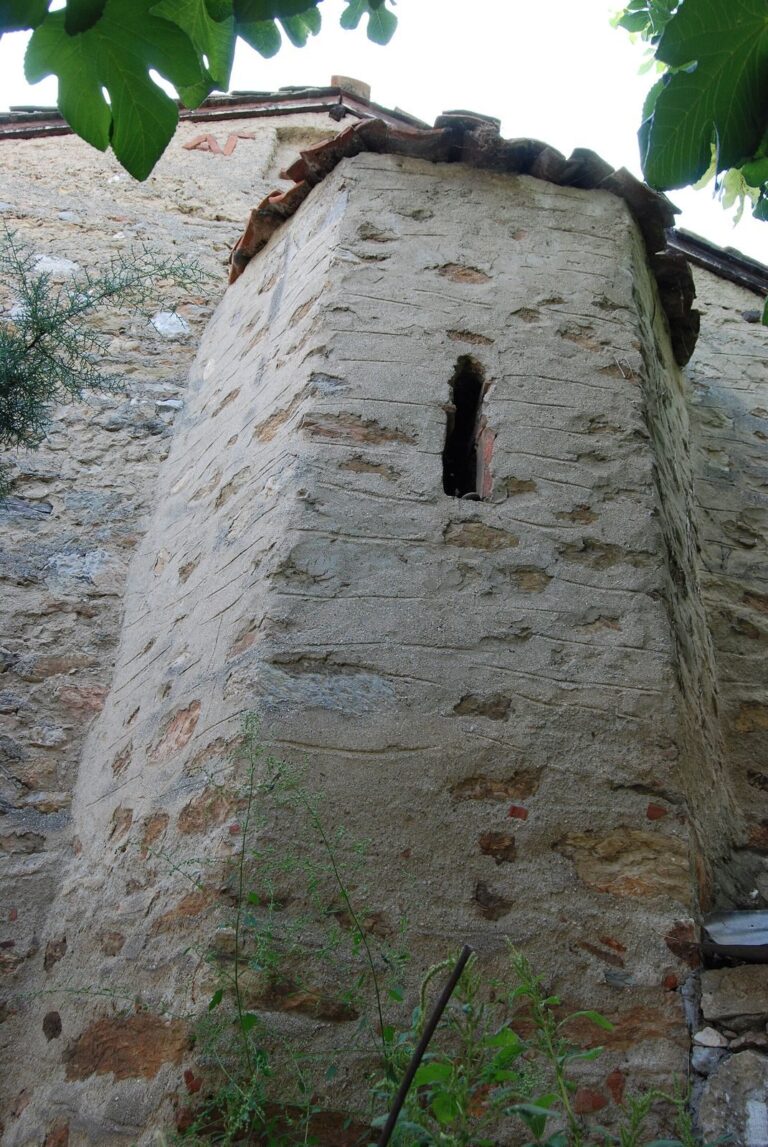
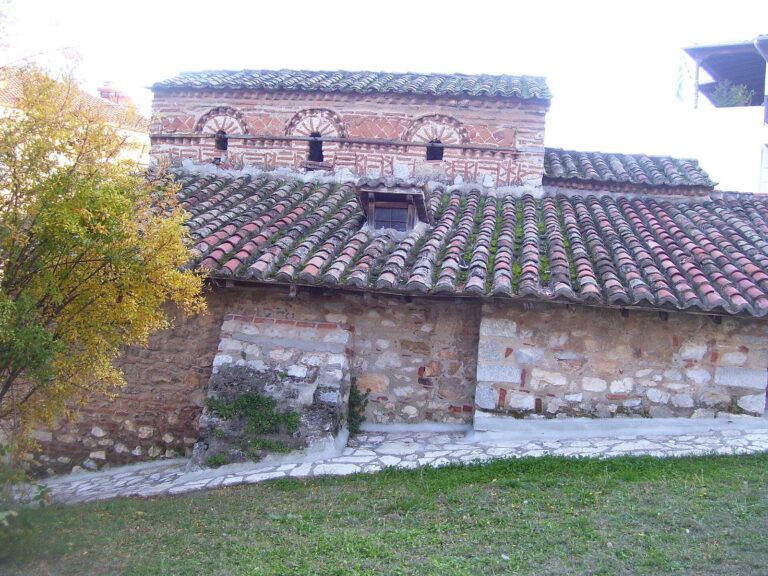
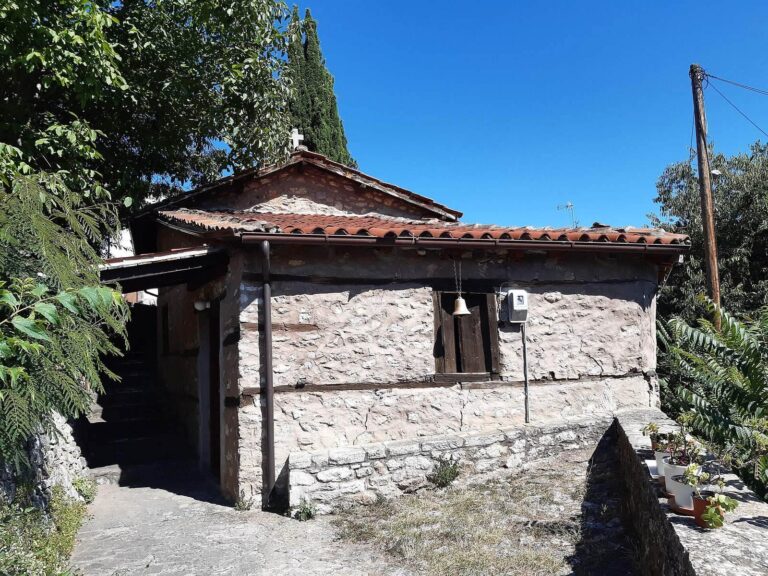
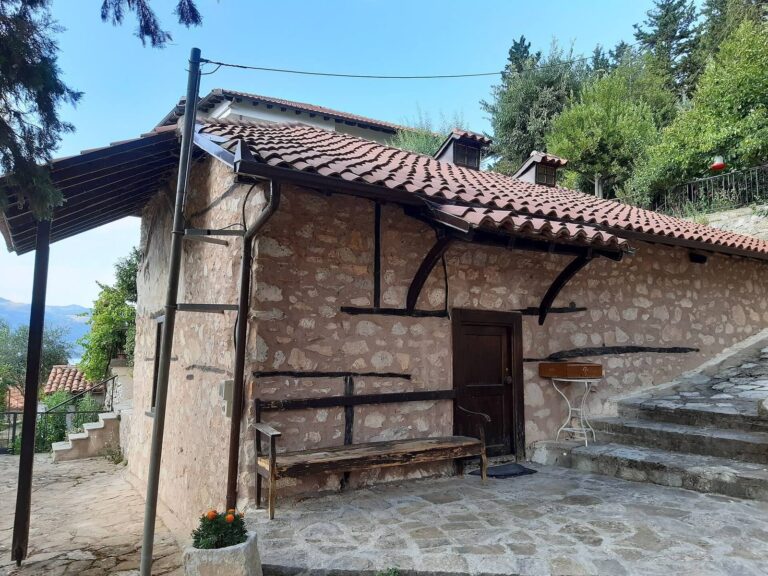
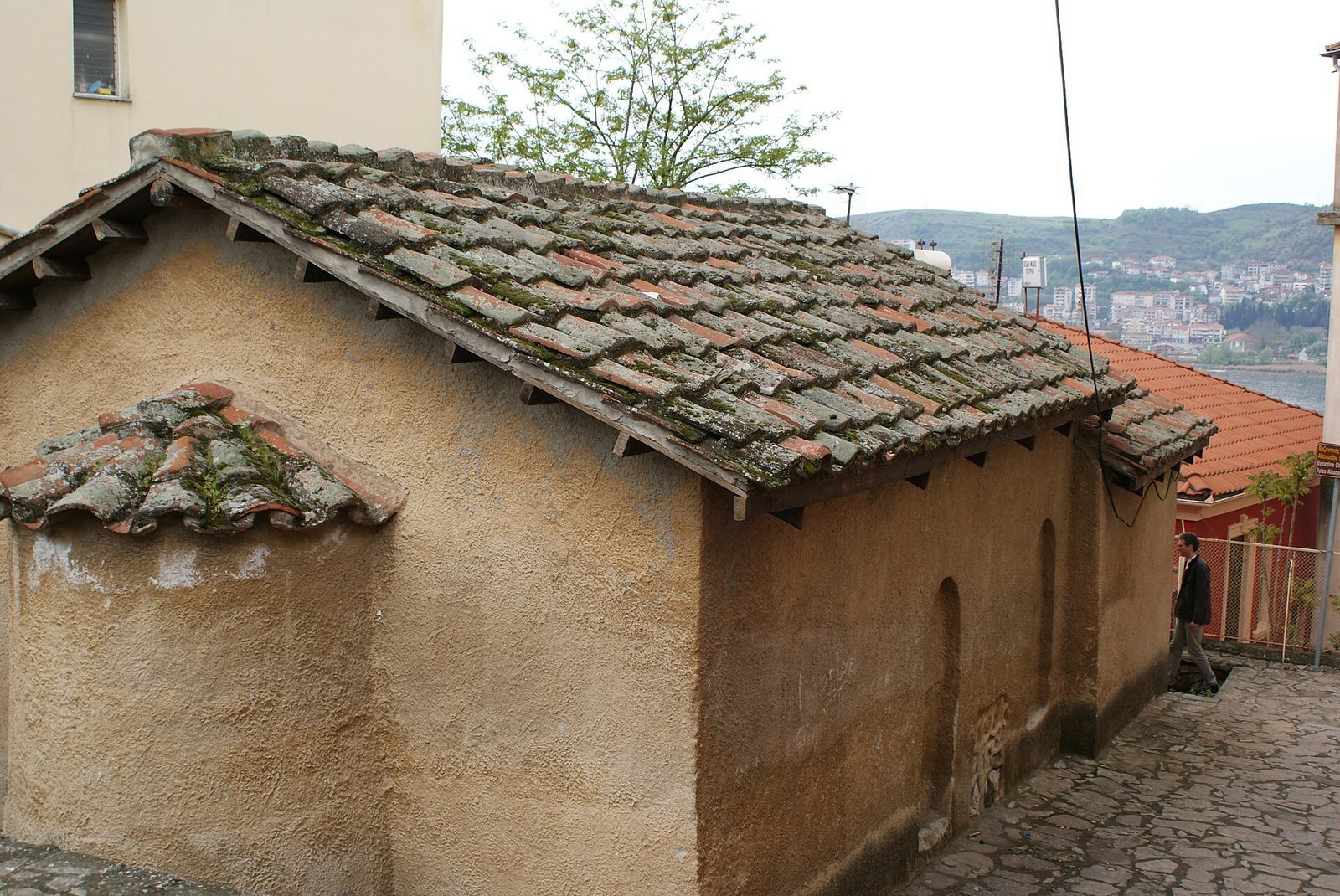
The church has a single-aisled basilica plan, with one main lengthwise space, a semicircular apse, or projecting rounded end, to the east, and an entrance area added at the west. Its wooden roof and roughly dressed stone walls, bonded with mud, give the building its simple structural form.
Exterior and roof
The present roof was reconstructed in the 1950s, using much of the original roofing material. Each of the north and south walls has two blind niches, recessed features that do not open into a room. Two more flank the west entrance. Above that entrance, the preserved founders’ inscription identifies the church’s patrons and bishop.
Interior paintings
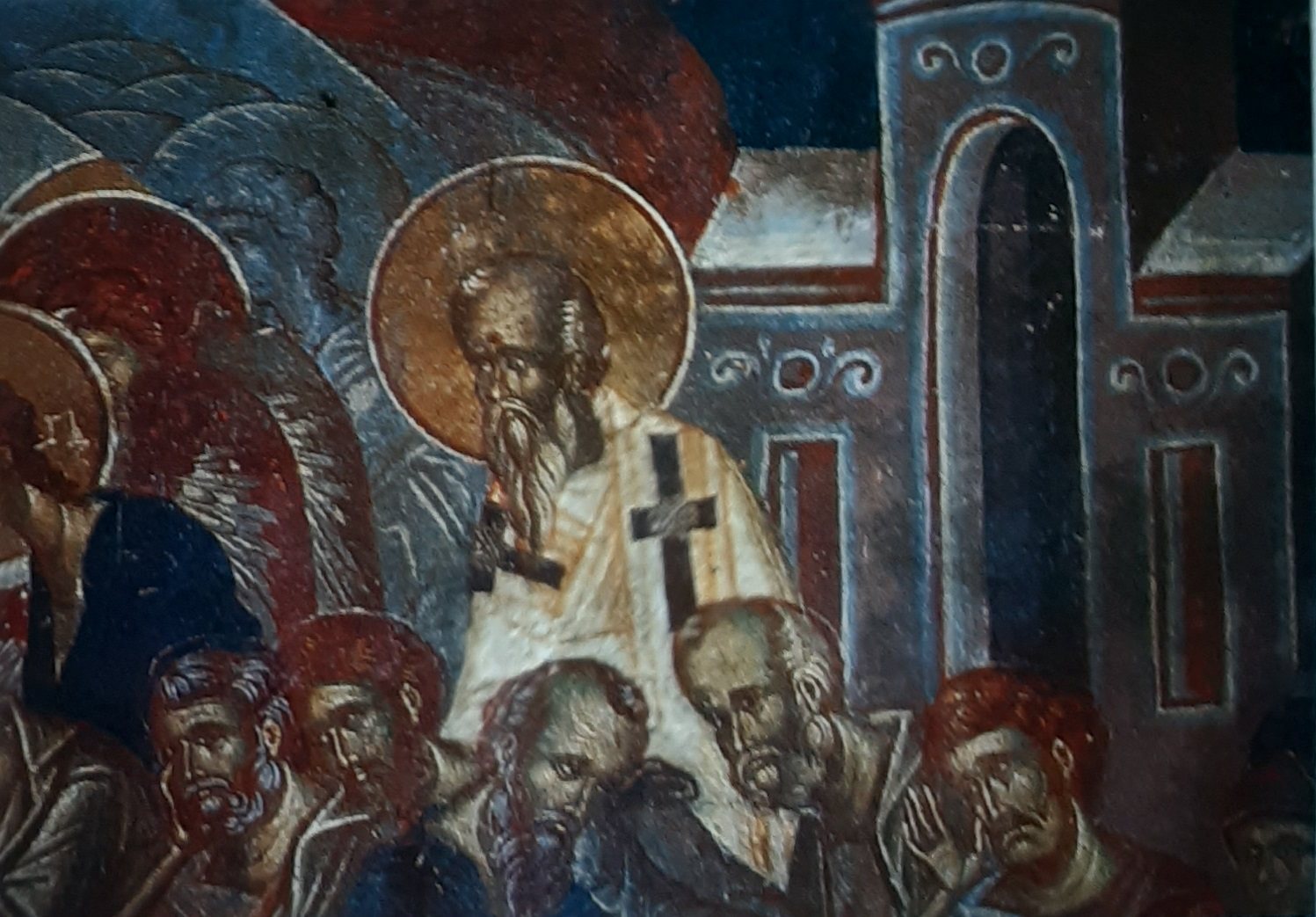
The wall paintings are arranged in three horizontal zones and cover the church’s interior walls. The descriptions below follow the imagery on each wall.
East wall
The Virgin Mary appears in the curved upper end of the apse. Below her, the middle zone contains the Communion of the Apostles, while the lower zone shows the Divine Liturgy. In the Deesis, an image of Christ with intercessory figures, Christ appears as the Great High Priest, a portrayal emphasizing his priestly role; the Virgin wears imperial dress. Remains of an Ascension scene survive above the apse. The middle zone also includes the Annunciation. In the curved upper end of the prothesis, the chamber used to prepare Eucharistic offerings, are Saint Stephen and Saint Simeon Stylites. Saint Cyril of Alexandria is shown on the side toward the south wall.
South wall
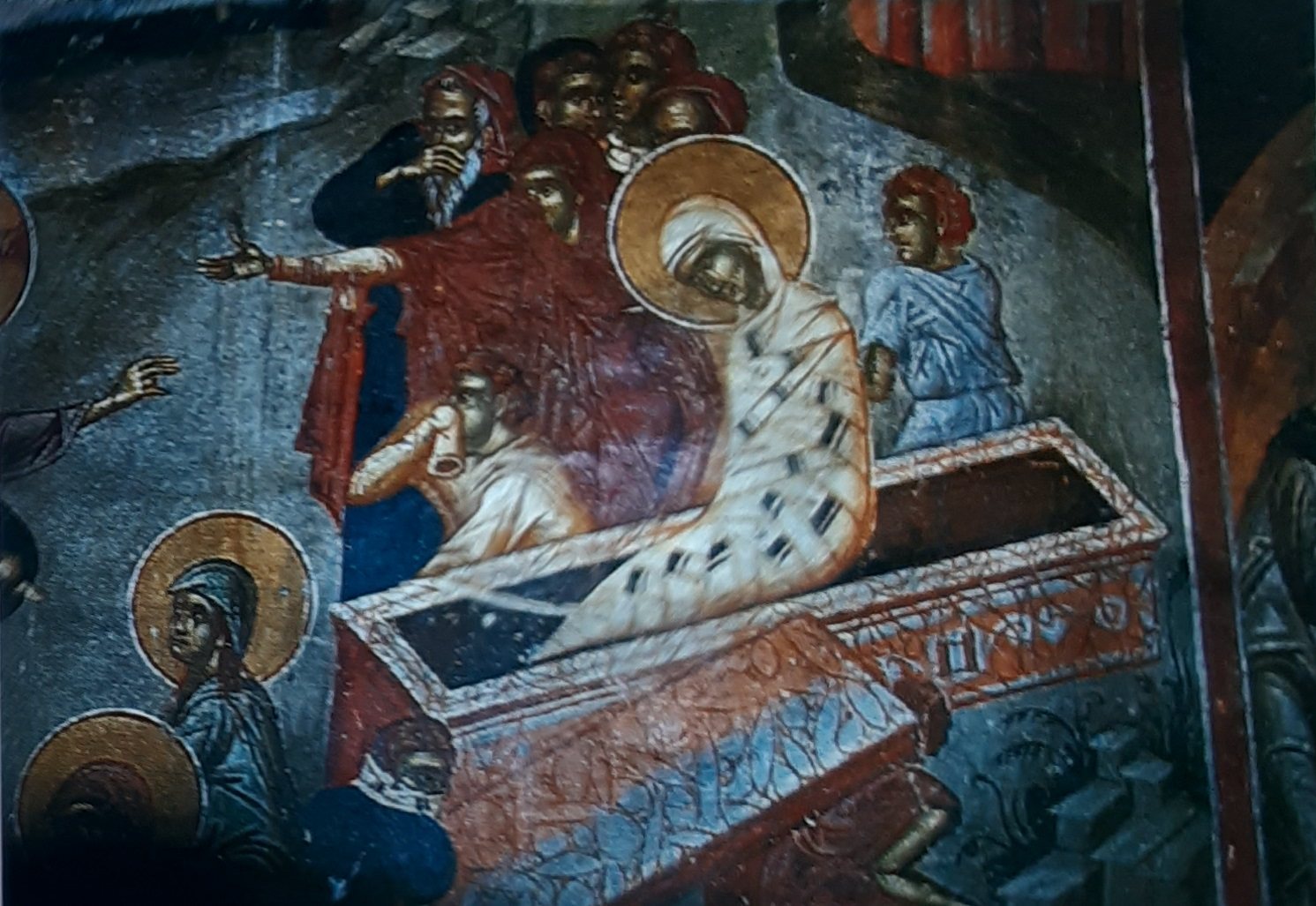
The lower zone includes Saints Clement of Ohrid, Achillius of Larissa, Athanasius, Nicholas, Demetrius, Theodore Tiron, Theodore Stratelates, Procopius, and Mercurius. The middle zone contains saintly figures in medallions: Dionysius the Areopagite, Gregory of Agrigento, Hypatius, Auxentius, Eugenius, Marmarius, Ananias, Azarias, Misael, and two unidentified saints. The Nativity, Presentation of Christ, Baptism, Raising of Lazarus, and Entry into Jerusalem are also placed in the lower zone.
West wall
Saints Constantine and Helena, Archangel Michael, and Saint Barbara occupy the lower zone. The middle zone depicts the Dormition of the Virgin, the Judgment of Caiaphas, and Peter’s Denial. Above them are the Prophet Zechariah, the Transfiguration, and the Prophet David.
North wall
The lower zone shows Saint Nicholas the New, Saint Alexander of Pydna, Saint Paraskeva, Saint Kyriaki, Saint George of Cappadocia, and the Vision of Saint Peter of Alexandria. The middle zone includes Saints Julitta and Cyricus, other unidentified saints, Saints Cosmas and Damian, Germanus of Constantinople, Polycarp, and Ignatius. The upper zone presents scenes from the Passion, including the Crucifixion, Lamentation at the Tomb, the Myrrhbearers at the tomb, and the Resurrection.
Painting style and imagery
The paintings are attributed to the same masters associated with the Church of the Virgin Mary on Mal Grad and the Church of Jesus Christ the Life-Giver at Borje. Their saints wear Byzantine clothing. The frescoes are considered the first works in Byzantine iconography to portray Christ and the Virgin in imperial costume, and the Virgin’s image as a queen is also described as unusual.
Saint Alexander, who is not usually classed among the military saints, and Saint Mercurius are depicted in military clothing. Saint George wears a mantle and cloak bearing a double-headed eagle, a heraldic emblem with two heads, and a central star. Albanian historian Pëllumb Xhufi interprets the emblem as connected to a supposed grant of the Byzantine eagle by Emperor John V Palaiologos to Andrea II Muzaka after Andrea’s victory over the Serbian ruler Vukašin. In this interpretation, the image reflects a view of Andrea among medieval Albanians as a great warrior of God.