Santa Maria Assunta Church: Parish Church of Villa Lagarina
Site at a Glance
- Popularity
- Low
- Country
- Italy
- Primary era
- Early Modern
- Eras represented
- Medieval, Early Modern, Modern
- Civilizations
- Austria-Hungary, Habsburg, Holy Roman Empire, Italian
- Site type
- Religious
- Remains
- Church
On this page10 sections
History
Santa Maria Assunta Church is the Roman Catholic parish church of Villa Lagarina, Italy. Dedicated to the Assumption of Mary, the Christian belief that she was taken body and soul into heaven, it belongs to the Vallagarina pastoral zone and the Archdiocese of Trento. First recorded in 1188, the church probably existed earlier. It once served as the parish church for the Adige’s right bank from Isera to Aldeno, a district broadly corresponding to the Lodron family’s fief.
Medieval church and Lodron patronage
The original church had Romanesque and Gothic features, but later rebuilding left little of its medieval fabric. In about 1626, Paride Lodron commissioned the Chapel of Saint Rupert in memory of his parents, Dorotea Welsperg and Nicolò Lodron. Paride was prince-archbishop of Salzburg, an office combining an archbishop’s religious authority with a prince’s governing power. The chapel was inaugurated in 1629.
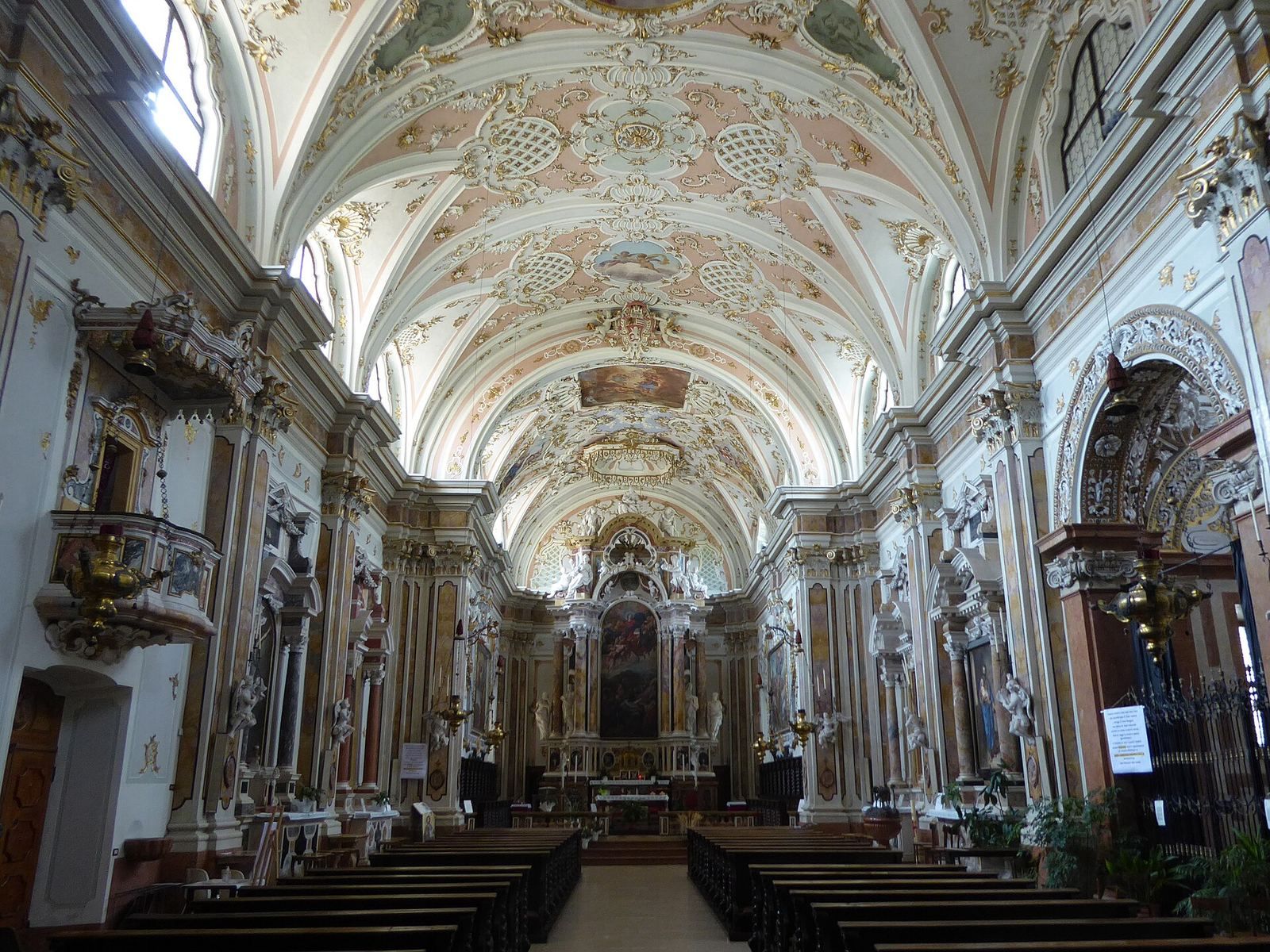
At the Lodron family’s request, architect Santino Solari designed a major reconstruction of the church. Work took place from 1645 to 1650 under master builder Domenico Orsini. The rebuilding transformed the medieval Romanesque-Gothic church in the later Baroque and Rococo styles, known for elaborate forms and decoration. Its three naves, or main divisions, were combined into one, and the church’s orientation was reversed. At Carlo Ferdinando Lodron’s direction, Cristoforo and Sebastiano Benedetti of Castione made the main altar between 1696 and 1700. Nicolò Dorigati painted its altarpiece, while Carlo Ferdinando supervised the lower inlays.
Further decoration and later changes
From 1756, Massimo Settimo Lodron commissioned extensive interior decoration. In 1756–58, workers clad the medieval masonry pillars in marble, following a design by Teodoro Benedetti and carrying it out under Valentino Villa. Gaspare Antonio Baroni Cavalcabò and Gerolamo Costantini painted the central vault and the areas between its openings. Giuseppe Canonica and Giovanni Vittorio Baldoe added stucco decoration, molded plaster ornament, in 1761–67. Canonica’s marble pulpit was installed in 1762.
The bell tower was renovated in 1575. Antonio Lodron added three bells in 1596, cast by the French masters Stefano and Giacomo. Giuseppe Ruffini made further bells in 1776 at the request of Massimiliano Lodron, an Austrian archpriest, or senior cleric with supervisory duties in a church district. In the early nineteenth century, Livio Tornaghi of Monza made the church organ. Architect Enrico Nordio rebuilt the façade in 1884; this work required the demolition of a chapel dedicated to Saints Anthony of Padua and Thecla, which contained the baptismal font. Luigi Cavenaghi and stucco artist Pietro Calori decorated the vault in 1897.
During the First World War, a bomb pierced the presbytery wall, destroyed a painting, and damaged the main altar.
Remains
Plan and connecting features
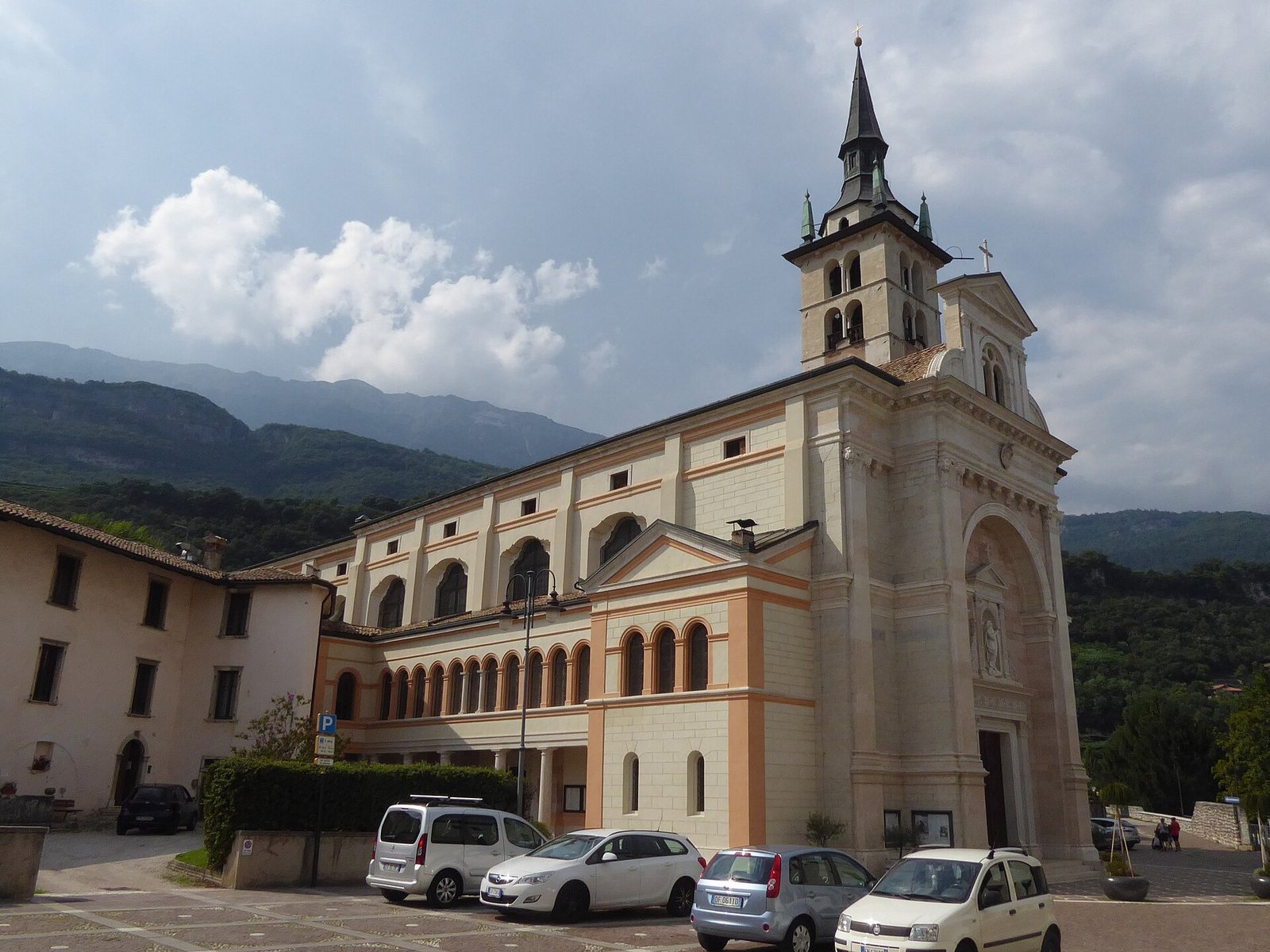
The church has a single nave, the main body of the building, and six side altars, arranged three to each side. Only a small amount of medieval fabric survives. An elevated exterior corridor supported by columns connects the façade, choir gallery and pulpit with the sacristy.
Bell tower and façade
The bell tower belongs to the church’s earliest building phase, although it has been substantially altered. Its original Romanesque masonry can be seen inside, while the tower’s exterior includes paired windows and an octagonal spire. A thirteenth-century fresco of Saint Christopher has also come to light in the tower. The façade has a Neo-Renaissance portal, a doorway using revived Renaissance forms, topped by a statue of the Immaculate Virgin Mary.
Interior altars
Main altar
The main altar’s altarpiece depicts the Assumption of Mary. Below it, inlaid figures represent Christian culture.
Side altars
On the left, the 1658 Altar of Saint Anthony has a painting from about 1700 by Antonio Gresta, showing the Madonna and Child offering the rosary to the saint. An altar dated 1655 carries Antonio Longo’s 1787 Crucifixion, while one dated 1651 has Giacomo Antonio Pellegrini’s 1783 painting of the Virgin giving the rosary to Saint Dominic. On the right, the 1791 Altar of Saint Thecla has Giorgio Telliè’s painting of her martyrdom. Another altar bears Eugenio Prati’s 1878 altarpiece of Saint Joseph with the Child. The altar dated 1650 carries Giuseppe Balata’s 1923 painting of the Immaculate Conception, the belief that Mary was preserved from original sin from the moment of her conception.
Chapel of Saint Rupert
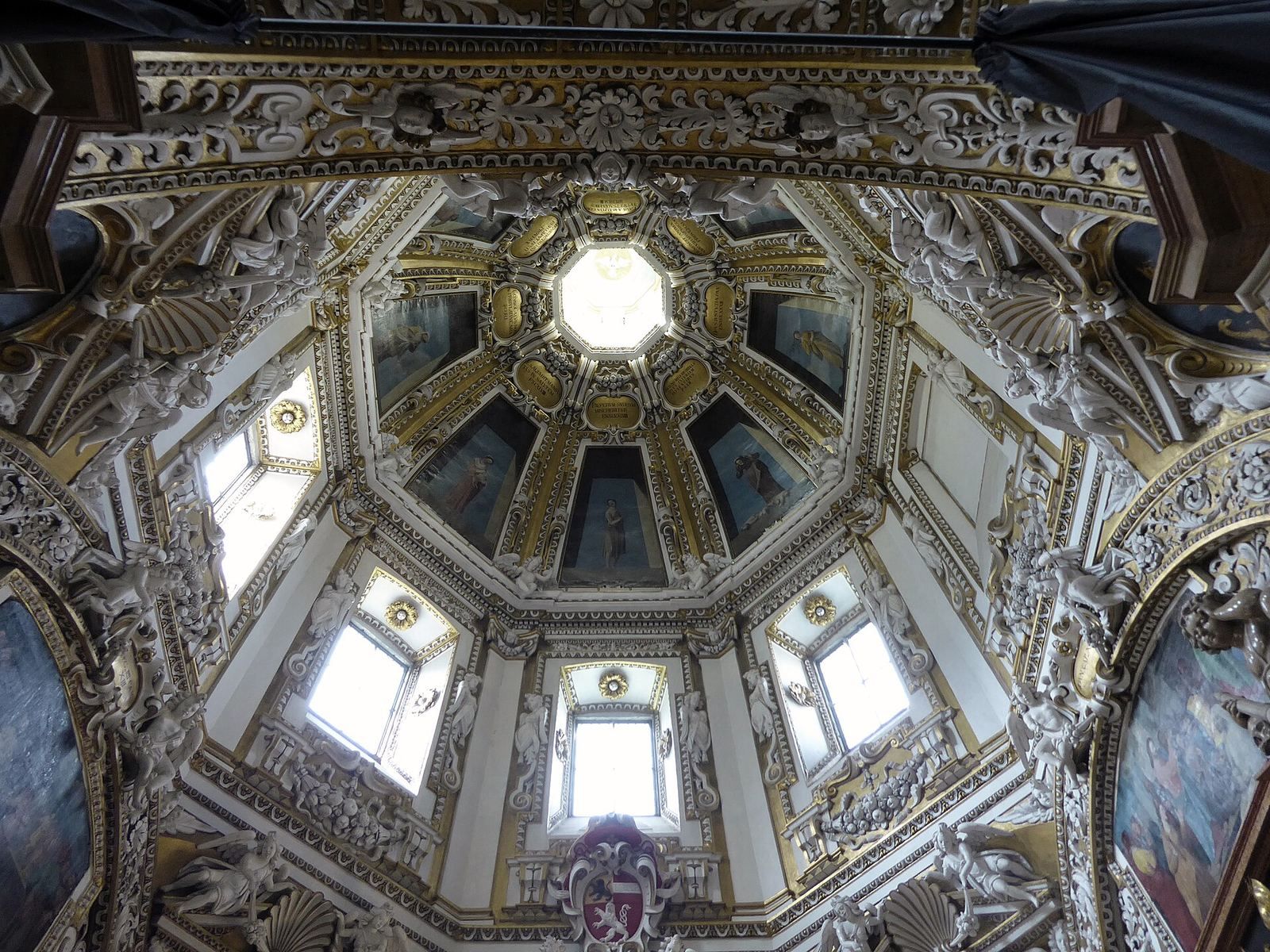
On the church’s north side, beside the bell tower, the Chapel of Saint Rupert is regarded as one of the leading examples of Mannerism in Trentino. Mannerism is a late Renaissance style associated with artful complexity and distortion. The chapel has a square room covered by a tall drum, the raised structure supporting a dome, which is octagonal. A smaller rectangular presbytery, the area around the altar, adjoins it. Rich stucco decoration includes 21 paintings on copper plates by Donato Mascagni, noted for using this technique.