Maestà del Ponte: A Marian Church in the Valdichiana
Site at a Glance
- Popularity
- Very Low
- Country
- Italy
- Primary era
- Early Modern
- Eras represented
- Early Modern, Modern
- Civilizations
- Duchy of Florence, Grand Duchy of Tuscany, Holy Roman Empire, Italian
- Site type
- Religious
- Remains
- Church
On this page11 sections
History
Maestà del Ponte is a Catholic church in the countryside of the Valdichiana in Italy, on the historic Via Lauretana, a pilgrimage route associated with Loreto. It belongs to the Diocese of Montepulciano-Chiusi-Pienza, a church district overseen by a bishop, and is one of seven churches dedicated to Mary in the Montepulciano area. Marian devotion, or religious devotion to Mary, the mother of Jesus, has deep roots in the region. The church was built by the people of Gracciano after a wayside shrine was demolished in 1551, and it was standing by 1616.
From roadside shrine to church
The earlier shrine held an image venerated as the Madonna del Salarco. It stood beside a bridge across the Chiana, linking the territories of Montepulciano and Valiano, near a crossing over the Salarco stream’s former course. In 1551 the shrine was removed to clear the way for excavation of the main Chiana canal, which was extended to Lake Montepulciano to drain the area. The people of Gracciano then built the church with money from alms and the labor of many workers. They placed the shrine’s image above its altar, where the parish priest of Gracciano officiated.
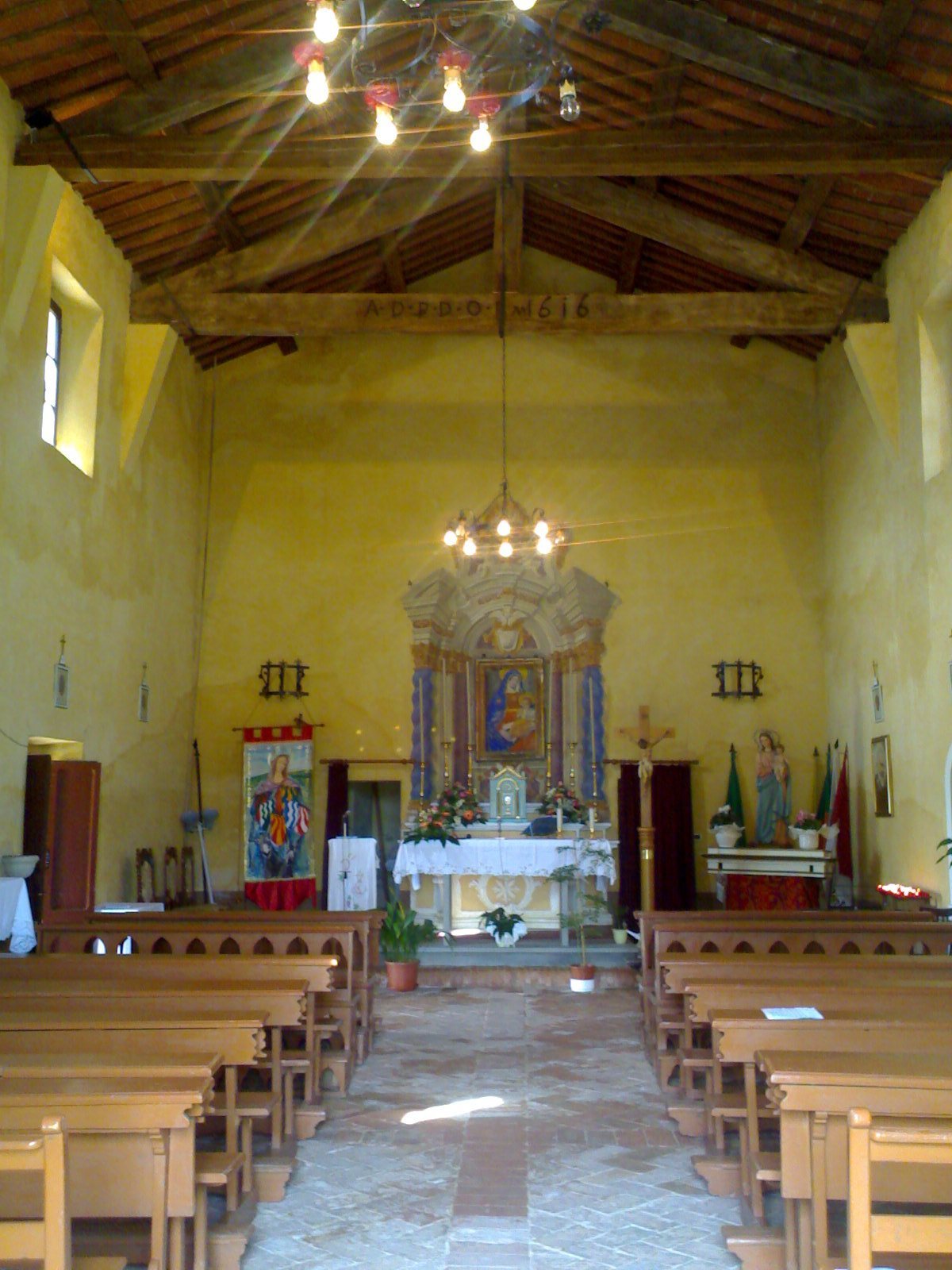
An inscription on a roof beam records that the church had been built by 1616. The following year, an inspection carried out on behalf of Bishop Roberto Ubaldini described it as an oratory, a place set aside for prayer and worship, and noted a request for its consecration. An inscription on the bell gable dates that structure to 1620. After a chaplain was appointed, the need for suitable accommodation led to successive enlargements that brought the church to its present form.
A map dated September 1646 shows the church at its present size and gives it the name Maestà del Ponte. The name recalls a wooden plank bridge supported on stilts, which before land reclamation led to the estate of Valiano. The crossing linked the two sides of the marsh and later connected areas of reclaimed land. It served pilgrims and supported trade and exchange.
Worship and the Bridge Fair
A large popular festival at the church is recorded by 1700. At a pastoral inspection in 1753, fifteen priests were present to serve religious needs. Morning services were followed by a multi-day Bridge Fair, where merchants sold goods, farm produce, and Chianina cattle, a traditional breed from the Val di Chiana. Horse races took place in the afternoon, first along Via dei Muli and later along Via della Madonna.
Over time, the celebration became a single annual fair, which continued at the church until 1929. That year, the prefect of Montepulciano ordered it transferred to the town center, where the fair continues.
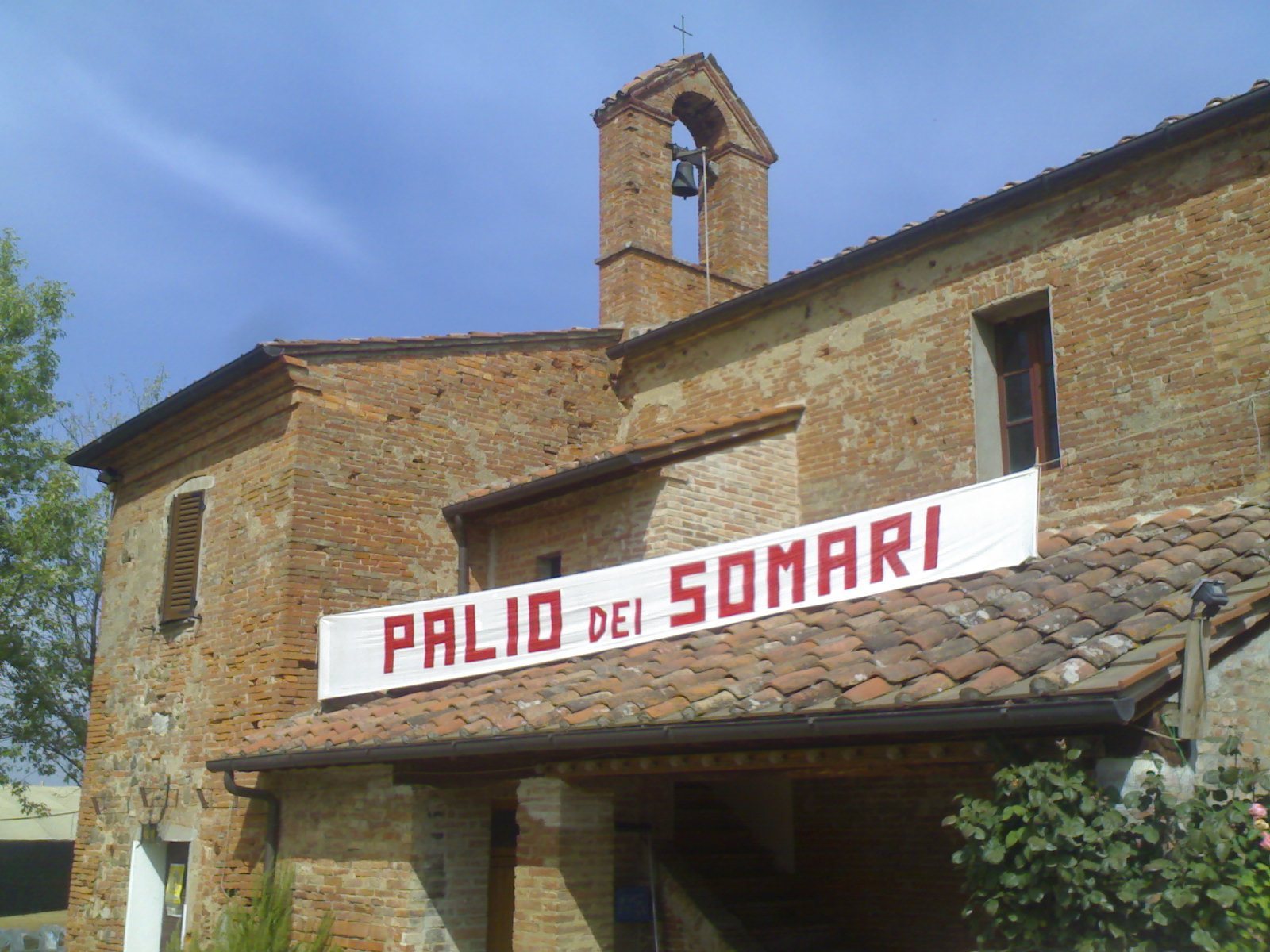
The church was restored in 1774. Following a revision of parish boundaries, it became part of the parish of Montepulciano Stazione in 1983. Parish priest Don Mario Ghezzi joined its traditional feast with the Feast of Our Lady Queen of Peace, formerly held on the last Sunday of September at the Church of the Sacred Heart of Jesus. The combined celebration takes place on the first Sunday of September and includes the Palio dei Somari, a donkey race between six districts: Aventino, Stazione, Fontago, Corbaia, Macchia, and Maestà del Ponte. Earlier districts included Casale, Cinta, Pollaio, Salarco, and Rovisci.
Later work replaced the roof in 1998, restored the adjoining house in 2000 and the exterior stair and side portico in 2001, and installed a new bell in 2011.
Remains
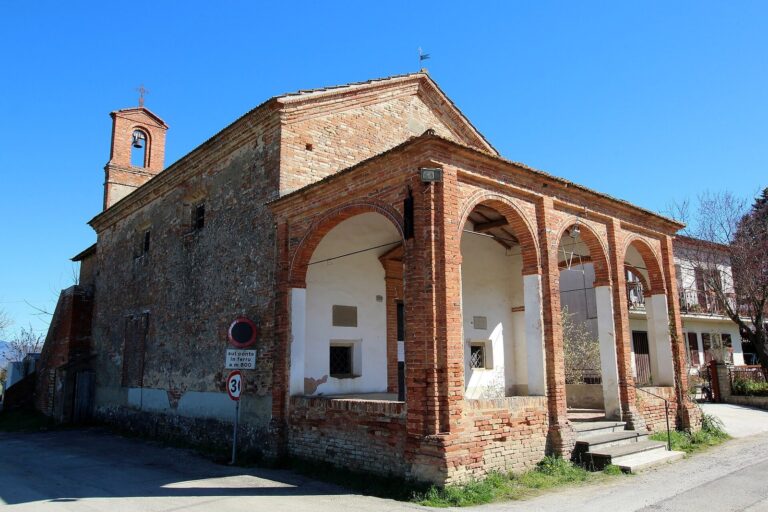
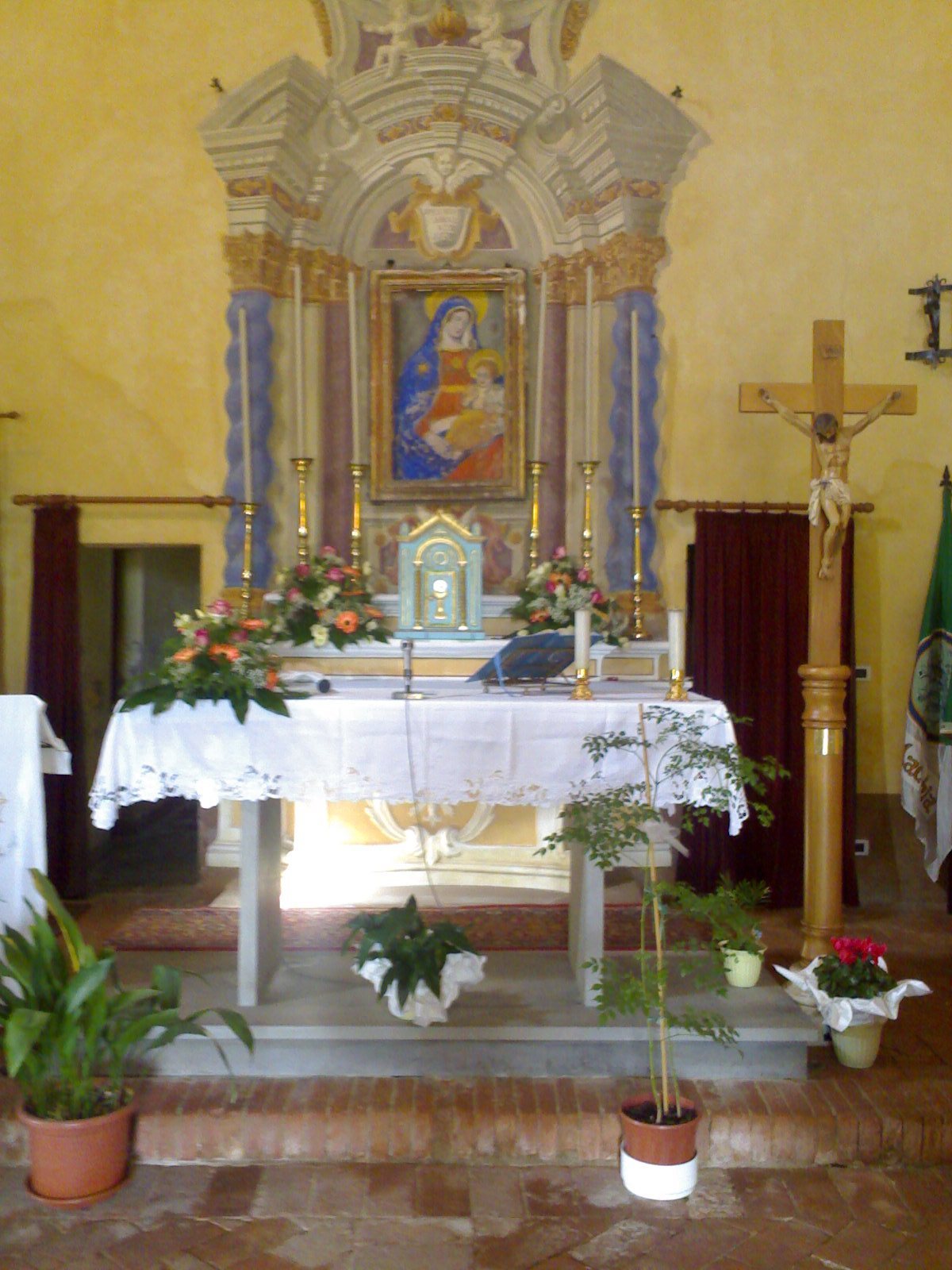
The church has a single nave, the main lengthwise space, beneath a roof supported by wooden trusses, or structural frames. Its simple exterior includes a gabled roof and a brick bell gable, a raised wall with openings for bells. Inside, the main and side altars preserve several layers of its devotional history.
Exterior and layout
Facade and former portico
The facade has a lintelled entrance, topped by a horizontal stone or timber support, with a circular opening above it filled by a four-color glass mosaic. The broad portico that once stood to the right of the entrance was later demolished; traces of its masonry remain visible.
Low windows and alms slot
Two low windows were positioned so travelers and pilgrims could kneel and pray before the Madonna when the church was closed. An original slot for alms survives on the facade, to the left of one of these windows, and its collection box remains inside.
Interior and furnishings
Main altar
The main altar features a trompe-l’oeil painting, a technique that uses illusion to make an image appear three-dimensional, depicting the Madonna and Child. Painter Cosimo Calosci created the altar painting in 1774 in clear Baroque forms; the image was repainted in the twentieth century. It is not the original Madonna del Salarco from the wayside shrine. The original image’s location is uncertain: it may lie beneath the present painting and its poor restoration, or beneath plaster to which the current image was later applied.
Left altar
The stucco altar, made of decorative plasterwork, holds a work by Montepulciano artist Francesco Volpi, dating to 1734–1743. Painted in oil on paper backed with canvas and finished with an arched top, it shows the standing Christ Child holding a globe, guided by Joseph and Zechariah.
Right altar and devotional objects
The right altar holds an oleograph of the Madonna of the Rosary, a color print made to imitate an oil painting. It replaced an earlier painting of Saint Anne teaching Mary to read, with four seraphim, angels of a high order in Christian tradition, behind them. A 1954 pastoral inspection by Bishop Emilio Giorgi described the oleograph as apparently replacing a painting attributed to the Feliciati school, an artistic tradition associated with a particular style or workshop.
A niche in the interior’s right wall contains a statue of Our Lady Queen of Peace, acquired in 1984 and carried in procession during the September feast. The church also keeps its earlier bell, dated 1624, inside the building; it was replaced by the new bell installed in 2011.