Gallavresi Palace: Caravaggio’s Municipal Town Hall
Site at a Glance
- Popularity
- Low
- Country
- Italy
- Primary era
- Medieval
- Eras represented
- Medieval, Early Modern, Modern
- Civilizations
- Duchy of Milan, Holy Roman Empire, Italian
- Site type
- Civic
- Remains
- Town Hall
On this page11 sections
History
Gallavresi Palace is a civic palace in Italy associated with the municipal government of Caravaggio. It has also been called the Palace of the Marchioness and, earlier, the Sforza-Colonna Palace. Its precise construction date is unknown, but it probably took its present form through a rebuilding in the second half of the 13th century. Its Gothic features place it within Lombard Gothic, the regional form of Gothic architecture in Lombardy, which began spreading there after the mid-13th century.
Municipal and private ownership
The palace housed Caravaggio’s town administration from the first half of the 14th century. Over the following centuries it passed into private ownership, first to the Sforza marquises, feudal lords of Caravaggio, then to the Villani marquises and the Schizzi family. The Bellinzaghi and Gallavresi families were its final private owners, holding it until the first half of the 20th century. In 1850, during Bellinzaghi ownership, two elevated passageways connecting the palace to neighboring houses were demolished. Those houses were associated with a podestà, a senior civic magistrate, and a governor.
Return to municipal use
Shortly after the Second World War, the municipality bought the palace back from the Gallavresi family and moved its town hall there from Via Mangone. The building has served as the municipal headquarters since 1947. A major renovation in 1981 brought its Lombard Gothic character into greater prominence.
Remains
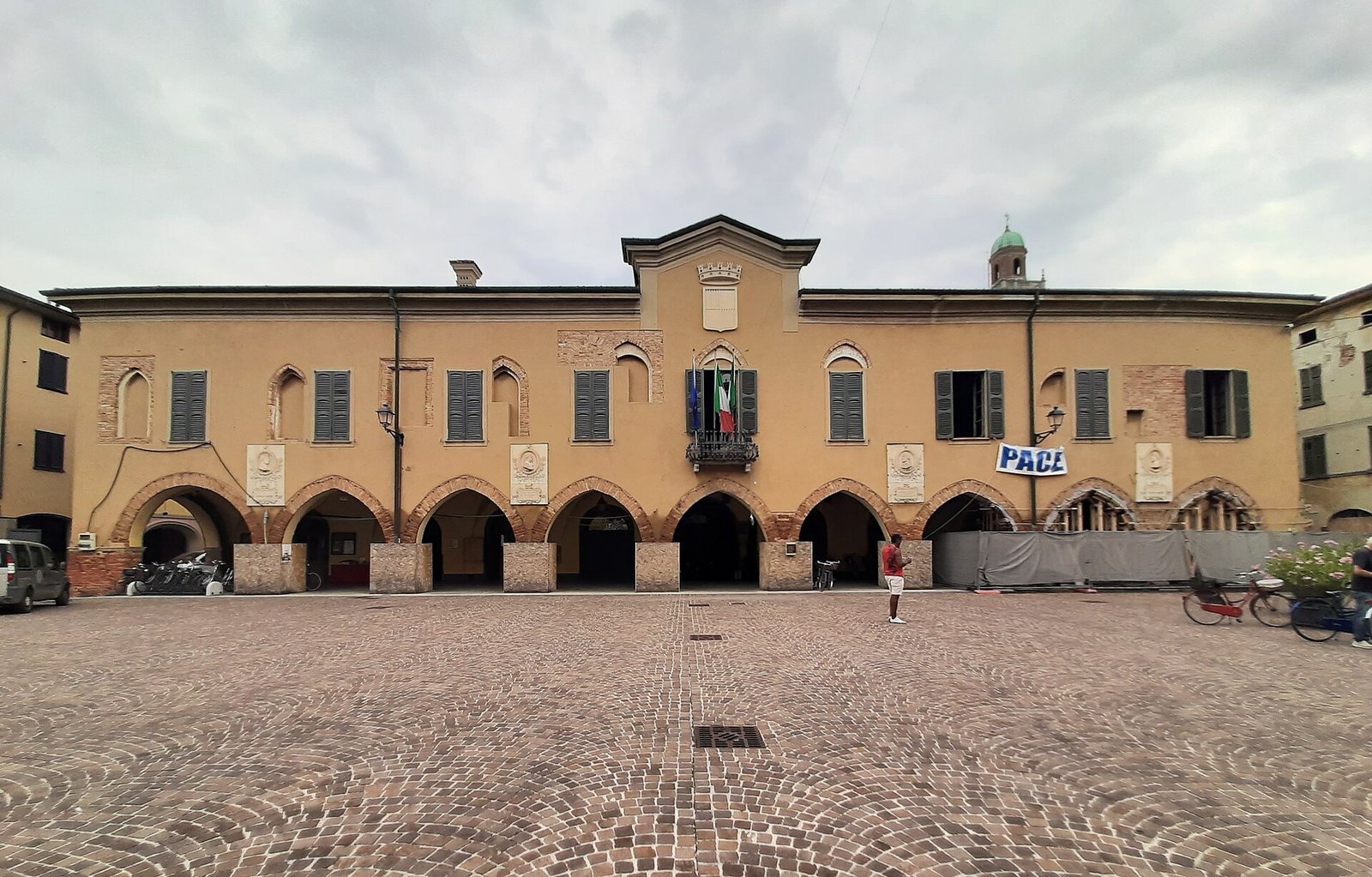
The palace has a rectangular plan, with its main façade facing Piazza Garibaldi, formerly Piazza Grande and the town’s central square. Pedestrian streets run along its other three sides. The surviving exterior and interior reflect several periods of architectural decoration.
Exterior
Portico, windows, and coats of arms
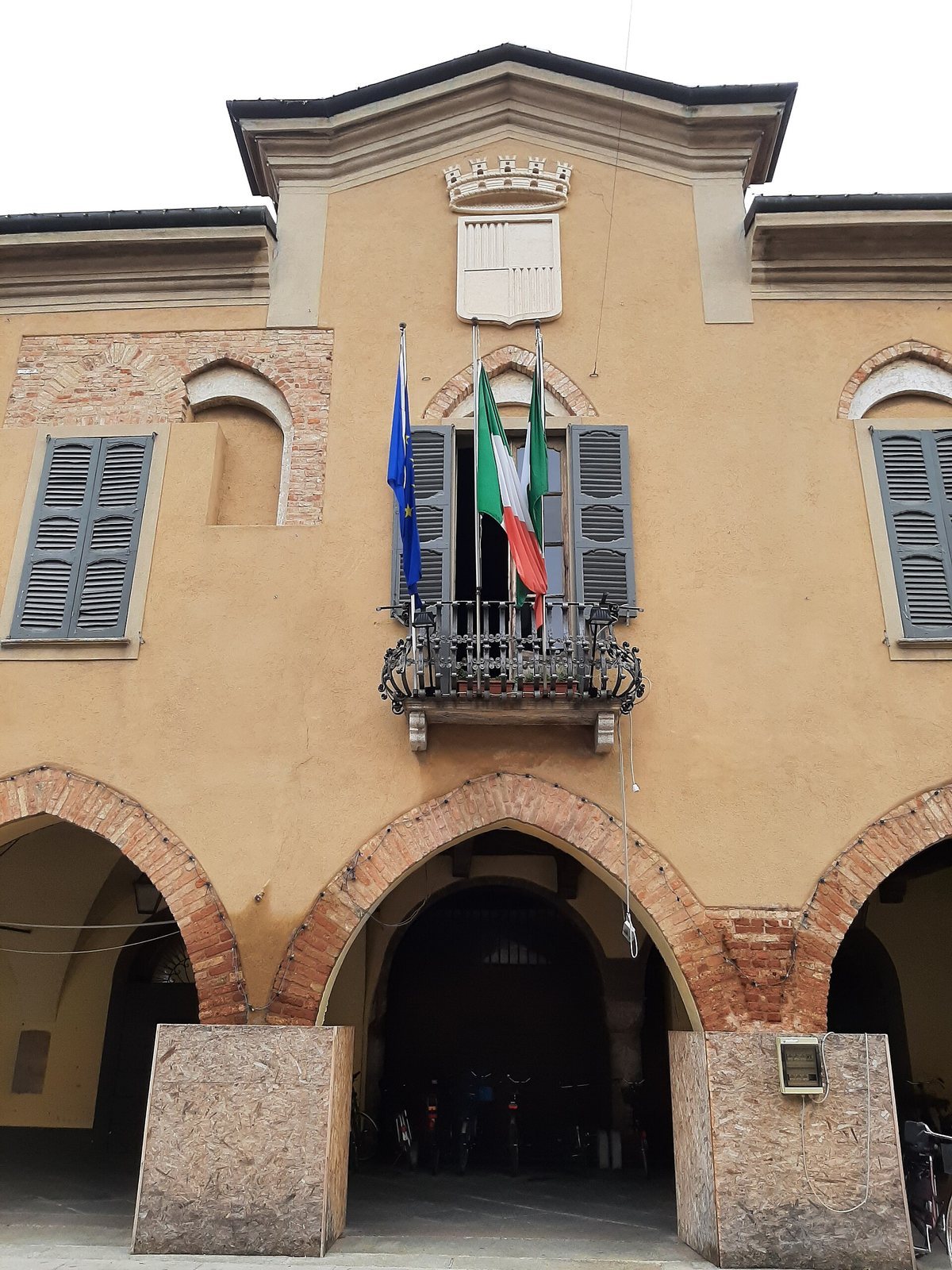
The portico has pointed arches dating to the 15th century, with terracotta elements left exposed. On the first floor, pointed window arches have slightly flared openings. Traces of Renaissance windows, from a style that drew on classical forms, remain beside them, including worked terracotta frames. The marquises’ coats of arms were once positioned between the windows. They represented, in succession, the Visconti, Sforza, Villani, and Schizzi families.
Balcony and medallions
A small balcony at the center of the main façade was intended for the mayor’s speeches to townspeople, and a projecting pediment rises above it. Marble medallions carved in shallow relief above the portico portray Giuseppe Mazzini, Giuseppe Garibaldi, Victor Emmanuel II, and Camillo Benso, Count of Cavour. Sculptor Giovanni Spertini of Pavia made them between 1884 and 1889. The four men were associated with Italian unification: Mazzini promoted nationalism and republicanism, Garibaldi was a revolutionary and military leader, Victor Emmanuel II became the first king of unified Italy, and Cavour was a leading statesman.
Interior
Staircase and council chamber
A monumental ceremonial staircase with a decorated ceiling leads to the large town council chamber on the first floor. The chamber is Baroque, a style known for elaborate decoration. Its ceiling has recessed panels, and an ornamental band runs beneath it around all four walls. The band incorporates a loggia, or open-sided gallery, with winged putti, childlike decorative figures, playing musical instruments. Baroque frescoes cover the chamber walls.
Chandeliers, mosaic, and bust
The chamber’s wrought-iron chandeliers were made by Alessandro Mazzucotelli and Tancredi Guerrerio, and a floor mosaic displays the town’s coat of arms. A bust of Emilio Gallavresi stands at the chamber entrance. Sculptor Enrico Pancera made the bust. Gallavresi was born and lived in the palace and served in the Italian Parliament as a member of the Italian Socialist Party, a party representing Italy’s socialist movement.
Painting collection
The palace houses a permanent collection of paintings owned by the municipal administration. Explanatory notes for the many canvases are displayed on the walls.