Schlosspark Pokój: A Historic Garden and Landscape Park in Poland
Site at a Glance
- Popularity
- Medium
- Country
- Poland
- Primary era
- Early Modern
- Eras represented
- Early Modern, Modern
- Civilizations
- German, Kingdom of Prussia
- Site type
- Domestic
- Remains
- Park
On this page19 sections
History
Schlosspark Pokój is a historic garden complex in Pokój, Poland, whose development began in 1780 with a formal French garden. An English garden followed, and later phases added landscape-style grounds. French gardens use symmetry and geometric layouts, while English landscape gardens favor irregular paths, tree groups and open ground.
Development and the Württemberg princes
The English garden was laid out between 1780 and 1790. Further areas in the English landscape style were created over subsequent decades, including a landscape park dating to the nineteenth century. The park became closely associated with Prince Eugene of Württemberg and Prince Eugene Erdmann of Württemberg, as well as other members of their family.
Prince Eugene of Württemberg owned Pokój and won the Battle of Kulm during the Napoleonic Wars, a series of conflicts between Napoleon’s France and European coalitions. During his rule, theater and opera thrived in Pokój. Eugene supported music and composed symphonies, overtures, songs and two operas. He also established a spa there in 1847.
Around 1850, when poverty and unemployment affected the area, Prince Eugene Erdmann and his wife arranged work for local people constructing ponds and artificial hills. Eugene Erdmann ruled Pokój from 1857 to 1875. Monuments in the park honor him and other Württemberg family members, including Duchess Alexandrine Mathilde and Prince Wilhelm.
Damage and restoration
Many park buildings were in decline by 1945. After the Second World War, the Victory Column was toppled, and the park’s Germania and eagle sculptures were lost. The Weymouth pine received protected natural-monument status in 2001. Restoration of the park and its monuments began in 2018, with an initial program intended to restore eleven sculptures to their original appearance. In 2024, the Victory Column was returned to its original plinth.
Remains
The complex lies in the southeast of Pokój and ranks among the largest parks in the Opole region. The French garden covers about 40 hectares, while the full garden complex extends across roughly 193 hectares. Its three principal areas are the French garden, a nineteenth-century landscape park and the English garden at Winna Góra. To the south, the grounds meet a vineyard hill and a landscape of ponds.
French garden and water salon
Layout and surviving ponds
The formal garden ran from the former palace toward the water salon, with its principal route continuing toward the English garden. The palace stood on the site of today’s roundabout. Baroque in character, the French garden used symmetry, geometric layouts, avenues, hedges, lawns, flower beds, sculptures and water features. Its four sections included an entrance area with paths, flower beds, sculpture, monuments and busts; several erratic boulders, rocks carried from their original geological setting, stood there with memorial plaques.
The second section had two water basins connected to the main avenue by bridges. Two symmetrically arranged ponds with small central islands survive as remnants. This part of the garden is now overgrown and damaged, and its paths have been altered. Farther along, hedge-lined paths led past a swing, a small shooting range, a carousel and an amphitheater. The fourth section began at a pond and included the tea room, also known as the water salon.
Water salon
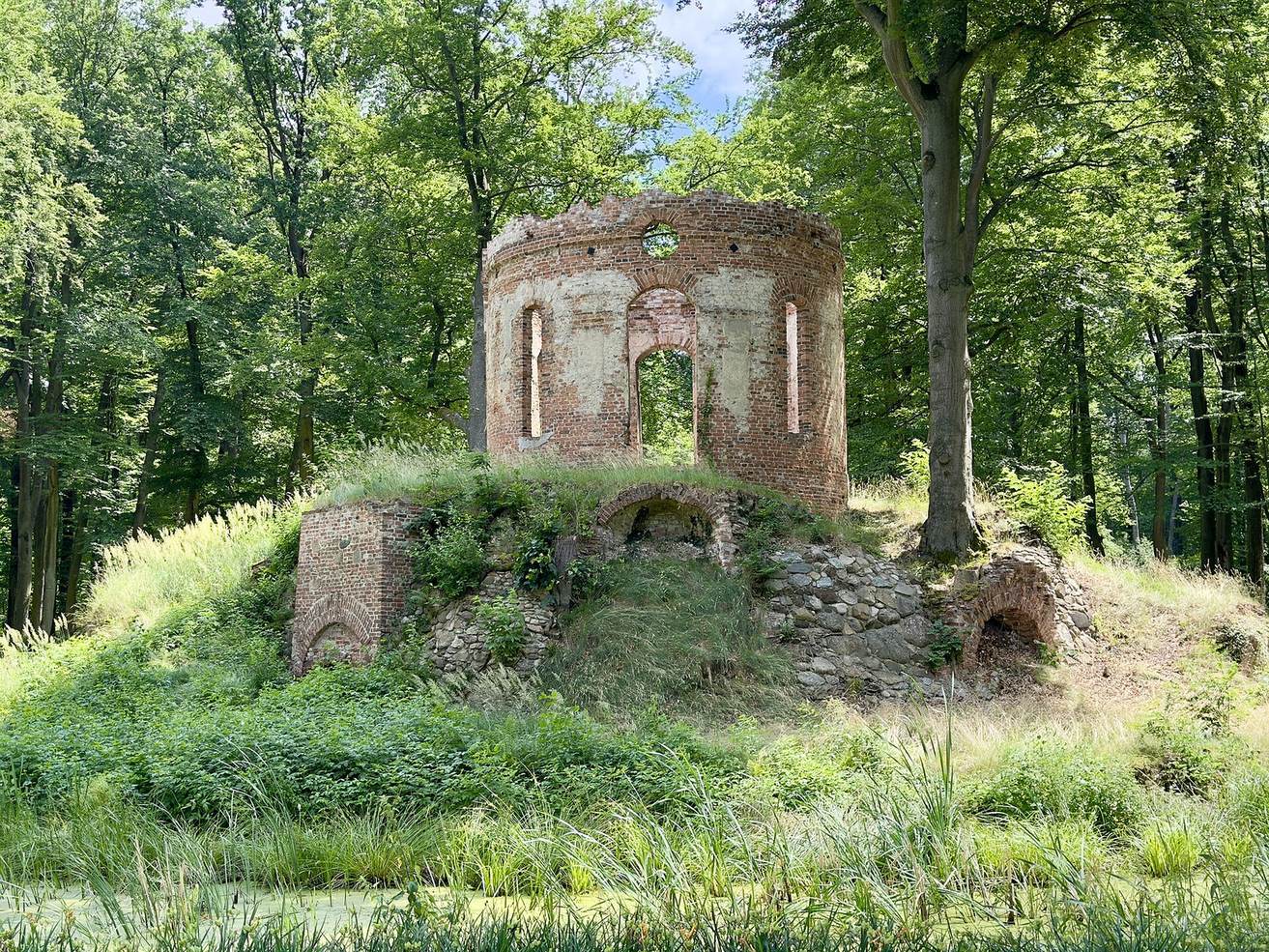
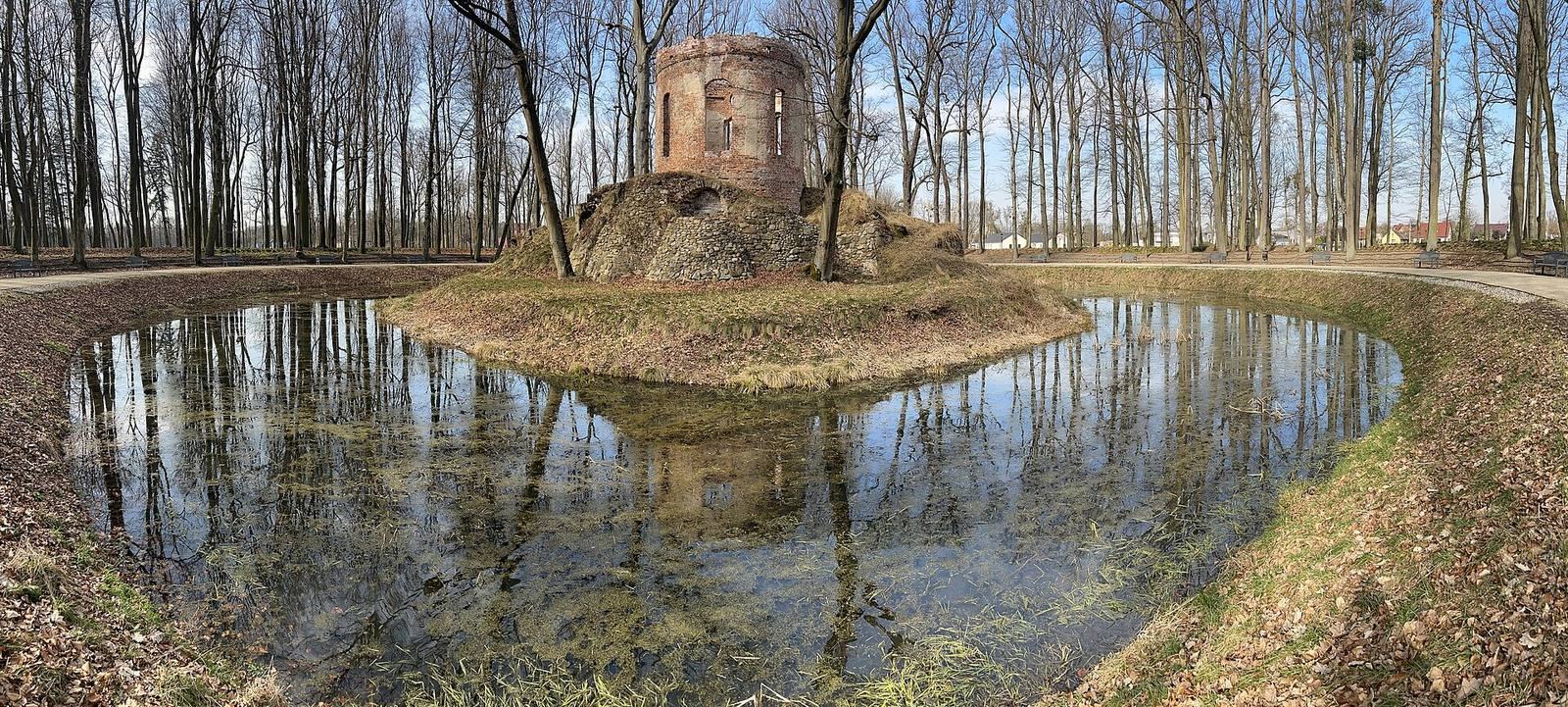
The water salon was poorly built and collapsed soon after it was constructed. After its connecting bridges were removed, the remaining structure stood on an island surrounded by water. The ruin is set in a pond about six metres across and encircled by a water-filled moat. Its massive base was divided into four rooms: a park worker used three, while the fourth held a pump and water tank.
The salon’s circular upper structure had a conical roof with a broken outline. Its fountains included flat cast-iron shells, with water jets emerging from dolphins’ mouths and colored duck figures. The building’s ruined form remains a feature within the pond setting.
English garden and its structures
Small English garden
The English garden stretched from the water salon toward Lake Wilhelmina, now within the fishpond area of the State Fish Farm in Krogulna. It was divided into a small and a large park. The small park began just beyond the salon, with irregular paths, tree groups and clearings among varied garden structures. These included ruins, obelisks, castles, temples, busts, pavilions and gazebos.
Castles and vineyard
The Swedish castle, built in 1776, stood at the far end of the English park. Lightning struck it during a storm, and it burned in 1912. A second castle was built on Winna Góra in 1780 and became a confectionery in the 1920s. A vineyard occupied a slope, alongside a winegrower’s house with a wine press. Other features included a rotunda, shooting-house, lantern, landing place, shooting range, birdhouse, temples and monuments.
Rotunda and temples
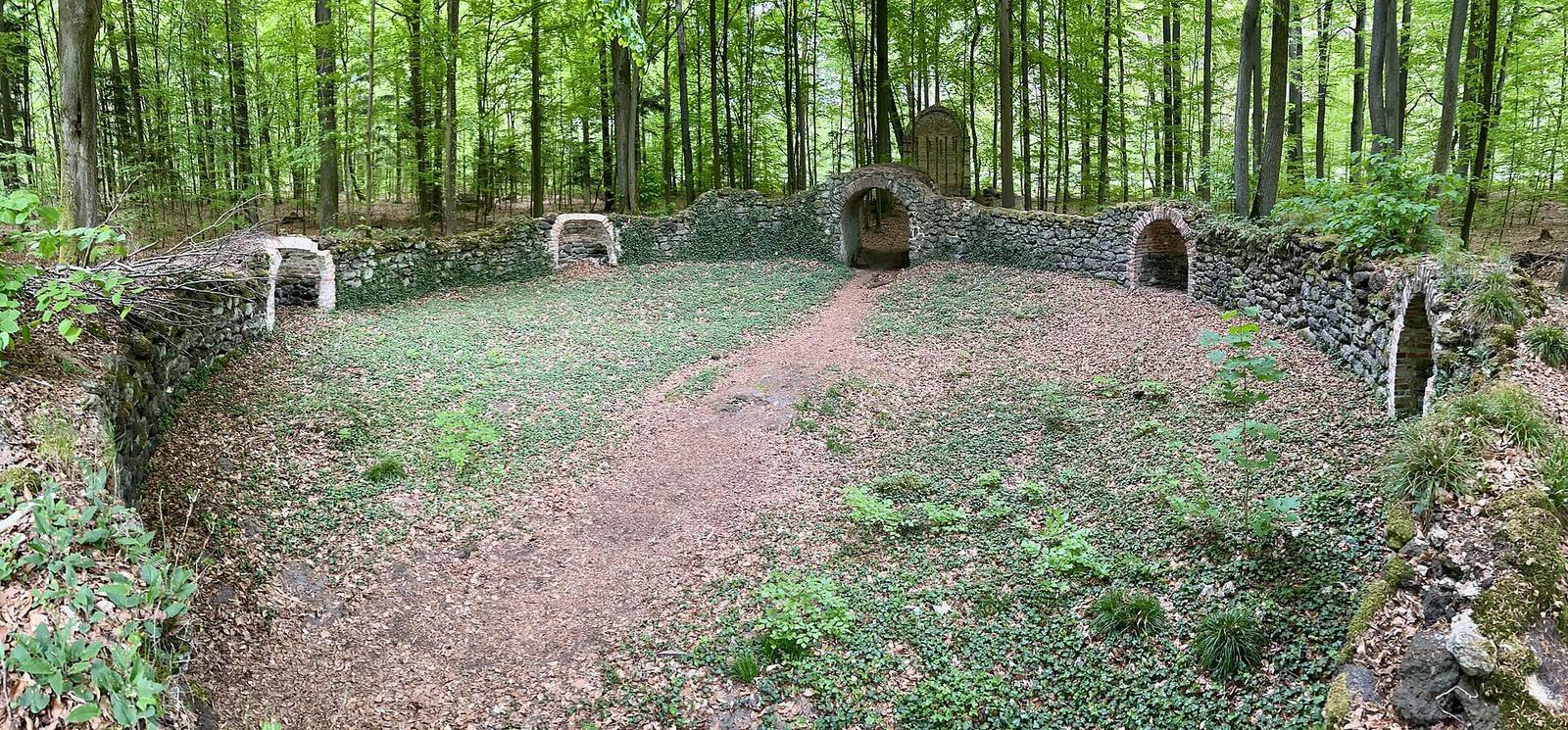
A rotunda, a circular building, was made for Helena, Prince Eugene Erdmann’s second wife. A high wall built from pieces of ore enclosed it, and a tunnel provided access. At the center stood a sculpture by M. Stein showing Frederick II of Prussia in a hat and holding a cane. Five wall niches contained figures of generals. The sculpture is damaged and is one of only two depictions of Frederick II in Poland; the other is by Johann Gottfried Schadow in the National Museum in Szczecin.
The domed Mathilde Temple stands on an island in Mathilde Pond. Leyser built it in 1826 in honor of Prince Eugene Erdmann’s first wife, who died aged 25 shortly after giving birth. Another restored structure, the Erdmann Temple, is supported by six columns and topped by a circular roof. It held a bust of Duke Nicolaus of Württemberg, who died in 1903, and took its name from his wife, Duchess Wilhelmine Eugenia.
Monuments and sculpture
Sleeping lion
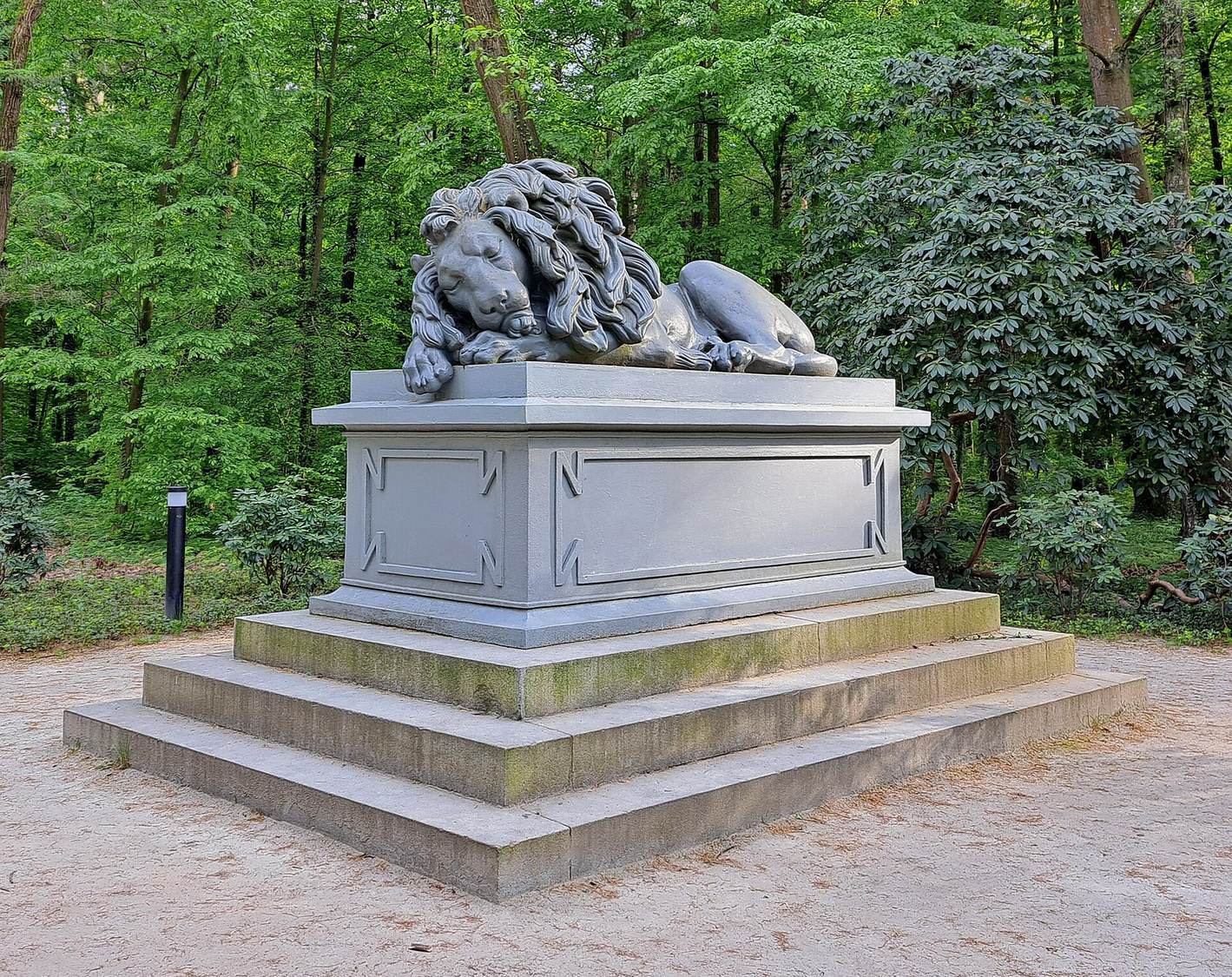
Behind the water-salon ruin stands a cast-iron sleeping lion made by Theodor Kalide. Installed in 1863 on a plinth of so-called Silesian marble, the sculpture honors Prince Eugene of Württemberg. Its symbolism joins the idea of peace in Europe after Napoleon’s defeat with remembrance of the fallen.
Victory Column
The Victory Column was erected in 1874 in the small English garden to commemorate Prussia’s victory in the Franco-Prussian War of 1870–1871, fought by Prussia and its German allies against France. Prince Eugene Erdmann financed it. A statue of Germania stood at its top until 1908, when it was moved to a pedestal about 1.5 metres high in the French garden; a Prussian eagle was then placed on the column. The column now stands again on its original plinth.
Württemberg memorials
A monument to Prince Eugene Erdmann was erected in 1886. A separate gratitude memorial to him is a well-preserved, neo-Gothic turret, a structure reviving medieval Gothic forms. Its pointed finial is no longer part of the structure. At the Opolska Street entrance, a pedestal marks the former position of a bust of Prince Wilhelm.
Alexandrine Mathilde memorial
A 50-ton erratic boulder brought from the millpond at Krogulna was placed in its present position in 1915 to mark the centenary of Duchess Alexandrine Mathilde’s birth. A steel relief showing her bust and an inscription meaning “The grateful people of Carlsruhe” were added in either 1927 or 1929. The relief and inscription were removed and have since been restored in their original form.
Music and royal memorials
A monument to composer Carl Maria von Weber included a column and a female figure; the figure is damaged. Another monument, made by Berlin sculptor Meltzer in 1790, represents Peace raising a laurel wreath above a white-marble bust of Frederick William II of Prussia. Its inscription gives the year 1791 and identifies Meltzer as its maker in Berlin. A plaster model was exhibited in Berlin in 1795 under the title “Peace Crowns Frederick William II.”
Classical statues
The garden’s statues include Minerva, also known as Athena, leaning on a shield bearing Medusa’s head; Diana, shown with one foot on a dog’s head and a quiver on her back; and Venus, accompanied by kissing doves. A statue of Apollo shows the young god leaning on a lyre.
Trees and plantings
The park contains a pedunculate oak, or English oak, with a circumference of about 435 centimetres and a broad crown, as well as a swamp oak measuring 190 centimetres around. Rows of common hornbeams form an avenue, where wood anemones carpet the forest floor in spring. A red-leaved beech has a circumference of 340 centimetres. A beech, a broad-leaved lime and a common hornbeam have grown together. The roughly 200-year-old Weymouth pine is about 20 metres tall and 500 centimetres around. Other plantings include old rhododendrons, ivy-covered trees, tulip trees, London planes, sweet chestnuts and Pennsylvania maples.