Holy Trinity Church in Staraya Russa: A Russian Orthodox Parish Church
Site at a Glance
- Popularity
- Medium
- Country
- Russia
- Primary era
- Early Modern
- Eras represented
- Early Modern, Modern
- Civilizations
- Russian
- Site type
- Religious
- Remains
- Church
On this page14 sections
History
The first church and the stone building
Holy Trinity Church in Staraya Russa, Russia, is a Russian Orthodox church dedicated to the Holy Trinity, the Christian doctrine of God as Father, Son, and Holy Spirit. A wooden church stood on the site before the present stone building, though its construction date is unknown. A city inventory made in 1625 by order of Tsar Mikhail Fyodorovich, Russia’s sovereign, records that Lithuanians burned the church in 1607. The site then stood vacant for more than 70 years.
In 1680, merchant Yakov Ivanovich Tverev financed a stone church there, using an unfinished building begun in the late 1660s. Metropolitan Korniliy, a senior bishop serving Novgorod and Velikiye Luki, consecrated the church on 13 December 1684.
Fire, storm damage, and nineteenth-century repairs
On 29 June 1759, a fire that began at the nearby Church of John Chrysostom, an early Christian theologian and bishop, spread to Holy Trinity Church. The altar, furnishings, and vestments burned, while the icon screen and some devotional images survived. The church was restored three years later. At the request of priest Feodosiy Savin, a chapel dedicated to John Chrysostom was established in the western entrance area, or narthex.
A severe storm on 13 June 1836 caused major structural damage. The northwestern dome fell beside the church, the southwestern dome tilted, and large cracks opened in the walls. Officials ordered the four side domes removed, but the building continued to deteriorate. In 1854, Emperor Nicholas I, who ruled Russia from 1825 to 1855, authorized repairs on the condition that the church’s old architecture be preserved. The restored church was consecrated in 1860, and its John Chrysostom chapel in 1865.
Parish life and twentieth-century disruption
The church operated a parish school where pupils studied literacy, arithmetic, church singing, and religious instruction known as the Law of God. After the revolution, the school became a four-year primary school. Vladimir Pylaev served at the church from 1929 to 1937 and was executed in 1937. In January 1930, during collectivization, the church’s summer section was assigned for grain storage. The church closed in early 1938 and came under the municipal executive committee.
Wartime damage and return to religious use
Fighting for Staraya Russa during the Second World War severely damaged the church. Restoration proceeded intermittently from 1968 to 1975 under T. V. Gladenko, and the building was restored by 1980. It was transferred to the local-history museum and used for art exhibitions and vocal performances. Between 1986 and 1993, architect G. P. Nikolskaya prepared plans under G. M. Shtender’s direction to recreate the nineteenth-century entrance area and altar projections. The work followed the church’s return to religious use.
The Russian Orthodox Church received the building in 1996, and Archbishop Lev consecrated it in 1997. Holy Trinity Church is active, holds daily services, and belongs to the Novgorod and Staraya Russa diocese, a church district overseen by a bishop. It is federally owned and designated a cultural heritage monument of federal significance in Russia.
Remains
Church building
Plan and massing
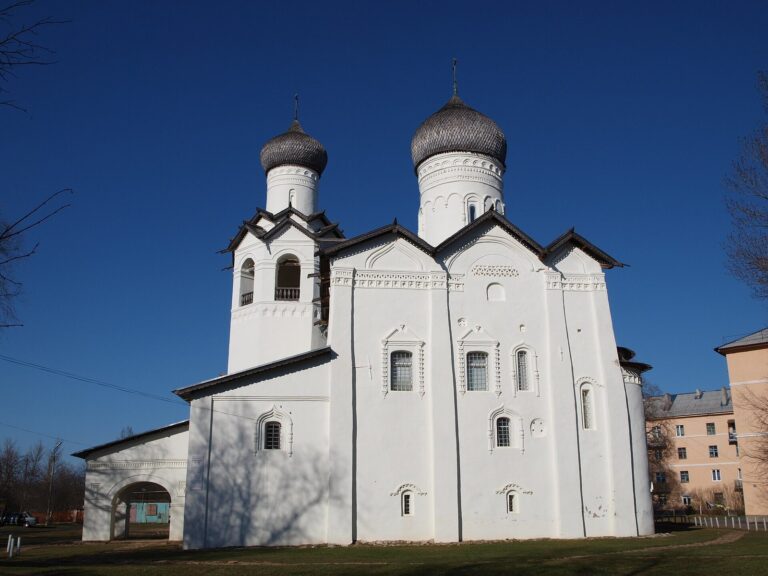
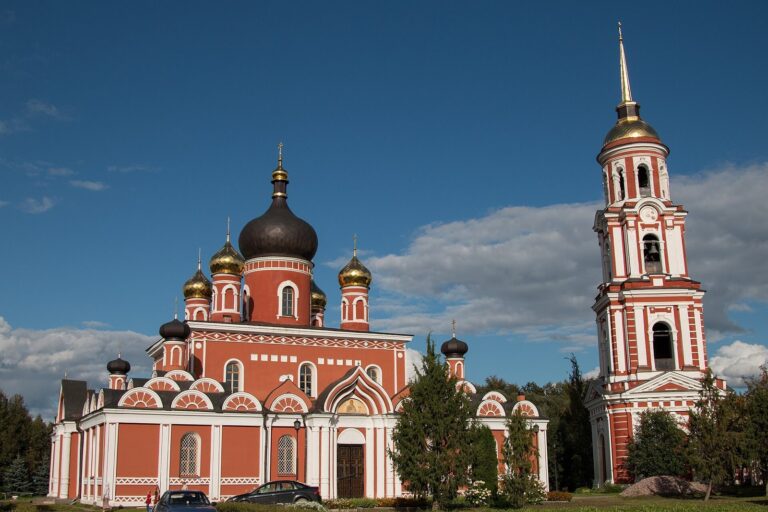
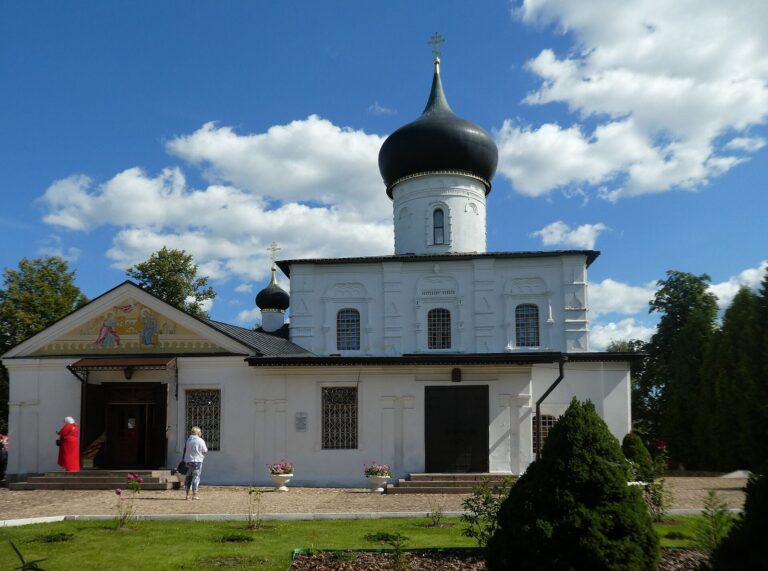
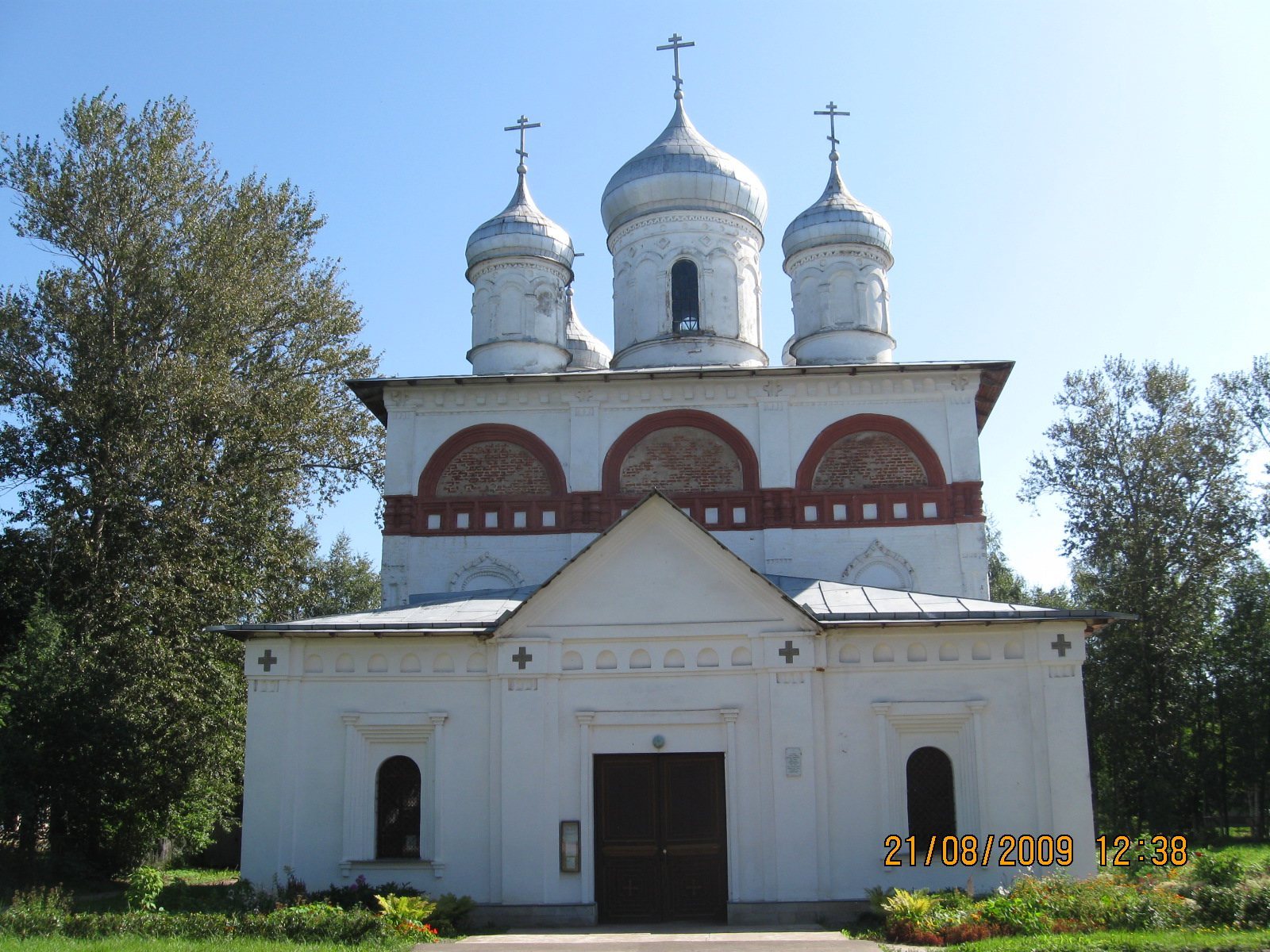
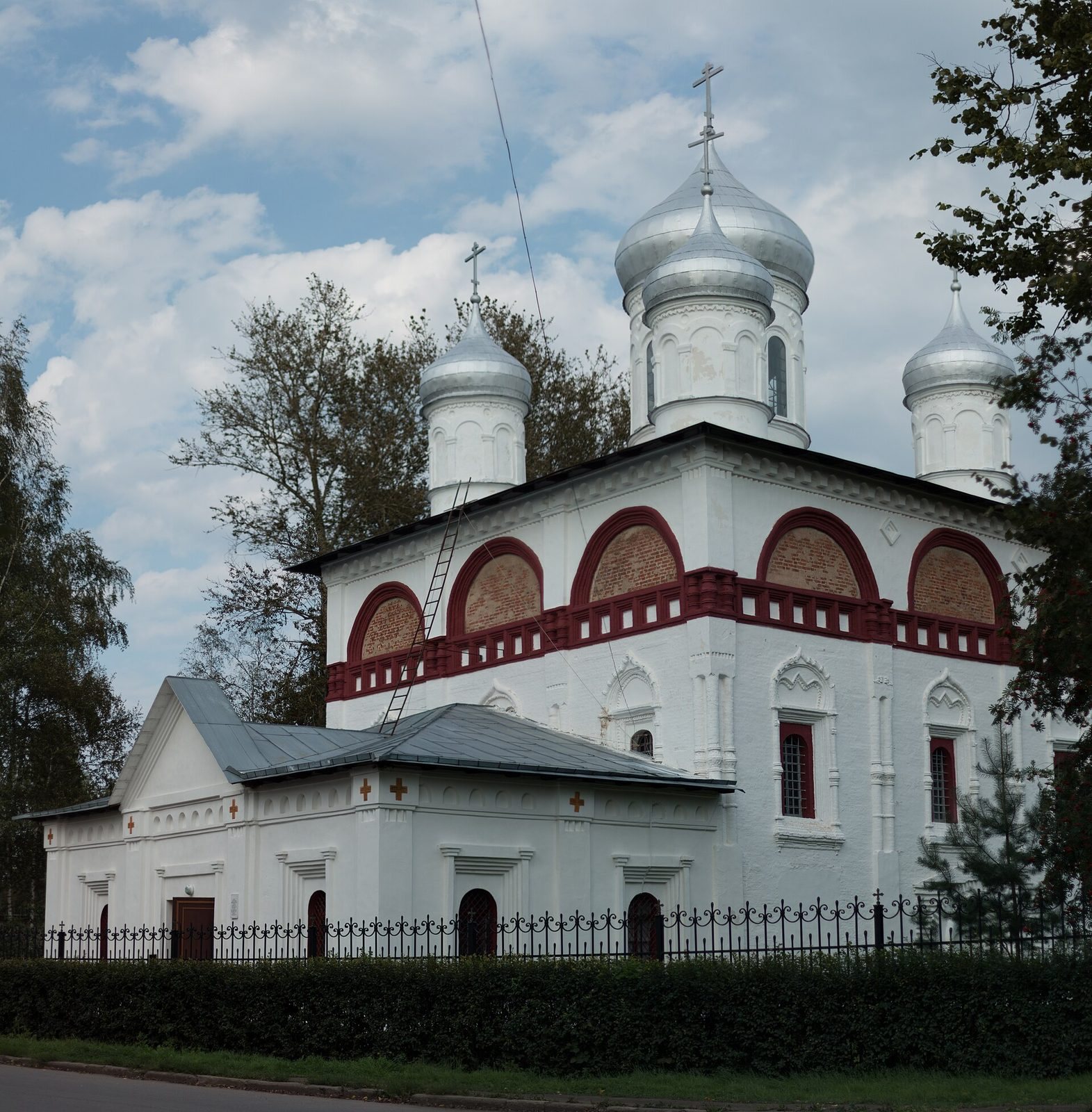
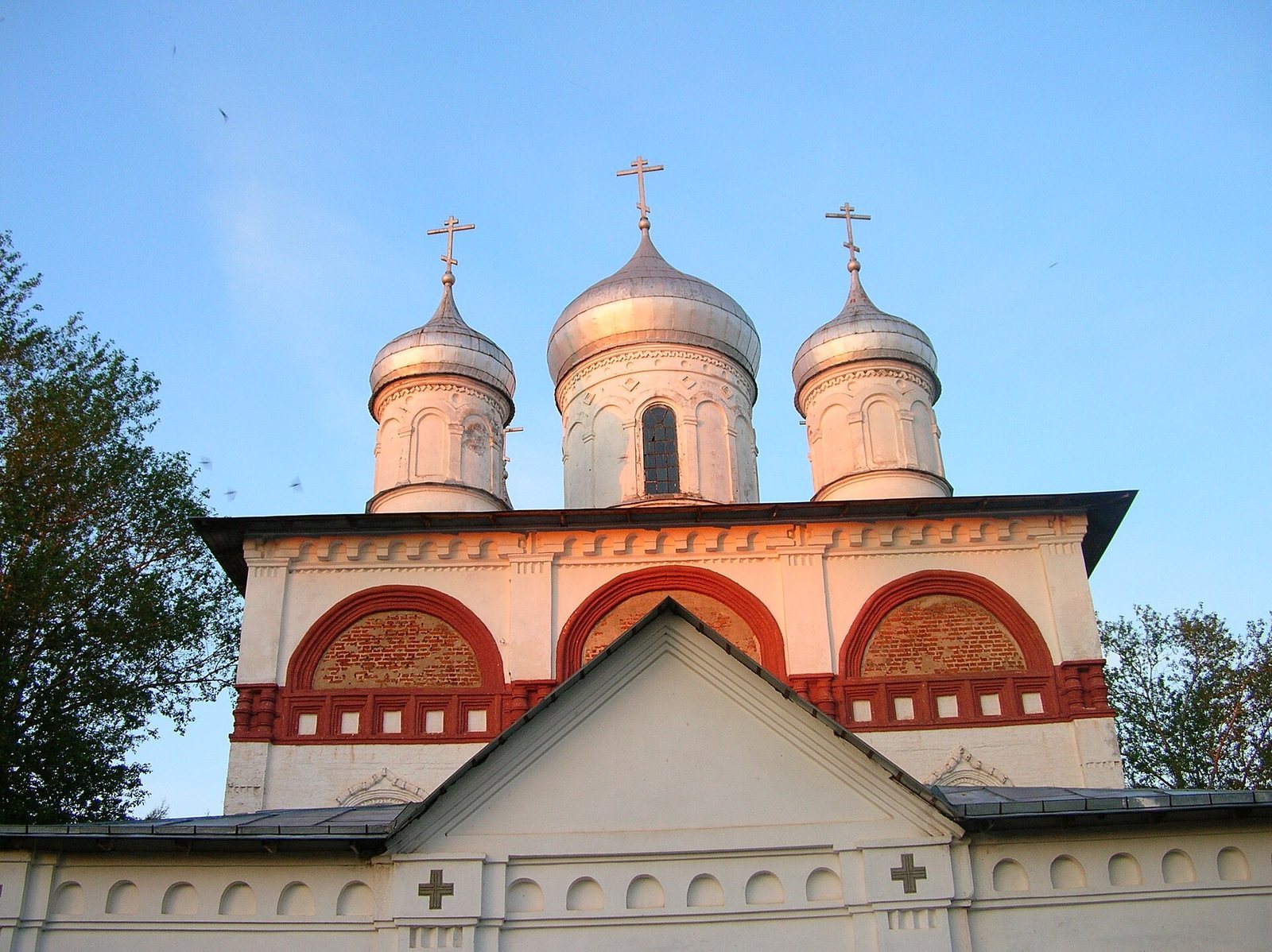
The church stands on the right bank of Staraya Russa, south of the Transfiguration Monastery, on Timur Frunze Street, formerly called Spaso-Troitskaya Street. Its cubic main body measures about 17 metres on each side and has four internal pillars, three altar projections, or apses, and five domes: a larger central dome and a smaller one at each corner. The building follows the type of a large church serving a Russian posad, an urban settlement outside a fortified center. A western entrance area and side entrance rooms form part of the structure.
Exterior decoration
Shallow vertical projections divide the walls into three sections. A shaped-brick cornice separates the wall surfaces from curved upper ends called zakomaras (curved crowns at the tops of church walls). The window surrounds have small columns at the sides and decorative arched or keel-shaped forms called kokoshniks.
Nineteenth-century form
The nineteenth-century repairs enlarged the altar projections and moved the John Chrysostom chapel from the entrance area to the right-hand projection. Workers strengthened the vaulted ceilings, raised the galleries and domes, and added a lower row of windows. They also replaced the earlier tent-like roof with a four-sided pitched roof. The entrance area and altar projections were later recreated in their nineteenth-century forms.
Bell tower and bell
A four-tier bell tower nearly 32 metres high stood opposite the church. Its 960-kilogram bell was cast in 1761 using copper salvaged from the 1759 fire, and an inscription on it commemorated that blaze. The bell was melted down during the 1930s.
Historic church furnishings
Cross and chalice
An eight-pointed altar cross, made of silver covered with gold, was decorated with designs worked into the metal. It bore a Crucifixion on its upper face and two relics, objects associated with saints, of the martyrs James the Persian and Mercury on its lower face. An inscription on the handle says that Nikifor, son of Zhitkov, gave the cross to the church in 1682 in memory of his parents. A silver-gilt chalice, a cup used in Christian worship, bore the words “Receive the Body of Christ; taste the fountain of immortality.” Its base inscription says that Kalistrat Filimonov gave it to the church in 1645 in memory of his parents.
Icons
Among the church’s older devotional images was an icon of the Holy Trinity with a silver covering weighing more than 13.5 kilograms and three gilded crowns. Another showed Christ Pantocrator, an image of Christ as ruler of all, seated on a throne beside the Virgin Mary, John the Forerunner, also known as John the Baptist, and two archangels. An Annunciation icon, depicting the angel Gabriel’s announcement to Mary that she would bear Jesus, was painted in 1680 by Veliky Novgorod artists Mikhail Kornilyev, Vasily Makarov, Pyotr Stepanov, and Grigory Mikhailov. An older image also depicted John Chrysostom.