Perdigões Archaeological Complex: A Prehistoric Ceremonial and Settlement Center
Site at a Glance
- Popularity
- Low
- Country
- Portugal
- Primary era
- Stone Age
- Eras represented
- Stone Age
- Civilizations
- Unclassified
- Site type
- Religious
- Remains
- Sanctuary
On this page14 sections
History
The Perdigões Archaeological Complex is a prehistoric settlement and ceremonial center in Portugal, about two kilometres northeast of Reguengos de Monsaraz. Occupied from about 3500 to 2000 BCE, it became an important population, cultural, social, and symbolic center in central Alentejo. Its communities were connected with groups elsewhere on the Iberian Peninsula, including along the Atlantic and Mediterranean coasts.
A long-lived prehistoric center
Perdigões served as a place where people gathered for religious rites, including practices concerning the dead and ancestors. Its architecture developed over time: a circular monument of timber posts was later covered by a stone structure. The settlement was eventually abandoned amid major social and cosmological changes.
Rediscovery and archaeological research
Archaeologist Mário Varela Gomes identified the site in the 1980s after discovering its group of standing stones, and also excavated in the former settlement area. Agricultural work to establish a vineyard damaged parts of the complex and prompted archaeological interventions in the 1990s. Excavations by Era-Arqueologia added substantial information, followed by a major research program launched in the early 2000s under archaeologist António Valera. The program gained international recognition as an important investigation of late prehistory in the southern Iberian Peninsula.
Excavations in 2015 strengthened the interpretation of Perdigões as a gathering place for people from across the Iberian Peninsula, and possibly farther away, for rites concerned with death and life. In 2020, a circular timber-post monument was identified as the first complex of its type recognized in the Iberian Peninsula. Portugal designated the complex a National Monument in 2019, while its standing-stone group has separate Property of Public Interest status.
Remains
The complex covers about 16 hectares on a slope overlooking the Reguengos megalithic plain, at the edge of the Ribeira do Álamo valley. Its remains form a varied prehistoric landscape of ditched enclosures, living areas, burial grounds, and standing stones. The standing-stone group lies east of the rest of the complex, where a natural amphitheatre opens toward the plain of the Álamo valley.
Enclosures and settlement areas
Seven straight ditches, three winding ditches, and a barrier of upright posts divide the complex into several broad areas. Within this system are residential spaces, storage pits, and installations for fire use, alongside areas with multiple functions. Together, the ditches and post barrier give the complex its large-scale arrangement of enclosed spaces.
Burial features
Graves and chambers
The burial ground includes underground and partly underground monuments, with corridors and chambers built from upright stone slabs. Several areas were used for burials, including graves for bodies buried intact and for later deposits of human remains. Deposits of cremated human remains date to around 2500 BCE, when cremation was rare. A possible second collective tomb may be a tholos, a circular tomb often shaped like a beehive.
Human remains in a ditch
Fragments of human skulls lay in soil that had filled a ditch marking one of the ceremonial enclosures built during the third millennium BCE. Some fragments had been burned, including remains of a child about three years old. Animal bones were mixed into the deposits.
Circular monuments and buildings
Timber-post monument
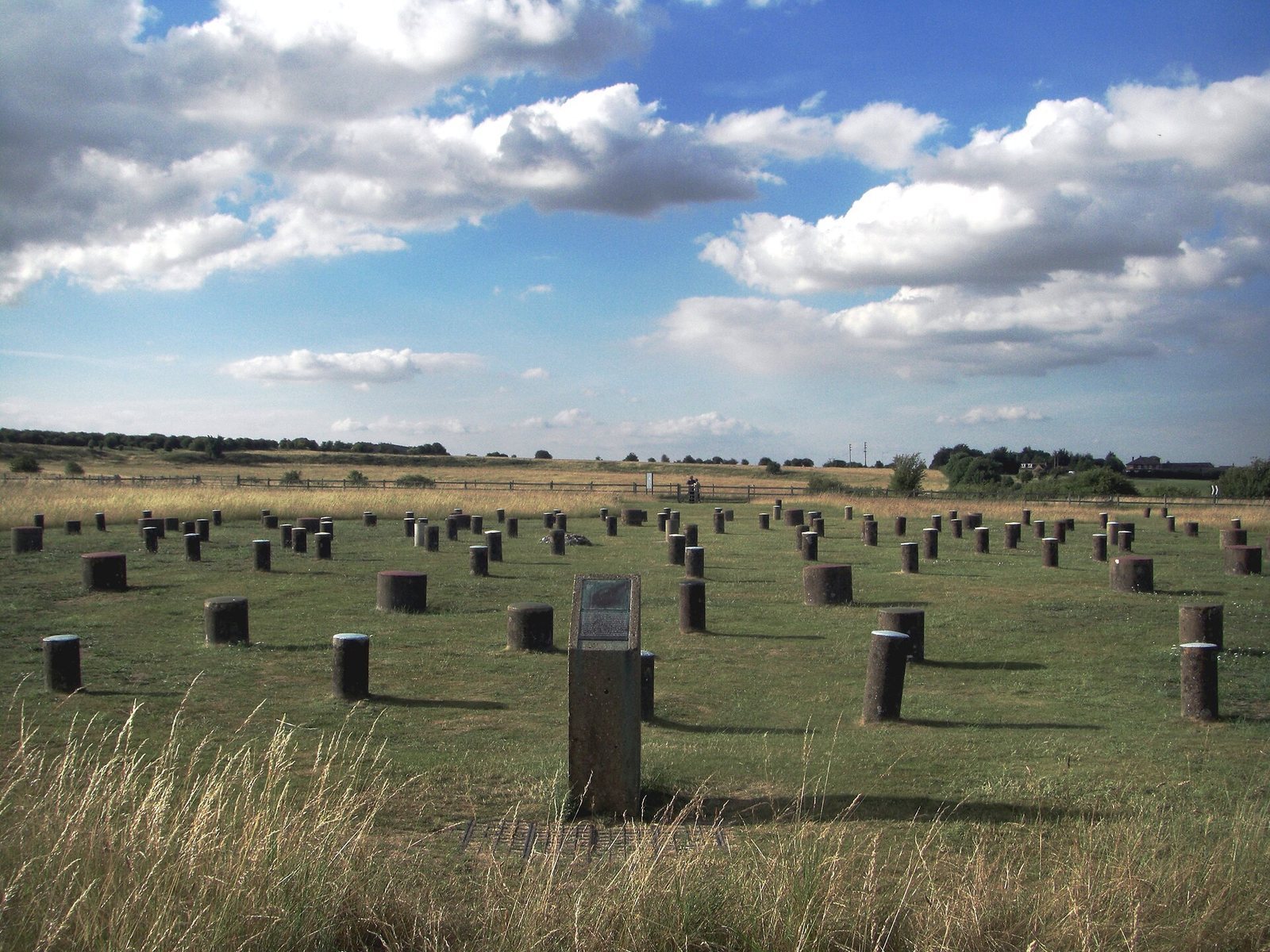
Within the ditched area, a circular timber monument measures more than 20 metres across. It consists of concentric rings of upright posts and rows of large timber posts or trunks. The monument dates to about 2800–2600 BCE; a stone structure was placed over it roughly 500–600 years later. Archaeologist António Valera interpreted its position in relation to views across the megalithic landscape toward the rise of Monsaraz on the eastern horizon. Circular monuments of this kind, sometimes called Woodhenges, are associated with ceremonial use and are more common in the British Isles and central Europe. They may also have served as astronomical observatories. A possible entrance at Perdigões faces toward the summer solstice, when the Sun reaches its northernmost point in the sky.
Central circular structure
A separate circular structure in the central area has an entrance facing east, toward the part of the horizon between the summer and winter solstices. It may have served either residential purposes or religious activities connected with particular ceremonies.
Objects and materials
Tools and pottery
Chipped-stone finds include blades, arrowheads, and a dagger made from several kinds of raw material. Other tools include polished-stone axes and adzes, percussors, and parts of hand mills. Finds also include schist plaques, bone objects, and animal remains, among them molluscs from both the Atlantic and Mediterranean coasts. Pottery ranges from fragments to complete vessels in varied forms associated with the Late Neolithic and Chalcolithic, or Copper Age, of central Alentejo. Many pieces carry decoration, including motifs from the Bell Beaker pottery tradition, named for vessels shaped like an inverted bell. Other ceramic finds include pottery with a thin red-clay surface coating, miniature vessels, parts of cheese strainers, spoons, crescent-shaped and plaque-like loom components, and fired-clay building material.
Ornaments and figurines
Objects thought to have come from outside the region include pieces of marble and limestone. Decorative finds include green stone, amber, gold, flint, and ivory. Human-shaped and animal-shaped figurines may have had religious functions. The ivory human figures are notably naturalistic; they may represent deities or individuals, or relate to social status, family groups, or shared identities. A connection between these figures and cremation practices has also been proposed.