Church of the Holy Crucifix: A Subsidiary Catholic Church in Italy
Site at a Glance
- Popularity
- Very Low
- Country
- Italy
- Primary era
- Early Modern
- Eras represented
- Early Modern, Modern
- Civilizations
- Duchy of Milan, Habsburg, Holy Roman Empire, Italian, Spanish
- Site type
- Religious
- Remains
- Church
On this page8 sections
History
The Church of the Holy Crucifix is a Roman Catholic subsidiary church in Italy, built from 1692 to 1695 on the site of a medieval church dedicated to Saint George. It was consecrated in 1703 by Giovanni Maria Corentano, a district vicar and provost, a clerical title in the local church hierarchy. The church follows the Ambrosian rite, a Catholic liturgical tradition associated especially with the Archdiocese of Milan, to which it belongs. Dedicated to Saint George, it has served as a subsidiary church rather than as a parish church.
Medieval predecessor and the new church
The earlier church on the site was consecrated in 1393. It was demolished about three centuries later, perhaps because it had fallen into ruin, although the reason remains uncertain. The church built in its place became known as the New Church, distinguishing it from the parish church dedicated to the Assumption of the Blessed Virgin Mary, the Catholic belief that Mary was taken body and soul into heaven.
The New Church took its present name in 1933. The older parish church, built in the seventeenth century, was demolished in the mid-twentieth century, and a new parish church with the same dedication was built in 1933. A parish record from 1769, concerning work around the church, contains the earliest known reference to a community called Sotena in the territory of modern San Giorgio su Legnano.
Eighteenth- and nineteenth-century changes
During the nineteenth century, the church received minor repairs and its façade was restored. Materials for the work, mainly bricks, were donated by the Cornaggia marquises, owners of Legnano Castle.
Twentieth-century repairs and wartime use
A severe storm destroyed the roof in 1910, prompting emergency work and more extensive repairs. In 1943, amid the Second World War and associated bombing, the church temporarily sheltered displaced people and served as a warehouse.
During a 1940 pastoral visit, Cardinal Alfredo Ildefonso Schuster, then Archbishop of Milan, noted that the church needed restoration. Modest interior and exterior work followed in 1946, chiefly focused on the altar. A more substantial restoration took place from 1959 to 1961.
Remains
Church building and interior
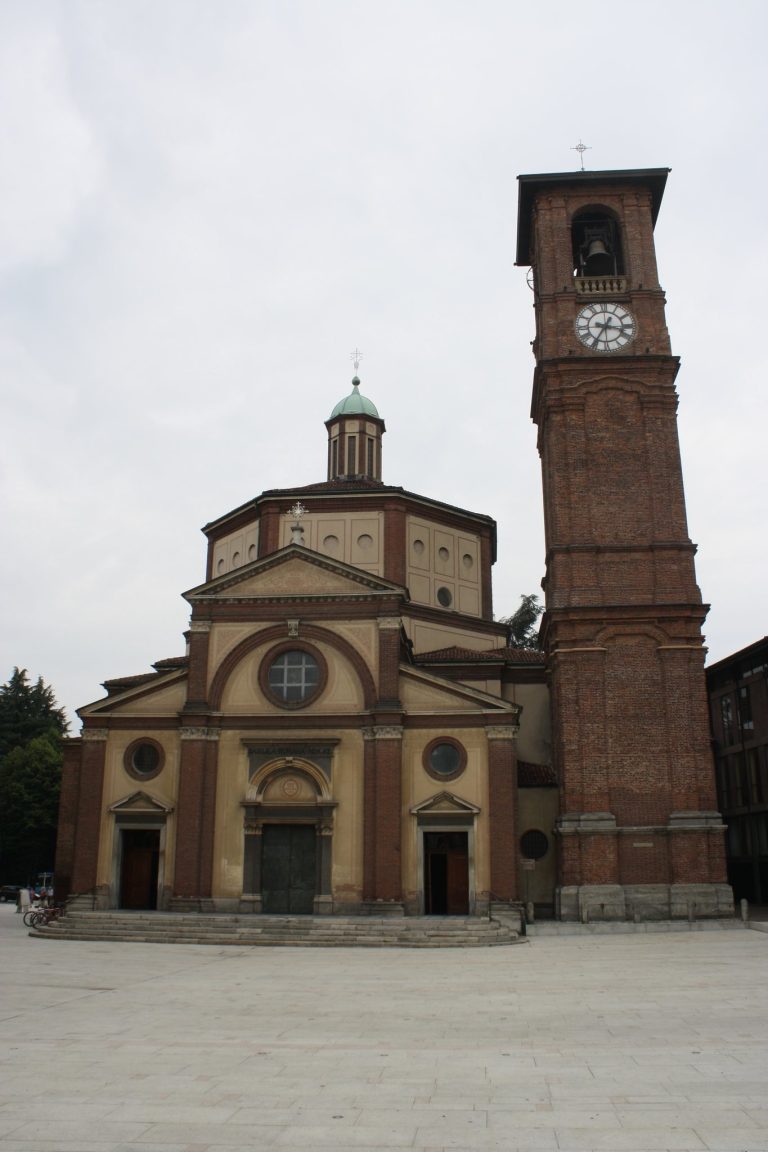
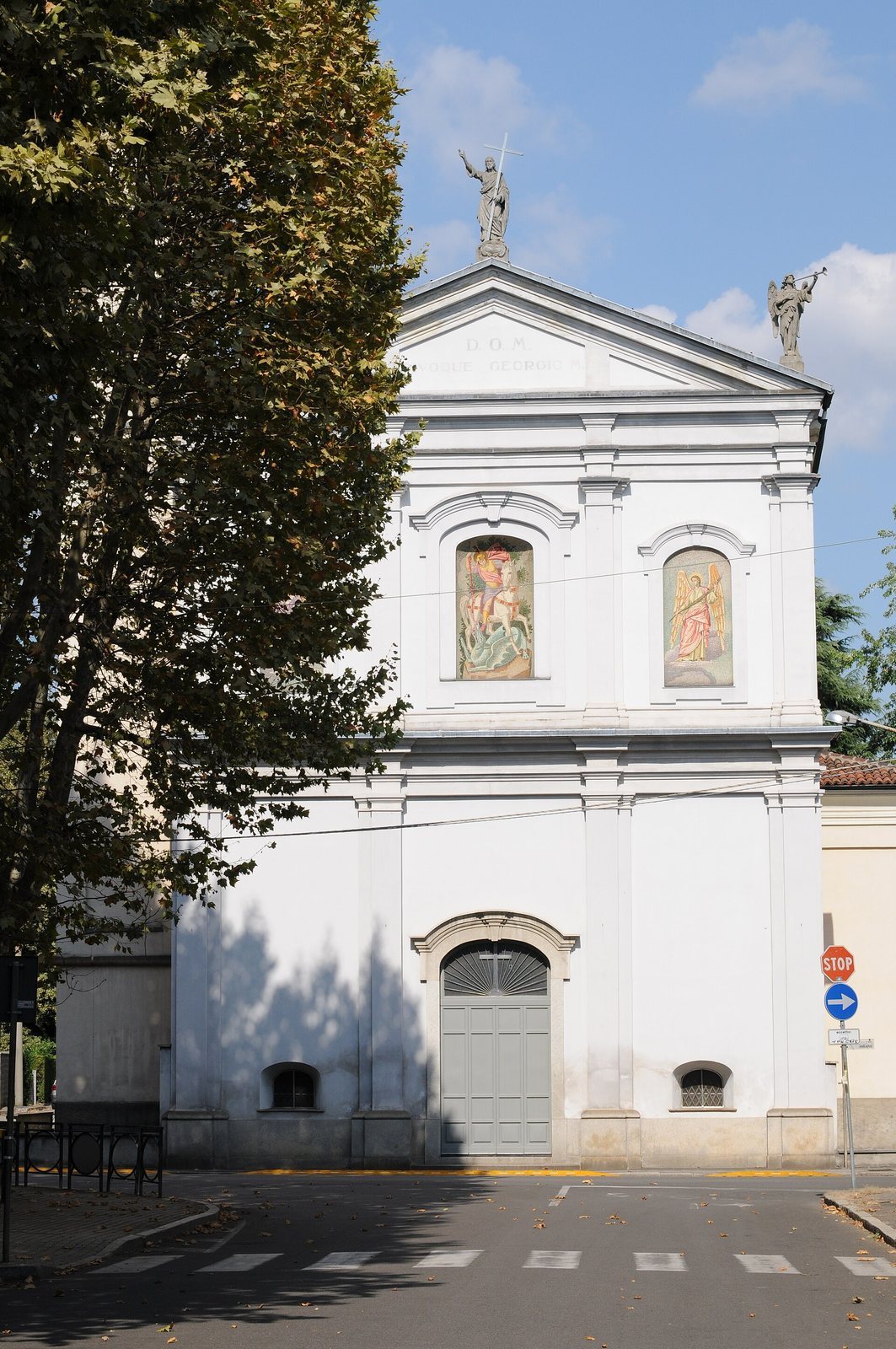
The church’s basic architectural lines have remained essentially unchanged. Its chapels were built in 1698, and the façade was completed in 1703. Three mosaics were added to the façade during the 1959 to 1961 restoration: Saint George overcoming a dragon, flanked by two angels. Inside, the Stations of the Cross, a sequence of devotions recalling episodes from Jesus’s final journey to his crucifixion, were installed in 1755, and the floor was laid in 1784. Furnishings and artworks transferred from the convent of Sant’Angelo in Legnano after its suppression in 1805 include a late-seventeenth-century papier-mâché crucifix above the main altar, an altar dedicated to Saint Peter, a wooden choir, and paintings, including one of Saint Nicholas.
Bell tower and roof features
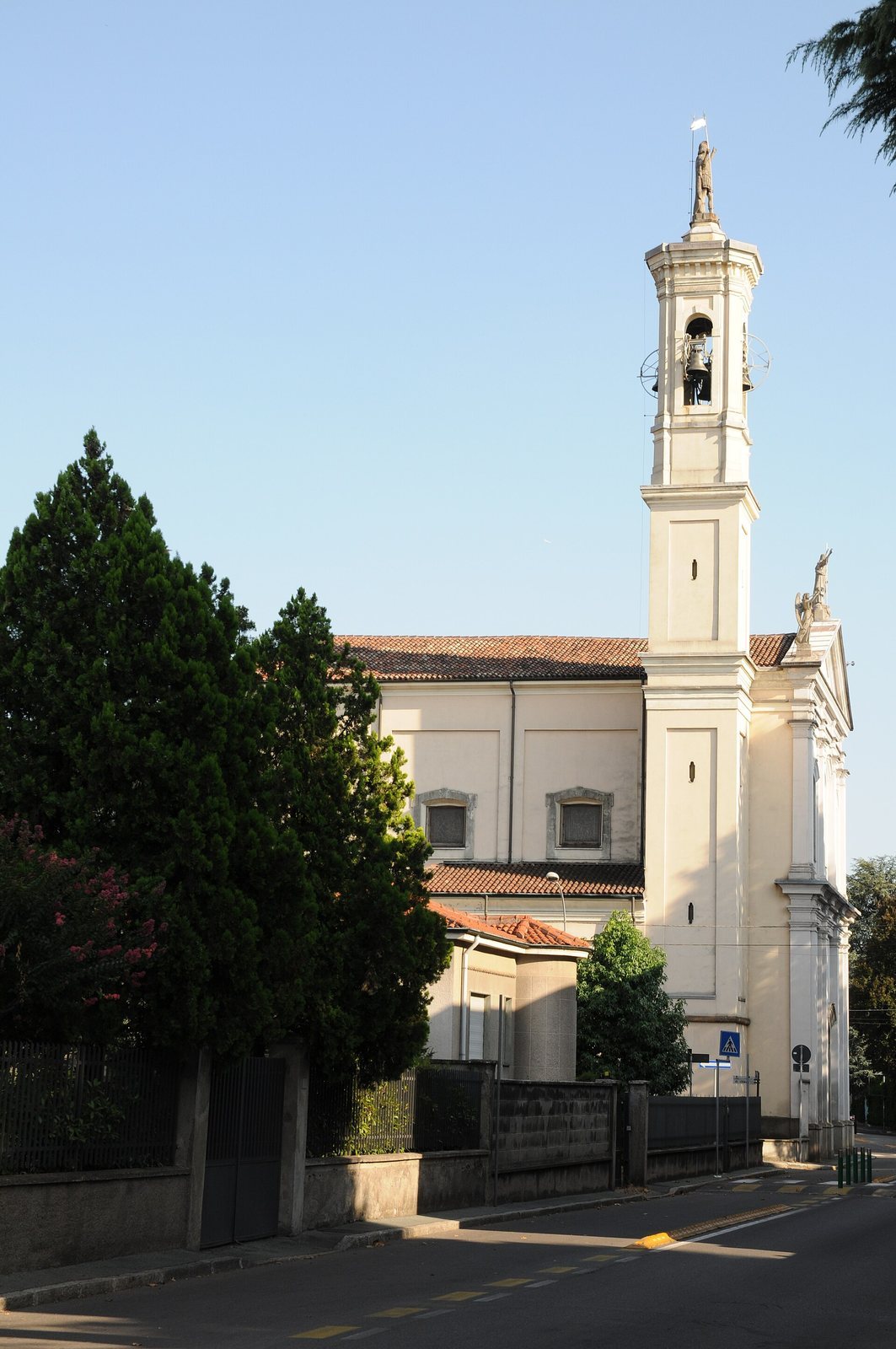
The bell tower was begun in 1888 and completed in 1894, when its bells were installed. Three statues were placed on the roof in 1907: a figure of the Redeemer and two angels made by the Pruvini Geremia firm of Milan. The roof was completely renewed in 1915, and the restoration from 1959 to 1961 also involved the roof and floor.
Ossuary chapels and burial ground
The first ossuary chapel, a chapel associated with human remains, was built beside the church in 1812. It was a small exterior structure to the right of the church’s main body. Its burials were later transferred to a cemetery on ground now occupied by the public gardens around the church. After the first chapel fell into ruin, a larger chapel with more substantial architectural lines replaced it in 1881. This chapel also held the remains of parish priests, including Giacomo Gerli. After its later demolition, those remains were moved to the municipal cemetery designed by Gino Maggioni and opened in 1928.