Church of Our Lady’s Protection: A Former Monastery Cathedral in Volokolamsk
Site at a Glance
- Popularity
- Low
- Country
- Russia
- Primary era
- Early Modern
- Eras represented
- Early Modern, Modern
- Civilizations
- Russian
- Site type
- Religious
- Remains
- Church
On this page12 sections
History
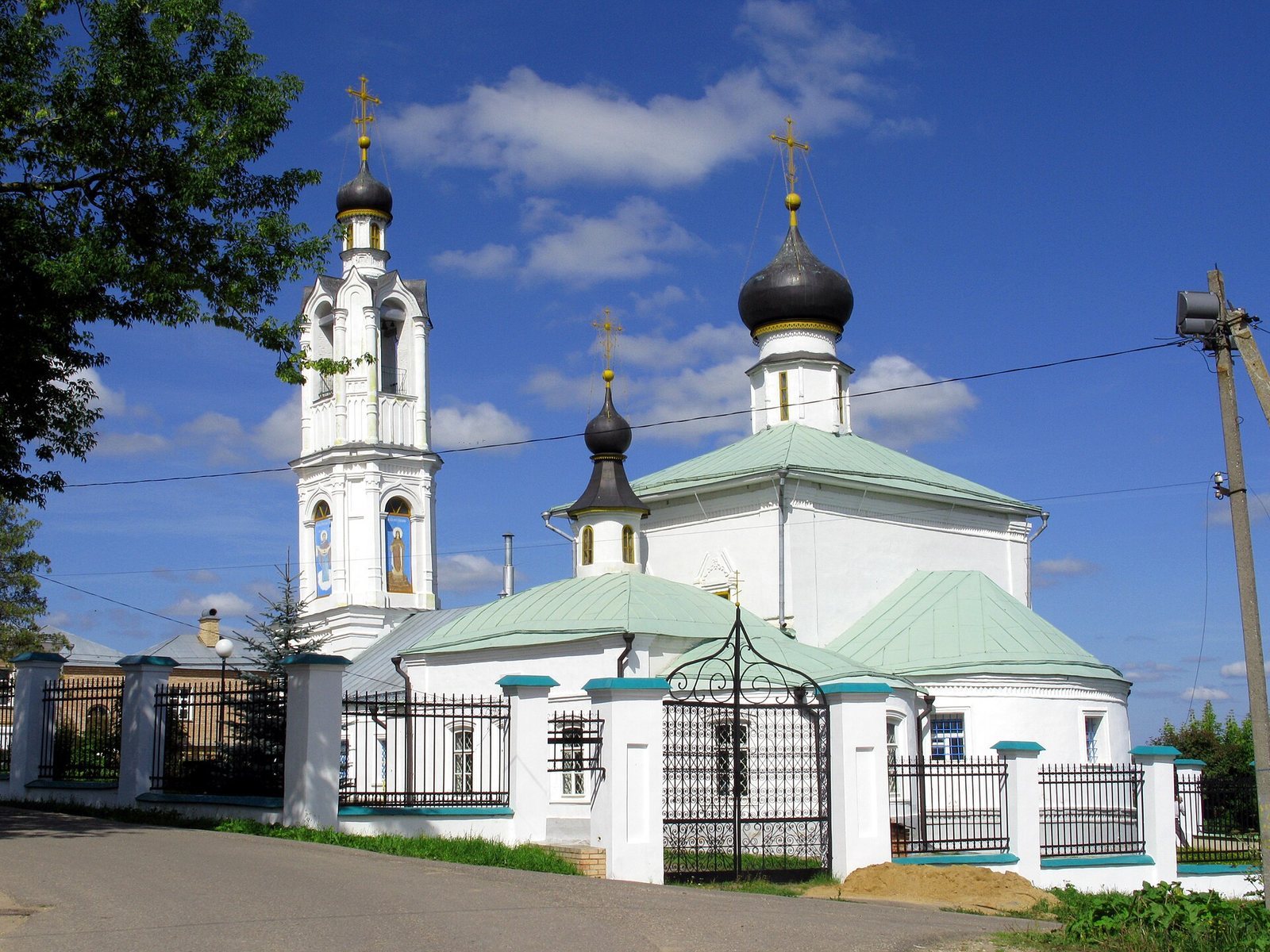
The Church of Our Lady’s Protection is a Russian Orthodox church in Volokolamsk, Russia, founded as the cathedral of the women’s St Barbara Monastery. Its stone building was completed in 1695 in the ornate Moscow Baroque style. Commissioned by Natalia Naryshkina, mother of Peter I, it became the monastery’s first stone church.
Monastery cathedral
In the early seventeenth century, the monastery had two wooden churches, one dedicated to the Assumption of the Mother of God and the other to St Barbara. The cathedral that followed was initially dedicated to the Assumption. Naryshkina paid for its construction before her death in 1694, and the church was built the following year by her order.
Parish church and new dedication
The monastery was dissolved in 1764, and its cathedral became a parish church. The monastery had held the village of Gorstkino among its lands until that year, when church property was transferred to state control. In 1803, an older Church of the Protection was dismantled after falling into disrepair. The former Assumption cathedral then took the Protection dedication in its memory.
The church’s principal dedication is the Protection of the Mother of God, an Orthodox feast honoring the Virgin Mary’s protection of the faithful. Its feast is observed on October 1 in the Julian calendar, corresponding to October 14 in the Gregorian calendar. St Barbara had been venerated in Volokolamsk since the time of Juliana of Volotsk, wife of Prince Boris Vasilyevich. Their feast days coincide, and the two saints are often depicted together.
Worship and Soviet-era persecution
The church remained active during the Soviet period, although members of its community suffered persecution. Its priest, Vladimir Pokrovsky, was exiled to Kazakhstan in 1932. After returning to Volokolamsk in 1935, he resumed serving at the church. Deacon Vladimir Ostashevsky was exiled and died there, while churchwarden K. N. Matveev (1877–1938) was executed at the Butovo firing range, a Soviet-era execution ground near Moscow.
The Church of Our Lady’s Protection remains a Russian Orthodox church and is protected as a regional cultural-heritage site.
Remains
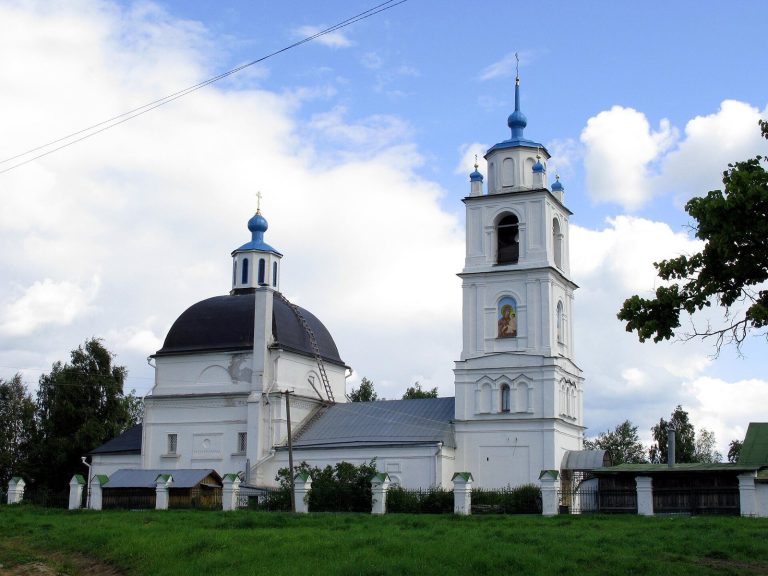
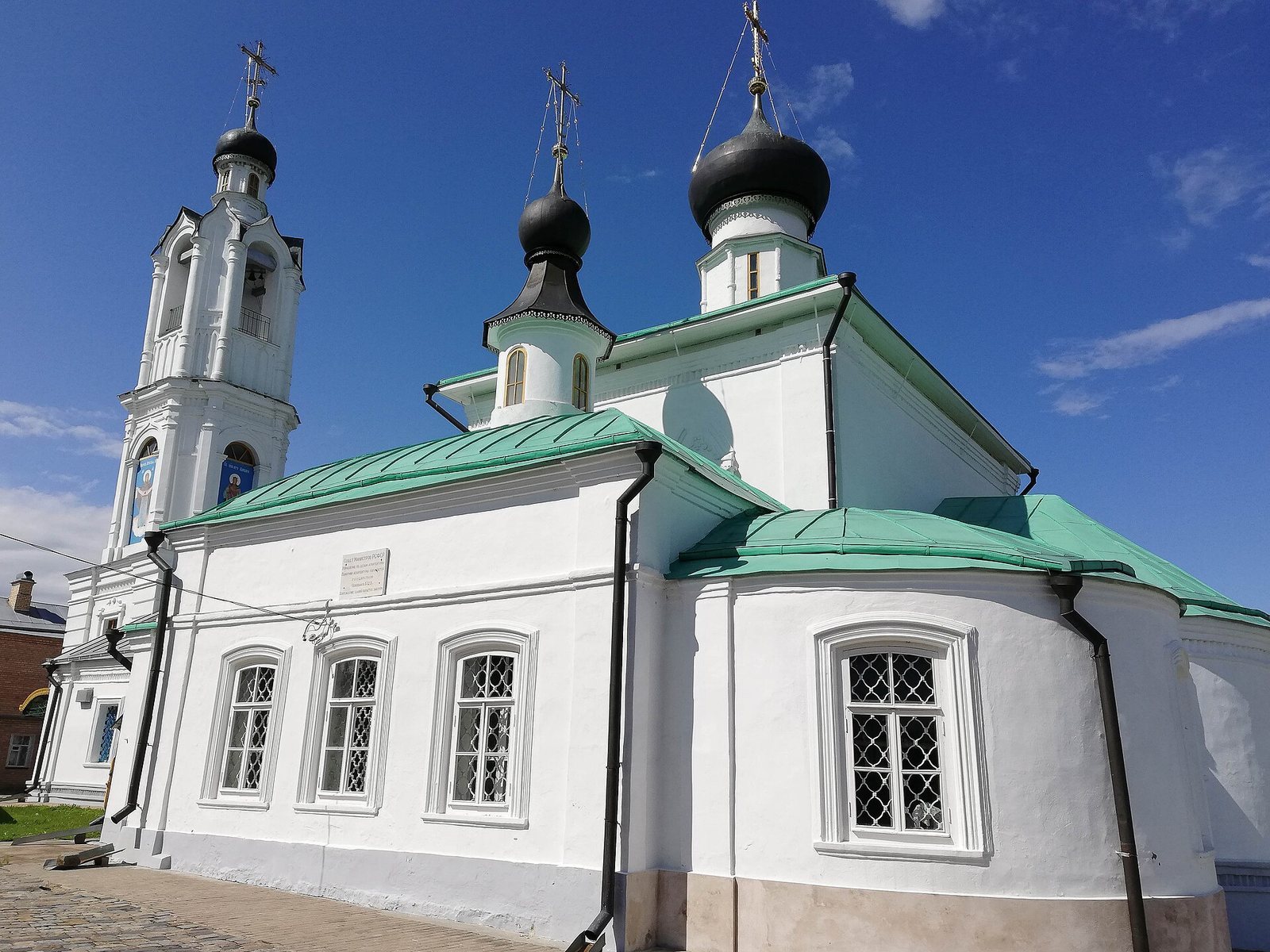
Built of stone and brick, the church is arranged around a cube-shaped main space, with a semicircular apse, or projecting altar end, and an adjoining refectory, a hall used for worship. The central space has two levels of windows and a cloister vault, a ceiling formed by curved sections meeting at the center.
Main church
Central space and exterior
The seventeenth-century design uses Moscow Baroque details, including elaborate surrounds around the upper windows and clustered columns at the corners. Later work plastered the exterior, enlarged the windows, and raised the drum, the structure supporting the dome above the main volume.
Altars and furnishings
The principal altar is dedicated to the Protection of the Mother of God. In the refectory, the north side altar is dedicated to the martyr St Uar and the south one to St Barbara. Most of the interior dates to the last third of the nineteenth century. The side-chapel iconostases, screens of icons separating the sanctuary from the worship space, were made in 1871. The main iconostasis was made in 1873 and restored in 1896 by the craftsman Chistov. The church also has eighteenth-century icons and a wooden sculpture of St Nicholas of Mozhaisk, brought from Cherlenkovo.
Paintings and icons
The wall paintings are in the academic style and were retouched in 1966. Icons kept at the church include venerated images of the Protection of the Mother of God and the Mother of God known as It Is Truly Meet. A Kazan icon of the Mother of God and an icon of St Paraskeva of Friday came from the Kazan church in Yaropolets.
The icon of St Barbara, dating to the late fifteenth or early sixteenth century, and the Assumption icon, dating to the sixteenth century, were transferred from the monastery’s wooden churches to the stone cathedral. They were removed in 1961 and are now held by the Sergiev Posad State Historical and Art Museum-Reserve.
Chapel and bell tower
Assumption chapel
Added on the south side in 1806, the Assumption chapel is a separate, single-domed structure. Its interior echoes the main church on a smaller scale and has a trough-shaped ceiling vault, an old-fashioned choice for a nineteenth-century building.
Bell tower
The four-tier bell tower was built in 1878 with an eclectic design, combining features from different styles. It replaced a tower dismantled during the refectory enlargement of 1870. The earlier tower is dated either to the early nineteenth century or to the church’s original construction.