Sanctuary of Santa Maria della Vita: A Marian Shrine and Former Hospital in Bologna
Site at a Glance
- Popularity
- High
- Country
- Italy
- Primary era
- Early Modern
- Eras represented
- Medieval, Early Modern, Modern
- Civilizations
- Italian, Papal States
- Site type
- Religious
- Remains
- Sanctuary
On this page23 sections
History
Origins and the hospital
The Sanctuary of Santa Maria della Vita is a Roman Catholic church in Bologna, Italy, rebuilt in Baroque style between 1687 and 1690 after four bays of its earlier church collapsed. Its origins lie in a late-thirteenth-century religious association and hospital. In 1260, the Disciplinati, a penitential movement whose members practiced public self-flagellation, spread from Perugia to Bologna. Its founder in Bologna, Raniero Fasani, established a confraternity, a lay religious association devoted to shared worship and charitable work. With Blessed Bonaparte Ghisilieri and Sister Dolce, a lay member of the Franciscan Third Order, he also founded a hospital for sick people and pilgrims. The hospital was operating by about 1275.
A small church was built around the same time, probably first dedicated to Saint Vitus. The hospital became known as the Hospital of Life, a name associated with its physicians and cures that people regarded as miraculous. As the complex grew, spaces for confraternity meetings were distinguished from areas used by other worshippers.
The church and Marian devotion
A larger church with three aisles and an oratory, a place for prayer associated with a religious group, on its upper floor was built between 1454 and 1502. In 1614, a long-forgotten image of the Madonna and Child with Saints was rediscovered at an altar. The discovery was regarded as miraculous, and devotion to the image grew alongside accounts of miraculous healings. Santa Maria della Vita consequently became a Marian sanctuary, a shrine centered on devotion to the Virgin Mary.
Rebuilding and changes to the hospital
After four bays of the fifteenth-century church fell in 1686, the decision was made to rebuild it entirely. Giovanni Battista Bergonzoni designed the replacement, which was constructed from 1687 to 1690. A dome was added in 1787. Meanwhile, the Hospital of Life moved to larger premises on Via Riva di Reno in 1725.
During the Napoleonic suppressions of 1796–1797, measures that dissolved religious institutions and confiscated their property, the hospital was taken from the confraternity and made public. It was united in 1801 with the Hospital of Death, situated opposite, and later became the nineteenth-century Ospedale Maggiore. Bombing destroyed its building in 1943. After the war, the hospital was rebuilt along Via Emilia, outside Porta San Felice.
Later religious and civic history
The sanctuary remained a religious center during the nineteenth century. Work on its unfinished façade began in 1905, supported by a bequest made in 1892 by the priest and printer Raffaele Mareggiani (1832–1899). Engineer Luigi Leonida Bertolazzi prepared the design. The sanctuary remains Roman Catholic and belongs to the Archdiocese of Bologna. Conservation work restored the Oratory’s interiors in 1997, and in 1999 an angel in Alfonso Lombardi’s terracotta group was repositioned. A museum of health and assistance opened in former hospital rooms in 1999.
Remains
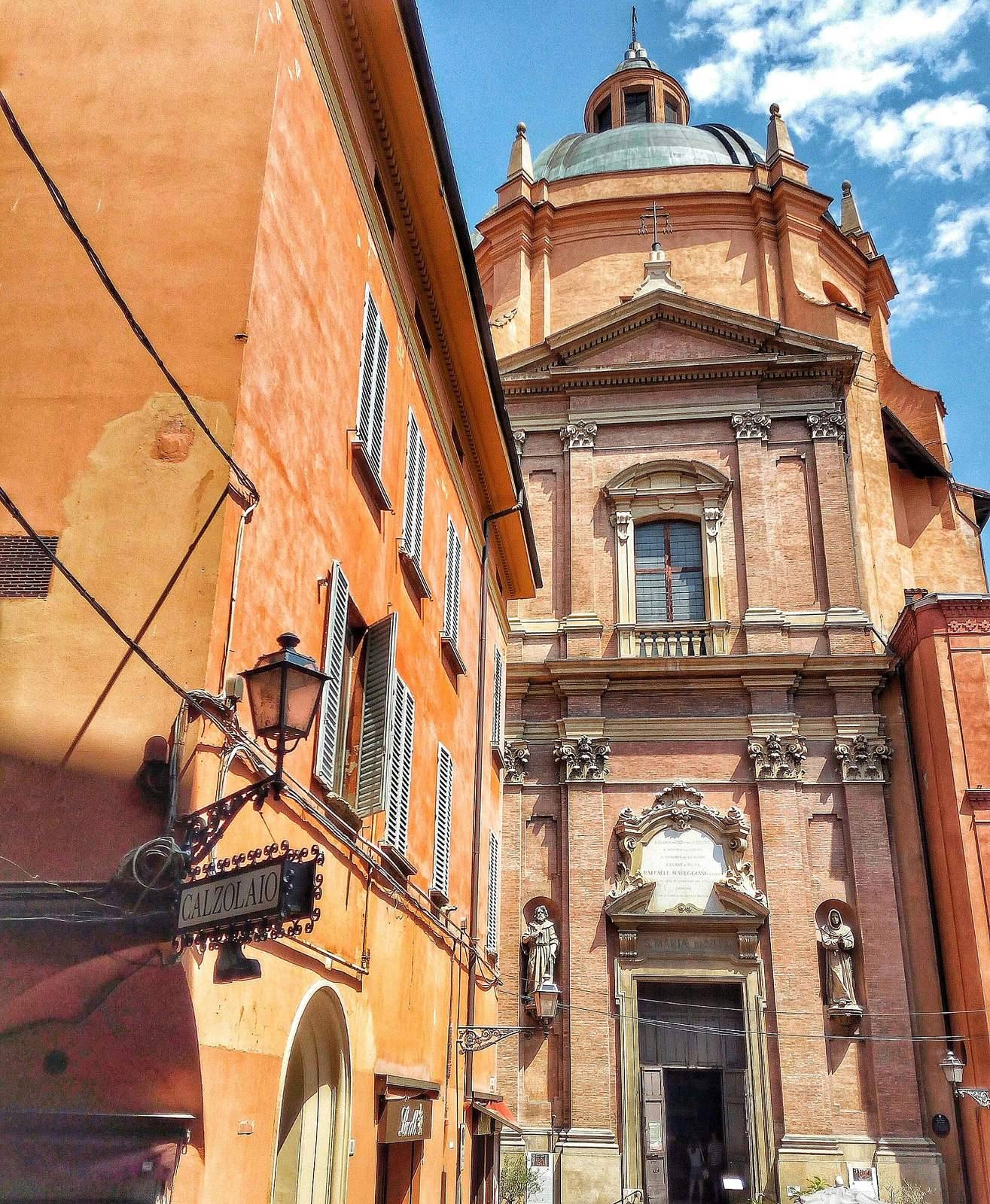
The church exterior and central plan
The present church has an elliptical central plan, organized around a dome rather than a rectangular nave. Inside are two principal chapels, four smaller chapels, and an elongated presbytery, the area around the main altar used by clergy, aligned with the entrance.
Façade
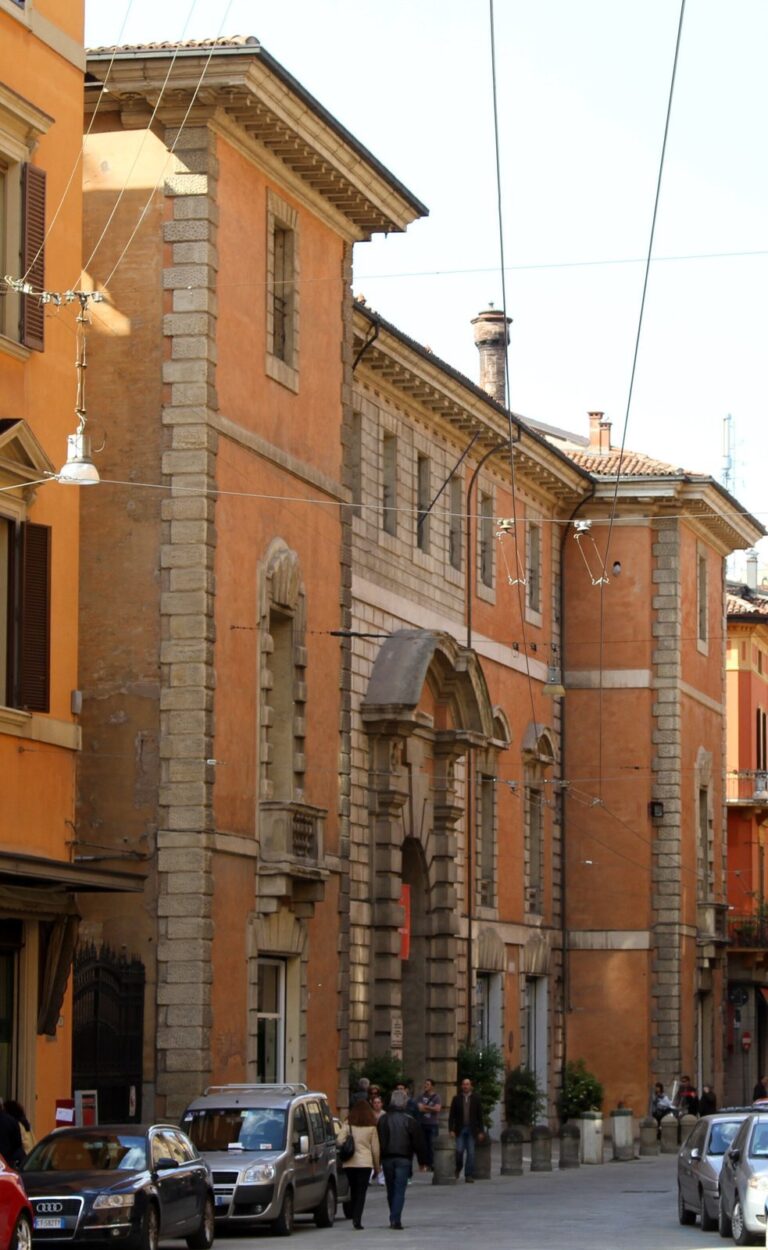
From Via Clavature, the large façade is the only part of the sanctuary visible. Its brickwork is covered with stucco, a decorative plaster finish, and accented by cement cornices and capitals. A triangular pediment, the crowning feature above the entrance, bears the confraternity’s emblem: a double-armed Latin cross with scourges hanging from it, set above three mounts representing Calvary. Niches beside the doorway contain statues of Blessed Raniero de’ Barcobini Fasani and Bonaparte Ghisilieri. Tullo Golfarelli sculpted the figures in 1903, and they were installed in 1905.
Dome and bells
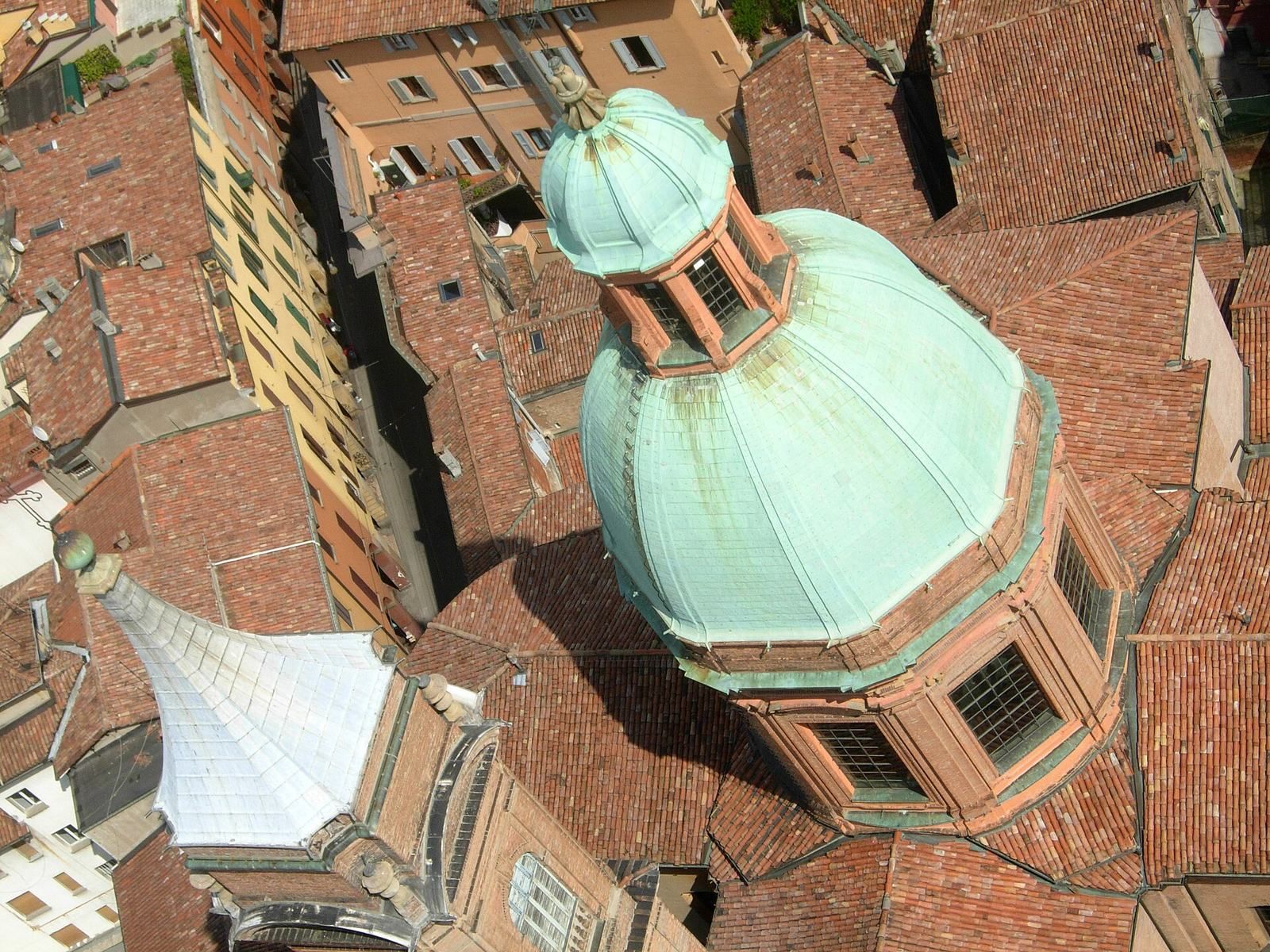
The dome rises 52 metres and is supported by a drum, the structure between the church and the dome. Antonio Galli da Bibbiena designed it, and Giuseppe Tubertini built it; the design may also have followed a proposal by a member of the Terribilia family. Four bells hang in openings at the base of the drum on the side facing Piazza Maggiore. They are difficult to see from outside and hang from wooden supports used in the local Bolognese bell-ringing tradition. Giuseppe Brighenti cast the three larger bells in 1826. Clemente Brighenti made the smaller one in 1883, completing the traditional set of four.
Dome interior
Four arches and curved triangular supports called pendentives frame the central space beneath the dome. Its drum has stucco-decorated windows, while sixteen sections of recessed panels divide the dome’s inner surface. Luigi Acquisti sculpted the large female prophetic figures on the pendentives. Known as Sibyls, these figures came from ancient tradition and were also used in Christian art. They represent the Cumaean, Phrygian, Erythraean, and Persian Sibyls.
Chapels and altar works
Principal chapel and altar
Angelo Venturoli designed and built the principal chapel and its altar between 1776 and 1779. The altar, in an early Neoclassical style that revived forms associated with ancient Greek and Roman art, is framed by a small shrine-like structure with a curved pediment. Two stucco angels by Giacomo Rossi sit above it, holding a medallion with a projecting sculpted image of God the Father blessing. Within the frame is the surviving portion of an early-fifteenth-century fresco showing the enthroned Madonna and Child. Now attributed to Pietro di Giovanni Lianori, it was painted on a wall built in 1406 and transferred to the altar that preceded the present one in 1692. Petronio Tadolini’s statues of Continence and Humility stand in niches beside the altar.
Paintings and organ in the presbytery
Gaetano Gandolfi painted the Assumption of the Virgin on the dome above the principal chapel between 1776 and 1779, while Flaminio Minozzi painted the curved altar end during the same period. Two wooden choir lofts occupy the presbytery’s side walls. Above the right loft is an organ built by Giuseppe Guermandi in 1867. It incorporates pipes from an instrument made by possibly Paolo or Giuliano Cipri in 1578 and from work by Francesco and Domenico Traeri in 1698. The Ruffatti firm of Padua restored it in 1996, and sculptures by Francesco Tadolini are also located there.
Saint Joseph chapel
The first chapel on the right is dedicated to Saint Joseph. Its stucco altarpiece contains Domenico Pedrini’s 1780 painting of Saint Joseph with the Christ Child. Below it is a fifteenth-century panel of the Madonna and Child by an unidentified artist.
Saint Jerome chapel
The larger chapel farther along the right side is dedicated to Saint Jerome. Its eighteenth-century stucco altar includes two angels by Angelo Piò, dated 1735. Above it, Aureliano Milani’s painting of the Madonna and Child with Saint Jerome and Blessed Bonaparte Ghisilieri, made around 1718, draws on models by the Carracci family. Part of Ghisilieri’s bones was buried at about that time in a funerary chest beneath the painting.
Saint Anne chapel
The chapel dedicated to Saint Anne contains a late-eighteenth-century painted terracotta group of Saint Anne with the young Mary. Made to serve as a container for relics, the sculpture is by an unidentified artist. A silver bust of Saint Charles Borromeo occupies a niche to its right.
Chapel of the Lamentation
A chapel to the right of the presbytery holds Niccolò dell’Arca’s terracotta Lamentation over the Dead Christ, a group of six life-size figures gathered around Christ’s body. The confraternity commissioned it in 1463. The work is signed on the pillow beneath Christ’s head and originally stood beside the entrance to the earlier sanctuary. The chapel also contains Denys Calvaert’s Saint Ursula before the Tyrant and Jacopo Calvi’s eighteenth-century painting of the Madonna in Glory with Saint Francis and other saints.
Left-side altar
At the central altar on the left is Domenico Pedrini’s painting of Blessed Raniero healing plague victims. It copies Giacomo Cavedoni’s painting at the entrance to the adjoining Oratory.
The Oratory and former hospital rooms
Upper Oratory
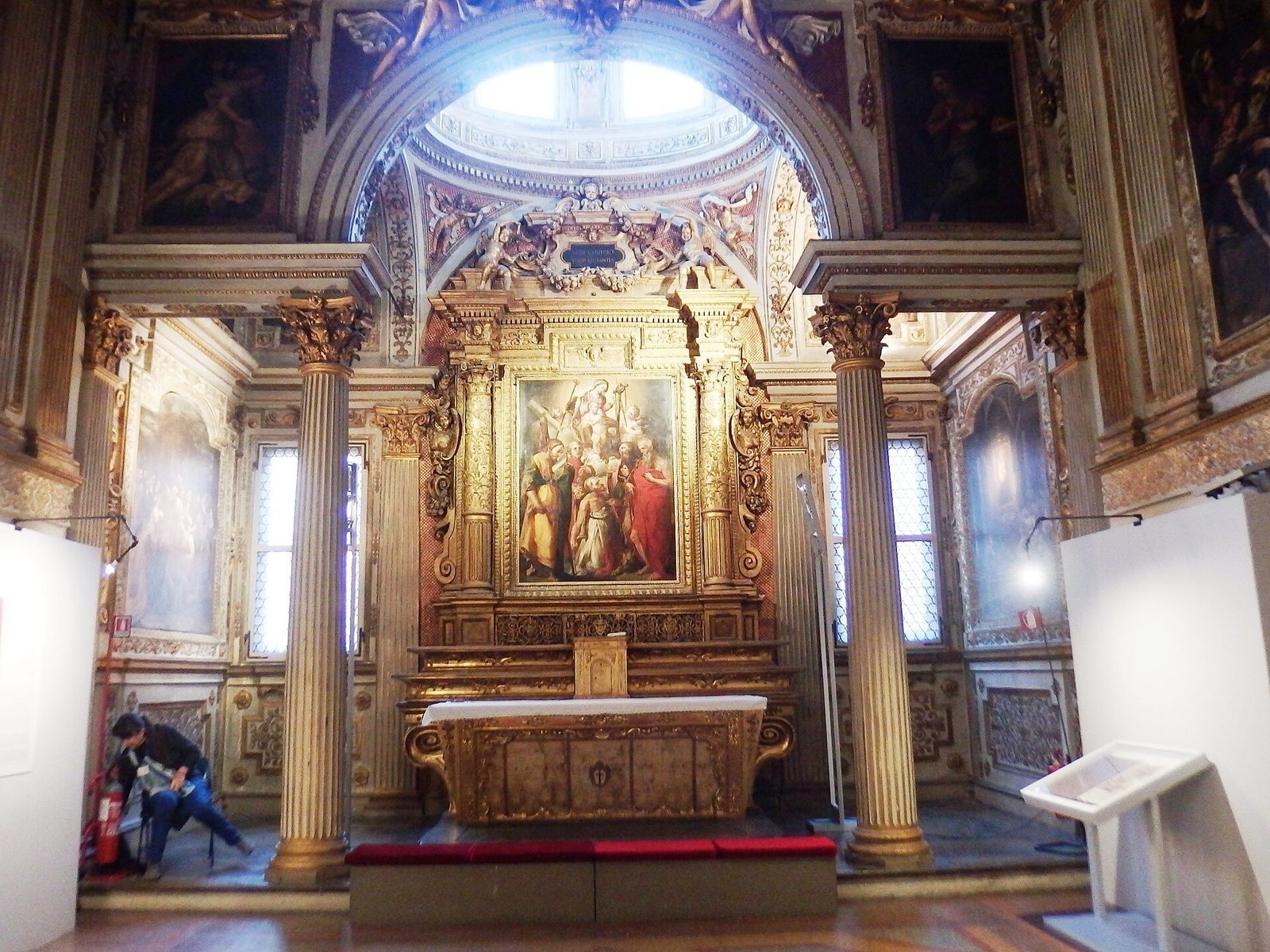
The present Oratory of the Battuti occupies the upper floor, replacing the earlier oratory. Its rectangular interior has gilded stucco decoration by Giulio Cesare Conventi and Antonio Martini, completed in 1639. At one end, a three-part opening with a central arch leads to a small, slightly raised presbytery. Sebastiano Brunetti’s paintings of the Archangel Gabriel and the Virgin Annunciate flank the arch. Their date is uncertain; Floriano Paleotti, a confraternity member, donated them in 1634. A small elliptical dome above the space before the altarpiece has winged stucco figures in its curved triangular supports.
Oratory walls and side rooms
The Oratory’s side walls have plain plaster below and shallow rectangular columns above. The columns support a horizontal architectural band enlivened by gilded putti and shaped into openings and semicircular niches with pediments. The niches contain statues of Bologna’s patron saints: Francis and Petronius on one side, Dominic and Proculus on the other. Petronius and Proculus are attributed to Alessandro Algardi; Giulio Cesare Conventi made the statues of Francis and Dominic.
Paintings on the walls include Giacomo Cavedone’s Blessed Raniero Healing the Plague-Stricken and Vincenzo Spisanelli’s Apparition of the Virgin to Blessed Raniero. Antonio Randa’s painting of 1626–1627 shows Raniero and a procession visiting the body of Saint Geminian, bishop of Modena. Opposite is a painting, possibly by Spisanelli, of Raniero and the bishop of Perugia displaying a letter received from the Virgin. Barrel-vaulted side rooms contain further works. On the far-right wall, Giacinto Gilioli’s painting shows Blessed Raniero and members of the flagellant confraternity venerating the Madonna della Vita, possibly in the early seventeenth century, with four paintings of Raniero’s posthumous miracles above. At the far-left end, Giovan Battista Bertusio’s Death of Blessed Raniero is surmounted by four scenes of miracles attributed to Raniero during his life.
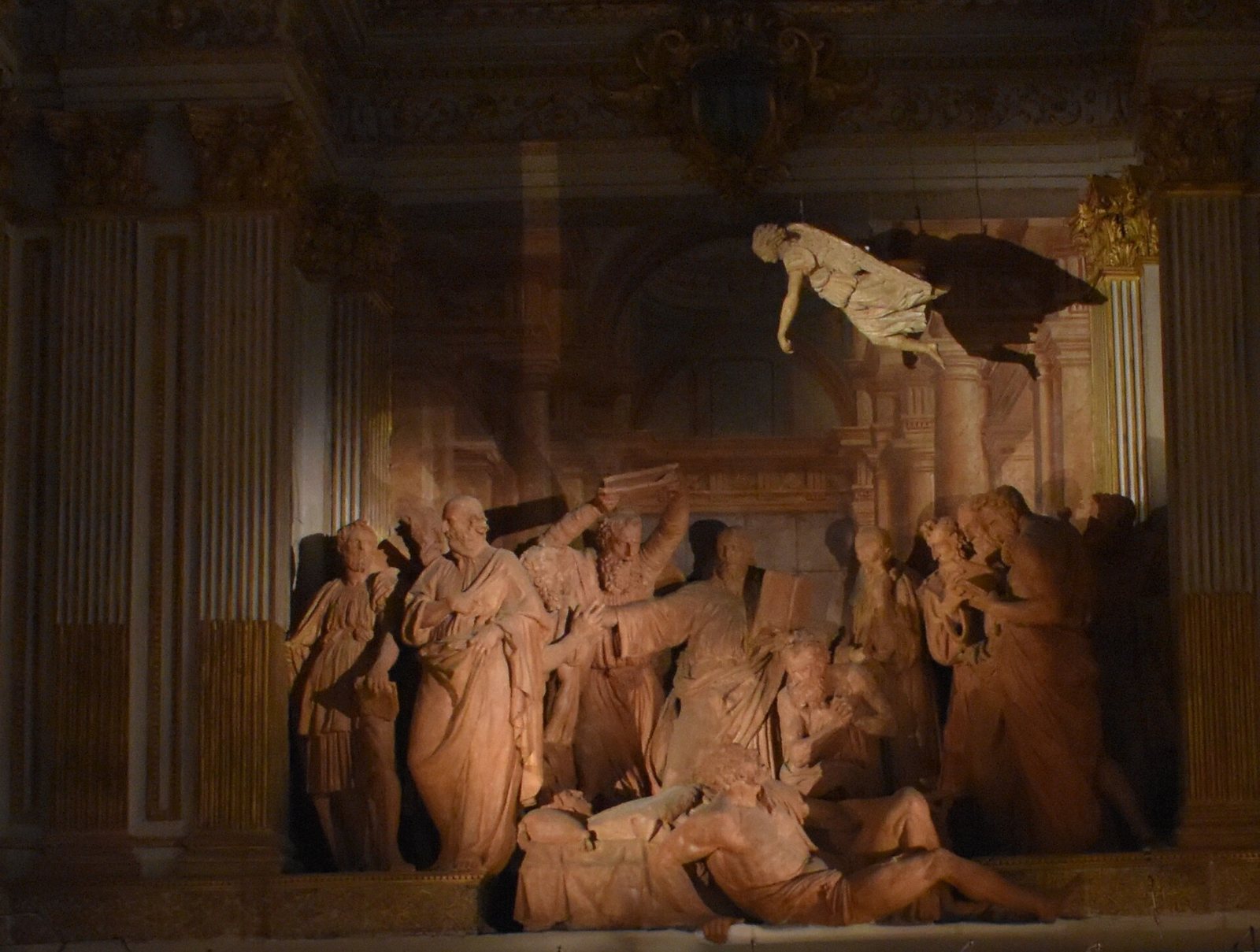
Death of the Virgin
In a deep recess at the end opposite the presbytery is Alfonso Lombardi’s terracotta Death of the Virgin, a group of fourteen statues. The confraternity commissioned it in 1519, and Lombardi completed it in 1522. It was placed in its present position in 1612. The composition has been described as inspired by Raphael’s School of Athens.
Former hospital rooms and museum
The museum of health and assistance occupies seventeenth-century rooms on the first floor beside the Oratory. These spaces correspond to parts of the former hospital used until 1725. They incorporate a house and studio associated with Guido Reni, now used for storage and the display of pharmacy objects. The museum also holds two paintings by Gaetano Gandolfi, Coriolanus and His Mother and The Continence of Scipio. Marquis Giacomo Marescotti Berselli commissioned them in 1784 for his palace on Via Barberia and donated them to the museum in 1922.