Santa Maria di Provenzano: A Marian Sanctuary in Siena
Site at a Glance
- Popularity
- Medium
- Country
- Italy
- Primary era
- Early Modern
- Eras represented
- Early Modern
- Civilizations
- Grand Duchy of Tuscany
- Site type
- Religious
- Remains
- Sanctuary
On this page20 sections
History
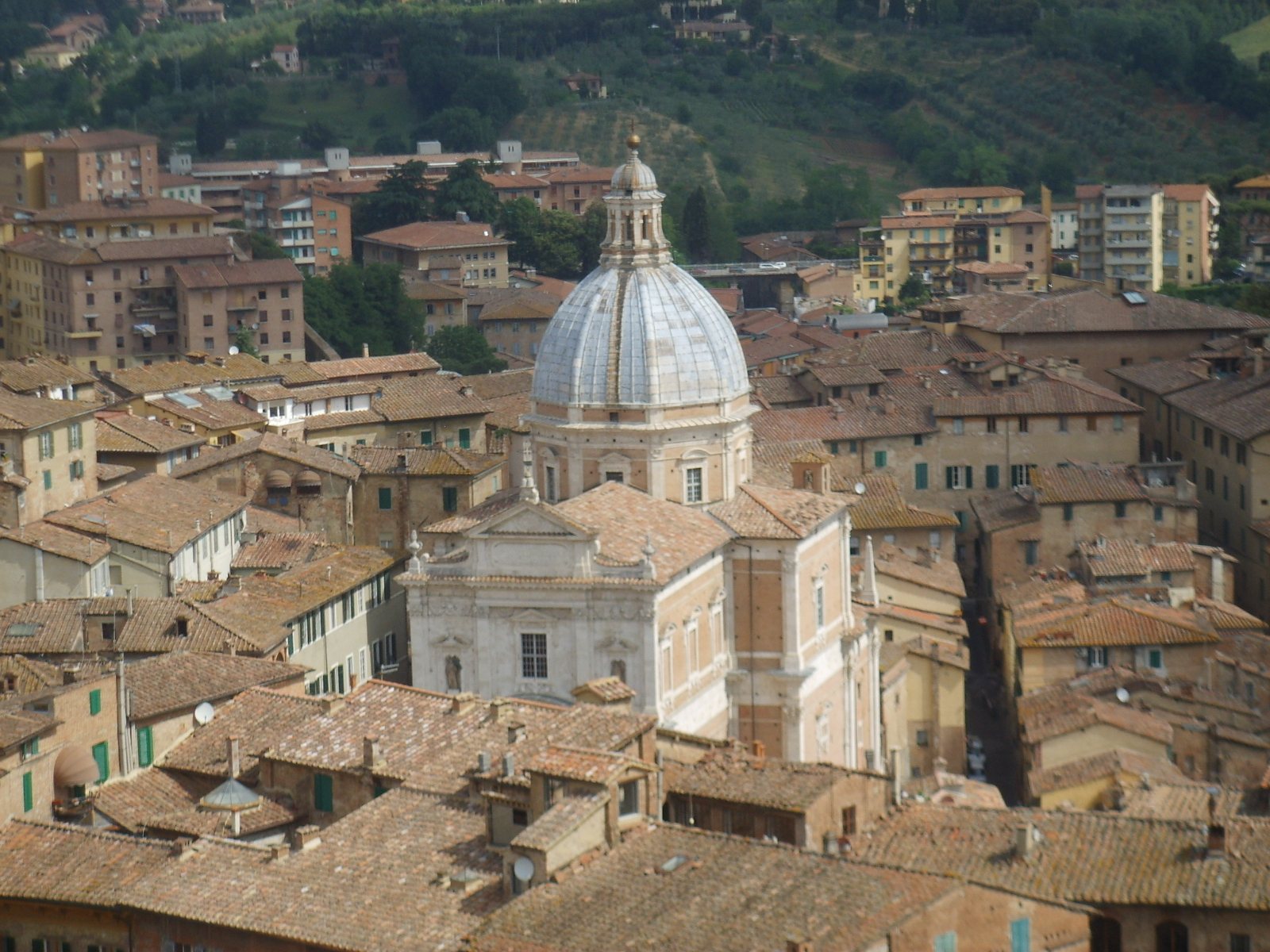
Santa Maria di Provenzano is a Roman Catholic Marian sanctuary in Siena, Italy, in the Provenzano district. Dedicated to the Visitation, the biblical meeting of Mary and Elizabeth, it belongs to the Archdiocese of Siena–Colle di Val d’Elsa–Montalcino and venerates the Madonna of Provenzano as Our Advocate. Construction began in 1595, and the church opened for worship in 1611. Its Mannerist style, a late Renaissance form, belongs to the period of the Council of Trent (1545–1563), a Catholic reform council whose decrees influenced worship and church design. The sanctuary grew from devotion to an image of the Madonna and remains closely associated with Siena’s religious life and its annual horse race.
The shrine and the Madonna of Provenzano
The Provenzano district takes its name from the former houses of the family of Provenzano Salvani, a Sienese military leader of the thirteenth century. Dante also refers to Salvani in the Divine Comedy. Tradition attributes the commission of a glazed terracotta Pietà, an image of Mary mourning the dead Christ, to Catherine of Siena. The image was placed in a wall shrine beside a house in the district.
In 1552, a Spanish soldier armed with an early firearm shot the image. The circumstances are unclear: the shot may have been accidental or fired as a prank. Its bust of the Madonna survived, but the arms and remaining parts were destroyed. A local tradition later connected the loss of the image’s protection with Siena’s eventual subjugation by Emperor Charles V and his Florentine allies.
Devotion to the damaged image increased, first in response to the shooting and later through reports of miracles attributed to the Madonna. These miracles received recognition in 1594, remembered as the year of miracles. A devotional story tells that about fifty years after the shooting, a local woman prayed before the image and an ulcerous lesion healed overnight. Before 1555, the hermit and preacher Brandano urged Siena to reform its civic life and undertake barefoot penance at Provenzano. He warned of troubles ahead and said the city’s welfare depended on the Madonna’s protection.
Construction and church institutions
In 1594, Pope Clement VIII and Siena’s civic magistrates approved the construction of a large sanctuary for the image. The Medici were among those who helped raise funds. Grand Duke Ferdinando I de’ Medici commissioned plans from Damiano Schifardini, a Sienese monk based at the Charterhouse of Florence. Schifardini initially coordinated the work, but Flaminio del Turco soon assumed responsibility because Schifardini lived far away. Don Giovanni de’ Medici also assisted with the dome. The foundations were laid on 24 October 1595.
Archbishop Camillo Borghesi consecrated the church and opened it for worship on 16 October 1611. A week later, on 23 October, a solemn procession carried the revered image through Siena and into the new sanctuary. In 1614, Grand Duke Cosimo II established the Opera of Santa Maria in Provenzano, an administrative body led by a lay rector to manage church property and provide for worship.
Pope Urban VIII elevated the sanctuary to a collegiate church in 1634. Its chapter of canons, headed by a provost, held second place in the archdiocese after the chapter of the metropolitan cathedral. On 1 November 1681, Cardinal Flavio Chigi donated an imperial-style crown for the Madonna’s image. The crowning was also associated with a papal bull issued by Pope Innocent XI. In 1806, the image was covered in silver as an act of reverence and to protect it.
Devotion, the Palio, and the parish
Since 1656, Siena’s traditional horse race, the Palio, has been run in honor of the Madonna on 2 July, traditionally the feast of the Visitation. The race was suspended during both world wars and during the pandemic emergency of 2020 and 2021. On the day before the race, the painted banner is brought to the church in procession, where civic authorities and Siena’s historic district associations pay homage to the Madonna. Following a blessing and hymn, the banner remains in the church until race morning. The winning district returns it after the race to give thanks.
Since 1988, Santa Maria di Provenzano has also served as a parish church. Archbishop Mario Ismaele Castellano established the parish after the older parishes of San Pietro a Ovile, San Cristoforo, and San Donato in San Michele all’Abbadia were suppressed.
Remains
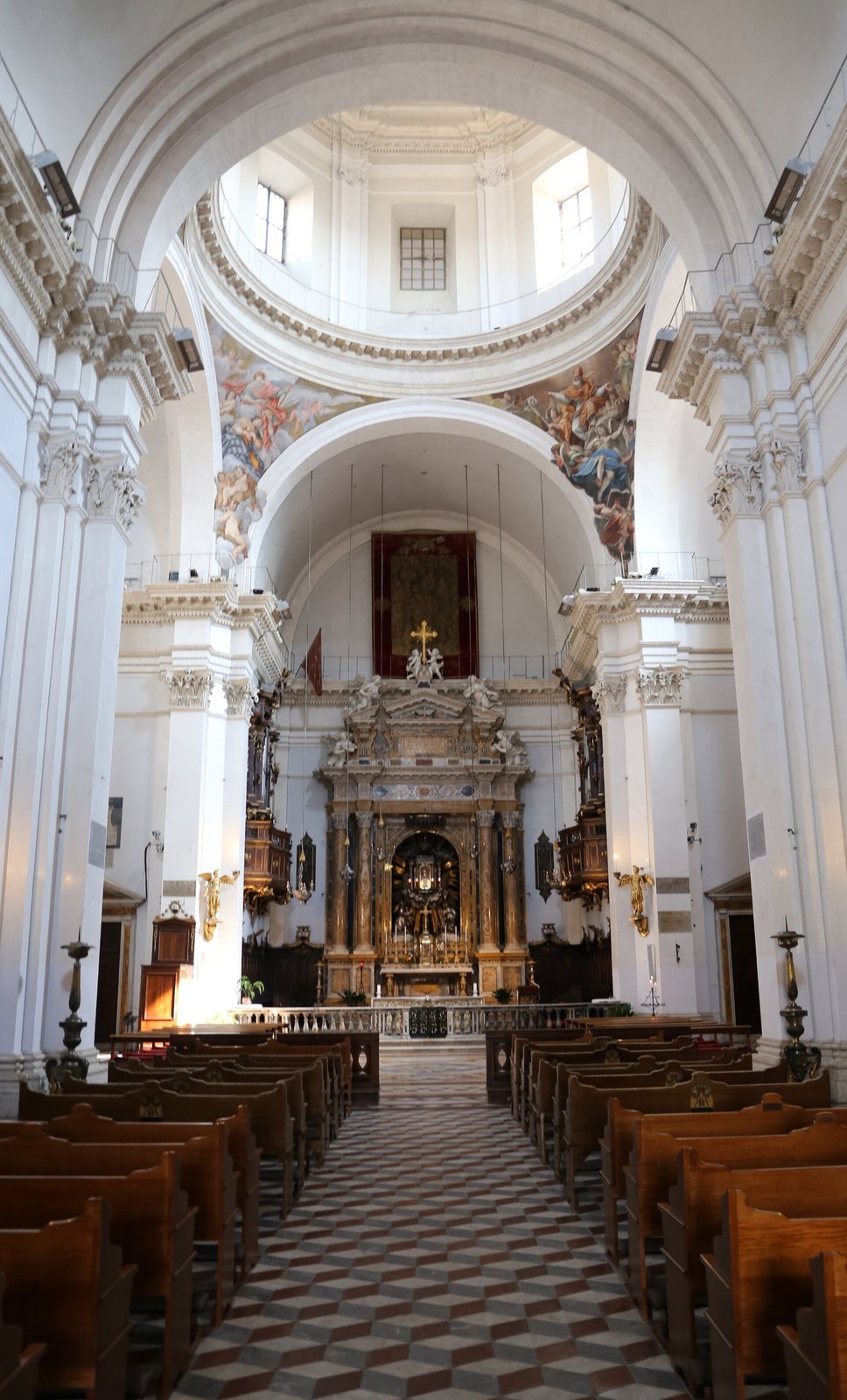
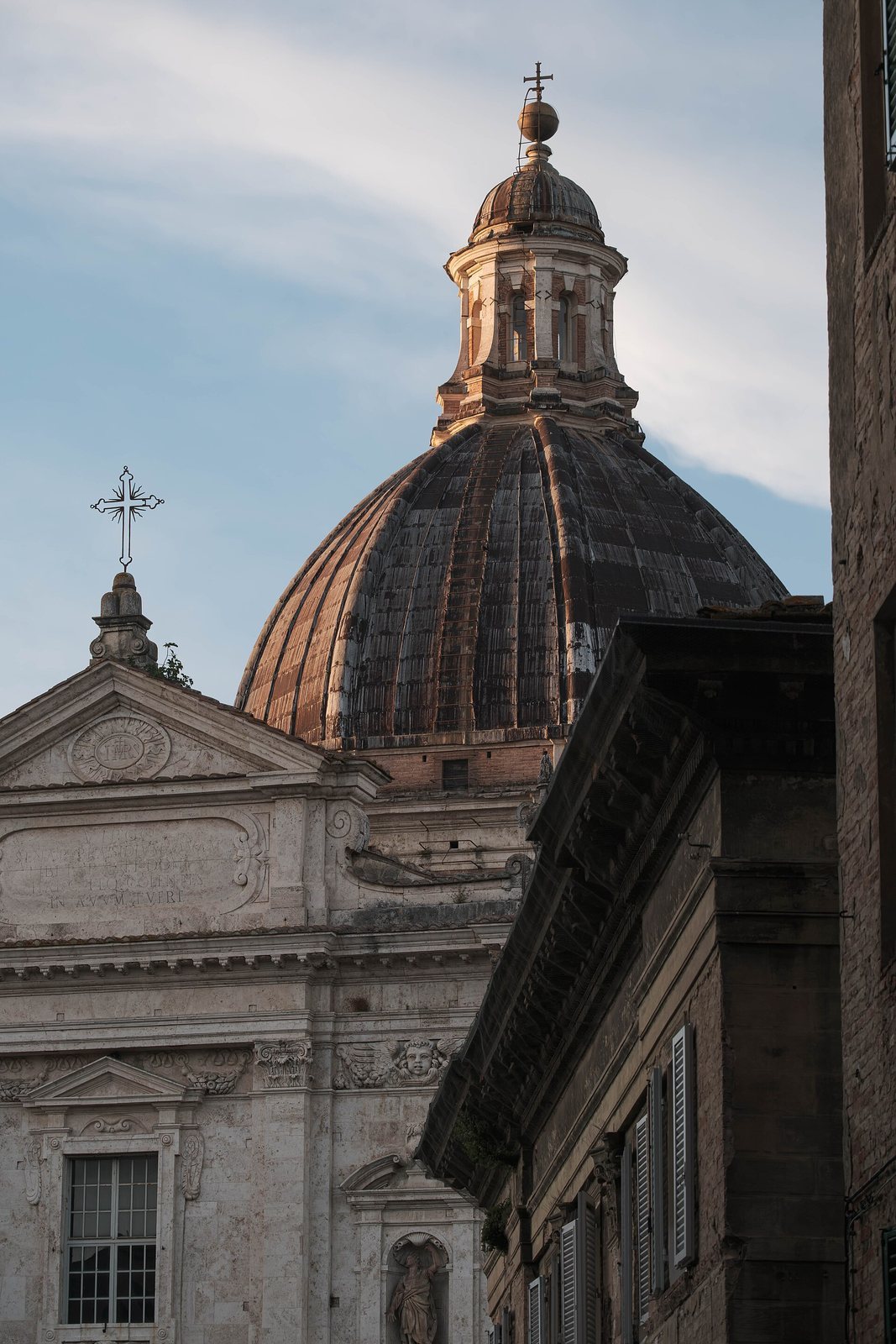
The church has a single nave and a Latin-cross plan, in which a long central space is crossed by a transept. An octagonal dome rises above the crossing, supported by a drum, the structure beneath a dome. The main altar stands at the end of the nave, with further altars in the side spaces and at the ends of the transept.
Façade
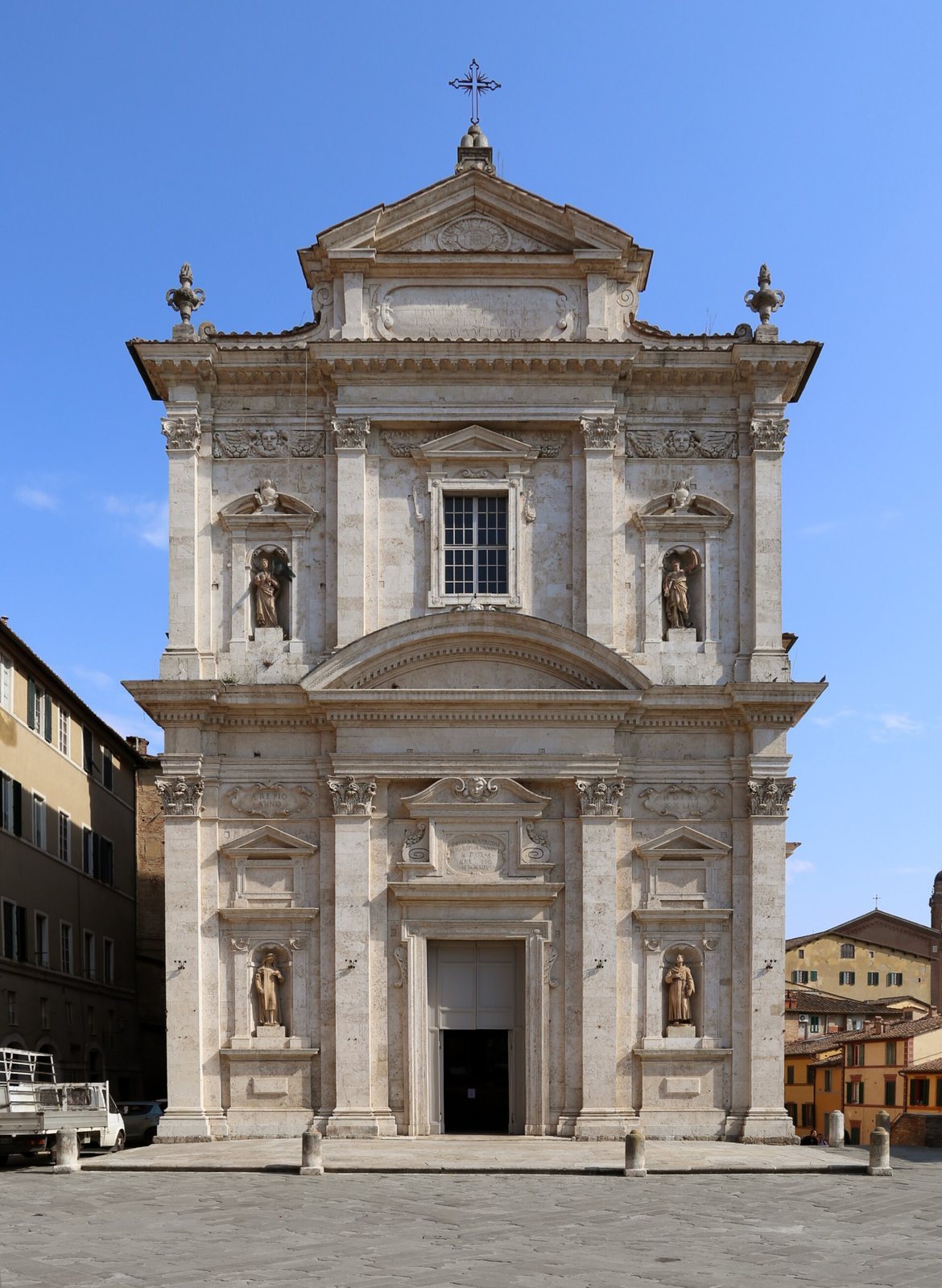
The front is built of travertine and divided into three vertical sections by pilasters. A strongly projecting cornice separates its two levels, while a central pediment with scroll-shaped forms completes the upper outline. The central entrance has a curved pediment above it and a rectangular window. Niches on either side hold statues of Saints Ansano, Vittore, Catherine, and Bernardino.
Main altar and the Madonna’s image
The Madonna’s fifteenth-century terracotta bust occupies a raised position at the center of the main altar. Silver angels by Giovan Battista Querci surround it, with silver statues of Saint Catherine and Saint Bernardino below. Flaminio del Turco made the altar between 1617 and 1631. The bust’s silver covering is now visible only in part. Above the altar, in the apse, a red velvet hanging embroidered with gold thread bears the insignia of Pope Alexander VII. Two similar hangings flank it: Fabio de’ Vecchi, Bishop of Montalcino, donated the left one in 1683, and Paolo Pecci, Bishop of Massa Marittima, gave the right one in 1690.
Side altars
First altar on the right
Rutilio Manetti’s painting of the Mass of Saint Cerbone is at the first altar on the right. Fabio Piccolomini, Bishop of Massa Marittima, commissioned it shortly after 1630. The scene recounts how Pope Vigilius cleared Cerbone of a charge of heresy after seeing angels appear during the consecration of bread and wine at the saint’s Mass.
First altar on the left
The first altar on the left holds Dionisio Montorselli’s Saint Catherine’s Vision of the Martyrdom of Saint Lawrence. The work was installed here in 1685, after first being made for the now-demolished church of San Lorenzo in Siena. Bishop Ippolito Borghese commissioned the altar.
Right transept altar
At the end of the right transept, the Venturi family altar has a painting by Francesco Rustici, known as Rustichino, showing Catherine of Siena and Catherine of Alexandria. A smaller Annunciation by Giandomenico Manenti is set within the larger canvas. The altar was under the patronage of the Order of Malta, a Catholic religious order associated historically with charitable and military service.
Left transept altar
The Petrucci altar at the end of the left transept contains a large nineteenth-century wooden crucifix with statues of three mourners. An eighteenth-century tabernacle, made of wood and colored marble by a Sienese workshop, is also part of the altar.
Paintings and interior furnishings
Dome, crossing, and floor
Curved triangular supports, called pendentives, carry the dome above the crossing. They bear paintings of Siena’s four patron saints. Giuseppe Nicola Nasini’s image of Saint Ansano dates to 1715; the other three represent Bishop Savino, Vittore, and Crescenzio. The colored marble floor beneath the dome has the arms of Grand Duke Cosimo III de’ Medici and Margherita Luisa d’Orléans at its center. Around them are the arms of the former Republic of Siena’s episcopal cities: Grosseto, Sovana, Pienza, Montalcino, Massa Marittima, and Chiusi. Four gilded wooden angels holding candlesticks stand on the transept pillars. They are attributed to Domenico Arrighetti, known as il Cavedone, and date to the early seventeenth century.
Paintings along the nave and transepts
Four large nineteenth-century canvases along the nave depict episodes from the life of the Virgin. Giovanni Bruni painted the Nativity of Mary, the Presentation of Jesus at the Temple, and the Coronation of the Virgin; Luigi Boschi painted the Visitation. Monochrome paintings in the entrance wall’s interior face and in the transepts include Bernardino Mei’s Mass of Saint Gregory the Great and Story of Judas Maccabeus, and Deifebo Burbarini’s Dream of Saint John the Evangelist and Gideon and the Miracle of the Fleece.
Francesco Mori’s paintings of Saint Bernard Tolomei and Blessed Savina Petrilli, made between 2013 and 2015, are in the transepts. Giovanni Gasparro’s oval portraits of Blessed Anna Maria Taigi and Blessed Pier Pettinaio, dated 2016 and 2018 respectively, are mounted on the two pillars of the triumphal arch.
Flags
Two flags are displayed in the nave. One hangs high on the left side of the apse and was captured from Ottoman forces at the Battle of Vienna in 1683 by the Sienese knight Paolo Amerighi. The other, on the left side of the entrance wall’s interior face, bears the Medici arms. It was a military banner flown at Siena’s Medici Fortress and was transferred to the church after Grand Duke Peter Leopold demilitarized the city.
The sacristy and chapter hall
Sacristy
Above the sacristy entrance is Francesco Vanni’s Holy Trinity, painted in 1595 and donated to the Madonna by the Confraternity of San Bernardino before construction of the church. The sacristy also contains a fourteenth-century fresco of the Madonna della staffa from the Sienese artistic milieu. It was removed from a roadside shrine on the street of the same name, now the last section of Via Sallustio Bandini. Three seventeenth-century paintings are also kept here. Bernardino Mei’s Prophecy of Brandano, which depicts the preacher, occupies the central position. Antonio di Taddeo Gregori’s painting of the 1611 procession that brought the Madonna’s image to the sanctuary is also in the sacristy.
Chapter hall
The chapter hall retains seventeenth-century wooden furnishings. Among its works are Alessandro Casolani’s Lamentation over the Dead Christ and the original crucifix Brandano used while preaching. It also contains two works by the contemporary Sienese artist Pierluigi Olla: a colored terracotta Madonna of Provenzano and a bronze Saint Anthony of Padua.
Oratory beneath the church
The church’s former crypt contains the Oratory of Suffrage, a chapel belonging to the Giraffa district association. Its entrance is on Via della Vergine.