Notarial Archive Building in Florence: A Former Hospital and Present Archive
Site at a Glance
- Popularity
- Very Low
- Country
- Italy
- Primary era
- Medieval
- Eras represented
- Medieval, Early Modern, Modern
- Civilizations
- Grand Duchy of Tuscany, Italian, Republic of Florence
- Site type
- Civic
- Remains
- Hospital
On this page9 sections
History
The Notarial Archive Building in Florence is a former hospital complex in Italy that now houses the District Notarial Archive of Florence. Its history connects the charitable institution founded by Folco Portinari with the later reuse of its buildings for the city’s notarial records.
Hospital origins and use
The building belonged to the original complex of the Arcispedale di Santa Maria Nuova, a major hospital founded by Folco Portinari with advice from his servant Monna Tessa. The great hall behind the entrance block first served as a hospital ward. After the hospital expanded on the opposite side of the piazza, the hall became the women’s ward, known as San Matteo.
Conversion to the notarial archive
The land beneath the entrance and office block had earlier been occupied by houses belonging to the Albertinelli family and later by an Oblate monastery. In 1884 the notarial archive acquired the building. The archive moved there from Orsanmichele as the complex was restored and rearranged, work that largely established its present appearance.
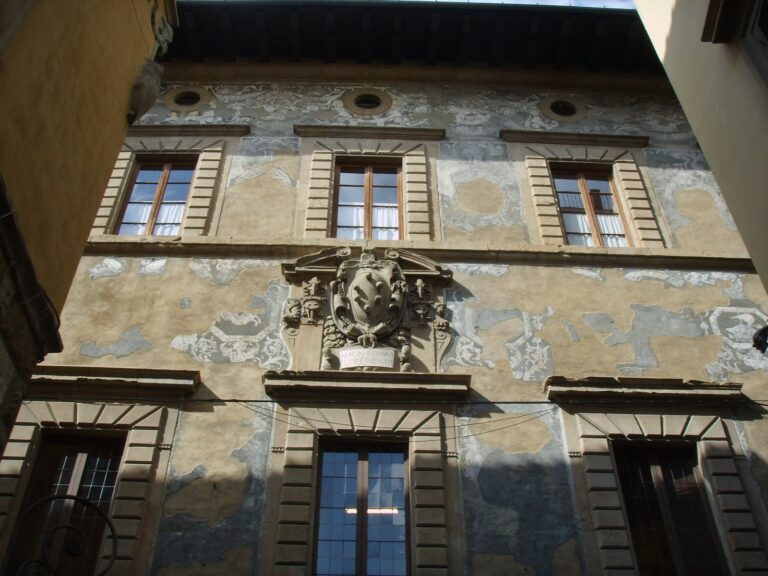
In the early twentieth century, the entrance block was extensively redesigned in neo-Gothic forms, damaging historic and artistic features. The office frescoes were restored by Gaetano Bianchi. Gaetano Milanesi had attributed them to Niccolò Gerini; they are now attributed to Pietro Nelli.
The roofs and the façade on Via Folco Portinari were restored in 1988, followed by the shorter façade on Piazza di Santa Maria Nuova in 1996-97. The building continues to house the District Notarial Archive of Florence under the Ministry of Grace and Justice.
Remains
Plan and street façades
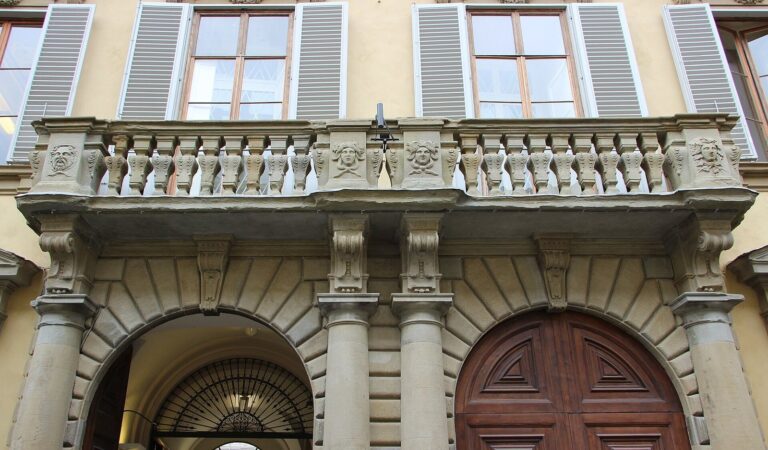
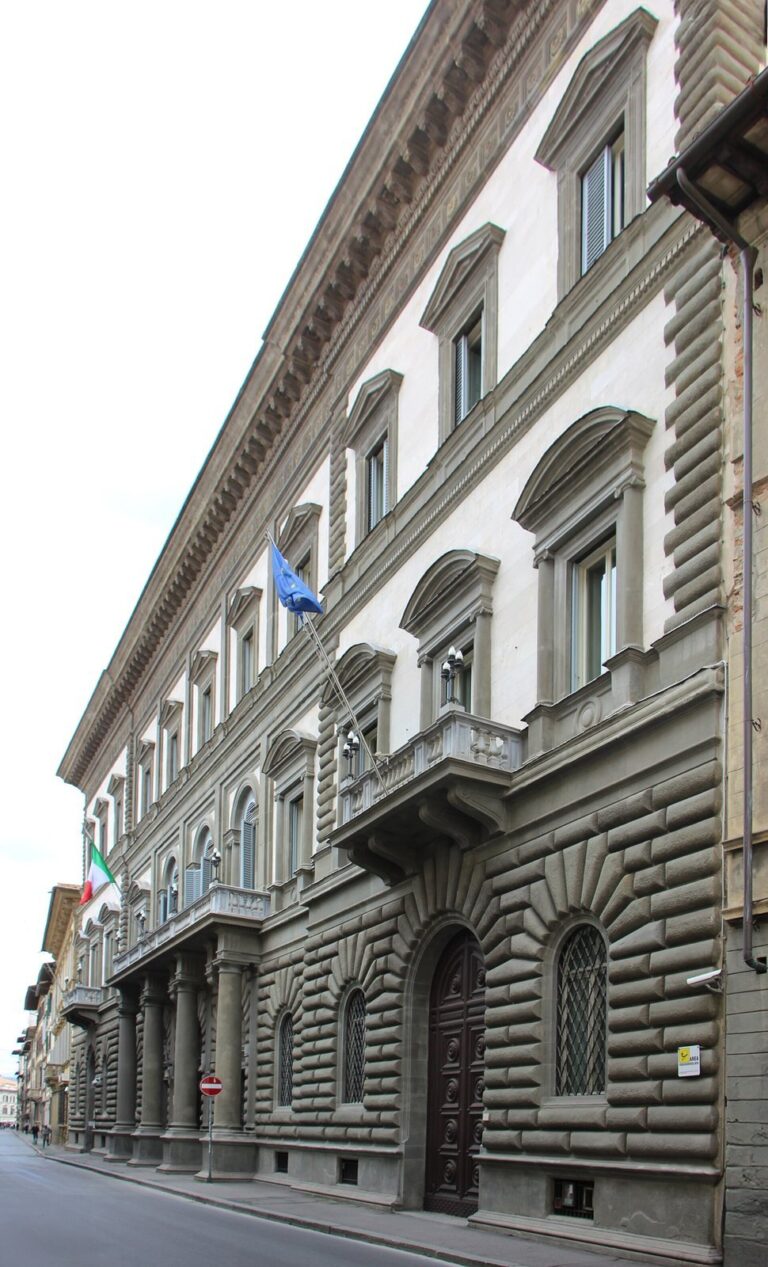
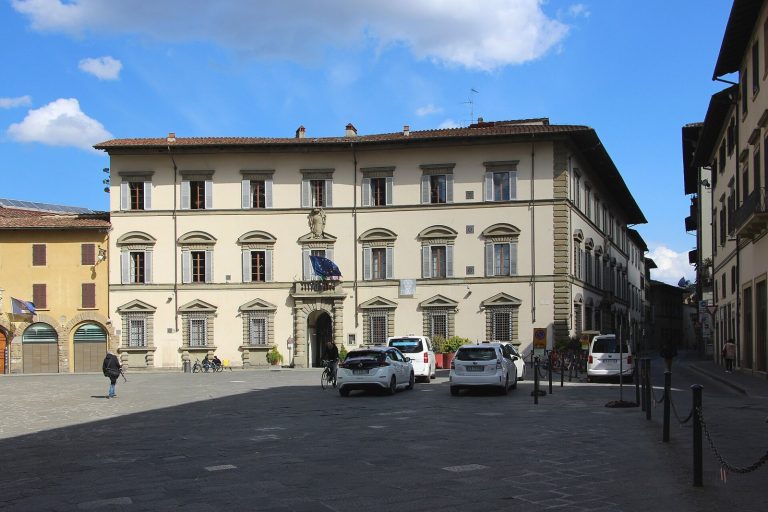
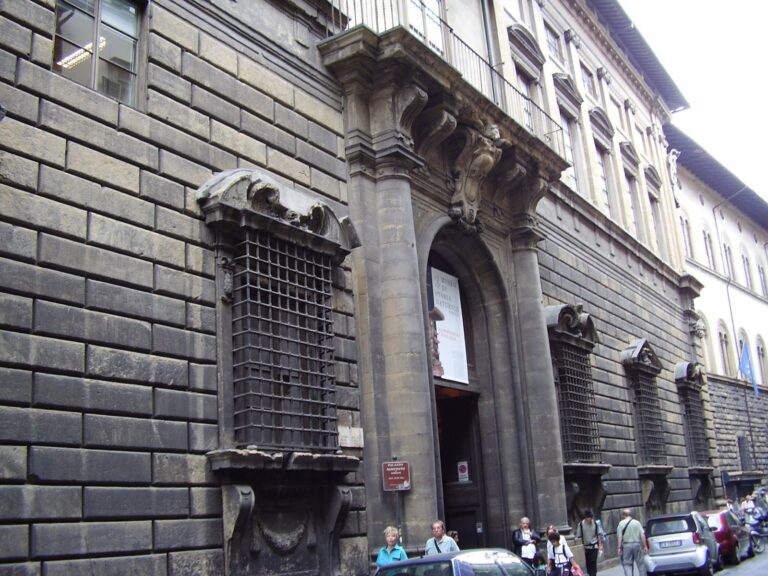
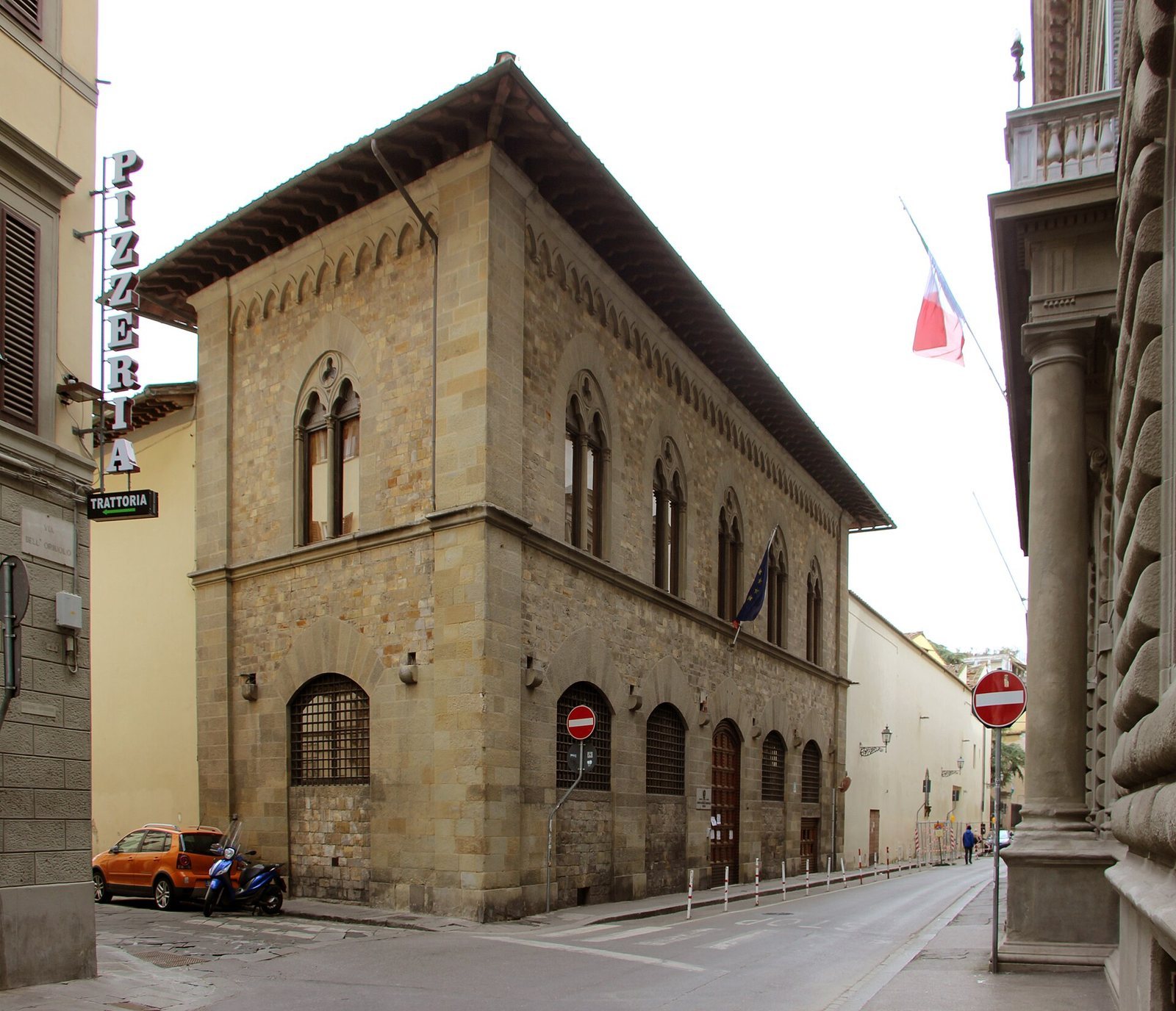
The four-storey complex extends along the eastern side of Via Folco Portinari, with its entrance and offices on Via dell’Oriuolo. The latter façade is faced throughout with stone blocks finished in varied ways. At ground level, five openings with shallow curved arches are flanked by holes for scaffolding poles, some fitted with projecting stone supports. Above them, five paired windows have small pointed arches.
The great hall and its commemorative wall
Hall and wall
A large hall lies behind the entrance block. Its side facing Via Folco Portinari is a tall, continuous plastered wall, marked by plaques and a religious image. The hall’s original principal entrance was from the piazza. Some interior features retain the building’s fourteenth-century character, and frescoes survive in the archive offices.
Devotional shrine and inscriptions
Around the middle of the wall, a tabernacle, or small devotional shrine, contains a Madonna and Child, with the Child shown blessing. The painting is attributed to the Florentine artist Matteo Rosselli. The stone frame bears the arms of the Sienese Mattioli family, while the lower support carries the crutch emblem of the Hospital of Santa Maria Nuova. Beneath the image, an offering slot has a partly damaged but legible inscription meaning “Mary, Mother of Grace,” dated 1721.
A plaque above the shrine records Cosimo II, the Medici grand duke of Tuscany, appointing Giovanni Mattioli as hospital prefect in 1619. A prefect oversaw a hospital’s administration. A second plaque, dated 1785, was moved from the old hospital interior and set into the wall in 1885. It recalls the hospital’s origins and improvements made under Pietro Leopoldo, a later grand duke of Tuscany from the Habsburg-Lorraine dynasty.
The shrine was restored in 2006 at the initiative of Alberto Bruschi and returned to public devotion. Its inscription commemorates Albertina Bruschi, gives the dates 11 February 1882 and 6 April 1906, and records the restoration by her great-grandson Alberto and his daughter Candida.
Hospital plaques
Two identical plaques near the piazza prohibit fouling the area around the hospital. They probably once stood at opposite ends of the street. During renovation of the building at the corner of Via dell’Oriuolo, one of two matching hospital plaques was remounted near the piazza.