Monte Giordano: A Medieval Fortified Complex in Rome
Site at a Glance
- Popularity
- Medium
- Country
- Italy
- Primary era
- Medieval
- Eras represented
- Medieval, Early Modern, Modern
- Civilizations
- French, Papal States
- Site type
- Domestic
- Remains
- Palace
On this page11 sections
History
Monte Giordano is a hill and former fortified complex in central Rome, Italy, known by the mid-12th century as a stronghold. The Orsini family gradually acquired the property in the 13th century and developed it into separate residences for several branches of the family. Its position between important medieval routes gave it strategic value, and its buildings later served as aristocratic homes and a setting for Roman social life.
Early ownership and the Orsini
By the middle of the 12th century, the fortified place belonged to Johannes Roncionis, lord of Raiano in the territory of Collinense, probably near modern Riano. In the following century it was held by Stefano Petri de Monte, thought to have been a member of the Stefaneschi family. Between 1242 and 1262, the Orsini acquired the property piece by piece, eventually becoming its sole owners. Branches living there called themselves Orsini de Monte, distinguishing their group from the Orsini de Campo and Orsini de Ponte.
The hill’s name may refer either to Cardinal Giordano, brother of Pope Nicholas III, or to Giordano, who held Rome’s senior civic office of senator in 1339. The place was also called Mons Ursinorum. Dante may allude to the hill in Inferno, the first part of his Divine Comedy.
In the Middle Ages, Monte Giordano stood between the Via Recta and the Via Papalis, or Papal Way. The latter was used for the pope’s ceremonial procession on formally taking possession of his ecclesiastical see. Its route is now followed by Via dei Banchi Nuovi and Via del Governo Vecchio. Together with Via del Pellegrino, these roads formed a principal connection between the city and the Vatican.
Orsini residences and damage
Over the following centuries, the Orsini developed the site as a fortified complex of separate residences for their branches of Bracciano, Monterotondo, and Pitigliano. The family did not live there continuously, often renting the buildings to distinguished guests. In 1477, members of the family placed the estate under a fideicommissum, a legal restriction on transferring or selling property, intended to keep it within the family.
In the late 15th century, parts of the older buildings collapsed and rubble accumulated in the atrium. On the night of 30 November to 1 December 1485, residences belonging to Gentile Virginio Orsini were burned. Around the death of Pope Alexander VI, troops commanded by Cesare Borgia and led by Michelotto Corella looted and set fire to the complex.
Aristocratic residence and social center
The Bracciano branch’s building became a Roman residence and a place of representation for Cardinal Ippolito II d’Este. He repeatedly welcomed the poets Bernardo Tasso and his son Torquato. Ippolito died at Monte Giordano on 2 December 1572. His body lay in the main hall before being taken the next day to the Church of Santa Caterina dei Funari.
In 1574, Paolo Giordano Orsini, the first Duke of Bracciano, and his wife Isabella de’ Medici came from Florence to live at Monte Giordano. Their rooms were altered during this brief period of shared residence. Meanwhile, members of the Monterotondo branch and Franciotto Orsini, as well as Alessandro Orsini of Bracciano, sought to sell parts or all of the estate in the later 16th and early 17th centuries. Pope Clement VIII opposed these plans by suspending the family restriction on sale. The Monterotondo branch’s fief, or hereditary estate, passed to the Barberini in 1646. Its building had previously passed by inheritance with Isabella Orsini to the counts of Carpegna, and later to the Tanari family of Bologna.
At the beginning of the 17th century, the Bracciano heirs acquired the adjacent residence of the counts of Pitigliano, who had moved to Tuscany. From 1626, Cardinal Maurizio of Savoy rented a building at Monte Giordano, which became a center of Roman social, cultural, and artistic life for several years. In the summer of 1637, he held celebrations at the palace and the square before it for the election of Ferdinand III of Habsburg as Holy Roman Emperor. The Holy Roman Empire was a central European political entity whose emperor was chosen by a group of prince-electors.
Heavy debts eventually brought the estate to Don Flavio, the last Duke of Bracciano, who had no heirs. He lived there with his second wife, Marie Anne de La Trémoille. She furnished the palace with artworks, fine furniture, and tapestries, and made it a gathering place for intellectual and social life. In 1688, the remaining complex was sold to the Roman marquises Pietro and Antonio Gabrielli. The sale allowed the Orsini to move to Palazzo Orsini at Pasquino, near Piazza Navona, in exchange for an annual allowance. In 1696, the Congregation of the Barons also arranged the sale of the Duchy of Bracciano to the Odescalchi.
Gabrielli ownership and later use
Much of the Orsini art and antiquities collection was sold with the palace. Toward the end of the 17th century, Pietro Gabrielli (1660–1734), a senior church official under Pope Innocent XI, assembled a notable collection of his own. It was later largely dispersed after his condemnation for heresy and flight to the Republic of Venice.
Pietro Gabrielli’s nephew, also named Pietro (1746–1824), had the complex restored and commissioned a new wing to connect its buildings. In 1809, he entrusted Liborio Coccetti with interior decoration in Neoclassical and neo-Pompeian styles, drawing on ancient Greek and Roman forms and decoration associated with Pompeii. The work remained until Coccetti’s death in 1816. Suspected of sympathizing with Napoleon, Coccetti spent several years living in voluntary confinement at the palace as the prince’s guest. This episode is thought to have inspired Victorien Sardou’s historical drama La Tosca, which in turn inspired Giacomo Puccini’s opera of the same name.
During the 19th century, the Gabriellis hosted members of the Bonaparte family, including Empress Eugénie and Cardinal Luciano Luigi, who died at the palace in 1895. In 1888, Prince Placido Gabrielli sold the property to Count Rinaldo Taverna. It passed by inheritance to the Gallarati Scotti family toward the end of the 20th century. From 1923 for more than half a century, the complex housed the library of the Giustino Fortunato Association for Southern Studies.
Remains
Setting and medieval features
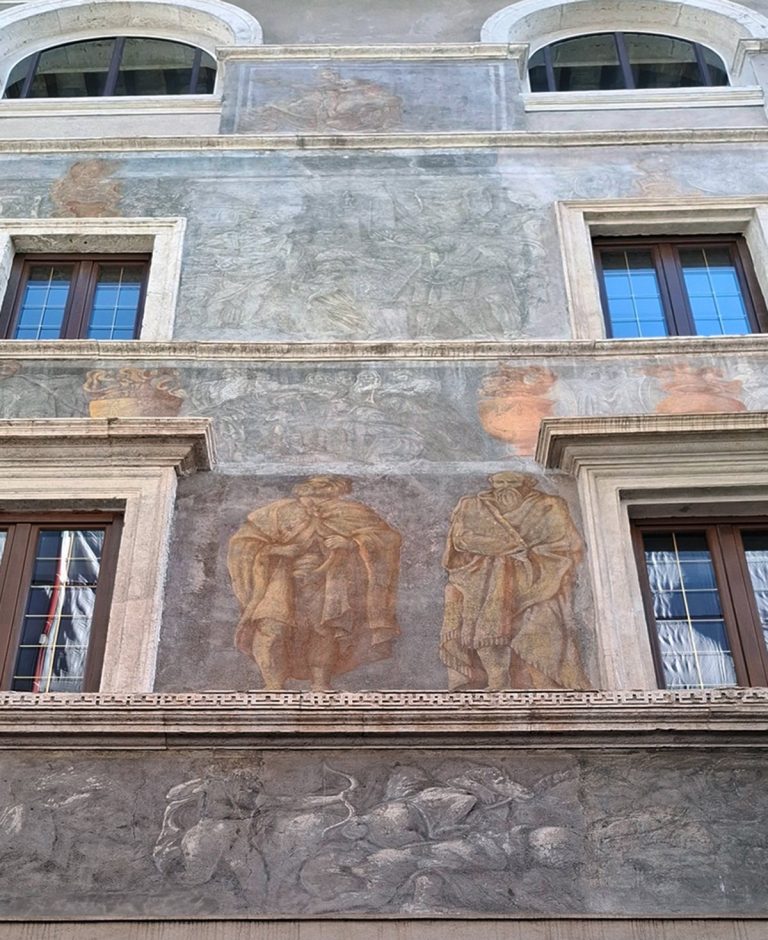
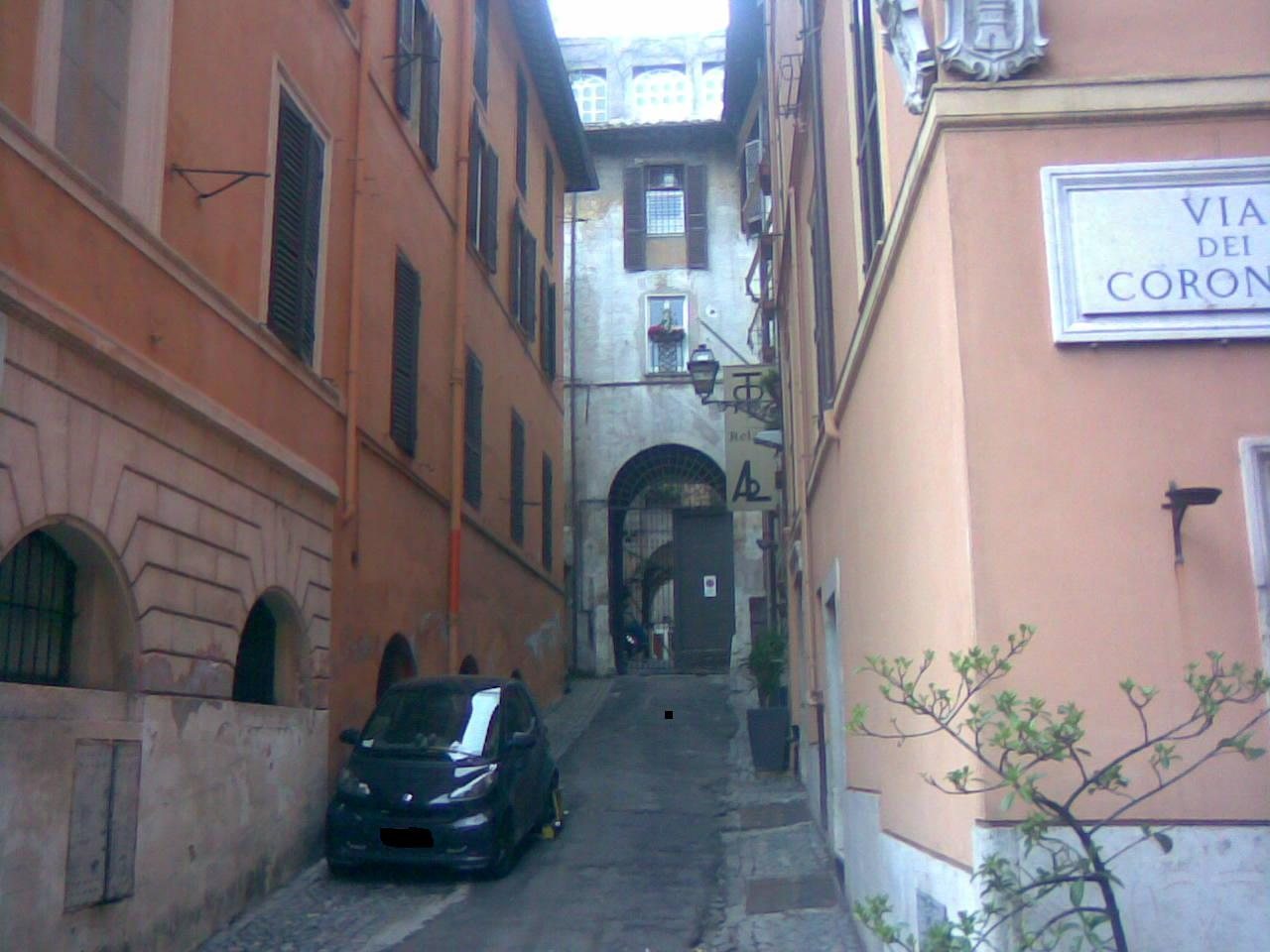
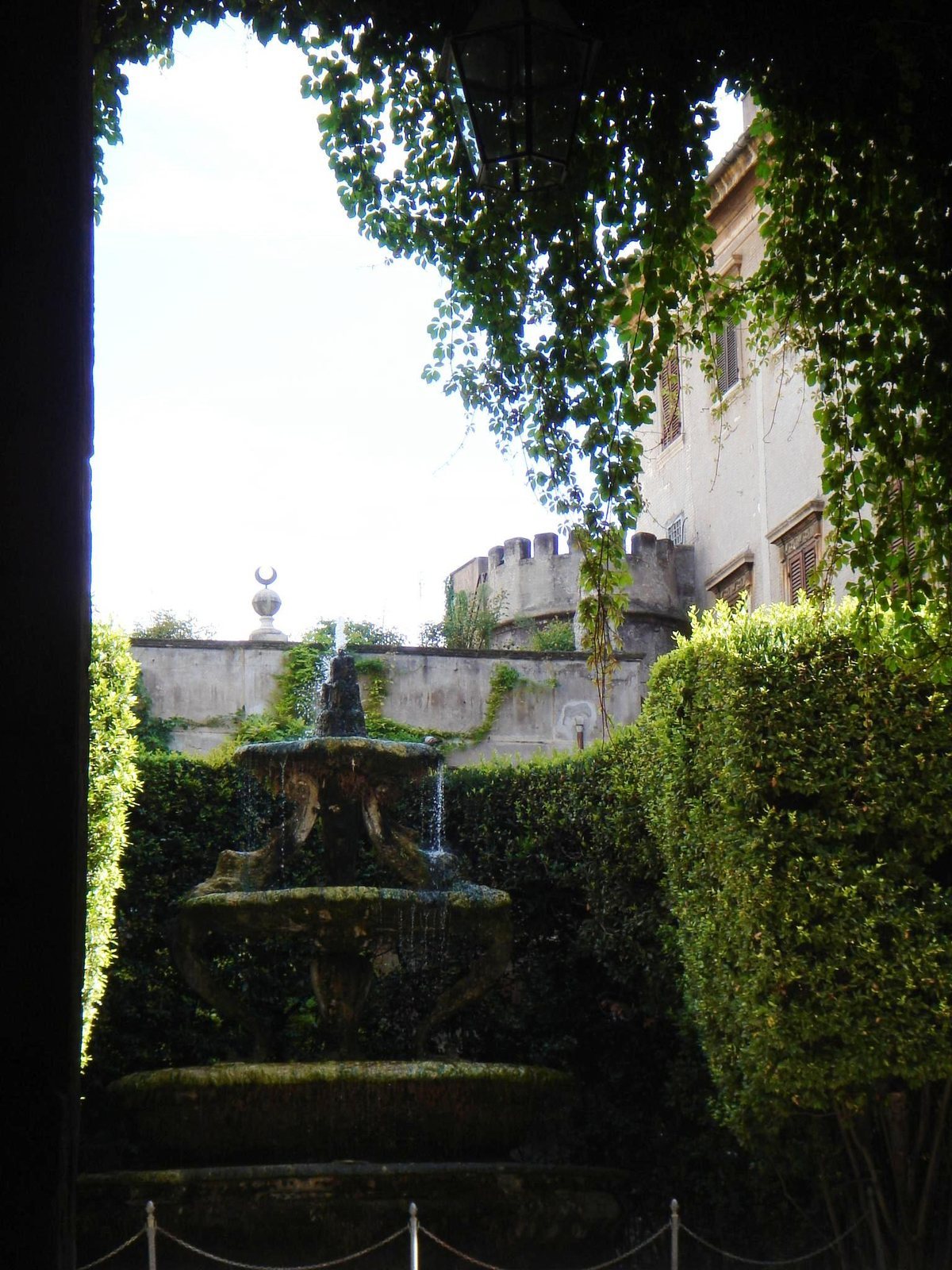
The site occupies a small rise in Rome’s Ponte district, in an area formerly called Scorteclaria. The hill probably formed from debris accumulated near the ancient marble-handling river landing at Tor di Nona. It lies along Via di Monte Giordano, an extension of Via di Panìco, facing Via dei Coronari near Piazza San Salvatore in Lauro. Via della Vetrina and Vicolo Domizio also mark the area’s bounds. The complex’s likely original entrance was on what is now Via dei Gabrielli.
The Church of Santa Maria in Monticello stood at the site by 1177 and belonged to the monastery of Saint Elia of Falleri. A tower called Turris Maior, meaning Main Tower, formed part of Stefano Petri de Monte’s property.
Fortified residences and connections
Bracciano residence
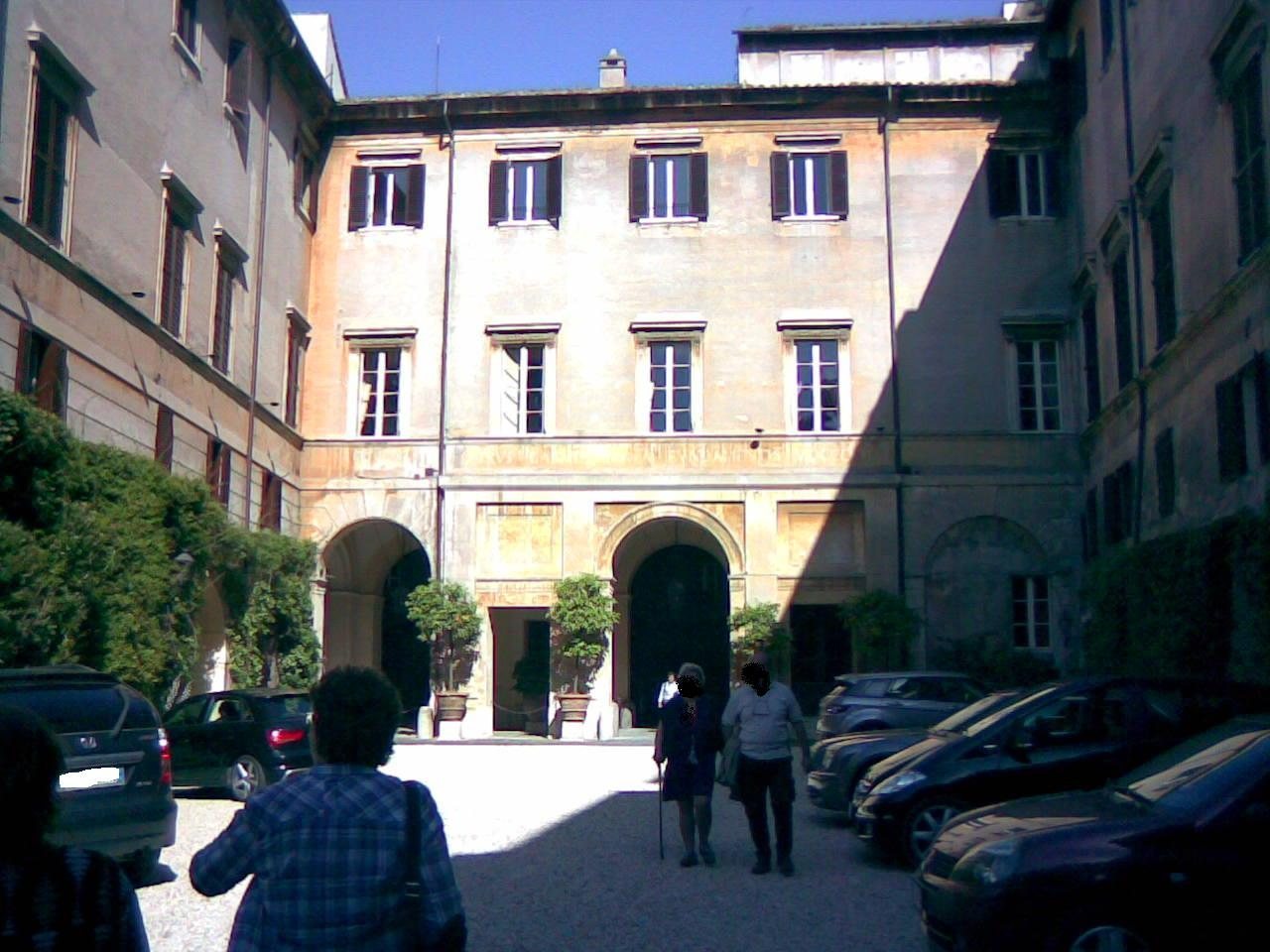
The Bracciano branch’s building projected toward present-day Via di Monte Giordano. It formed one of several separate residences within the fortified complex.
Pitigliano residence and connecting arch
The adjacent residence of the counts of Pitigliano was joined to the Bracciano building by an arch. The arch was altered in the 19th century.
Connecting wing
A later wing linked buildings within the complex. It was commissioned during Pietro Gabrielli’s restoration of the property.