Saint Anne Church: A Baroque Church in Krzywa, Poland
Site at a Glance
- Popularity
- Very Low
- Country
- Poland
- Primary era
- Early Modern
- Eras represented
- Medieval, Early Modern, Modern
- Civilizations
- German, Habsburg, Holy Roman Empire, Kingdom of Bohemia, Kingdom of Prussia
- Site type
- Religious
- Remains
- Church
On this page14 sections
History
Saint Anne Church is a Baroque church in Krzywa, Lower Silesia, Poland, first built as a Catholic church between 1325 and 1335. Its history includes a long period as a Protestant church and repeated rebuilding after wartime damage.
Medieval origins
A church in Krzywa is first mentioned in 1305. It was probably a wooden building, later taken down to make way for the present church. The new church was constructed between 1325 and 1335.
Reformation and Protestant use
The local noble von Festenberg-Packisch family acquired the village in the sixteenth century and held it until the eighteenth. Under the influence of one of its barons, the Reformation, a sixteenth-century movement that led to the establishment of Protestant churches, reached Krzywa. The church became Protestant and remained so until 1945.
Wartime destruction and rebuilding
In 1641, during the Thirty Years’ War, a European conflict fought from 1618 to 1648, the church was largely destroyed. At the initiative of Hans S. von Festenberg, a local nobleman, it was rebuilt and enlarged in 1714. The restored building served as a refuge church, offering shelter to people in times of danger.
From the nineteenth century to the present
In 1813, retreating French troops set fire to the church during the Napoleonic Wars, conflicts involving Napoleonic France and European powers. Local residents helped save the building, which was repaired in the second half of the nineteenth century.
After the Second World War, displaced people from different parts of Poland settled in Krzywa, most of them Catholic. In 1953, the church became a branch of the Roman Catholic parish of Our Lady of the Rosary in Okmiany. The parish name refers to Mary and the Catholic prayer of the rosary. Repairs to the church followed in 1990.
Remains
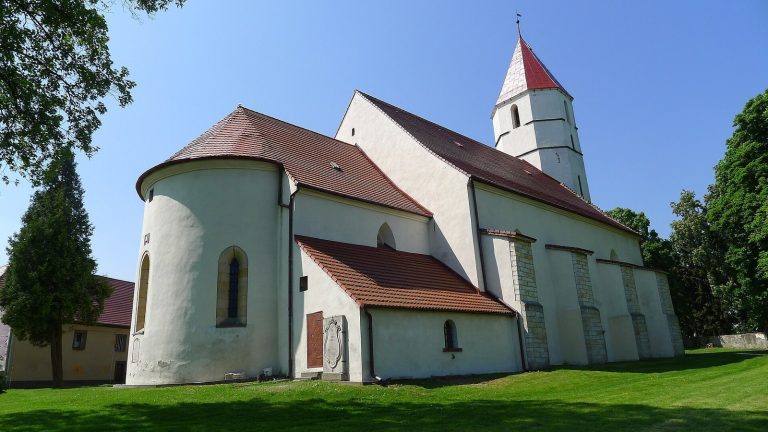
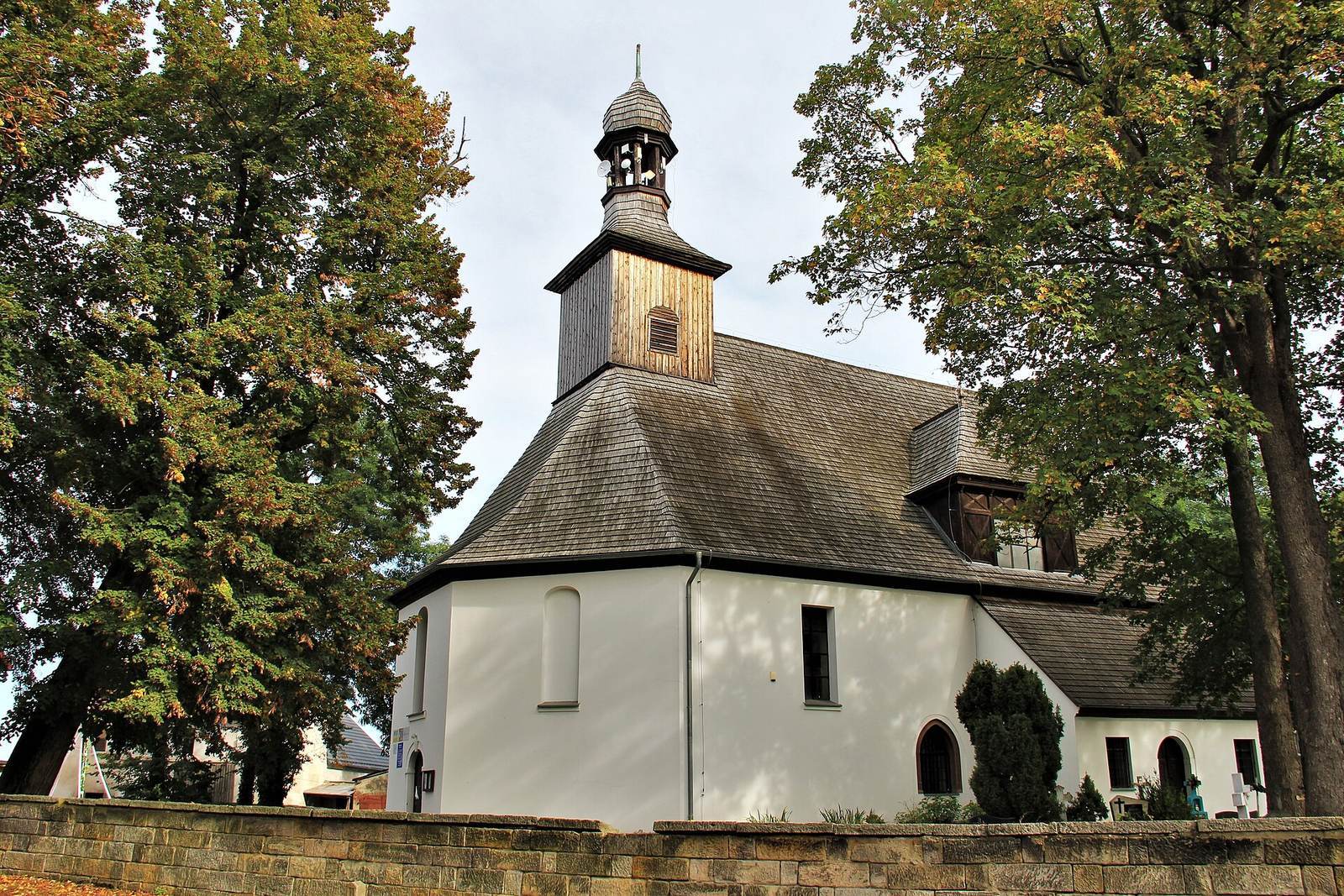
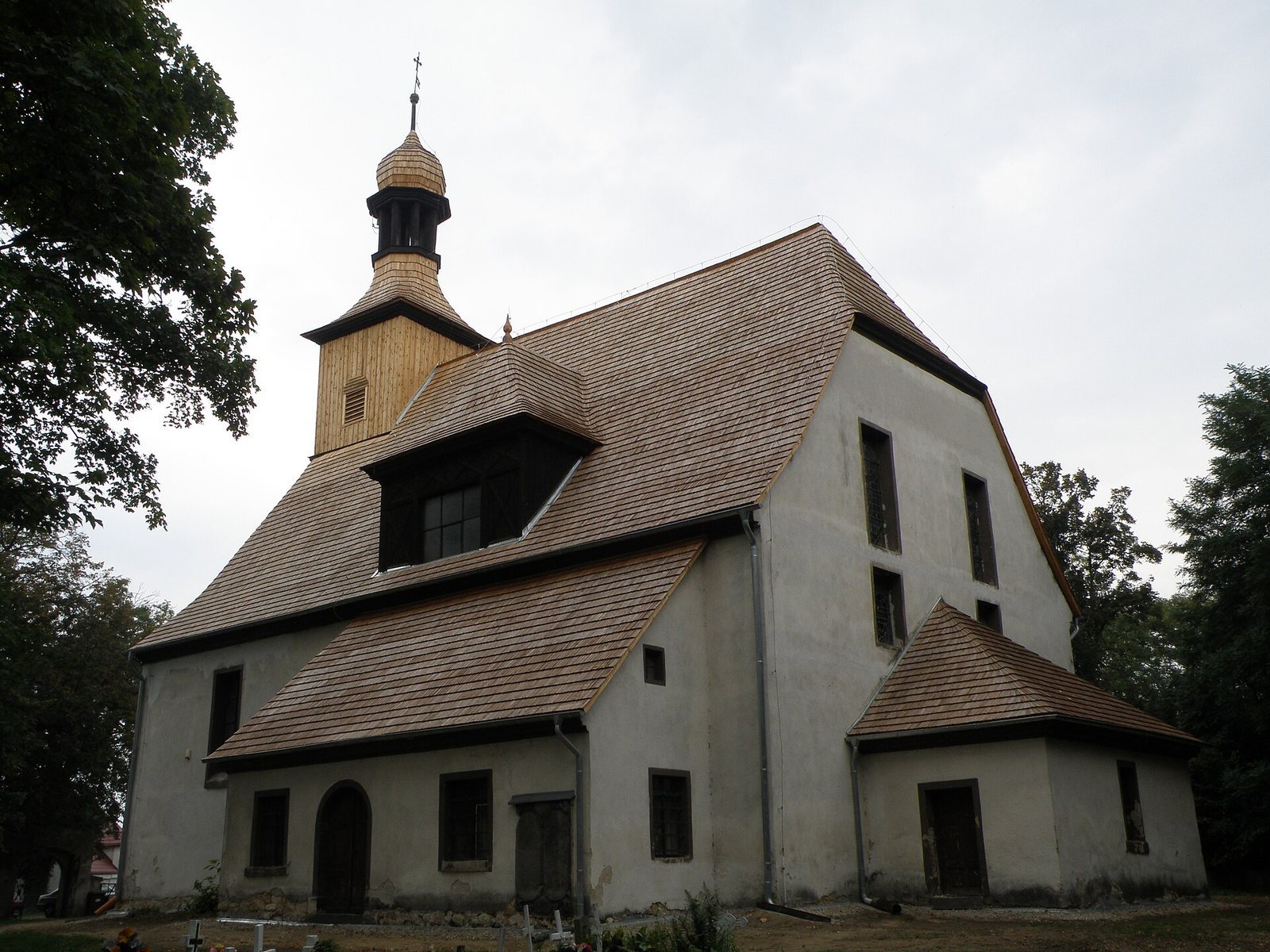
The church is a brick-and-wood building with one main worship space and a three-sided eastern end. Its Baroque interior has two levels of galleries. The roof and surviving fittings reflect rebuilding and additions made over several centuries.
Exterior and memorials
Main structure
The church has a roof whose ends slope partly down toward the walls, along with dormer windows projecting from the roof. Lower portions of the earlier building may have been retained when the church was rebuilt and enlarged in 1714.
Tower and bell turret
The church has one tower, repaired in the 1970s and then covered with zinc sheet. A separate wooden bell turret rises above the roof ridge, capped by an openwork Baroque roof. It holds a bronze bell 72 centimetres in diameter, funded by the von Festenberg-Packisch family in 1661. Its Latin inscription begins with Ave Maria, gratia plena, meaning Hail Mary, full of grace.
Tomb slabs
Late Renaissance tomb slabs are set into the lower tower wall and the north façade. They portray Maria Elisabeth von Reibnitz in a high cap and scarf, and two women named Barbara von Festenberg-Packisch. One Barbara, who died in 1656, wears a long dress, hood, and shoulder mantle; the other is shown with an infant. Further slabs depict Georg von Festenberg-Packisch as a bearded knight with a small ruff and sword, and Christoph von Festenberg-Packisch, who died in 1656, in upper-body armor with his hand on a rapier. Another slab shows an unidentified long-haired knight in plate armor.
Interior
Vault and paintings
Broad bands divide the wooden barrel vault, a long curved ceiling, into panels painted with scrolling plant designs. Baroque paintings from 1714 decorate the vault and galleries. Their subjects include Moses on Mount Sinai, the Holy Trinity, the Baptism of Christ, the Last Supper, and an allegorical scene.
Furnishings and sculpture
Eighteenth-century furnishings include a Baroque altar and confessional, painted benches, and a baptismal font. A fifteenth-century folk-style Pietà, an image of Mary mourning the dead Christ, once stood on the main altar. The painted sculpture probably came from one of the earlier buildings and was stolen.
Organ
The organ was made in 1907 by the organ-building firm Schlag & Söhne. It is in poor technical condition.