Chiesa di San Vincenzo Martire: A Neo-Romanesque Parish Church in Italy
Site at a Glance
- Popularity
- Very Low
- Country
- Italy
- Primary era
- Early Modern
- Eras represented
- Early Modern, Modern
- Civilizations
- Unclassified
- Site type
- Religious
- Remains
- Church
On this page12 sections
History
Chiesa di San Vincenzo Martire is a Roman Catholic parish church in Italy, descended from a medieval chapel at La Bricola. The present church was built in the seventeenth century and later reshaped in the Neo-Romanesque style, a revival of forms associated with medieval Romanesque buildings.
Medieval chapel and parish
The chapel of Urzano first appears in a surviving record from 1230, when it was listed among the dependencies of the parish church of Sasso. Documents also mention it in 1299 and 1354. Its dedication to Saint Vincent the Martyr, an early Christian deacon and martyr who became widely venerated, is first recorded in 1494. In 1564, the church became an independent parish. It belongs to the Diocese of Parma and the Mountain Pastoral Zone.
Seventeenth-century rebuilding
By 1650, the medieval church had fallen into serious disrepair, and local inhabitants resolved to replace it. They initially disagreed about where to build. In 1656, Bishop of Parma Carlo Nembrini directed that the new church should occupy a central position. Construction began on 31 January on land owned by Gabriele de la Nive. The church was completed in 1661, and its bell tower followed in 1663.
Twentieth-century changes and restoration
A comprehensive renovation began in 1925 and gave the church its Neo-Romanesque character. The sacristy was rebuilt in 1930. In 1935, workers extended and raised the nave and rebuilt the facade. The interior floor was renewed around 1950, a new baptismal font was installed in 1960, and painter Ragazzini decorated the interior in 1979. After the 2008 earthquake, structural reinforcement and restoration took place from 2012 to 2017.
Remains
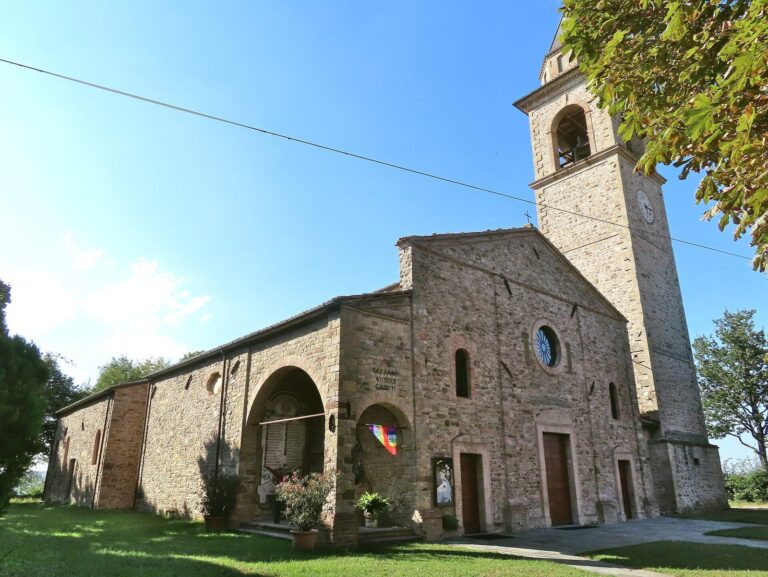
The church has a single nave, with one chapel projecting from each side, an entrance facing south, and a presbytery, the area around the main altar, at the north end. Its exterior combines a brick-faced front with stone side walls, while the interior includes a timber roof structure and vaulted ceilings.
Exterior
Facade
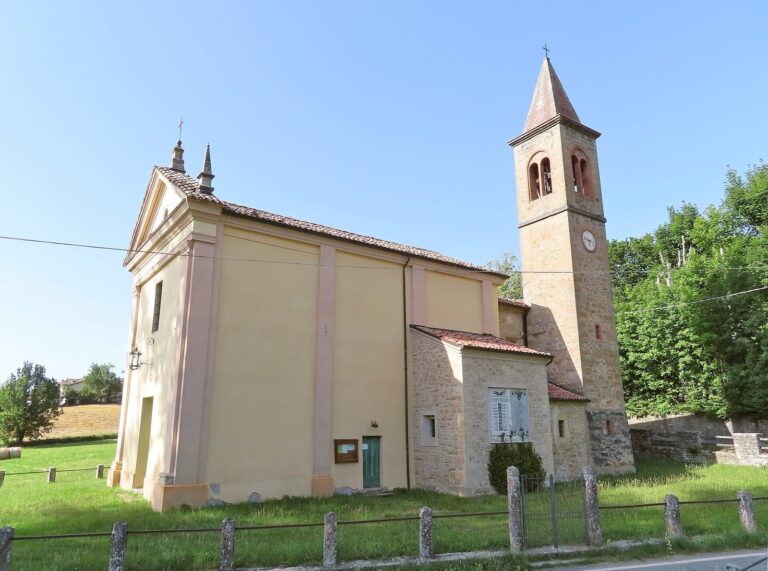
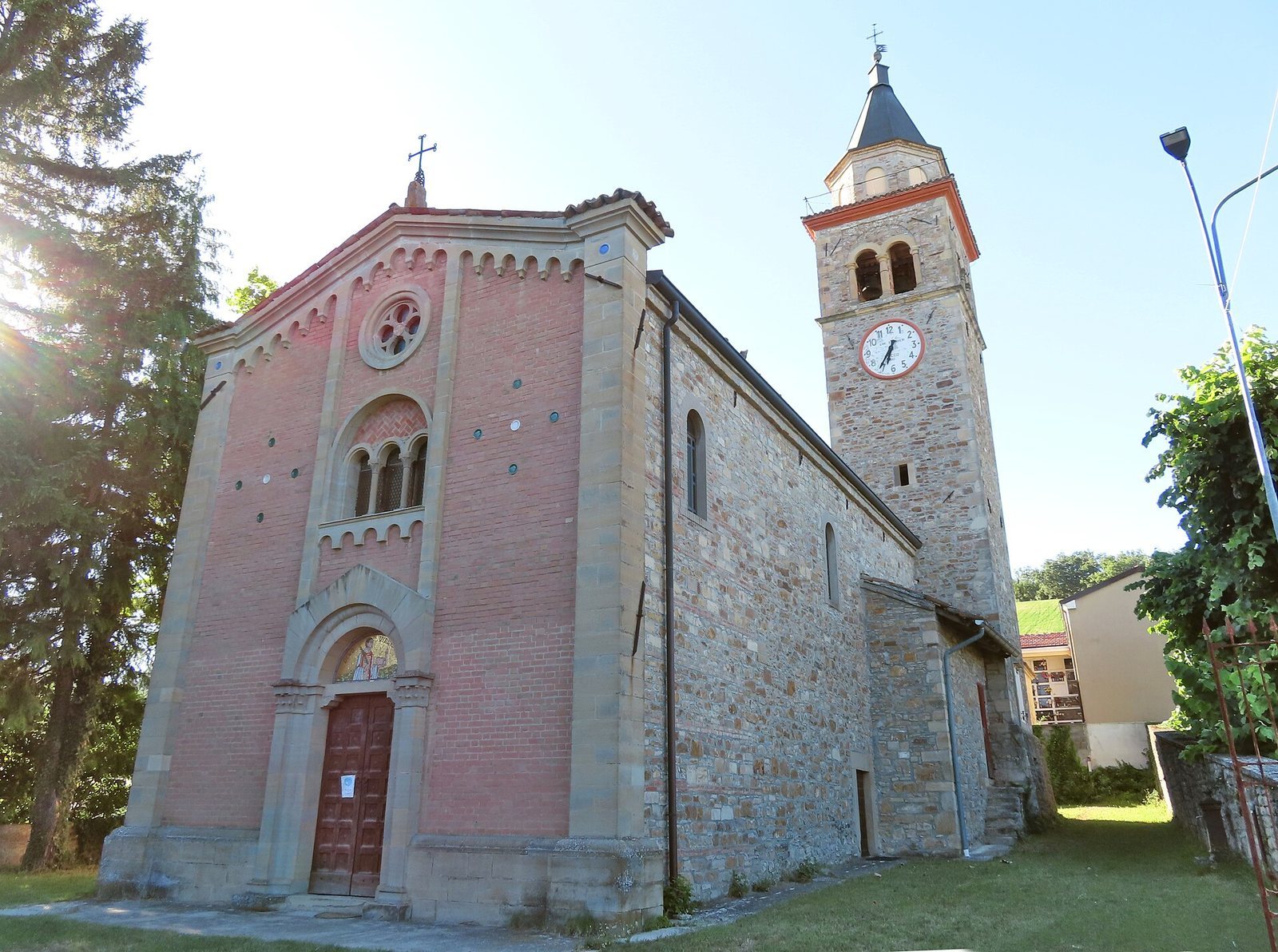
The symmetrical facade rises to a gable and is faced with brick. Two sandstone pilasters frame it, while a broad entrance with outward-splayed sides is bordered by a pair of stone pilasters. Above the doorway, a round-arched recess contains a mosaic of Saint Vincent the Martyr. Higher up, a window divided into three openings by small columns sits below a circular rose window. Small arches form a decorative band along the roof slopes.
Side elevations and bell tower
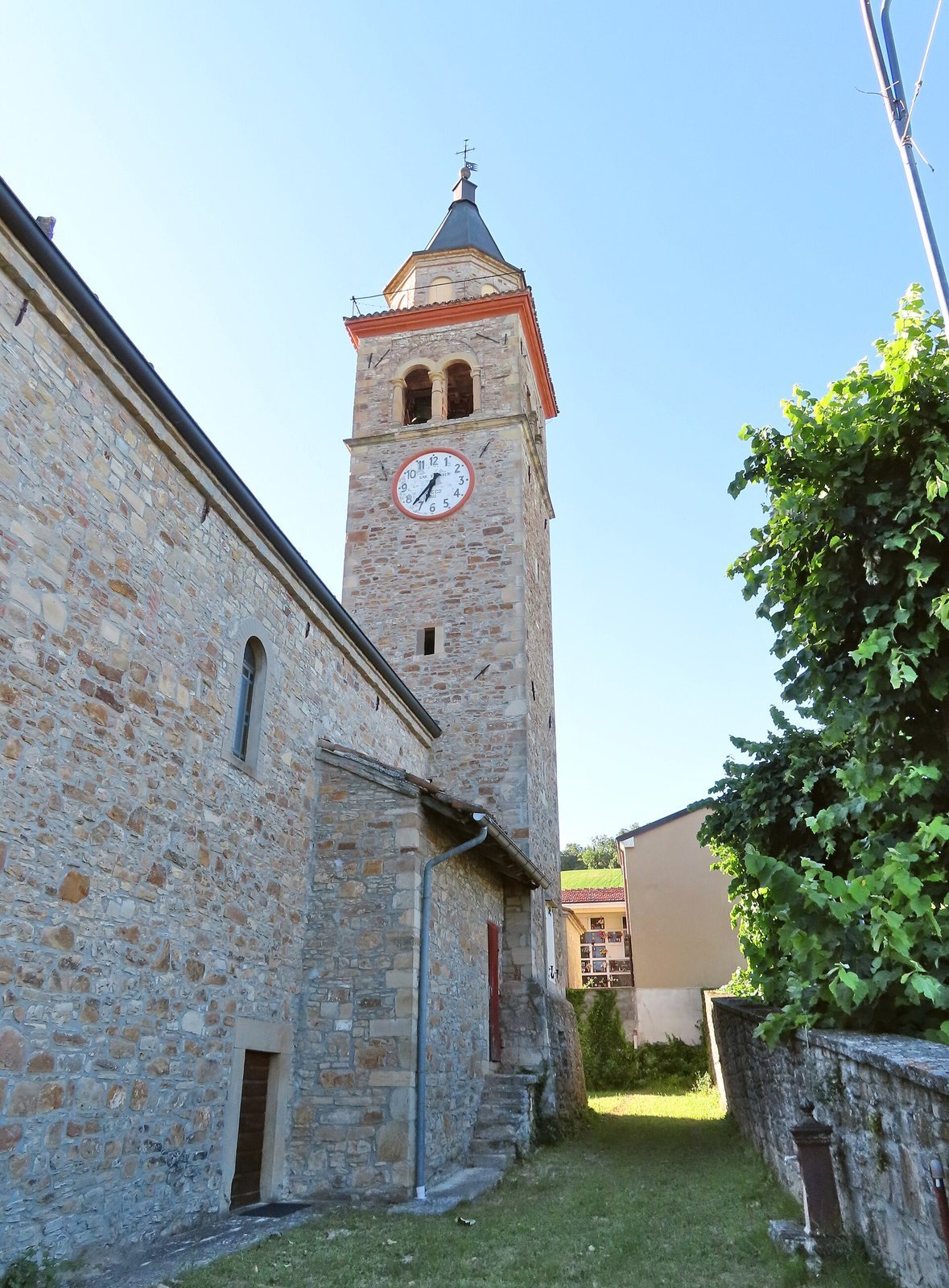
The side walls are faced entirely with stone, and the lower side chapels project from them. At the rear of the right side stands the tall bell tower. Its bell chamber has broad paired openings on each of its four sides, divided by columns. An octagonal upper structure, or lantern, supports a copper spire.
Interior
Nave and chapels
The nave has a ceiling supported by timber trusses. The two spacious side chapels open through rounded arches and have curved, barrel-shaped ceilings.
Presbytery
The slightly raised presbytery is reached beneath a large arch flanked by two niches. Its ceiling is also barrel-shaped. Behind the altar, a richly carved, gilded frame holds an altarpiece dated 1661, showing the Birth of the Virgin, Saint Vincent, and a bishop saint. A smaller sixteenth-century painting of the Nativity of Jesus hangs above it.
Altars and artworks
The wooden main altar, made between 1970 and 1980, is arranged as a table and incorporates pieces from an eighteenth-century gilded papier-mache altar. The church also contains fourteen Stations of the Cross painted by Paolo Ferrari in 1776, along with eight oil paintings of the apostles John the Evangelist, James the Less, James the Greater, Thomas, Andrew, Philip, Simon, and Peter.
Other works include an eighteenth-century Madonna and Child, a painted seventeenth-century tabernacle, and a seventeenth-century brass processional cross. A sixteenth-century pax, a liturgical object used during the exchange of peace in worship, is made of embossed, silvered copper.