Basilica of St. Nicholas of Bari: A Medieval Parish Church in Taormina
Site at a Glance
- Popularity
- High
- Country
- Italy
- Primary era
- Medieval
- Eras represented
- Medieval, Early Modern
- Civilizations
- Crown of Aragon, Kingdom of Sicily, Spanish
- Site type
- Religious
- Remains
- Basilica
On this page16 sections
History
The Basilica of St. Nicholas of Bari is a Roman Catholic parish church in Taormina, Italy, within the Archdiocese of Messina-Lipari-Santa Lucia del Mela. Built in the thirteenth century under Hohenstaufen rule in Sicily, it replaced an earlier church dedicated to St. Nicholas. The church became a focus of civic and religious life around medieval Piazza Duomo.
Medieval church and Taormina’s diocese
Taormina’s earliest known cathedral was the Church of St. Francis of Paola. Bishop Procopio was killed by the Arab Ibrahim, while repeated attacks by Saracen forces and restrictions on Christian worship prompted the transfer of the episcopal seat inland to Troina. Taormina’s diocese was eventually suppressed. After the Hauteville-led Norman conquest, the town lost its bishop’s seat. In 1078, its diocese was absorbed into that of Troina. Count Roger I favored Troina, which within a few years became part of the new Diocese of Messina. Its seat was the restored Cathedral of St. Nicholas in Messina.
Additions and civic life
The church received additions in the fifteenth and early sixteenth centuries, including Renaissance-style portals. In the seventeenth century, work gave the main entrance a Baroque treatment and added marble altar tables along the walls. The town’s jurats, or municipal magistrates, remodeled the main portal in 1636.
Restoration and recognition
The main portal was restored in 1936. Following the bombing of 9 July 1943, a statue of St. Agatha was brought to the basilica from the destroyed Church of St. Agatha at the Dominican convent. From 1945 to 1948, architect Armando Dillon led restoration work that revealed the original apse arcades beneath Baroque stucco and reinstated terrace roofs over the side aisles. On 6 February 1980, Pope John Paul II granted the church the title of minor basilica, a papal distinction that does not make it a cathedral or a diocesan seat.
Remains
Plan and exterior
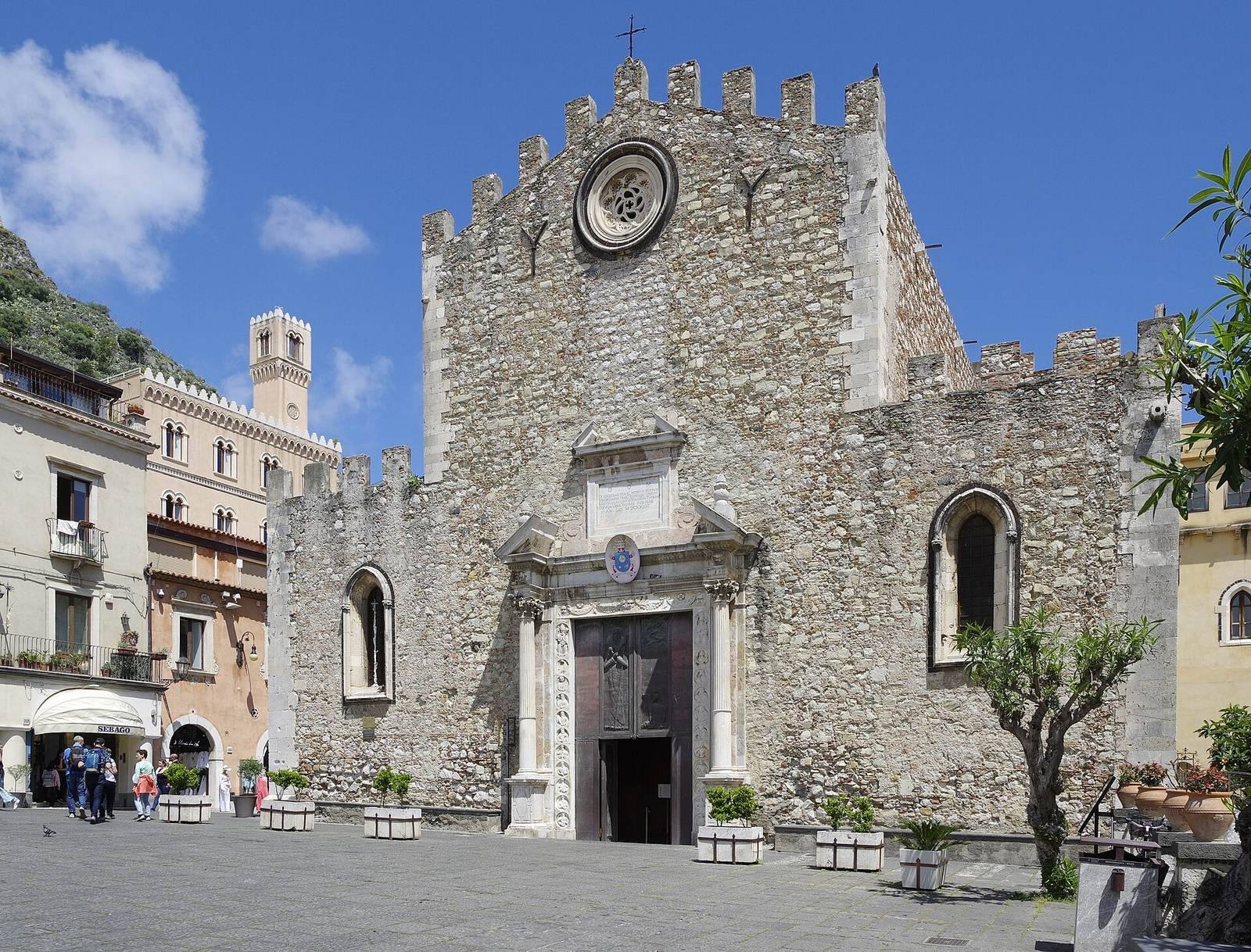
Standing in Piazza Duomo along Corso Umberto, near Porta Catania, the basilica has a Latin-cross plan. Its main nave is flanked by two side aisles, while a projecting transept (the crossarm of a church) ends in three apses (projecting spaces at the ends). Battlements crown the facade, and a tower resembling a defensive bastion rises at the rear; bells were installed there in 1750. The exterior’s defensive character has earned the church the nickname “fortress cathedral.” A large Gothic-inspired rose window crowns the facade, and two more stone rose windows, made from Syracuse stone, occupy the east and west sides, aligned with the transept walls.
Portals
Main portal
The central entrance lies between two fifteenth-century lancet windows, narrow openings with pointed arches. Its architectural frame has fluted Corinthian columns on raised bases, a horizontal architrave above the columns, and a broken pediment. A second pediment frames the dedicatory plaque, while carved angel faces appear above the column capitals. The fifteenth-century marble Renaissance portal is attributed to the Gaginesque tradition, the sculptural style associated with the Gagini family in Sicily. Eleven figures appear on each side, including full-length statues of St. Nicholas and St. Pancras, busts of St. Peter, St. Paul, and King David, and the four Evangelists with their symbols, alongside other apostles and prophets. A garland frieze and a carved child’s head decorate the architrave.
West portal
Opposite the fifteenth-century Palazzo dei Giurati, the west portal is a late Gothic work edged in black lava. Its reliefs include Christian grape-cluster imagery. On the Taormina-stone lintel, Christ Pantocrator, an image of Christ as ruler of all, appears between St. Peter and St. Paul. Trilobed arches decorate the pointed arch above.
East portal
The east portal, in the eastern side of the church, dates to the sixteenth century and reflects Sicilian Gothic work from the first half of that century. Its pointed arch has multiple lobes, and its side jambs are richly molded.
Interior
Nave and entrance area
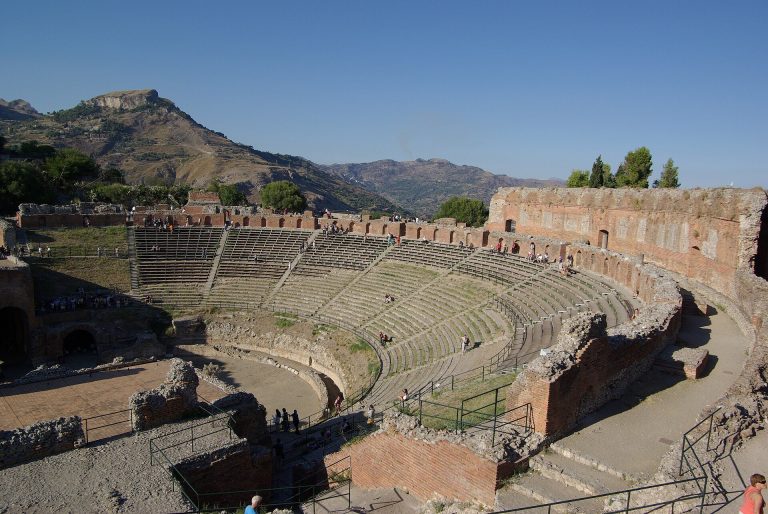
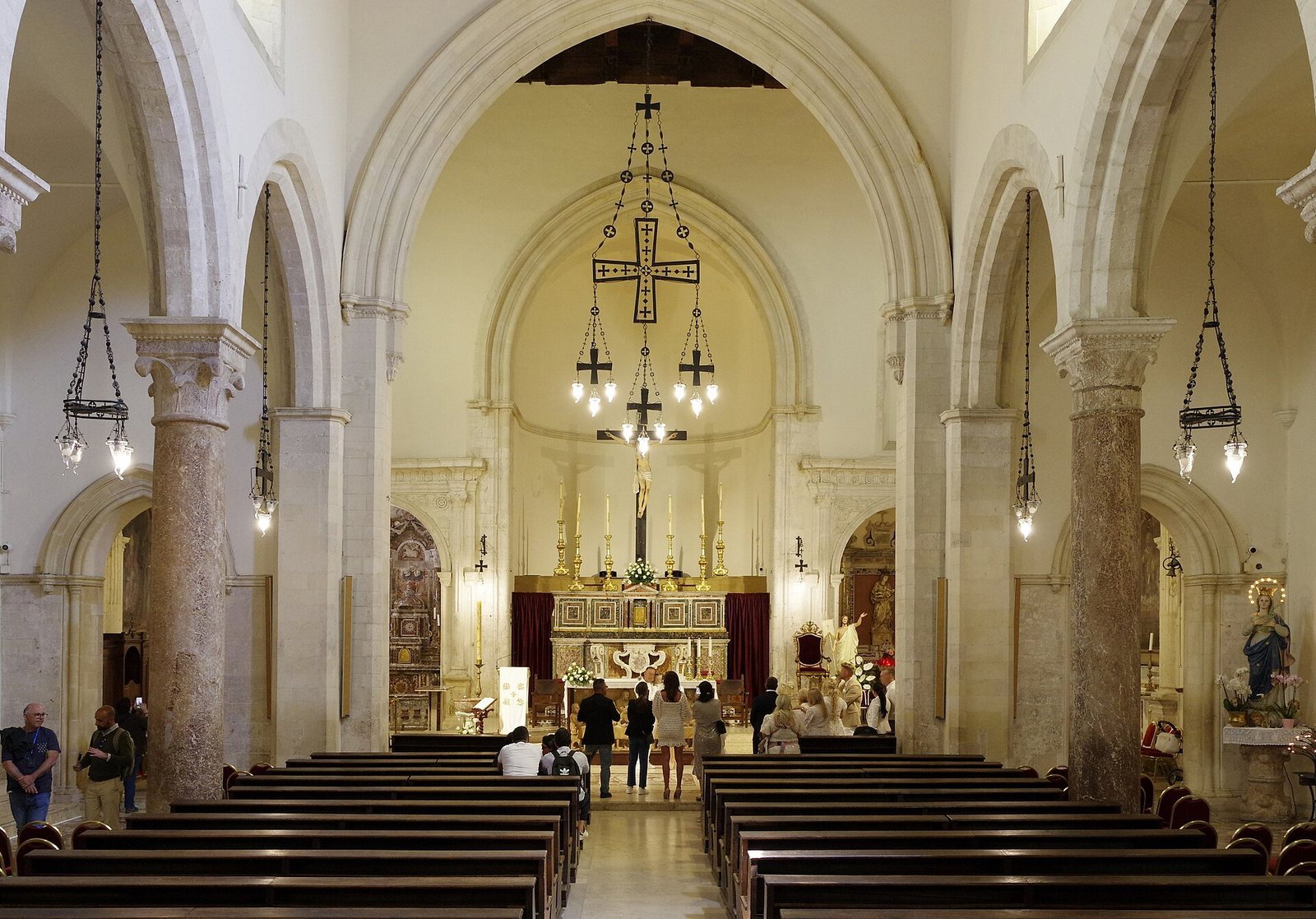
Six pink columns of Taormina marble support the nave. Their capitals carry leaf and fish-scale patterns and are described as Gothic in workmanship; they are thought to have come from Taormina’s ancient theatre. Large wooden beams cross the ceiling, resting on carved brackets with Arab motifs rendered in a Gothic manner. The inner face of the facade contains mausoleums for Antonio San Martino De Spuches, Prince of Pardo and Duke of Santo Stefano, who died in 1868, and Leonardo Sgroi Camiola Paternò Castello Faraone, who lived from 1850 to 1875. A thirteenth-century marble holy-water stoup nearby has a shaft, carved top, and basin.
Right aisle
The first bay holds an altar dedicated to the Visitation and a Renaissance painting of the Visitation with St. Gregory and St. Zechariah. Antonino Giuffrè painted it in 1457, and it came from the Church of Varò. A baptismal font of red-veined marble stands nearby. In the second bay, a six-panel altarpiece by Antonello de Saliba, dated 1504, sits in an inlaid wooden frame behind the altar. The frame is attributed either to his brother Pietro or to his father Giovanni. The central panel shows the Virgin and Child between St. Jerome and St. Sebastian; above it is the Deposition between St. Agatha and St. Lucy. Five small scenes of the Last Supper form the lower panel. The work came from the former Church of St. Sebastian, now the former Church of St. Augustine.
The third bay contains the Altar of the Virgin and a wooden painting of the Madonna described as “not made by human hand,” decorated with silver motifs. Once venerated at the Church of the Virgin Assumed into Heaven, destroyed during the Arab period, the painting was later kept for a long period at Santa Maria dei Greci, also called the Church of Our Lady of Mount Carmel, and its Carmelite convent. A dedication and prayer beside the image gives thanks to the Virgin for Taormina’s survival of the Val di Noto earthquake in January 1693. A statue of the Virgin stands by the side entrance in the fourth bay.
Left aisle
The first bay contains a sixteenth-century Renaissance painting of the Madonna and Child by Alfonso Franco. St. John the Baptist and St. Elijah of Enna appear beside Mary, while a crescent-shaped panel above shows the Crucifixion. A bust of St. Pio of Pietrelcina is also in the aisle. In the second bay, the Altar of St. Agatha stands beside a sixteenth-century marble statue of the saint, attributed to Martino Montanini and commissioned by the Corvaja family. The family’s banded coat of arms appears on the statue’s base; the same arms are found at Palazzo Corvaja and over the entrance to Palazzo Ciampoli. The bay also contains the burial of Marianna Bottari Cartella.
The third bay holds a thirteenth-century painting of the Adoration of the Magi and a holy-water stoup made from red Taormina marble. A side entrance occupies the fourth bay.
Right transept
The apse at the right end of the transept contains the Chapel of the Madonna delle Grazie. Its altar has columns, an architrave, spiral-scroll forms, and an intermediate plaque. Reconstructed in 1747, it incorporates Gothic elements from a chapel demolished at the Church of St. Peter. The Madonna statue, commissioned by the Grugno family, has richly detailed clothing and gently modeled expressions. The family, originally from Catalonia, came to Sicily in 1347; its coat of arms, three boar heads, appears on either side of the statue’s base. On the chapel’s right wall, a small Renaissance shrine holds the face of the Dead Christ. A crucifix hangs high on the wall, and a figure of the Risen Christ stands on a pedestal in a corner. A tabernacle associated with the Gagini tradition is set into the left wall.
In the right arm of the transept, the Altar of St. Nicholas has a painting of the saint by Garofalo, dated 1653. The east portal is also in this arm.
Left transept
The apse at the left end of the transept contains the late-seventeenth-century Baroque Chapel of the Blessed Sacrament, with columns whose capitals turn into spiral forms. A sarcophagus is associated with the chapel. In the left arm, the Altar of St. Pancras stands alongside the west portal and a monument to Canon Giovanni Battista Marziani.