Church of the Dormition of the Theotokos in Mogiltsy: An Orthodox Parish Church in Moscow
Site at a Glance
- Popularity
- Medium
- Country
- Russia
- Primary era
- Modern
- Eras represented
- Early Modern, Modern
- Civilizations
- Russian
- Site type
- Religious
- Remains
- Church
On this page8 sections
History
Early church and uncertain beginnings
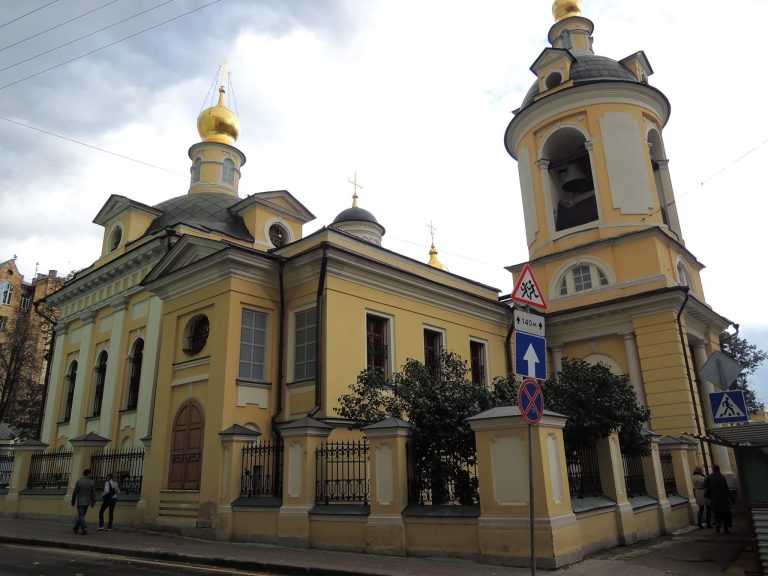
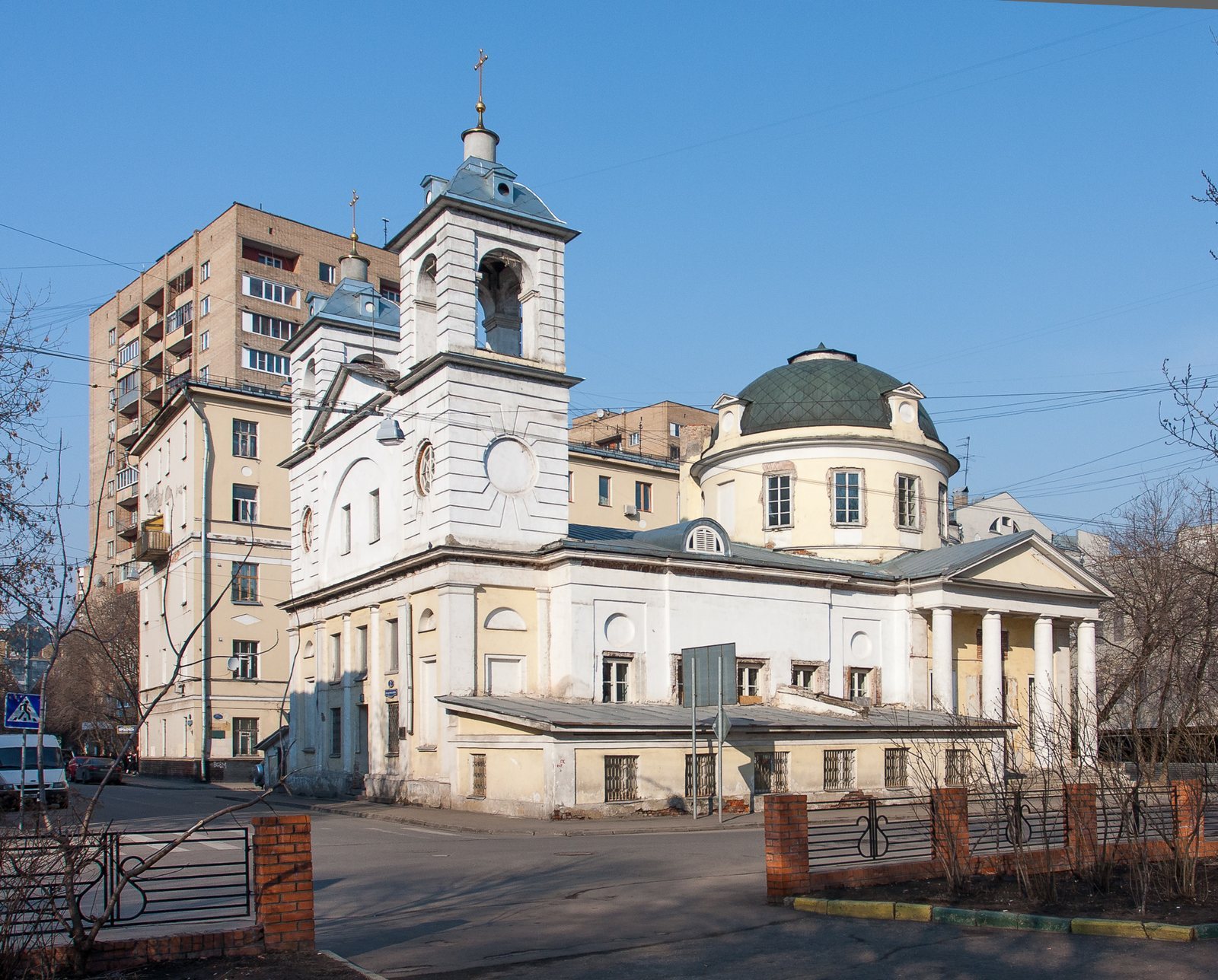
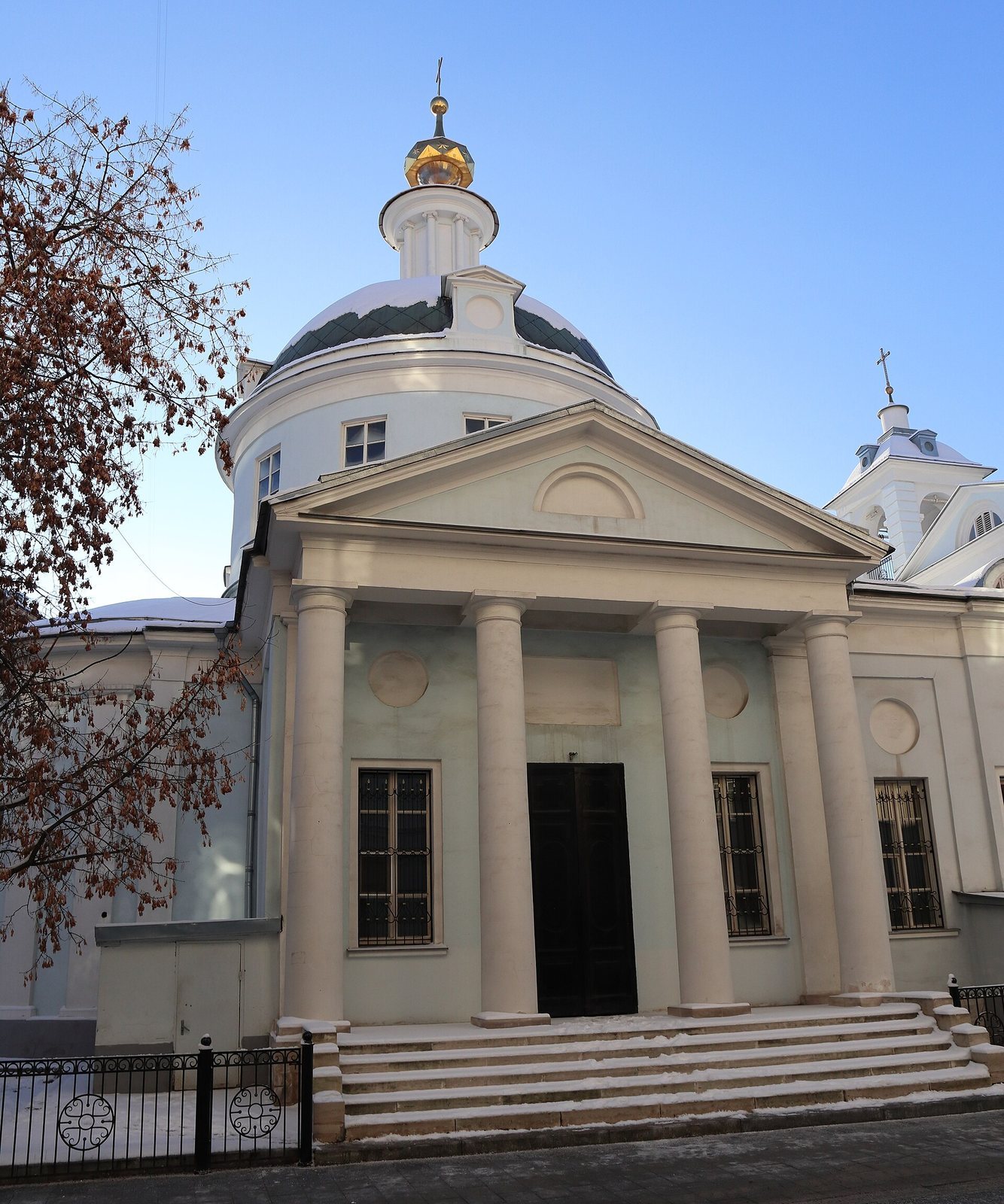
The Church of the Dormition of the Theotokos in Mogiltsy is an Eastern Orthodox parish church in Moscow, Russia. The Dormition is the Orthodox commemoration of Mary’s death and assumption. The present brick church, designed by Nicolas Legrand in the Moscow Classicist style, was begun in the late eighteenth century and completed in 1806.
The church is known from the fourteenth century, although the first specific reference to a wooden church there dates to 1560. Its early building history remains uncertain. One date given for its foundation is 1625, while the stone church has been placed either in 1566 or in the reign of Tsar Alexei Mikhailovich, who ruled from 1645 to 1676. A proposal holds that work in 1653 added a bell tower and an entrance vestibule with a side altar, a subsidiary altar within the church, dedicated to St Nicholas to an existing stone building.
The name Mogiltsy is most often linked to the hilly ground where the church was first built. Other explanations connect it with a cemetery or burial mounds. The cemetery theory is considered unlikely because parish churches in Moscow commonly had cemeteries before the eighteenth century. A local story claims that everyone on nearby Prechistensky Lane died during the plague of 1770–1771 while residents of neighboring Clean Lane survived. The lane’s earlier name, Dead Lane, probably came instead from the surname of a local property owner.
Rebuilding and parish life
A side altar dedicated to St Spyridon was added in 1750. The earlier church was dismantled in 1791, and W. Tutomlin funded construction of the present building. It was consecrated in 1806. The church’s dedication gives its principal feast, observed on August 15/28.
An iconostasis, the screen of icons separating the sanctuary from the main worship area, was made in 1861 to a design by architect Grigory Bukin. The building was renovated in 1899. A parishioner established a poorhouse in a neighboring house under the terms of Maria Mukhanova’s will; a kindergarten later occupied the site.
Literary associations and twentieth-century changes
Before the 1917 Revolution, the church’s rector was Archpriest Fyodor Lovtsov, a senior Orthodox priest. In 1918, the parents of Andrei Sakharov, later known as a physicist and public figure, were married there. Leo Tolstoy also placed the church in two novels. In War and Peace, Natasha Rostova and Sonya visit after Maria Dmitrievna Akhrosimova invites them; in Anna Karenina, Levin and Kitty are married there within the story.
The church closed on 12 July 1932, when it was taken from its Orthodox parish for use by the Moscow Installation Directorate of the Ministry of Installation and Special Construction. The conversion substantially changed the interior and damaged original features. After the Soviet Union dissolved, the building did not immediately return to the parish. The local community initially used only the St Nicholas side altar. The whole building became parish property in 2000 and was transferred to the Church on 25 December that year. It was consecrated on 20 May 2001, after which restoration began. The church belongs to the Russian Orthodox Church’s Moscow City Eparchy, or diocese, and Central Deanery, a grouping of local parishes. It is designated a federal-level cultural heritage site in Russia.
Remains
Plan and exterior
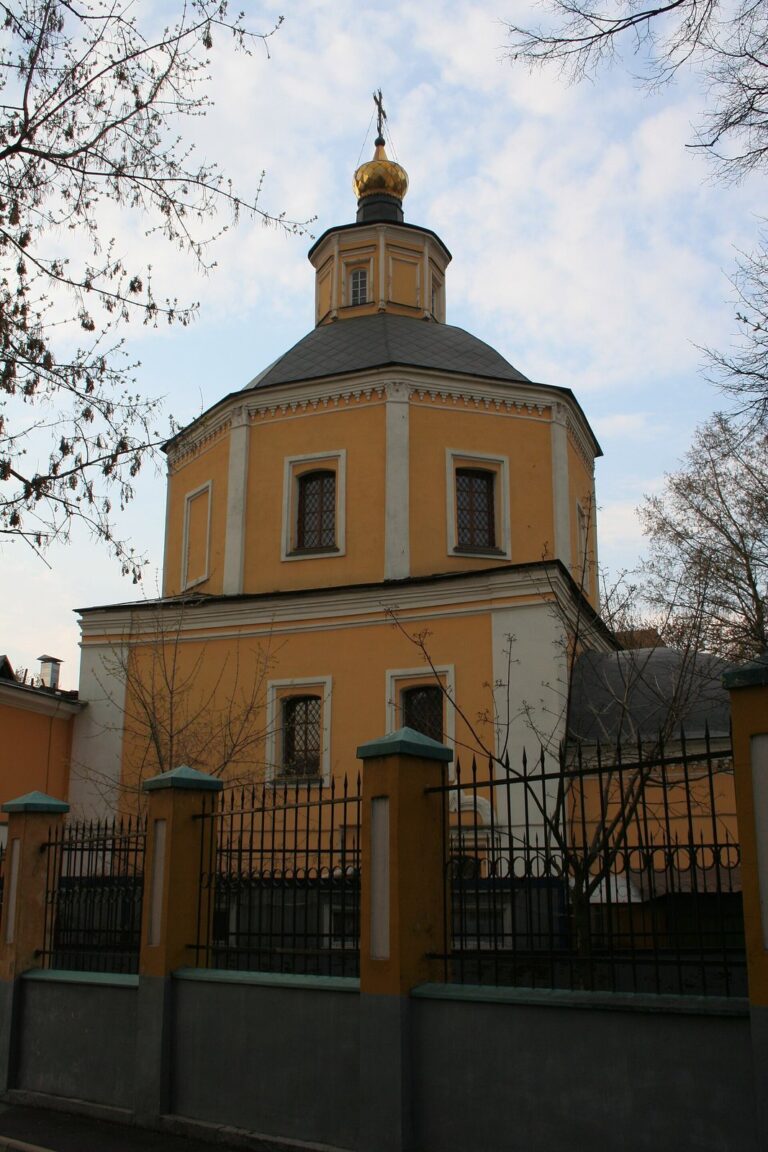
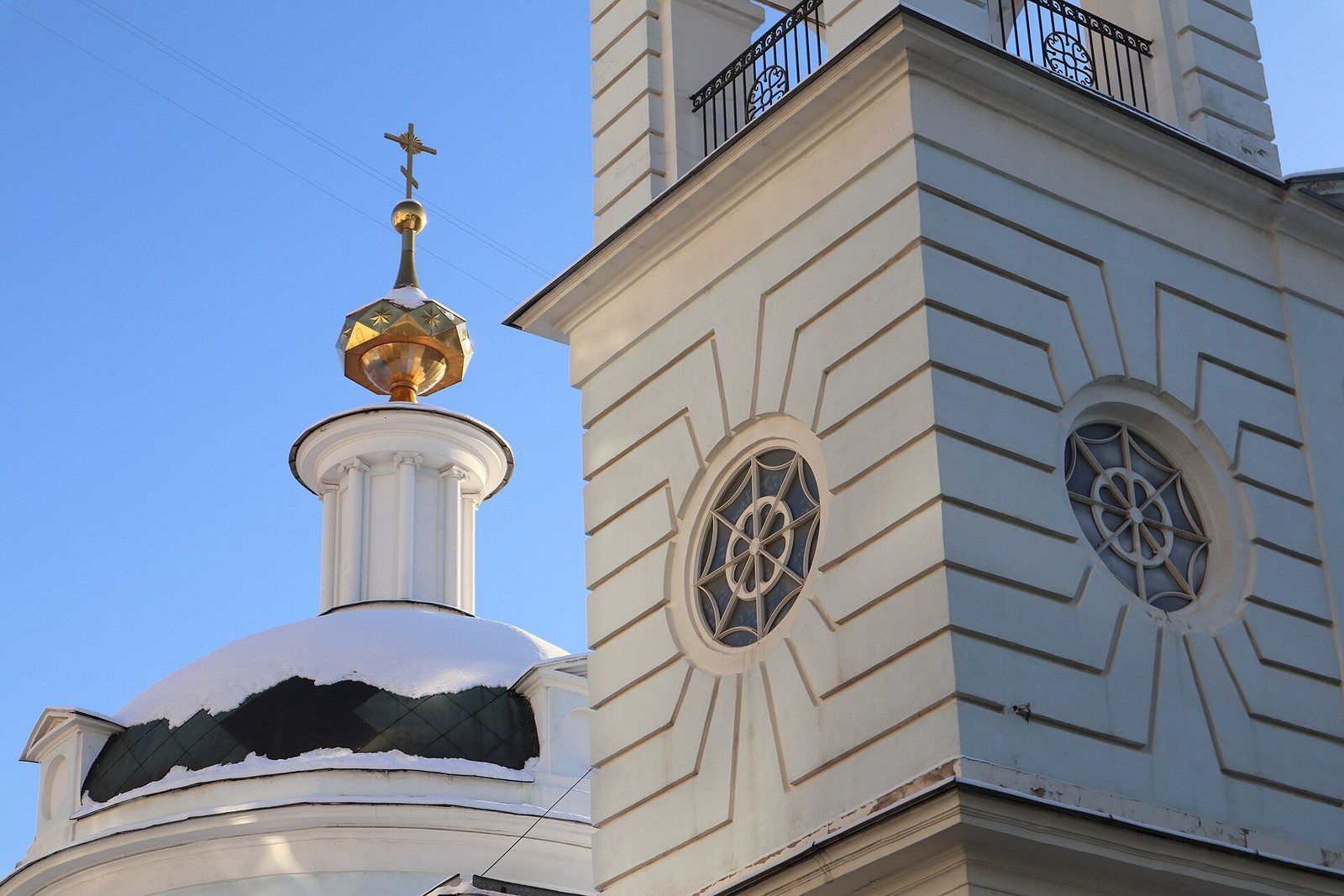
The brick church has a single nave, the main area used by the congregation, one dome, and two bell towers. Its three altars are dedicated to the Dormition of the Theotokos, St Spyridon, and St Nicholas. Four lanes, Bolshoy Vlasyevsky, Bolshoy Mogiltsevsky, Bolshoy Levshinsky, and Prechistensky, surround the building, which has consequently been described as forming a small block.
Alterations and restoration
During the 1932 conversion, the cupolas and their supporting drums, the structures beneath the domes, were removed, and the surrounding fence was demolished. Extensions were added, the colonnade was built over, and two windows were cut into a semicircular niche. Crosses were later placed atop the bell towers. The church’s dome was restored in 2014, and the niche was returned to its original form.
Interior and sacred objects
The church has one iconostasis, made in 1861 to Bukin’s design. Its sacred objects include a copy of the icon of the Mother of God “Unfading Flower” and a reliquary, a container for sacred relics, holding relics of monastic saints associated with the Kyiv Pechersk Monastery. Other icons represent Theophan the Recluse, a Russian Orthodox bishop and spiritual writer; Theodore Ushakov, a naval commander later venerated as righteous; Theodore of Sanaksar, an Orthodox monk; and the Diveyevo monastics Martha, Alexandra, and Elena. These icons contain particles of relics.