Palace in Czerwonka, Sochaczew: A Manor House and Music School
Site at a Glance
- Popularity
- Low
- Country
- Poland
- Primary era
- Modern
- Eras represented
- Modern
- Civilizations
- German, Kingdom of Prussia, Russian
- Site type
- Domestic
- Remains
- Elite Residence
On this page10 sections
History
The Palace in Czerwonka, Sochaczew, Poland, was built around 1800 for the Błeszyński family. Its design was probably by Hilary Szpilowski, though the attribution remains uncertain.
Nineteenth-century ownership
Jan Nepomucen Toczyski, a local administrative official serving as marshal of Błonie County, owned the estate from 1817 to 1823. Augustyn Radwan, commander of a line-infantry regiment of Grand Duke Michael, followed as owner from 1823 to 1843. After Radwan died, his widow married Stanisław Rychłowski, who became the next owner.
In 1855, Kazimierz Aleksander Garbolewski and his wife, Marianna Cotin, bought the estate. Around 1870, a small addition on the south side provided extra living space. Włodzimierz Ignacy Garbolewski was the last owner before the Second World War.
German occupation and wartime command
German forces occupied Czerwonka during the Second World War. Dr. Hans Scheu, the Sochaczew county administrator, lived in the palace. Interior work in 1943 removed furnishings and changed the arrangement of rooms established during the Garbolewski period.
In 1944, the palace became the headquarters of the Warsaw District, an administrative division of German-occupied Poland. General Erich von dem Bach, a senior German military and SS official under the Nazi regime, resided there and commanded German operations against the Warsaw insurgents.
Postwar use
In 1945, the estate was divided into parcels, and communist authorities compelled its heiress, Halina Garbolewska, to leave. The estate became part of Sochaczew in 1946. From 1945 to 1973, the manor and park were used by the Directorate of the Sochaczew Horticultural Technical School.
In 1973, the city assigned the building to the State First- and Second-Level Music School named for Fryderyk Chopin in Sochaczew, which still uses it. The building was enlarged in 1984–1985 to meet the school’s need for more space.
Remains
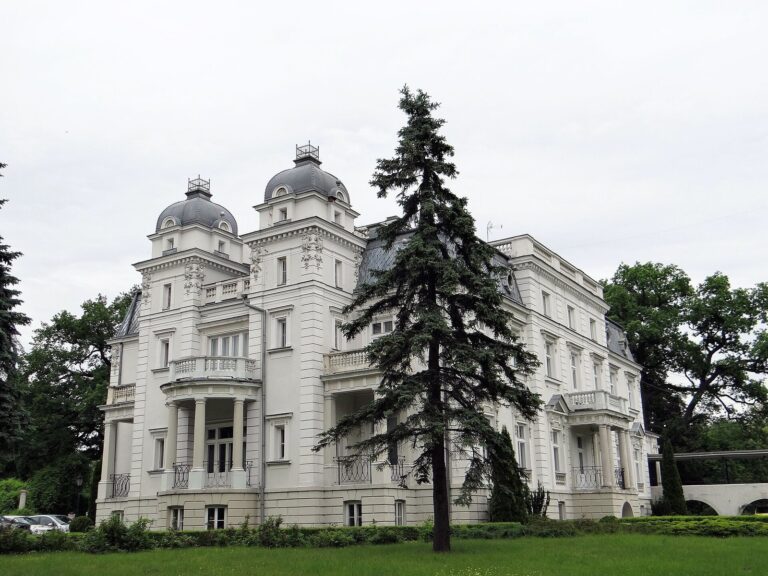
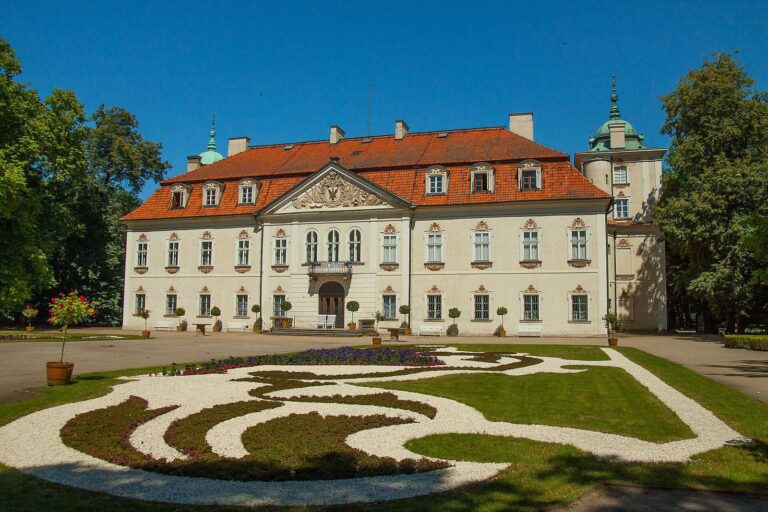
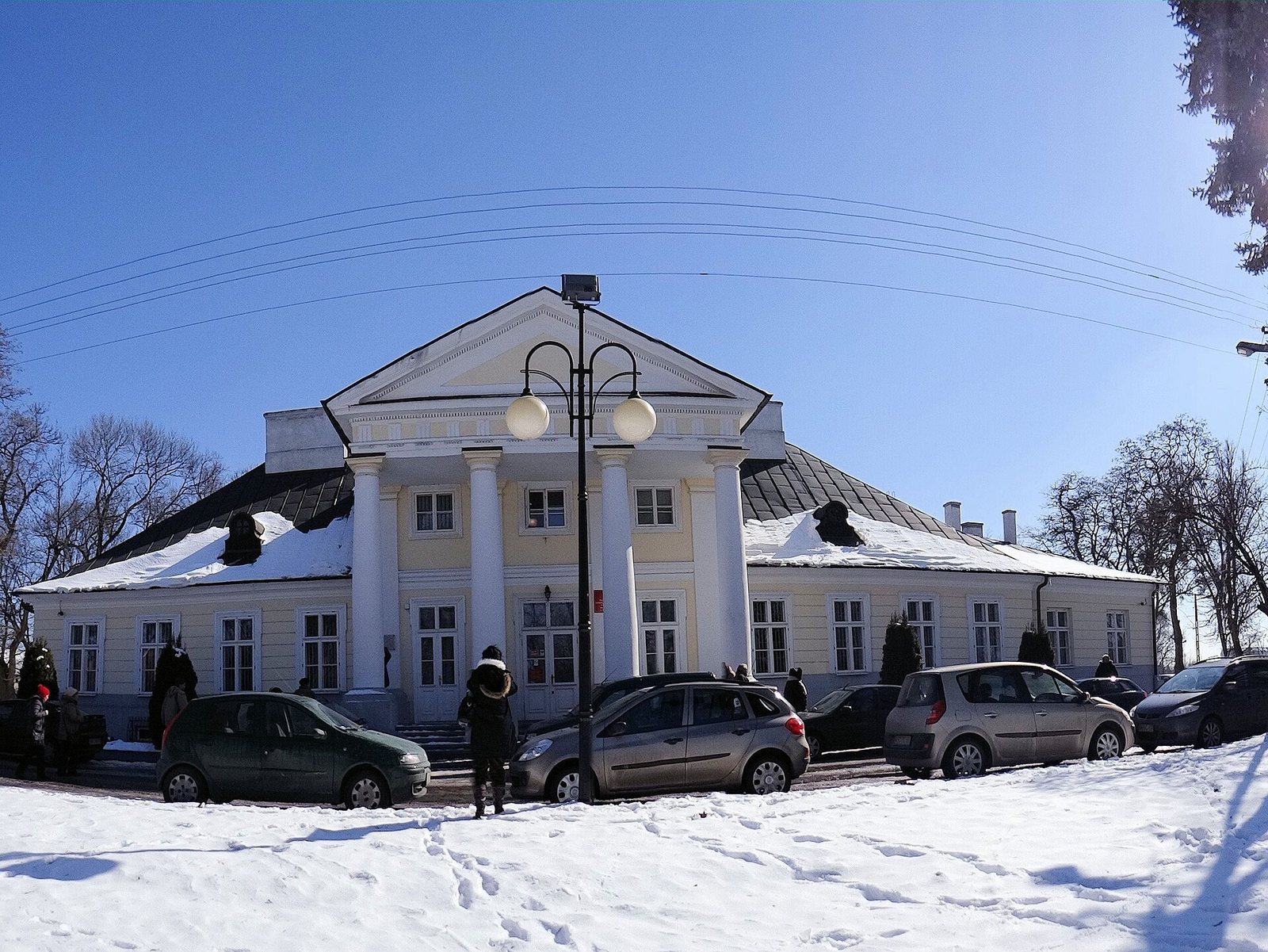
The palace has an elongated rectangular plan and is built of brick beneath a plaster finish. Its main front faces west. The building is mostly one storey, with a taller central section, and its masonry has a rusticated finish, shaped to emphasize rough surfaces and joints.
The palace
Exterior
The west-facing front has eleven window divisions and a central section that projects outward across three divisions and rises two storeys. In front of it, four columns span both floors in a giant order. They support a horizontal entablature, the structure resting above columns, with a decorative band of grooved triglyph blocks and a triangular pediment. Moulded surrounds frame the windows, while rustication covers the ground floor. The rear elevation has nine window divisions and a modified terrace. A southern addition, entered from the front, extends the frontage by two windows. The roof slopes on all sides and has projecting dormers.
Interior
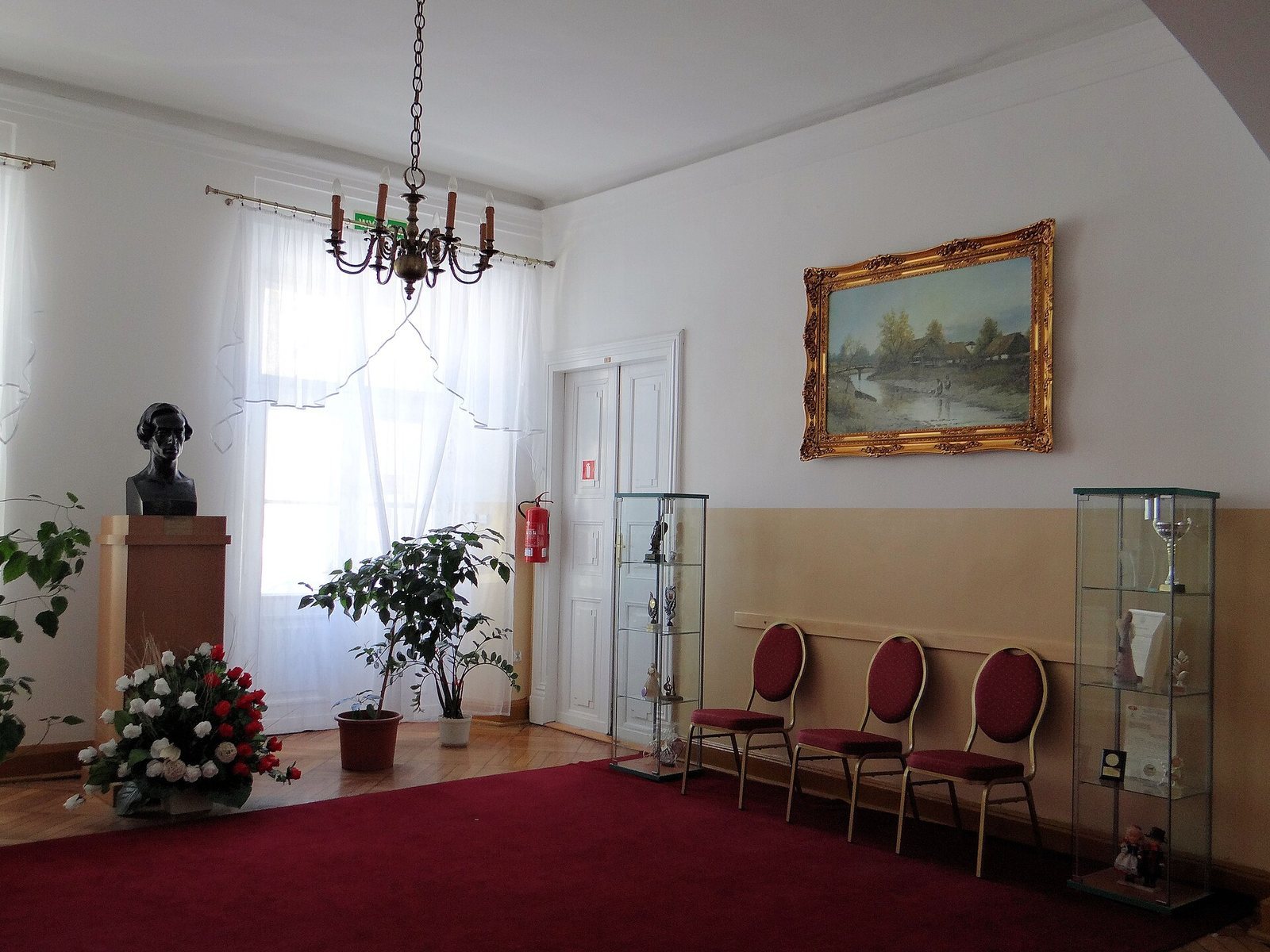
The original rooms were arranged in two parallel bands along a central corridor, with an entrance hall on the building’s central axis. Fragments of a classical sandstone fireplace from the first half of the nineteenth century remain in the room to the right of the entrance hall. Pairs of small Ionic columns, a classical column form, frame the fragments. The interior also retains a nineteenth-century tiled stove and sections of moulded cornice along parts of some walls.
Music-school extension
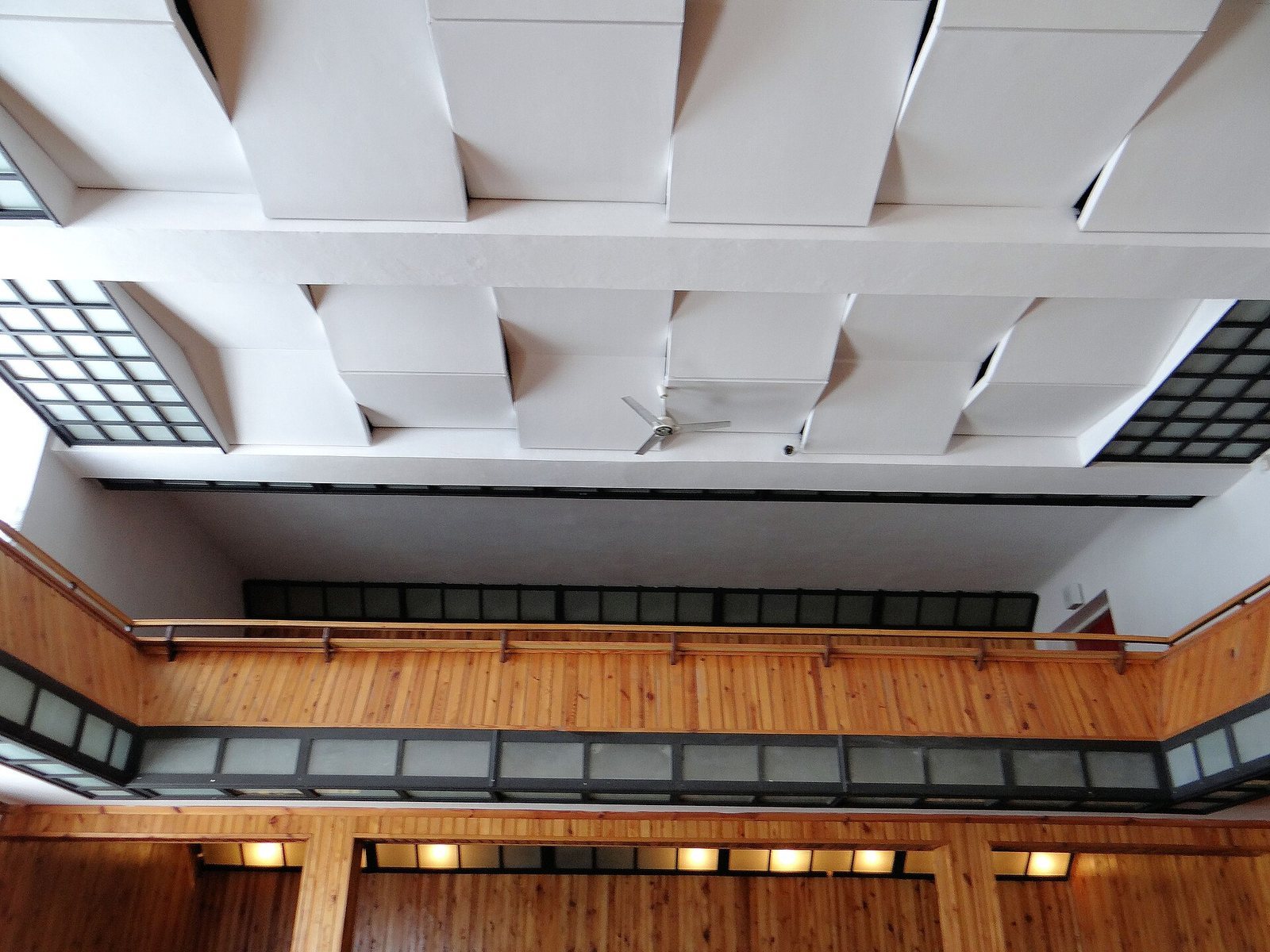
A long, single-storey connector runs southeast from the palace to a spacious concert hall that rises two storeys.
Landscape park
The three-hectare landscape park around the palace dates to the mid-nineteenth century and takes its name from the estate’s last owner. A pond lies in its southern section. A 2018 renewal restored historic paths and a circular ornamental flowerbed. An outdoor stage occupies the site of a former manor outbuilding, and a music garden contains outdoor instruments.