Nový Hrádek: A Gothic Castle Ruin in Czechia


Site at a Glance
- Rating
- 4.7
- Popularity
- Low
- Country
- Czechia
- Primary era
- Medieval
- External website
- Open
- Eras represented
- Medieval, Modern
- Civilizations
- Holy Roman Empire, Margraviate of Moravia
- Site type
- Military
- Remains
- Castle
On this page9 sections
History
Nový Hrádek is a medieval Gothic castle ruin in Czechia near Lukov, founded in 1358 by Jan Henry of Luxembourg, the Moravian margrave and younger brother of Emperor Charles IV. The castle began as the lower part of a larger fortified complex and was built at a narrow point in a bend of the Dyje River.
Foundation and Medieval Expansion
Jan Henry’s son, Jošt of Luxembourg, later margrave of Moravia, transferred the castle in 1403 to his supporter Přech of Kojetice. In 1418, the Austrian nobleman Oswald of Eytzing acquired it. The Eitzinger family also held Kaja Castle on the opposite bank of the Dyje.
During the fifteenth century, the castle grew through several building stages. A second, upper section was added above the older lower castle, and by the beginning of the sixteenth century the complex had reached its present extent. The two parts remained distinct, with separate courtyards and identifiable upper and lower castles.
Changing Ownership and Destruction
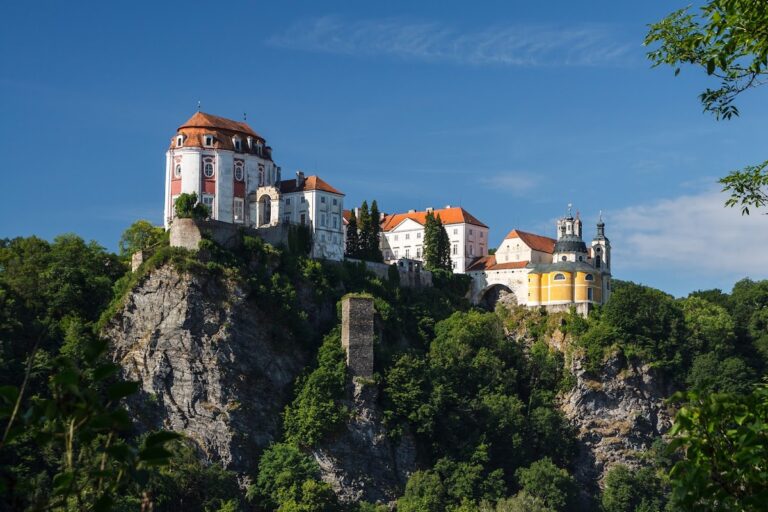
Ownership passed during the sixteenth century among the Lords of Kunštát, the Krajíř family of Krajk, the Dietrichsteins, the Tetour family of Tetov, the Čertorejský family of Čertorej, and the Štreyn family of Schwarzenau. From the seventeenth century, the Althann family held Nový Hrádek for a long period. The Althanns also owned nearby Vranov Castle.
In 1517, Michael of Eincingen sold the Neuhäusel estate, together with the deserted Schenkenberg Castle, to Adam of Batschkowitz of Joslowitz. Near the end of the Thirty Years’ War, a major European conflict that lasted from 1618 to 1648, Swedish troops commanded by General Torstenson captured and destroyed Nový Hrádek, probably in 1645. The castle then ceased to serve as a residential seat and was used mainly for storage.
The upper castle was later repaired as a hunting lodge and summer residence, while the lower castle continued as a ruin. At the beginning of the nineteenth century, the new owners, the Mnizskys and Stadnickys, adapted several rooms for habitation. They also converted agricultural buildings in the courtyard into a forester’s lodge.
Modern Use and Protection
During the First Czechoslovak Republic, the Czech Tourist Club used the castle, opened it to visitors, and established a hostel with twenty beds. A memorial plaque beside the entrance commemorates Znojmo scouts, for whom Nový Hrádek became a meeting place during that period.
Following confiscation in 1920, the castle became state property. After 1948, it stood within a strictly guarded border zone and was closed to visitors. The ruin deteriorated during this period, including the former forester’s flat and tourist hostel. Nový Hrádek reopened in 1992 after the end of the former border regime.
The Czech Republic now owns the castle, which is administered by the National Heritage Institute. Nový Hrádek has been protected as a cultural monument since 1973 and as a national cultural monument since 2001, a Czech heritage designation for sites considered of exceptional national importance. It lies within Podyjí National Park and forms part of the heritage complex associated with Vranov nad Dyjí Castle.
Remains
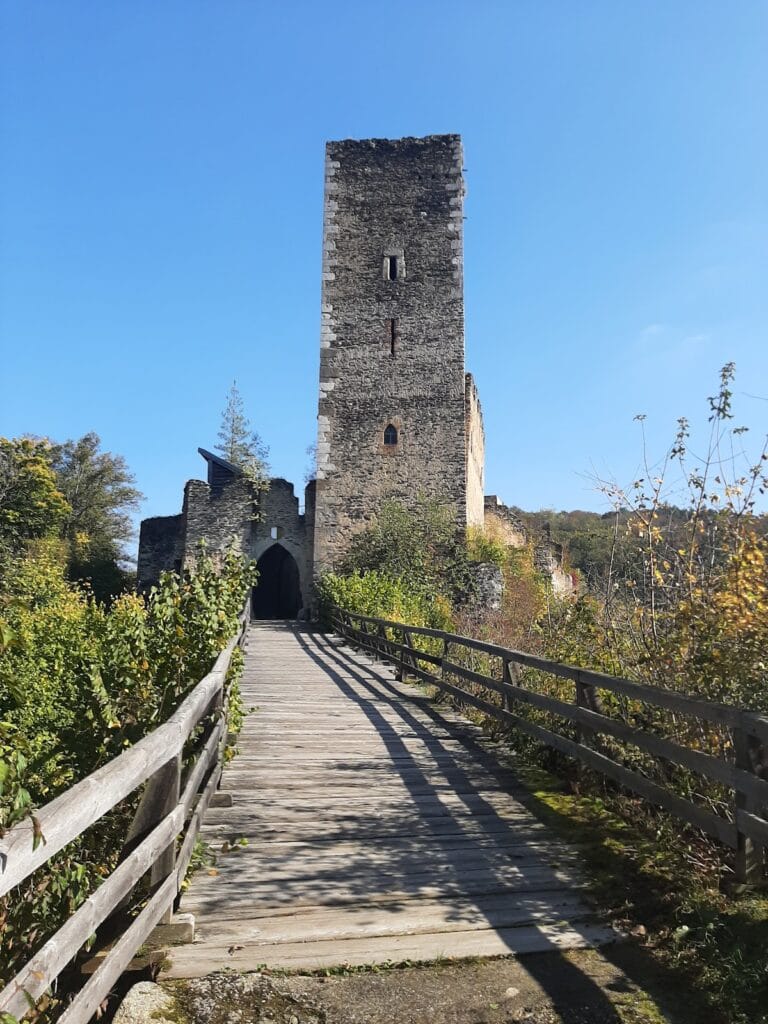
Nový Hrádek is an extensive, relatively well-preserved ruin of a Gothic hill castle and a mantle-wall castle, a type defended mainly by enclosing perimeter walls rather than a developed system of projecting towers. The complex consists of a lower, older castle and an upper, younger castle, each with its own courtyard. It stands about 2.5 kilometres south of Lukov and about 10 kilometres southwest of Znojmo, at a narrow point in a bend of the Dyje River. Kaja Castle lies across the river.
Lower and Upper Castles
Lower Castle
The lower castle belongs to the foundation phase that began around 1358. Its Gothic walls were built from two-mica schist, a local stone containing visible mica layers. The lower section remains a ruin and forms the older part of the surviving double complex.
Upper Castle
The upper castle was added during the fifteenth-century expansion. Its separate courtyard and buildings remain identifiable within the complex. Several rooms were adapted for habitation in the early nineteenth century, and courtyard agricultural buildings were rebuilt as a forester’s lodge. The lodge survives as part of the courtyard remains.
Walls, Entrance, and Landscape
A wooden viewing gallery has stood on the wall crown of the front, younger castle since 1995. The gallery overlooks the surrounding landscape and the Dyje valley below. The entrance gate was installed in 1992.
The underground spaces provide winter shelter for more than ten species of bats, including the greater mouse-eared bat, the barbastelle, and the lesser horseshoe bat. The castle and its immediate rubble slope also support rare animals such as the Aesculapian snake, green lizard, violet carpenter bee, stag beetles, rose chafers, and the clouded Apollo butterfly.
Plants found at the site include showy mullein, Pyrenean honewort, Hungarian bugloss, purple cyclamen, and a rare bolete. The calcium-rich scree below the castle particularly suits Pyrenean honewort and the bolete. A period lithograph made by the painter A. F. Kunike depicts the castle in the first half of the nineteenth century.