Kellie Castle: A Scots Baronial Historic House in Fife


Site at a Glance
- Rating
- 4.5
- Popularity
- Low
- Country
- United Kingdom
- Primary era
- Medieval
- External website
- Open
- Eras represented
- Medieval, Early Modern, Modern
- Civilizations
- British, Kingdom of Scotland
- Site type
- Domestic
- Remains
- Castle
On this page15 sections
History
Kellie Castle is a historic Scottish castle in the United Kingdom, near Pittenweem, whose surviving form developed from a tower house around 1360 and later became an example of Scots Baronial domestic architecture. The place is first recorded in 1150, when its name appeared in a charter issued by King David I, although the castle’s exact origins remain unknown.
Medieval origins and the Siwards
The name Kellie may have been associated with the armigerous Clan Kelly, a Scottish clan without a chief recognized by the Lord Lyon King of Arms. The first known owner was Robert of London, an illegitimate son of William the Lion, the medieval king of Scotland. In 1266, ownership passed to the Siward family of Northumbria. Their forebear had helped Malcolm Canmore, the common English name for Malcolm III, overthrow Macbeth.
The Siwards supported England during the Scottish Wars of Independence, conflicts between Scotland and England fought chiefly in the late thirteenth and early fourteenth centuries. After the Scottish victory at Bannockburn, Sir Richard Siward forfeited his Scottish lands. His daughter Helena Siward, known as “Lady Kellie,” retained Kellie, although none of the buildings occupied by the Siwards appears to have survived.
The Oliphant estate
Around 1360, Helena transferred Kellie to her kinsman Walter Oliphant of Aberdalgie. He was married to Elizabeth, a daughter of Robert the Bruce, King Robert I of Scotland and the leader of the Scottish kingdom during the Wars of Independence. The Oliphant family then occupied and owned the estate for approximately 250 years, until 1613.
The castle expanded during the later Oliphant period. A new east tower was built in 1573 by the 4th Lord Oliphant, probably as a jointure-house, meaning property reserved for his wife Margaret after his death. Between 1573 and 1606, a range connected the original tower with the east tower and ended in another tower at the south-west. These changes established the T-plan arrangement that survives today.
The Erskines and royal association
Sir Thomas Erskine acquired Kellie in 1613. He had saved the life of King James VI during the Gowrie Conspiracy, a 1600 political episode involving the king and members of the Ruthven family, by killing Sir Alexander Ruthven. James stayed at Kellie in 1617 during his only visit to Scotland after the Union of the Crowns. This was the 1603 succession through which James VI of Scotland also became James I of England and Ireland.
James appointed Erskine Earl of Kellie in 1619. For much of the seventeenth century, the castle was owned by the Erskines of Dirleton. Alexander Erskine, 3rd Earl of Kellie, who lived from 1615 to 1677, served as an investigator in the 1666 case of Margaret Guthrie, an accused witch from Carnbee.
Abandonment and the Lorimer family
Methven Erskine, 10th Earl of Kellie, died in 1829 and was succeeded by John Francis Miller Erskine as the 11th Earl. In 1830, the castle was abandoned by Erskine and emptied during a public auction. In 1835, John Francis Miller Erskine was confirmed as the 26th Earl of Mar, bringing the Earldoms of Kellie and Mar together.
The property subsequently appears to have passed to James Maitland Hog of Newliston, later styled “of Newliston and Kellie.” He made little use of the estate, and the castle remained abandoned for many years. In 1878, James Lorimer, Regius Professor of Public Law at the University of Edinburgh, rented Kellie from the Earl of Mar and Kellie. The Lorimer family first restored it as a holiday retreat, but it soon became their home.
After James Lorimer’s death, his wife Hannah assumed the tenancy in 1890. Their son John Henry Lorimer later lived at Kellie. When he died in 1936, the tenancy lapsed and the house was cleared. In the same year, the sculptor Hew Lorimer, Robert Lorimer’s son, and his wife Mary renewed the Lorimer tenancy.
Preservation and public care
Hew and Mary Lorimer purchased Kellie in 1948. Hew continued to live in part of the castle from 1970 to 1990 and used the stable block as his studio. In 1970, he sold the castle, 6.5 hectares of gardens, and the organic walled garden to the National Trust for Scotland, a charitable organization responsible for historic buildings, landscapes, and collections in Scotland.
The Trust received the principal contents of the castle into its care from the Secretary of State for Scotland and purchased the Lorimer family artefacts in 1998. It restored the drawing-room fireplace painting in 1996 after the work had been concealed since the late 1940s. Kellie was designated a Category A listed building in 1984 and added to Scotland’s Inventory of Gardens and Designed Landscapes in 1987. The castle, its collections, and its Lorimer associations are now presented to the public, with a permanent exhibition of Hew Lorimer’s work and studio in the former stables.
Remains
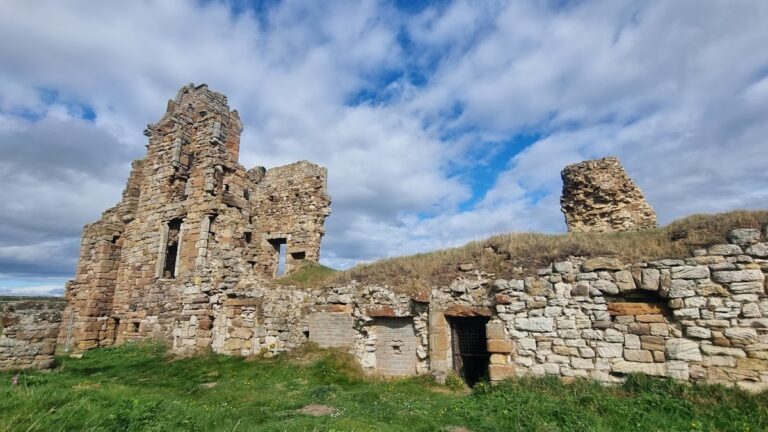
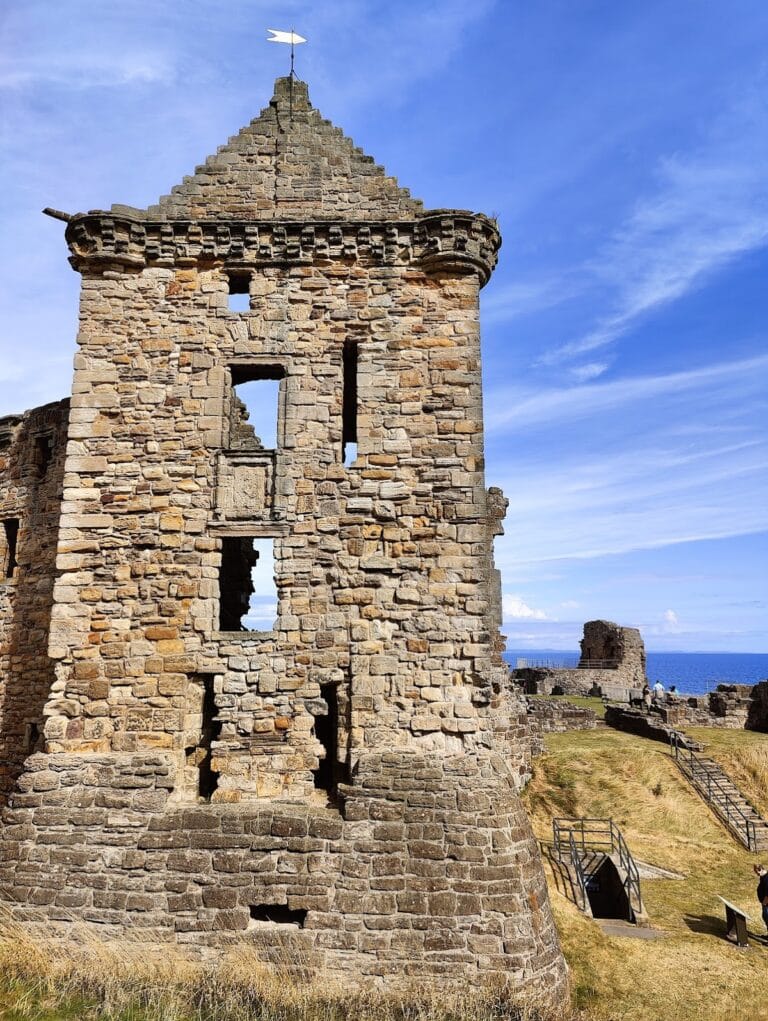
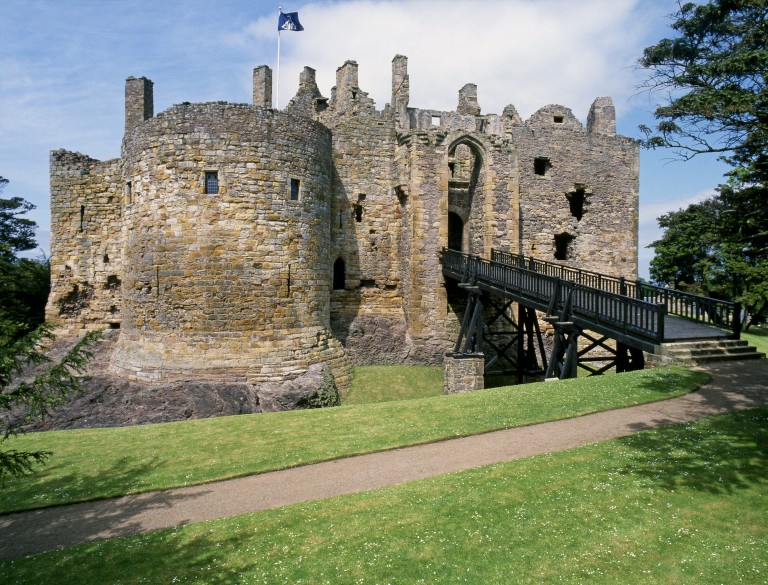
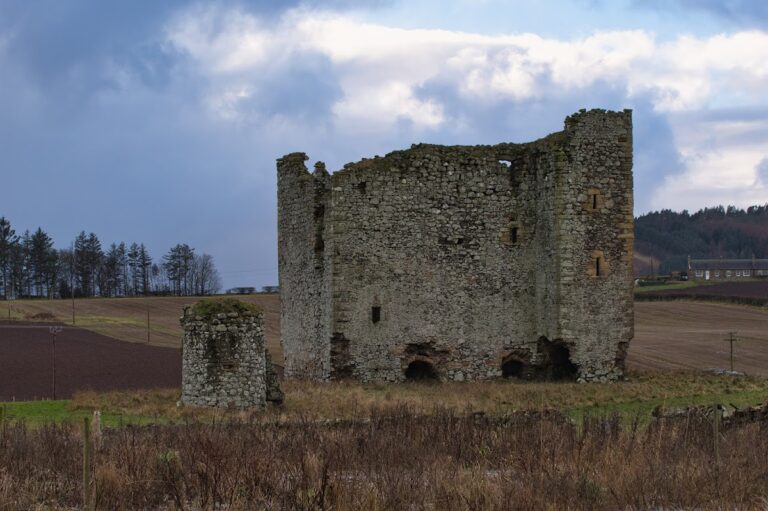
Kellie Castle stands just outside Arncroach, beneath Kellie Law and about 4 kilometres north of Pittenweem in the East Neuk of Fife. Its surviving plan grew from a simple tower house into a T-shaped group of towers and connecting ranges. Gables, corbelled towers, and numerous chimneys give the building the characteristic appearance of Scots Baronial domestic architecture, a Scottish revival style known for varied gables, corbels, towers, and prominent chimneys.
Towers and principal rooms
North-west tower
The lower part of the present north-west tower is the oldest surviving section of the castle and dates from around 1360. It forms the medieval core of the building. The tower is traditionally said to be haunted, a belief associated with the castle’s oldest surviving fabric.
East tower and library ceiling
The east tower, built in 1573, contains the present library. Its plaster ceiling was probably created in anticipation of King James’s visit in 1617. The decoration may be the earliest Scottish example of the “London style,” an early modern treatment that used ornamental plasterwork instead of traditional painted timber ceilings. The ceiling incorporates the date 1617 and the monogram “TVF,” referring to Thomas Viscount Fenton, a title awarded to Thomas Erskine in 1606.
Great Hall
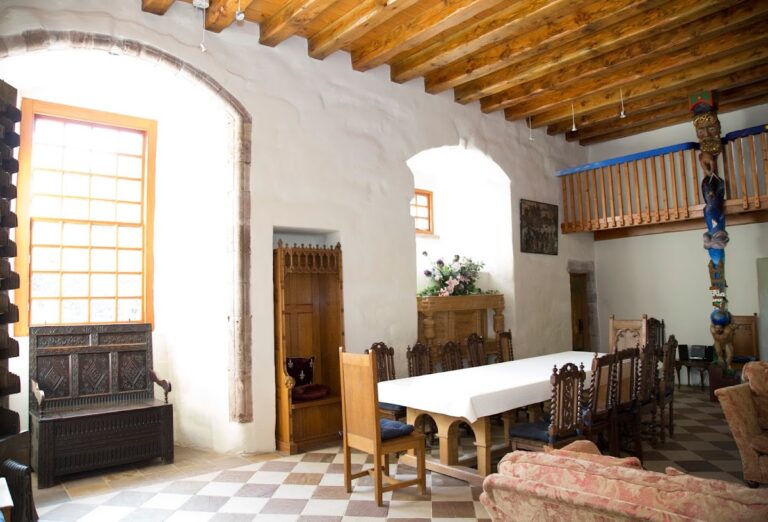
The Great Hall, the castle’s largest room, was completed around 1606 and later served as the Lorimers’ drawing room. Its west wall contains two mirrors with eagle cresting, designed by Sir Robert Lorimer and made by Whytock and Reid of Edinburgh. Positioned on either side of the west window, they create an optical effect in which a reflected figure appears to remain the same size while moving away.
Interiors and artistic works
Drawing-room fireplace panel
Phoebe Anna Traquair completed the painted panel above the drawing-room fireplace in 1897, while John Henry Lorimer lived at Kellie. The image is based on Botticelli’s Primavera, a renowned Renaissance allegorical painting. In the late 1940s, Hew and Mary Lorimer covered the panel with cartridge paper fixed with flour paste, taking care not to damage the painting. The National Trust for Scotland restored it in 1996.
Dining-room tapestry
The tapestry in the dining room is formed from at least two, and possibly three, separate pieces. Its central and principal element is a Flemish tapestry dated 1580, depicting Europa and the Bull. In the myth, Zeus takes the form of a white bull and carries Europa from Phoenicia to Crete. The tapestry was formerly in the drawing room, where it appeared in a 1964 Country Life photograph, and its borders were added later.
A Latin inscription on the tapestry does not describe its main scene. Its meaning is, “The young man has saved his wounded father, carried him back and put him on his horse.” The castle also displays a bust of John Henry Lorimer and two of his paintings, Sunlight in the South Room, Kellie and The Long Shadows. Paintings by Hannah Cassels im Thurn, the eldest daughter of Hannah and James Lorimer, form part of the Lorimer family artefacts acquired in 1998.
Gardens and later additions
The walled garden dates from the seventeenth century and contains late Victorian additions. Its planting includes old-fashioned roses, fruit trees, and herbaceous plants. Robert Lorimer restored the garden and added a doocot, a purpose-built building for pigeons or doves, and a garden house in 1900. A survey drawing of Kellie Castle made in 1887 is displayed within the castle.
Robert Lorimer also restored plaster ceilings, painted panelling, and furniture in the castle. The former stable block now contains Hew Lorimer’s studio and a permanent exhibition of his work, preserving the connection between the building and the sculptor’s later life at Kellie.