St Andrews Castle: Episcopal Residence and Fortress in Scotland


Site at a Glance
- Rating
- 4.5
- Popularity
- Medium
- Country
- United Kingdom
- Primary era
- Medieval
- External website
- Open
- Eras represented
- Medieval, Early Modern
- Civilizations
- Kingdom of Scotland
- Site type
- Military
- Remains
- Castle
On this page14 sections
History
St Andrews Castle is a medieval episcopal residence and fortress in St Andrews, United Kingdom. It probably originated around 1200 during the episcopate of Roger de Beaumont, and served the wealthy and powerful bishops and archbishops of St Andrews while the town was an ecclesiastical centre of Scotland before the Protestant Reformation. In Latin charters, the archbishops called it their palace, signing documents “apud Palatium nostrum,” meaning “at our palace.”
Wars of Scottish Independence
During the Wars of Scottish Independence, the late-thirteenth- and early-fourteenth-century conflicts in which Scotland resisted English claims of overlordship and military occupation, the castle repeatedly changed hands. After Edward I of England sacked Berwick in 1296, English forces captured St Andrews Castle and prepared it for the king’s visit in 1303.
Following the Scottish victory at Bannockburn, the castle was recaptured in 1314. Bishop William de Lamberton, who was then Guardian of Scotland, an official governing the kingdom when the monarch could not rule directly, repaired it and supported Robert the Bruce, the Scottish king Robert I. The English regained the castle in the 1330s and strengthened its defences in 1336. Sir Andrew Moray, acting as Regent of Scotland during David II’s absence, recovered it after a three-week siege. To prevent its reuse as an English stronghold, the Scots destroyed the castle in 1336 or 1337.
Episcopal rebuilding and royal connections
The castle remained in ruins until Bishop Walter Trail rebuilt it at the turn of the fifteenth century. The work was completed around 1400, and Trail died inside the castle in 1401. His rebuilding forms the basis of the surviving ruins.
The rebuilt castle retained close links with Scotland’s royal and ecclesiastical life. James I received part of his education from Bishop Henry Wardlaw, who founded the University of St Andrews in 1410. Bishop James Kennedy became a trusted adviser of James II, and James III was born at the castle in 1445.
Episcopal authority also gave the castle a role as a prison. Local offenders and prominent prisoners were held there, including David Stewart, Duke of Rothesay, in 1402 and Murdoch Stewart, 2nd Duke of Albany, in 1425. Archbishop Patrick Graham, who was considered insane, may also have been imprisoned at St Andrews, although he died in captivity at Loch Leven Castle in 1478.
Reformation conflict
During the Scottish Reformation, the sixteenth-century movement that established Protestant forms of worship and transformed Scotland’s religious and episcopal institutions, the castle became a centre of persecution and controversy. In 1521 James Beaton, then Archbishop of Glasgow, became Archbishop of St Andrews and moved into the castle. He altered its defences to meet the threat posed by heavy artillery and built a new artillery blockhouse.
In 1538 James Beaton was succeeded by his ambitious and wealthy nephew, Cardinal David Beaton. His account book reveals details of life at the residence. Beer was brewed by the Widow Fallousdale, onions and lettuce grew in the gardens, coal arrived from West Wemyss, and a whale stranded at Byrehills in 1541 was brought to the castle and salted. William Blair served as a drummer, while the priests Henry Balfour and James Bykartoun supervised work on the castle and gardens. Christopher Grymmerschere supplied guns, Master Wolf made new cannon, and John Fynnyk served as gunner.
Three women from Edinburgh and Dunfermline who were accused of witchcraft were held at the castle and burned on 10 October 1542. David Beaton’s opposition to the proposed marriage of Mary, Queen of Scots, to Prince Edward, later Edward VI, contributed to renewed conflict in 1544. In 1546 Beaton imprisoned the Protestant preacher George Wishart in the castle’s Sea Tower. Wishart was burned at the stake outside the castle walls on 1 March.
On 26 May 1546, Wishart’s associates entered the castle during building work disguised as masons. They overpowered the garrison, murdered Cardinal Beaton, and suspended his body from a window on the front of the castle. Protestant refugees then occupied the stronghold and formed Scotland’s first Protestant congregation there.
The siege of 1546 and 1547
The Scottish Regent James Hamilton, 2nd Earl of Arran, ordered a prolonged siege of the occupied castle. In October 1546, the attackers began cutting a mine through the rock. The defenders responded with a counter-mine, a tunnel excavated to intercept an attacking mine. Arran called on Fife lairds, Scottish landed proprietors who could mobilize followers for military service, including John Wemyss, to bring men and artillery by 4 November in case an English relief force arrived.
Henry VIII planned to assist the besieged Protestants, but the English invasion did not take place and Edward VI sent no aid. During an armistice in April 1547, John Knox entered the castle and served as preacher to the garrison for the remainder of the siege. He was temporarily permitted to travel between the castle and the parish church to preach.
A French fleet eventually arrived with the Italian engineer Leone Strozzi, who directed a heavy artillery bombardment. Guns were positioned against the castle and on St Salvator’s and the towers of St Andrews Cathedral. According to Robert Lindsay of Pitscottie, the castle became indefensible within six hours. The defeated Protestants were taken away, with some imprisoned in France and others, including Knox, condemned to the galleys.
Decline of the episcopal stronghold
After the Protestant defeat, Archbishop John Hamilton, an illegitimate brother of the Earl of Arran and David Beaton’s successor, substantially rebuilt the castle. After Hamilton’s death in 1571, successive constables mainly occupied it.
In 1606, Parliament separated the castle from the archbishopric and granted it to the Earl of Dunbar, who had served as constable since 1603. It returned to Archbishop George Gledstanes in 1612, although efforts to restore the archbishop’s former estates failed. As the Reformation succeeded, the office and authority of Scotland’s bishops were progressively reduced and were abolished by William of Orange in 1689.
Deprived of its former function, the castle rapidly deteriorated. By 1656 it was so dilapidated that the burgh council ordered its building materials to be used in repairing the town pier. The mine and counter-mine were rediscovered in 1879. The grounds are maintained by Historic Environment Scotland as a scheduled monument, a legally protected archaeological or historic site whose preservation is regulated by the state. A visitor centre presents historical displays and carved fragments from the castle.
Remains
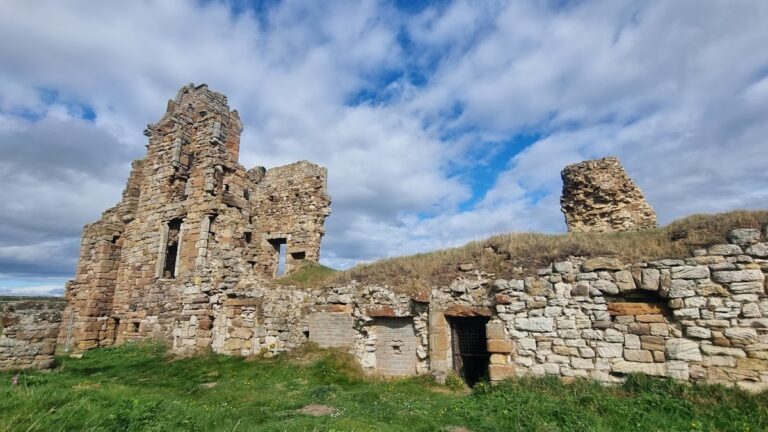
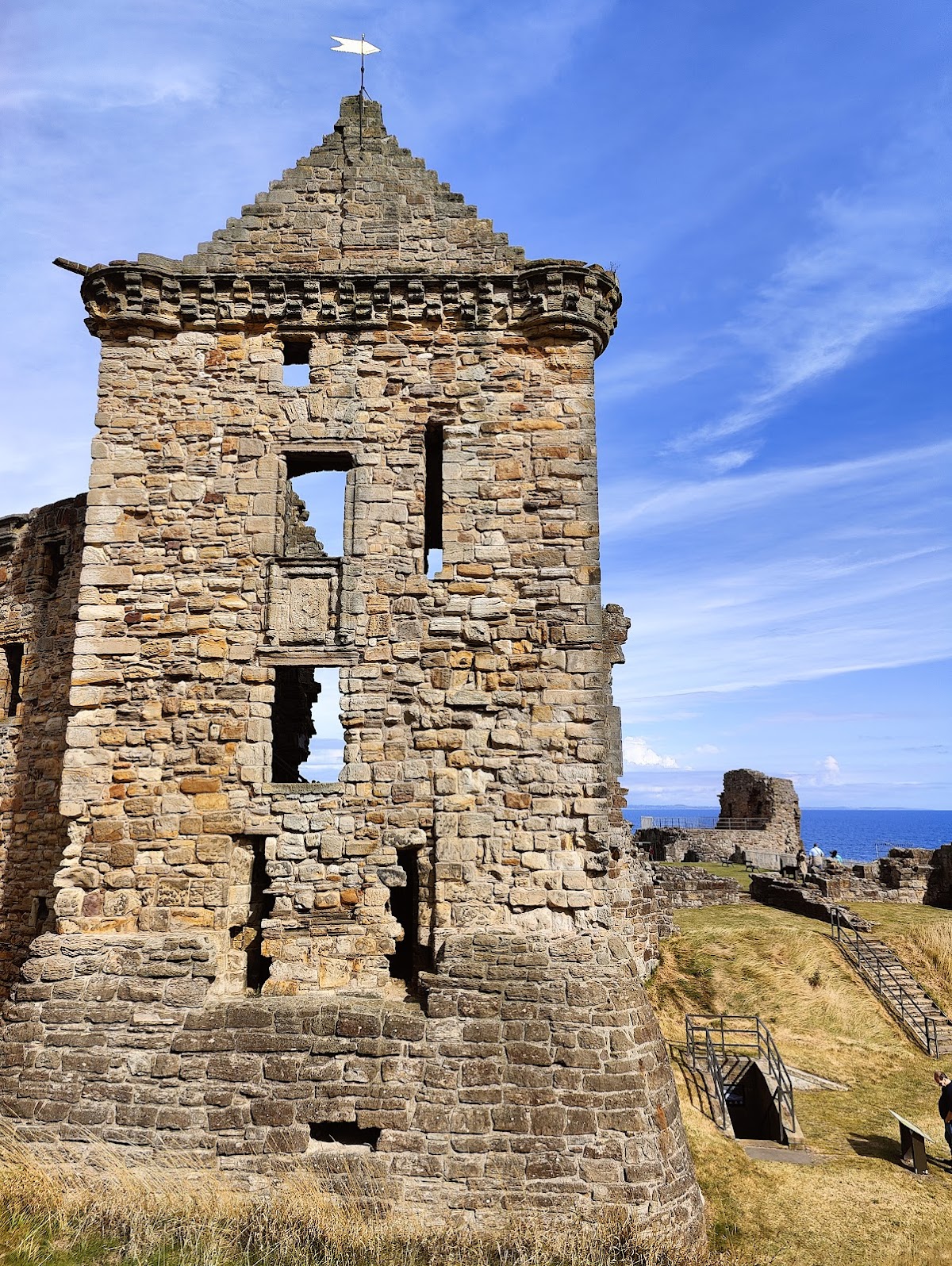
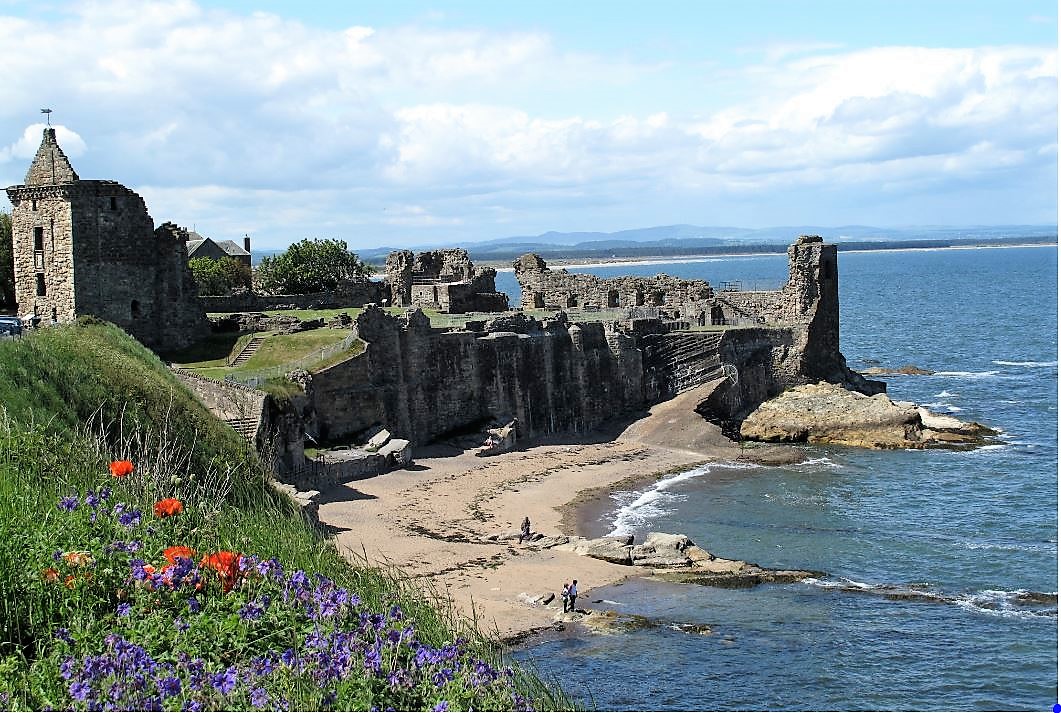
St Andrews Castle survives as a stone-built ruin on a rocky coastal promontory overlooking Castle Sands and the adjoining North Sea. The principal remains include part of the south wall, a square tower, the north-west tower with its bottle dungeon, the kitchen tower, the Sea Tower, and the underground mine and counter-mine. These fragments preserve elements of the castle’s medieval episcopal residence, later artillery defences, and sixteenth-century siege history.
Walls and domestic buildings
South wall and towers
Part of the south wall survives with a square tower incorporated into the remains. The castle’s stone construction and surviving wall lines express the fortified enclosure rebuilt by Bishop Walter Trail around 1400. The north-west tower contains the bottle dungeon, a damp and airless pit cut directly into the solid rock beneath the tower.
Kitchen tower and Sea Tower
The kitchen tower forms another surviving part of the castle complex. The Sea Tower is associated with the imprisonment of George Wishart in 1546, before his execution outside the walls. The castle also included a garden where onions and lettuce were grown during Cardinal David Beaton’s occupation.
Artillery and siege works
Artillery defences
James Beaton altered the castle’s defences in the sixteenth century to withstand heavy artillery, including a new artillery blockhouse. The castle’s guns included the large Scottish cannon called Thrawynmouthe. During the bombardment of 1547, artillery was placed against the castle as well as on St Salvator’s and the towers of St Andrews Cathedral.
Mine and counter-mine
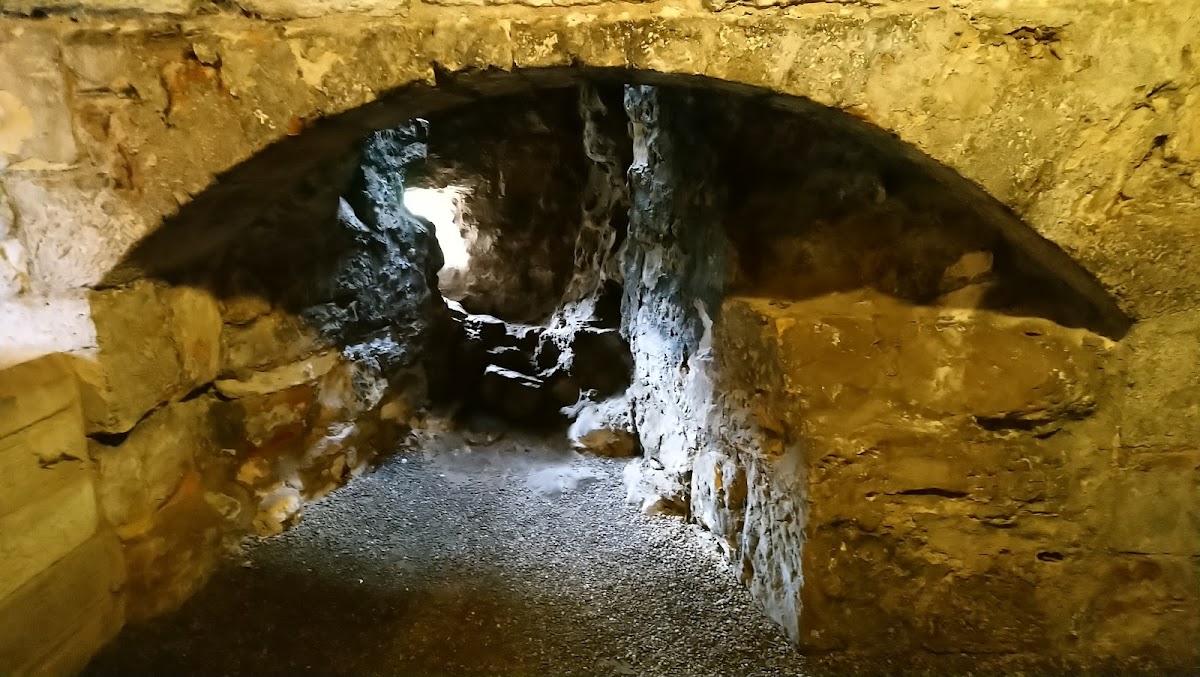
The attackers’ mine and the defenders’ counter-mine were both cut through solid rock during the siege of 1546 and 1547. Their underground passages survive and were rediscovered in 1879. The intersecting tunnels preserve the physical evidence of the attempt to breach the castle and the defenders’ effort to stop it.
Memorial and carved remains
Brick lettering bearing George Wishart’s initials marks the place outside the castle walls where he was executed. Some of the best-preserved carved fragments from the castle are displayed in the visitor centre, providing surviving details from the ruined fabric of the former episcopal residence.