Čabraď Castle: A Medieval Fortress in Slovakia


Site at a Glance
- Rating
- 4.8
- Popularity
- Low
- Country
- Slovakia
- Primary era
- Medieval
- External website
- Open
- Eras represented
- Medieval, Early Modern
- Civilizations
- Habsburg, Hungarian
- Site type
- Military
- Remains
- Castle
On this page12 sections
History
Čabraď Castle is a medieval fortress in Slovakia that developed as a successor to the earlier Litava Castle and guarded routes leading toward the mining towns of central Slovakia. Its position above the Litava valley gave it a defensive role, while its domain connected the castle to the political and military history of the Kingdom of Hungary.
From Litava Castle to Čabraď
An earlier Litava castle stood about 2.5 kilometres southeast of the present site. It was first mentioned in 1276 and declined after 1318 during conflicts with Matthew Csák, a powerful oligarch whose influence challenged royal authority in the Kingdom of Hungary. A successor was then established at the present location. It inherited the earlier castle’s territorial domain and name, and later became known as Čabraď.
The castle formed part of a group of central Slovak fortifications protecting routes from the region toward the northern Hungarian mining towns. One route ran from Šahy through the castle and continued toward Bzovík, Krupina, and the mining towns of what is now central Slovakia. The early castle was royal property and changed owners frequently, particularly during the early reign of Sigismund of Luxembourg. After 1394 it was held by the Kakas family and became involved in the wider power struggles of the Hungarian kingdom.
Fifteenth-century conflicts and rebuilding
In the mid-fifteenth century, troops commanded by Ján Jiskra occupied the castle. Jiskra led Hussite forces in northern Hungary during the conflicts of the period. The forces of Matthias Corvinus, king of Hungary from 1458 to 1490, besieged Čabraď in late 1461 and recovered it in 1462. Rebuilding followed, and the form Čabrad increasingly replaced the earlier name from 1469 onward. The castle subsequently came into the possession of the Horváth family.
Bakócz, the Erdődys, and the Pálffys
In 1511, Urban Fánchy sold the castle and its lordship for 1,000 gold florins to Tamás Bakócz, Archbishop of Esztergom and one of the most influential churchmen in the Kingdom of Hungary. Bakócz financed repairs and expansion, with major work taking place around 1520. After his death in 1521, ownership passed to the Erdődy family and later to the Pálffy family.
In 1547, Menyhért Balassa and his robber-knight followers seized the castle. Balassa was a Hungarian nobleman and military figure whose armed seizure gave him this contemporary reputation. An imperial army commanded by Nicolas Salm besieged the castle in 1549 and caused heavy damage.
Ottoman pressure and strengthened defenses
During the sixteenth century, the Pálffy owners repaired and strengthened Čabraď because parts of its lordship had been occupied by the Ottoman Empire. Extensive defensive works began in the 1580s under Italian engineering direction. The strengthened fortress resisted repeated Ottoman attempts to capture it, including attacks in 1585 and 1602. Its lords nevertheless remained involved in conflict with the Ottomans until the late seventeenth century.
Ownership passed in 1582 to Stephan I Illésházy after his marriage to Katharina Pálffy, the widow of the former castellan Johann Krusics. In 1622, with the approval of Ferdinand II, the Koháry family acquired the castle. Ferdinand II was Holy Roman Emperor and king of Hungary, and the transfer followed P. Koháry’s military service against the Ottomans. The castle passed through the anti-Habsburg uprisings of the seventeenth century without major events. After the Rákóczi uprising, an early-eighteenth-century revolt against Habsburg rule in the Kingdom of Hungary, was suppressed in the region in 1709, the Kohárys were able to return.
Decline, abandonment, and conservation
Čabraď’s importance declined as the old route through the Litava valley lost significance. From 1744, the Kohárys began building a new representative residence at Svätý Anton, and valuable objects were gradually transferred there. By about 1750, Čabraď no longer served as the family’s main residence, although it was retained for a time as a summer retreat.
Franz Josef Koháry had the castle burned in 1812. It then remained a ruin and progressively became overgrown by the surrounding woodland. After his death in 1826, the male line of the Koháry family ended. Through the marriage of his sole heiress, Maria Antonia Gabriele von Koháry, the castle and lordship passed to Duke Ferdinand of Saxe-Coburg and Gotha.
The castle was abandoned by the nineteenth century, while the lordship and the small settlement below it continued to exist. A urbar, a manorial register of lands, obligations, and inhabitants, records the settlement in 1830. A granary near the entrance gate survived until the late nineteenth century. The abandonment of the castle was regarded as final after the events of 1848, including the Hungarian Revolution.
During most of the twentieth century, the ruins stood abandoned and became heavily overgrown. The first conservation measures began in the 1990s, and the Rondel Association, founded in 2000, has progressively conserved the surviving parts of the complex. In 1967, the castle hill and its surroundings were declared the Čabraď National Nature Reserve, whose protection focuses particularly on the area’s exceptionally diverse reptile fauna. The castle also lies within the Čabraď natural-reserve landscape.
Remains
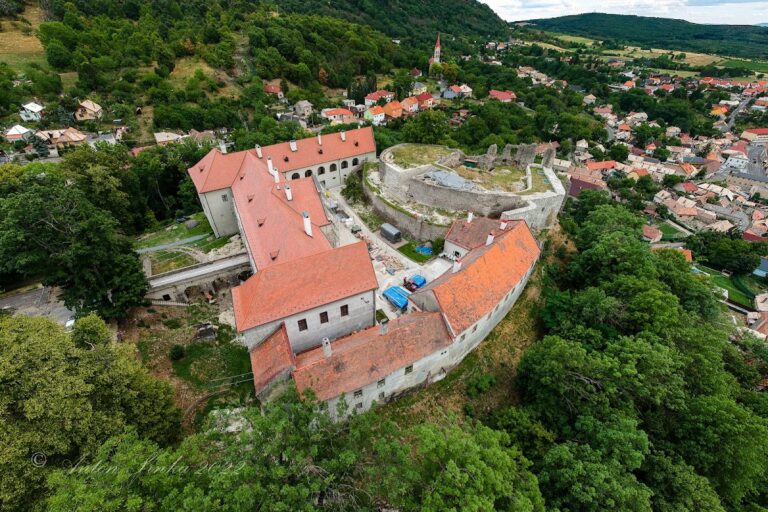
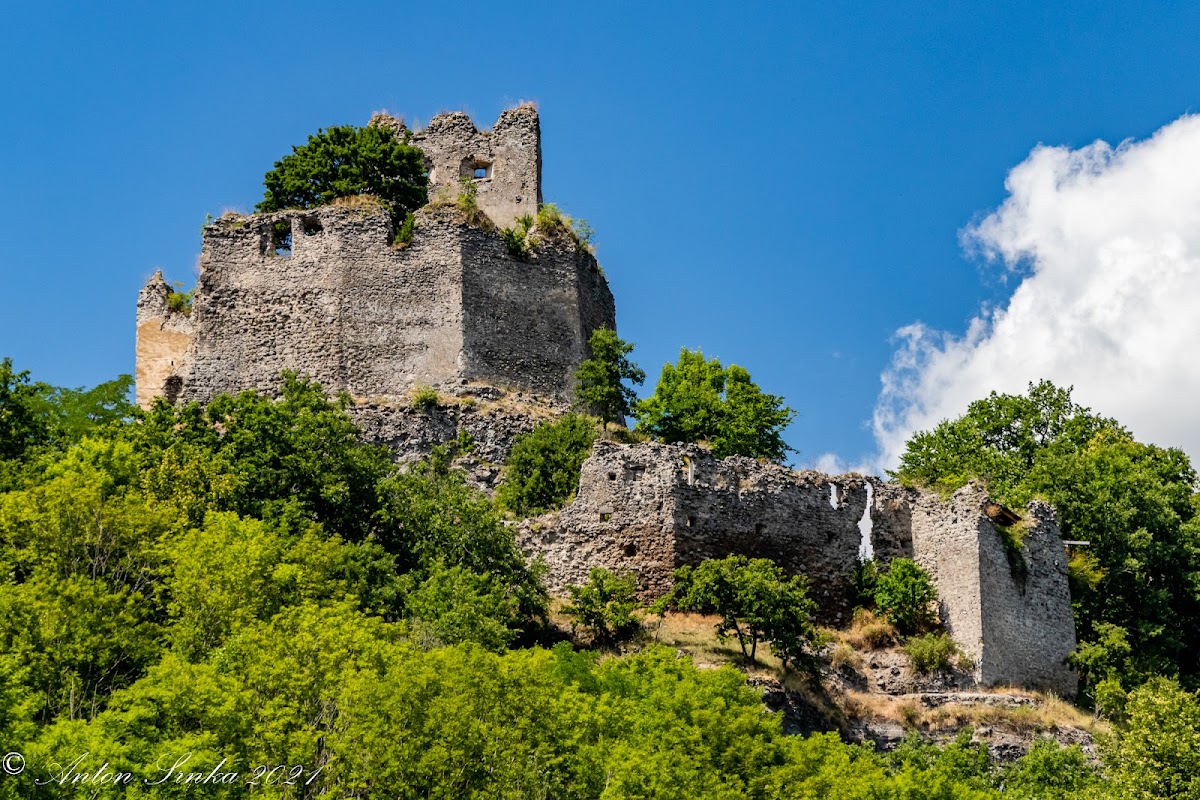
The ruins stand at approximately 305 metres above sea level on a hill in the Krupinská planina, above the Litava valley. The Litava River curves around the hill in a meander, providing natural protection. The upper castle occupied the elongated summit, while the lower castle extended around the fortified core. Surviving structures are deteriorating and are progressively affected by vegetation, although conservation work continues to stabilize and preserve the complex.
Upper castle
Gate and entrance defenses
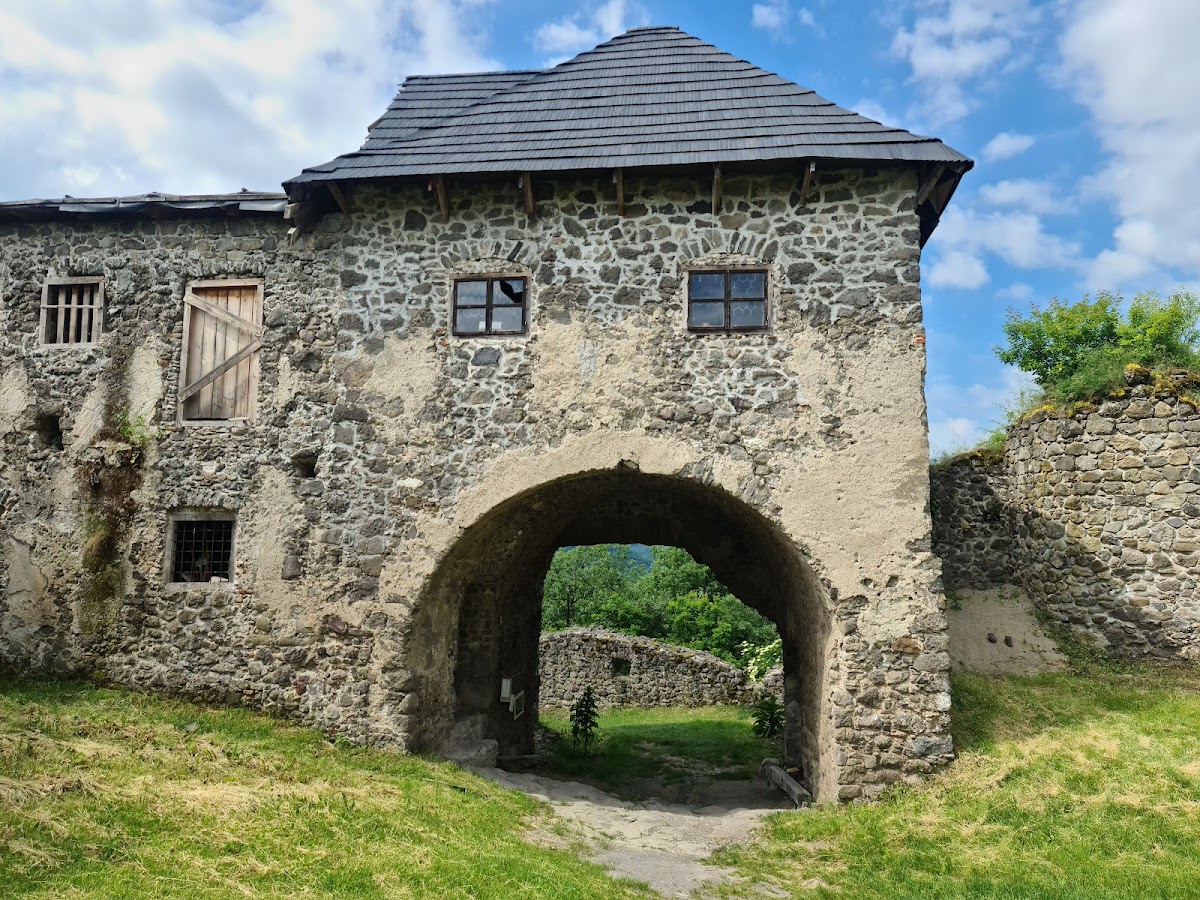
The upper castle was entered from the north through a three-storey gate building with a basement. The entrance probably had a drawbridge. A second entrance on the south side incorporated a tower and an upper storey above the passage. Beyond it stood an advanced gate protected by two substantial loopholes and another drawbridge. These entrances controlled access to the castle’s upper and lower defensive areas.
Central tower and residential core
The medieval core consisted of a central tower protected by four bastions and a palace placed above a carefully controlled, angled entrance to the upper courtyard. The summit complex also contained a residential tower, a large courtyard, three palace buildings, and economic buildings. Later rebuilding expanded and altered the residential areas, leaving the upper castle as a fragmentary part of the surviving ruin.
Lower castle and forecourt
Bastions and smaller bastions on the western side formed part of the outer fortified enclosure, or lower castle. A residential building on the eastern side probably served the garrison. The southwestern side contained an additional bastion with a gate. During the sixteenth century, the residential areas were expanded particularly in this lower castle, also described as the forecourt. Seventeenth-century rebuilding transformed the inner castle into a more comfortable aristocratic residence, adapting the defensive complex to the needs of its owners.
Granary and later additions
A granary was added to the castle complex during the nineteenth century. Nineteenth-century drawings still show it as a functioning building near the entrance gate, but it is now in ruins like the rest of the complex. Its remains form part of the later architectural history of Čabraď, whose surviving structures are being stabilized through ongoing conservation.