Modrý Kameň: A Gothic-Renaissance Castle in Slovakia

Site at a Glance
- Rating
- 4.5
- Popularity
- Medium
- Country
- Slovakia
- Primary era
- Early Modern
- External website
- Open
- Eras represented
- Medieval, Early Modern, Modern
- Civilizations
- Habsburg, Hungarian
- Site type
- Military
- Remains
- Castle
On this page12 sections
History
Modrý Kameň is a Gothic-Renaissance castle in Slovakia, rising above the town of Modrý Kameň in the Banská Bystrica Region. Its beginnings are uncertain, but construction probably started after the Mongol invasion, the thirteenth-century attack on the Kingdom of Hungary that led to the building or strengthening of many fortified sites. A memorial plaque gives the foundation date as 1237, while the earliest written references date from 1278 and 1290. A document from 1285 names Peter Forró as the owner and presumed builder.
Medieval origins and Balaša ownership
After Peter Forró’s death, the castle passed to the sons of Kazimir from the Bíňa branch of the Hunt-Poznan family. Peter’s siblings, who founded the Balaša family, recovered it in 1290. The powerful magnate Matúš Čák Trenčiansky, who controlled extensive territories in the Kingdom of Hungary during the late thirteenth and early fourteenth centuries, later interrupted their possession. The castle returned to the Balašas after his death.
The Balaša family, also known as Balassa or Balassi, retained Modrý Kameň for approximately six centuries, although ownership was interrupted at times. János Balaša held it until 1562, followed by Bálint Balaša. In the sixteenth century, the castle became part of the anti-Ottoman defensive line. The state strengthened and maintained it with public funds in 1559, but Ottoman forces occupied it from 1575 or 1576 until 1593 and destroyed it.
Ottoman warfare and reconstruction
After the castle was recaptured in 1593, it was rebuilt between 1609 and 1612. This reconstruction gave the complex a Renaissance appearance and added artillery platforms. Žigmund Balaša directed the work during a period of conflict involving the estates of the Kingdom of Hungary and the Habsburg monarchy.
Žigmund later sought the office of Prince of Transylvania and allied himself with the Ottomans. Royal forces captured Modrý Kameň in 1616, and he was imprisoned. Ottoman forces attacked again in 1659. In 1683, insurgent forces led by Imrich Tököli, a seventeenth-century nobleman and leader of an anti-Habsburg uprising, attempted to take the castle and caused extensive damage. The owners did not restore the upper castle. The complex had earlier served as a base for Kuruc forces, and Márton Kókay burned it after the Peace of Szatmár in 1711.
Baroque rebuilding and later ownership
During the first half of the eighteenth century, Gabriel Balaša built a large Baroque manor house on the older, destroyed foundations. The rebuilding used the lower courtyard, while the upper section remained unreconstructed and was turned into a garden. Pál Balaša reportedly added the Chapel of Saint Anne in 1759.
In 1813, the estate passed from the Balašas to Forgáč, an ispán, or high-ranking territorial official, associated with Gýmeš and Halič. It later belonged to Count Károly and then to his daughter Gabriela Almási, the last private owner. She sold the estate to the state in 1923, and it has remained state-owned.
Administrative use and museum history
After Modrý Kameň became a district administrative center in 1923, parts of the complex housed district offices and a district court. Barred prison cells were installed in the court section in 1927 and 1928. During the twentieth century, other parts served as a pharmaceutical company warehouse and, from 1968, as a state district archive. The archive moved to Veľký Krtíš in 1985 because the castle did not provide suitable conditions.
A local-history museum occupied the complex from 1991. Since 2002, it has housed the Slovak National Museum’s Museum of Puppet Cultures and Toys. Its exhibitions address the history of puppetry, Slovak children’s toys, dental technology, Bálint Balaša, and finds from nearby Slavic and Avar burial grounds. The castle ruin and grounds are protected as a national cultural monument, a state heritage designation for historically or architecturally important cultural property. The protected complex includes the garden, bridge, castle chapel, economic building, moat, and Baroque manor house.
Remains
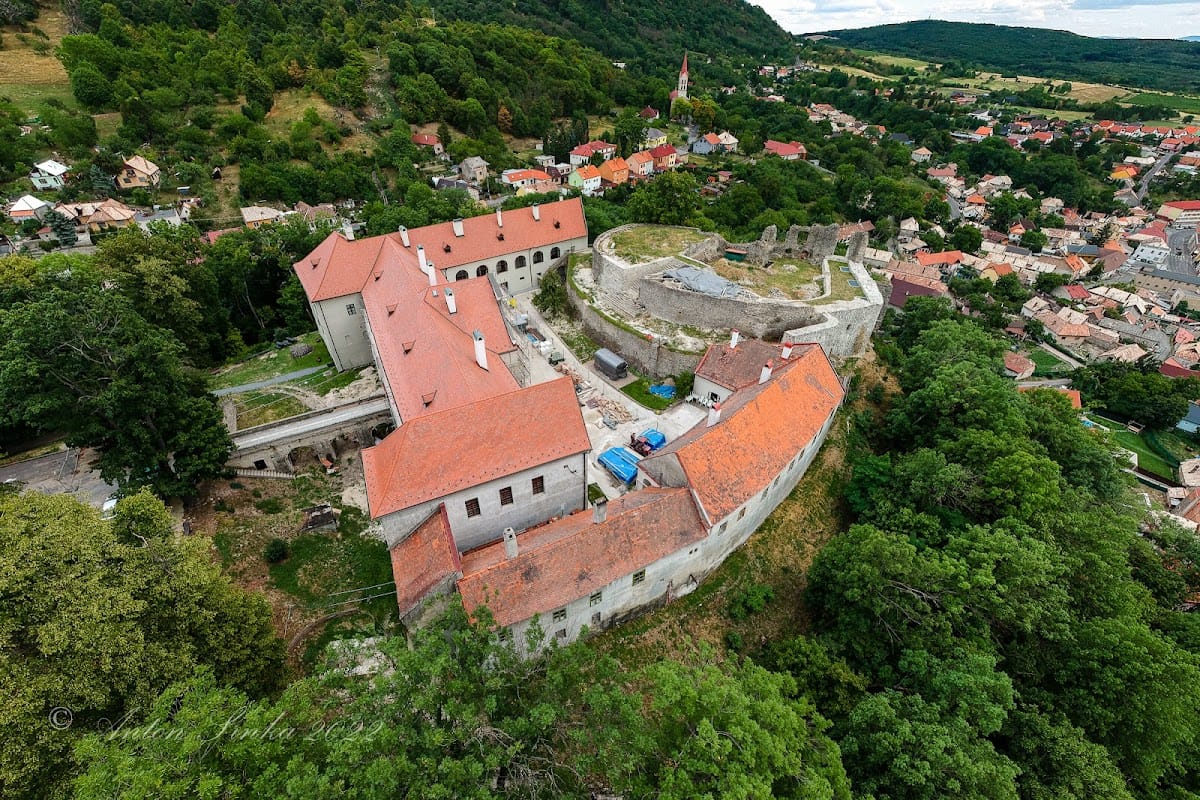
Modrý Kameň stands at approximately 315 metres above sea level. The surviving complex has two physically and historically different parts: the upper medieval and early-modern castle, which remains chiefly in ruins, and the Baroque manor house occupying the lower courtyard. The grounds also include a garden, bridge, chapel, economic building, moat, and a nearby Calvary layout attributed to the eighteenth century.
Castle and manor
Upper castle
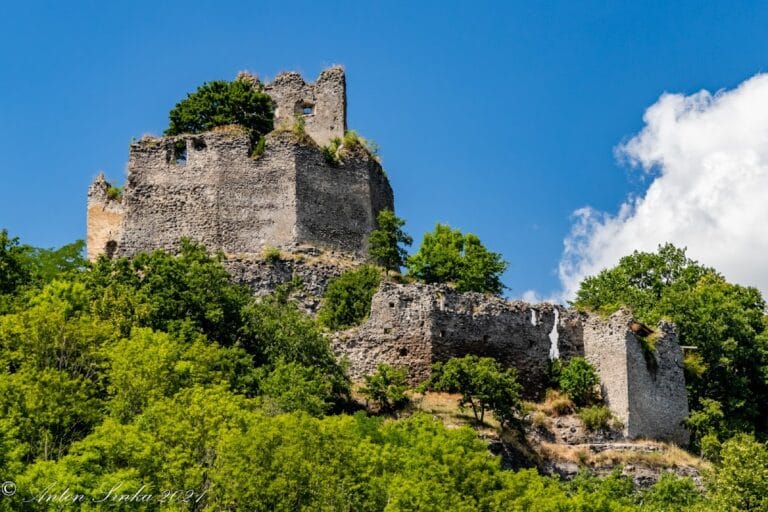
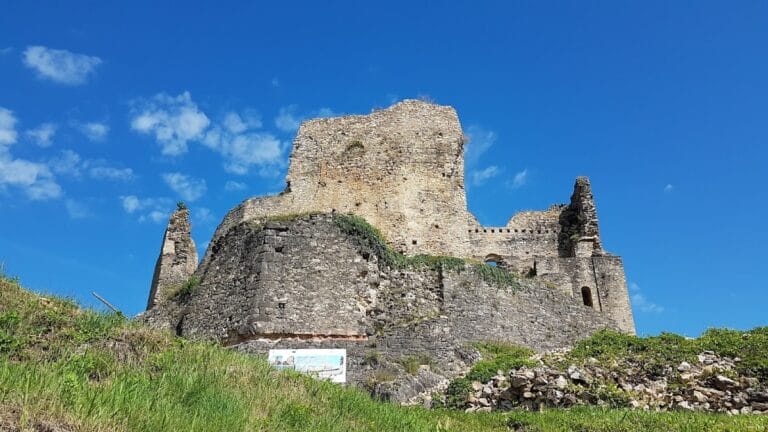
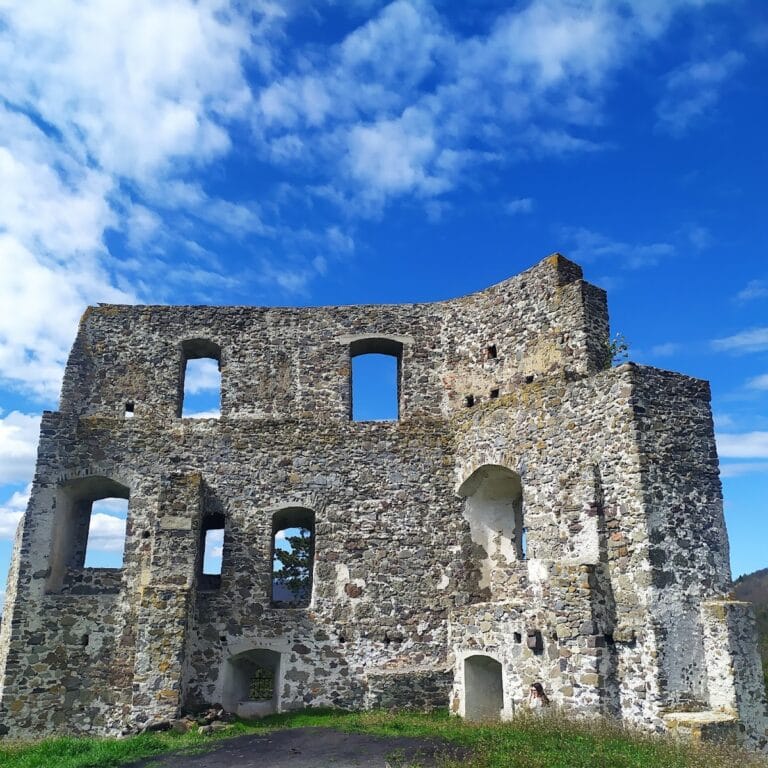
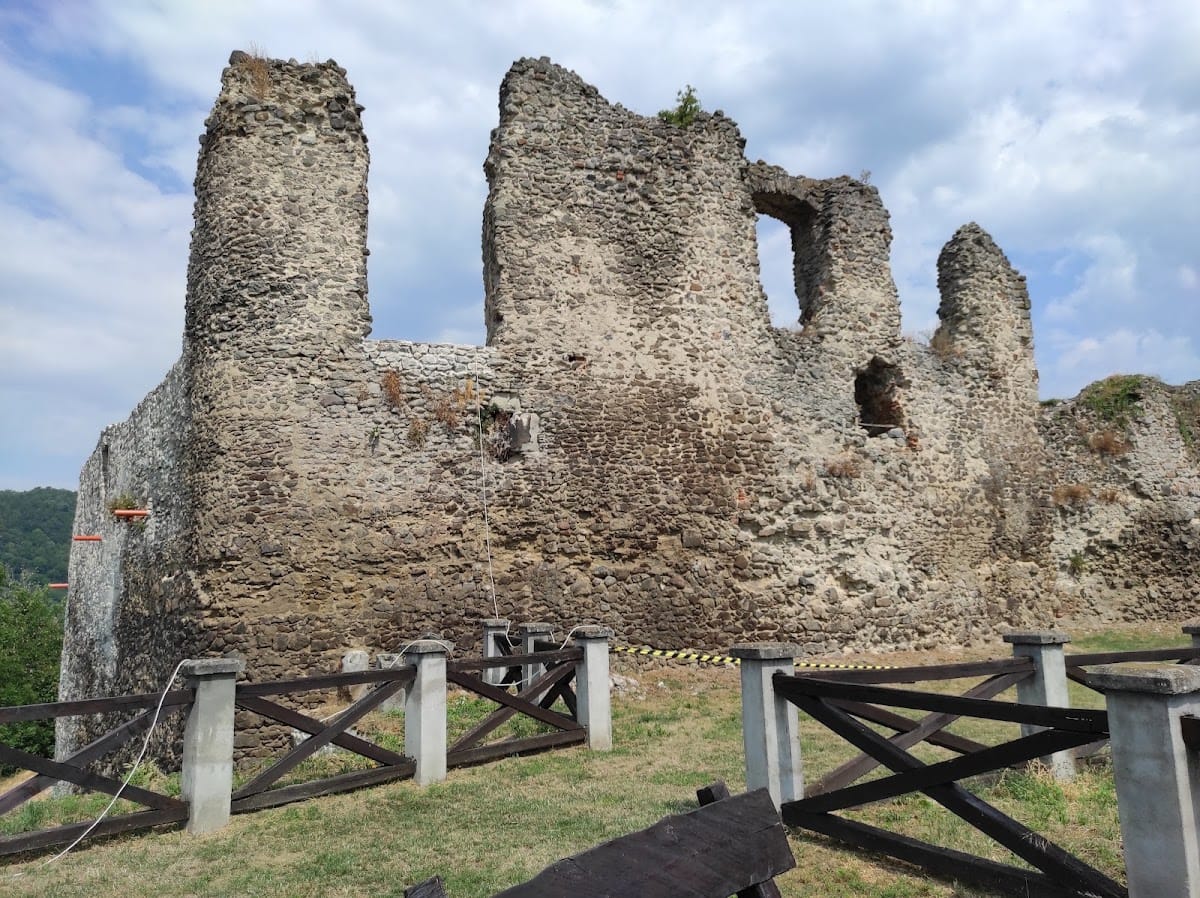
The upper castle survives primarily as ruined remains. Its appearance was altered during the rebuilding of 1609 to 1612, when artillery platforms were added and new walls, defenses, and residential spaces were created. The upper section suffered extensive damage during the seventeenth-century conflicts and was not restored afterward. It was subsequently converted into a garden, while the medieval and early-modern castle remains distinct from the manor building below.
Baroque manor house
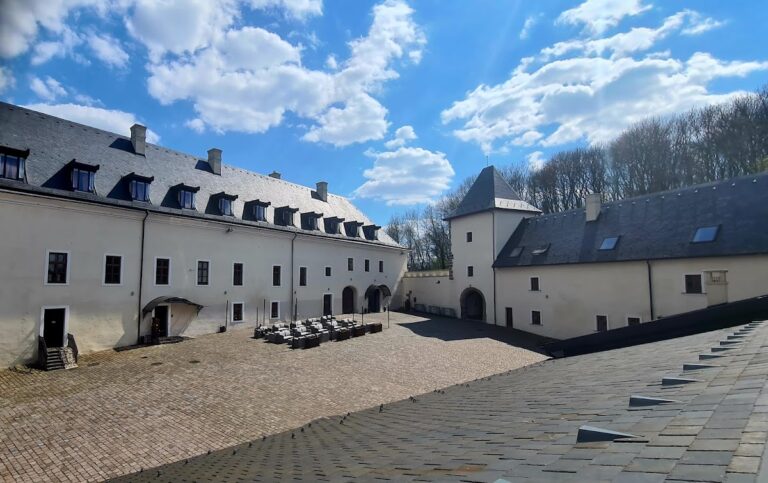
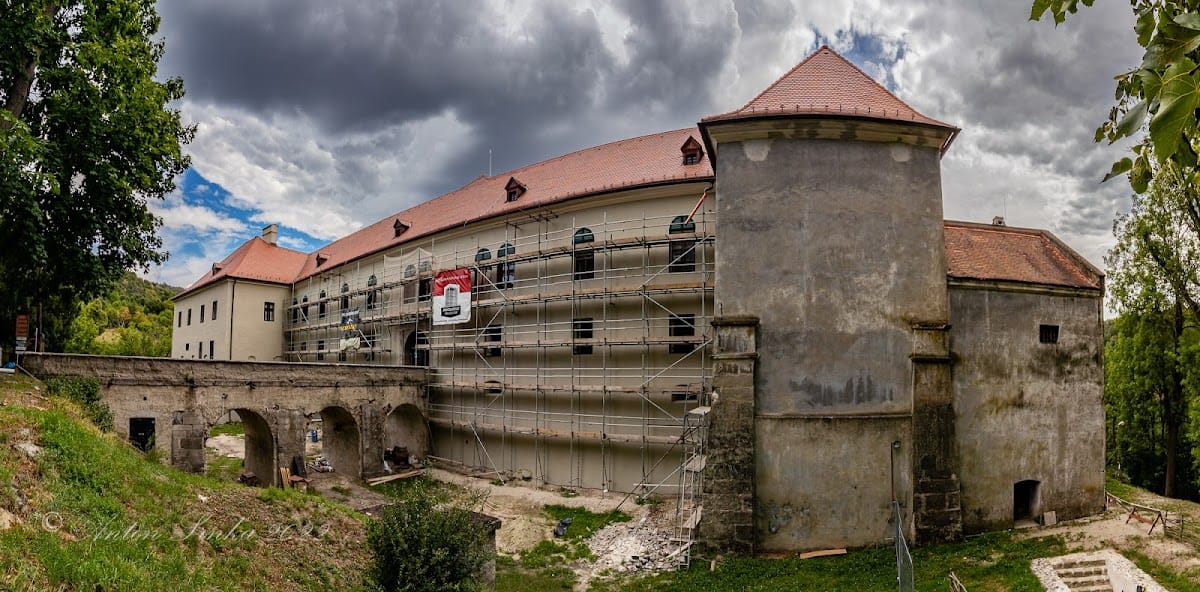
The large Baroque manor house occupies the lower castle level and stands partly on the foundations of the destroyed earlier structures. It was built during the first half of the eighteenth century, using the lower courtyard rather than rebuilding the upper castle. The building now forms the principal setting for the museum complex. The manor is often mistaken for the castle itself, although the medieval and early-modern fortress survives as the ruined upper section.
Chapel and associated grounds
Chapel of Saint Anne
The Chapel of Saint Anne belongs to the later manor complex and was reportedly added by Pál Balaša in 1759. Behind its main altar, an eighteenth-century bronze vessel containing a cattle heart was found. The object was probably connected with the cattle epidemic that affected the region around the beginning of the eighteenth century. Local people apparently placed the heart near a devotional image in the hope that the epidemic would end.
Entrance and surrounding features
The lower gate contains a marble inscription bearing the dates 1237, 1576, 1593, 1609, and 1612. It describes the castle’s foundation by the Balaša family, its Ottoman occupation in 1576, destruction in 1593, decline under imperial officials, and enlargement and restoration under Žigmund Balaša between 1609 and 1612. The surviving grounds include the bridge, moat, economic building, garden, and a nearby eighteenth-century Calvary layout, preserving the relationship between the ruined fortress and its later estate buildings.