Merkenstein Ruins: A Medieval Hilltop Castle in Austria



Site at a Glance
- Rating
- 4.5
- Popularity
- Low
- Country
- Austria
- Primary era
- Medieval
- External website
- Open
- Eras represented
- Medieval
- Civilizations
- Duchy of Austria, Holy Roman Empire
- Site type
- Military
- Remains
- Castle
On this page11 sections
History
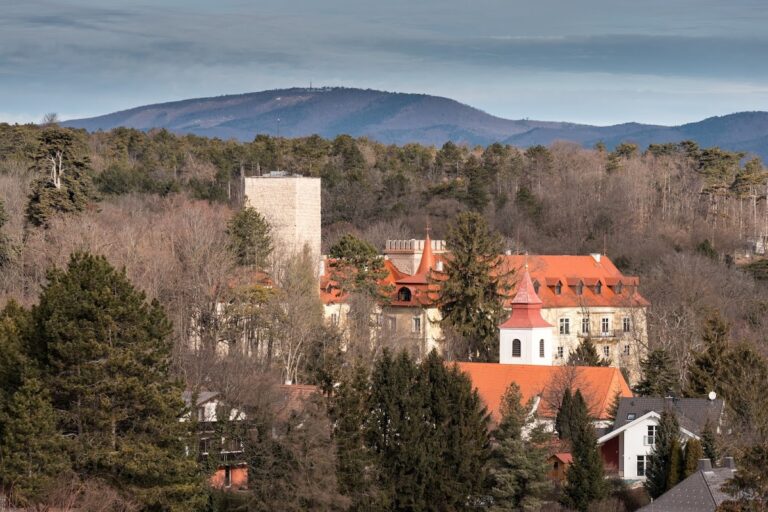
Merkenstein ruins are the remains of a medieval hilltop castle near Bad Vöslau, Austria, built before 1166. The castle stood in the Großau cadastre, an officially defined administrative district in Lower Austria, and became the centre of a lordship whose history was shaped by noble succession, warfare, and destruction.
Early Lords and the Wallsee Possession
An earlier reference to Merkenstein before 1141 is uncertain. The first definite written reference appears in the Codex Falkensteinensis around 1170. This medieval record associated with the Falkenstein noble family provides the earliest secure documentary link to the castle. The Lords of Merkenstein retained it until 1322, after which it passed through the hands of several owners, including Otto von Gerlos and Konrad de Werde.
Merkenstein later came into the possession of the Wallsee family, a medieval noble house. A castle chapel existed by 1330. Members of the Wallsee family redeemed the chapel from a debt owed to the mother church at Aland, linking the castle to the religious administration of the surrounding area.
Hohenberg Rule and the Wars of the Fifteenth Century
The Wallsee family held Merkenstein for about a century. In 1440, family disputes and indebtedness led them to sell the estate to Stephan von Hohenberg. The Hohenberg family remained in possession until 1484, during a period when the castle became involved in the struggle between Matthias Corvinus, king of Hungary, and Emperor Frederick III.
In 1482, Hans III von Hohenberg placed Merkenstein, Hohenberg, and Kreisbach at the disposal of Matthias Corvinus. Corvinus was the fifteenth-century king of Hungary and a leading opponent of the Habsburg emperor Frederick III. Imperial forces besieged Merkenstein for four weeks but failed to take it. After Hans III reconciled with Frederick in 1484, he sold the castle to the emperor. Merkenstein then became a possession of the territorial sovereign, administered by imperial representatives.
Matthias Corvinus recaptured the castle in 1486. Following his death, Merkenstein returned to the empire. During the sixteenth century, the Merkenstein lordship included Gainfarn, Großau, the lordship of Pottenstein, and the offices of Furth, Muggendorf, and St. Veit. The estate also contained the much younger Merkenstein Castle and covered about 40 percent of the territory of the former municipality of Großau.
From Estate Centre to Ruin
The Heißperger family owned Merkenstein from 1603 until 1672, when the estate passed to the Dietrichstein family. In August 1683, Ottoman forces captured and burned the castle after a prolonged siege. One hundred and seventy-three people died inside. Following the destruction, the castle remained in decline, while the Dietrichstein estate administration moved to the old castle at Gainfarn.
The castle and estate later belonged to the German branch of the Krupp family until the end of the Second World War. Because the property was German-owned, it came under Soviet administration from 1945 to 1955. After the Austrian State Treaty, the Republic of Austria took ownership and placed the castle under the Austrian Federal Forests. The site has been privately owned since 1978 and has undergone careful restoration. Ludwig van Beethoven, a German composer of the late eighteenth and early nineteenth centuries, dedicated two songs to the ruins. In October 2008, the remains were also used as a setting for the Austrian television crime series Four Women and a Funeral.
Merkenstein Cave and Later History
Merkenstein Cave, below the castle, was investigated in 1921 by Franz Mühlhofer, a researcher of prehistoric remains and cave deposits. The Krupp estate administration removed about 6.5 tonnes of cave soil, which was sold or used as fertilizer for meadows and the zoo. During the castle’s occupation from the early Middle Ages until its destruction in 1683, the cave received household waste through a shaft leading directly from the castle kitchen.
The upper sediment layer also indicates that the cave served as a refuge during the Ottoman wars of 1529 and 1683. A defensive wall dating from 1529 remains inside it. During the 1930s, a small exhibition operated in the cave for weekend visitors. The cave was used again as a refuge during the Second World War, when its installations and exhibits were destroyed or removed, although interpretive work continued for several years. Merkenstein Cave received natural-monument status in 1942.
Remains
Castle Ruins
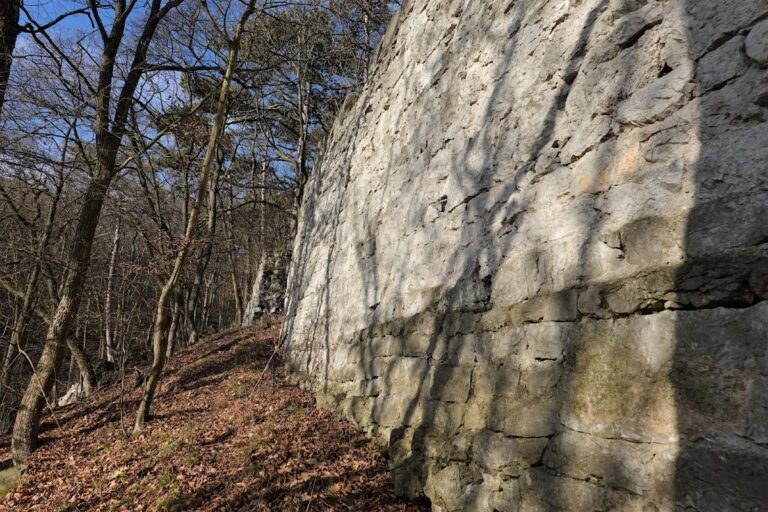
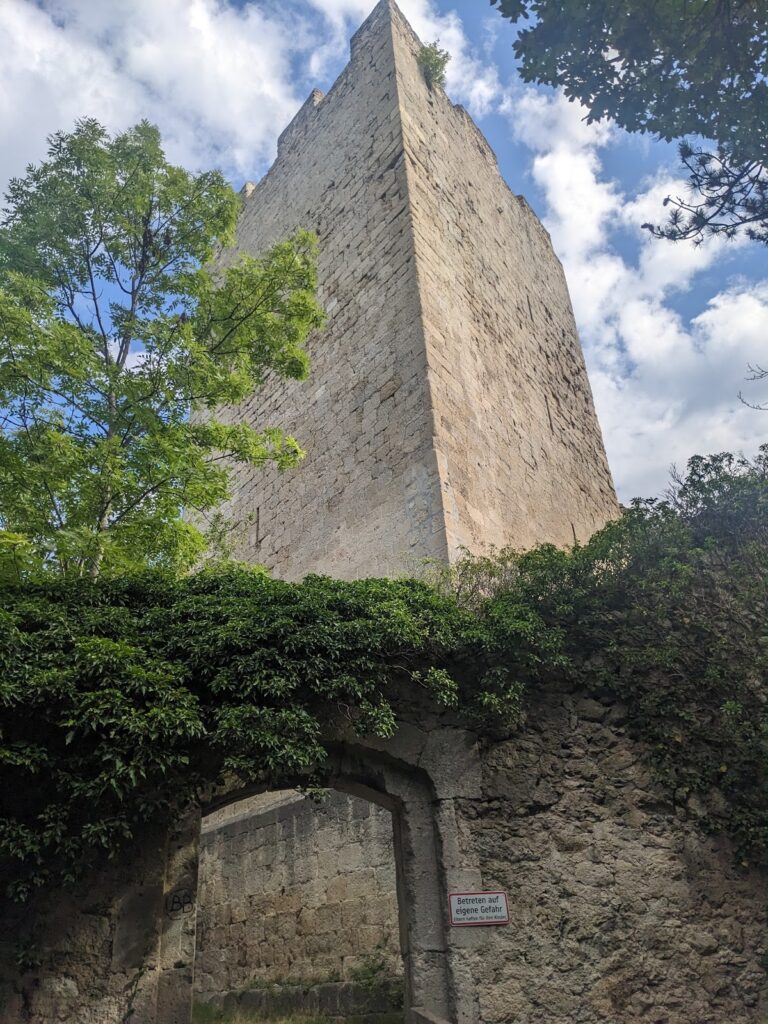
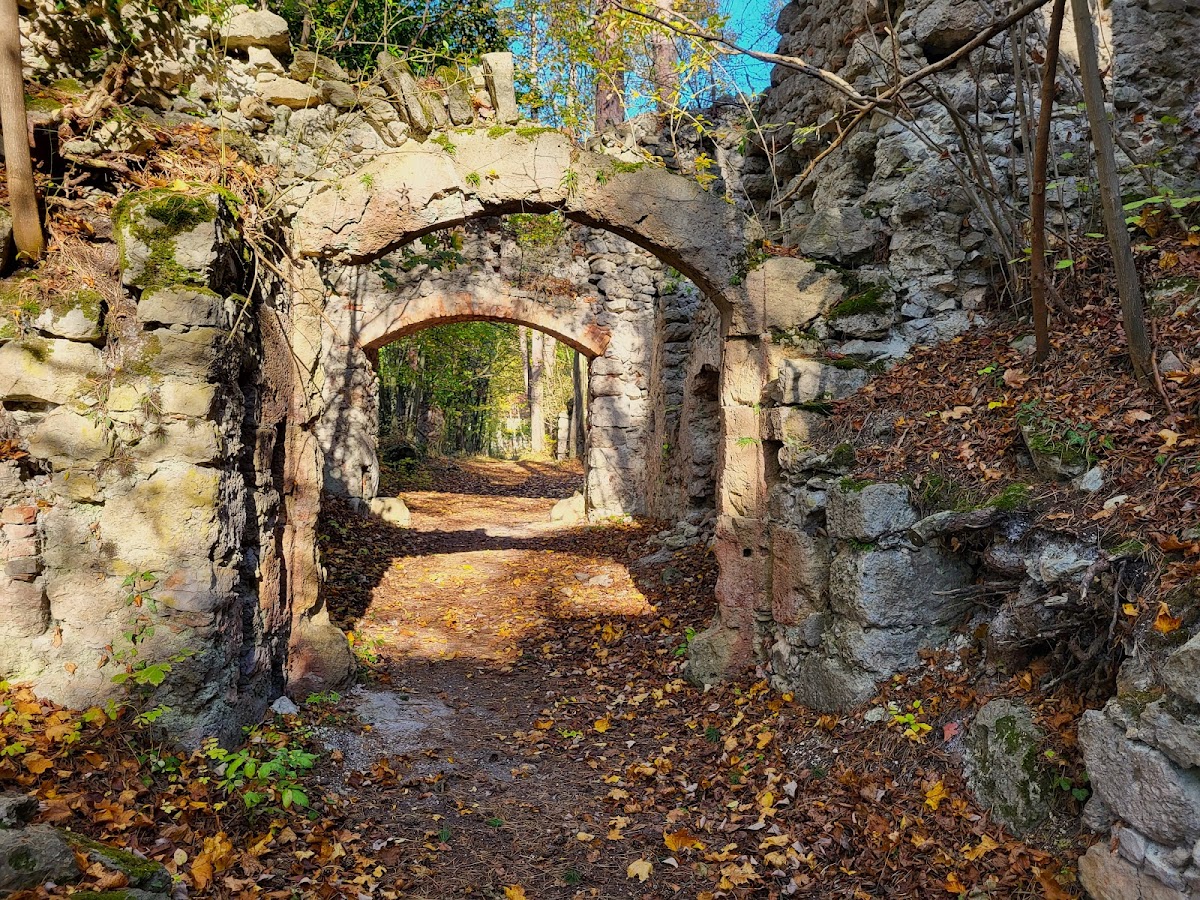
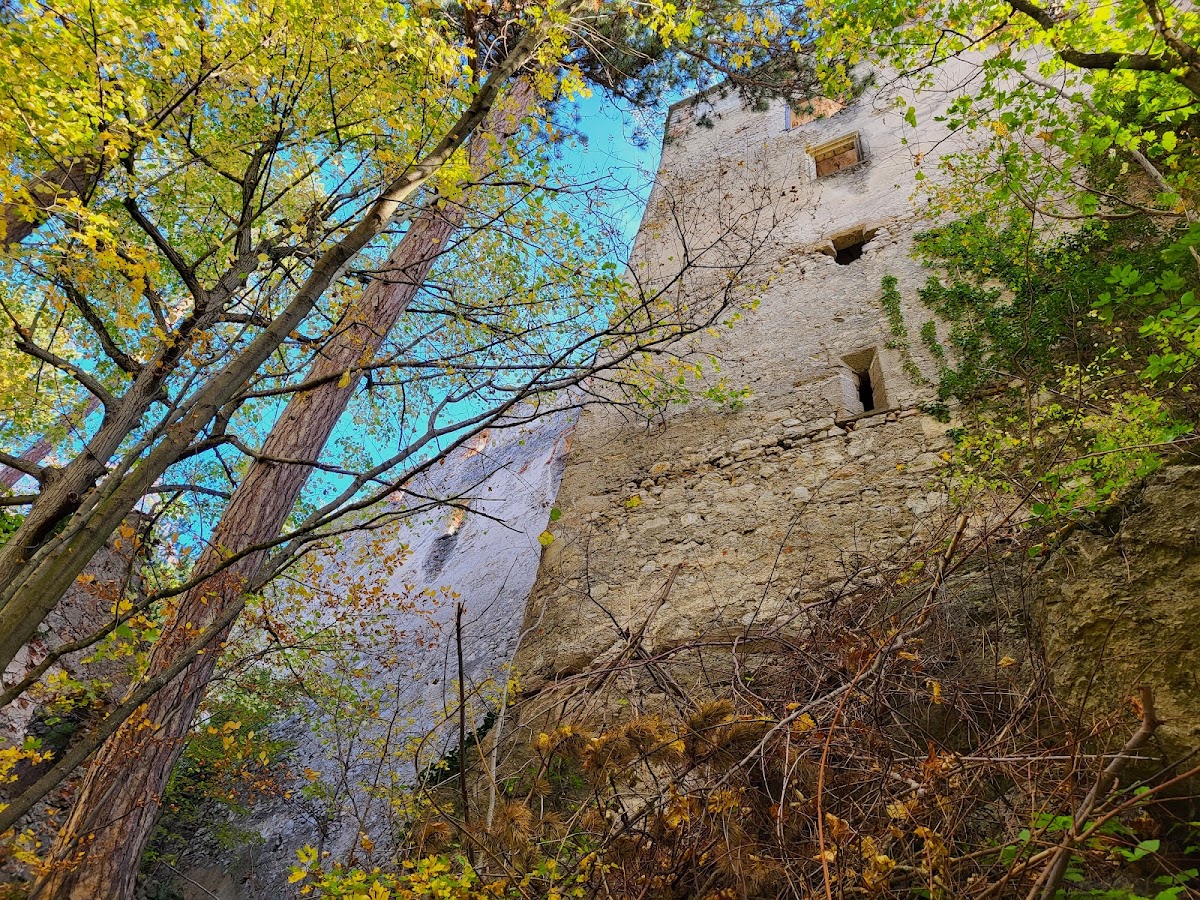
Merkenstein survives as the ruin of a hilltop castle. Its exterior walls, built of rubble stone, remain comparatively well preserved. Because the castle did not have a surrounding ring wall, a defensive wall enclosing the fortified site, parts of the surviving exterior masonry were built up to 6 metres thick. A large arch is also preserved within the ruins, offering a visible fragment of the castle’s former construction.
Merkenstein Cave
Merkenstein Cave lies east of and below the castle ruins. It extends for 72 metres and has a vertical difference of 15 metres. The cave formed in Baden dolomite breccia, a rock made from angular fragments cemented together with dolomite as the principal component. This formation is described as approximately contemporary with Leithakalk, a regional limestone formation.
Archaeological Deposits
The cave floor contains archaeological and palaeontological deposits from several periods. Deeper layers include material from the Roman period, the Hallstatt period, an Iron Age archaeological period in central Europe, and the Copper Age, particularly remains associated with the Baden culture. The Baden culture was a Copper Age society centred in the Carpathian Basin and neighbouring regions.
Ice Age Remains
Deposits from the last Ice Age contain remains of reindeer, Arctic fox, moose, snow leopard, and Siberian tiger. Cave-bear remains were studied in detail, while owl pellets accumulated over tens of thousands of years also occur in the sediments. Numerous small animal remains are partly exceptionally well preserved. Stones once interpreted as wheat remains were later identified as gizzard stones from rock ptarmigans.
Excavation Record and Collections
Before the reference section was removed at the end of the excavations, Franz Mühlhofer identified 17 layers in its vertical profile. A reference section is a recorded cut through sediment layers used to examine their sequence and contents. Because the excavation records are inadequate, only a small number of finds can now be assigned confidently to particular layers. The recovered material is held by the Natural History Museum in Vienna.