Penrith Castle: A Medieval Defensive Castle in Cumbria



Site at a Glance
- Rating
- 4.3
- Popularity
- Low
- Country
- United Kingdom
- Primary era
- Medieval
- External website
- Open
- Eras represented
- Medieval
- Civilizations
- English
- Site type
- Military
- Remains
- Castle
On this page6 sections
History
Penrith Castle is a medieval English defensive castle in Penrith, United Kingdom, built between 1399 and 1470 to protect against Scottish raids. The lordship of Penrith was created in 1397 for the newly established Earl of Westmorland, and the castle is first documented in a grant of 1437.
Origins and the Neville lordship
The castle’s builder remains uncertain. It was once attributed to William Strickland, who later became Bishop of Carlisle, but the late documentary reference has led historians to regard Richard Neville, 5th Earl of Salisbury, as the more likely builder. It is not known whether Neville established the castle on a new site or developed an earlier work associated with Strickland.
A possible reference to construction dates from 1412, while Ralph Neville is recorded as authorizing the building of a tower there in 1413. The idea that local inhabitants built the castle themselves for protection is considered very unlikely. During the fifteenth century, the castle and lordship became the Neville family’s most important local possession and a major source of patronage.
From 1441 to 1444, Richard Neville, Earl of Salisbury, sublet the lordship to Marmaduke Lumley, Bishop of Carlisle and Warden of the West March. This office involved responsibility for the English border facing southwestern Scotland. The Neville estates at Penrith were valued at approximately £350.
Royal possession and Richard of Gloucester
After Salisbury died at the Battle of Wakefield in 1460, his inheritance passed to his son, Richard Neville, Earl of Warwick. Warwick, a powerful political figure in the Wars of the Roses, became known as the Kingmaker. He was killed at the Battle of Barnet without a male heir, and the castle and lordship then reverted to the Crown.
In 1471, Edward IV, the Yorkist king, granted Penrith to his brother Richard, Duke of Gloucester. Gloucester used the castle as a base for military measures against the Scots and drew revenue from the estates of the Forest of Cumberland. He also served as Sheriff of Cumberland for five consecutive years. In 1478, he was described as being “of Penrith Castle.”
Gloucester later seized the throne as Richard III and died in 1485. The castle and town remained Crown property until 1696, when William III granted them, along with much other Crown property in Cumberland, to his friend Hans Willem Bentinck, 1st Earl of Portland.
Dismantling and modern preservation
The Earls and Dukes of Portland sold the castle to the Dukes of Devonshire in 1787. The Devonshires later sold it to the Lancaster and Carlisle Railway Company, which built Penrith railway station nearby. The castle subsequently passed to Penrith Urban District Council. In the 1920s, the council turned the grounds into a public park and built housing in the vicinity.
After the English Civil War, the seventeenth-century conflict between supporters of the monarchy and Parliament, the castle was dismantled and some of its building materials were sold. English Heritage now maintains the ruins. Penrith Castle is listed on the National Heritage List for England as a Grade I building, a designation reserved for buildings of exceptional architectural or historic interest.
Remains
Castle layout and surviving fabric
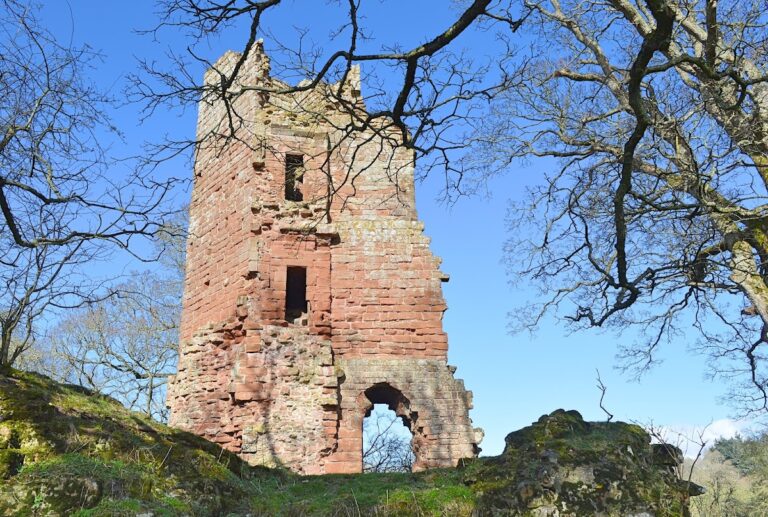
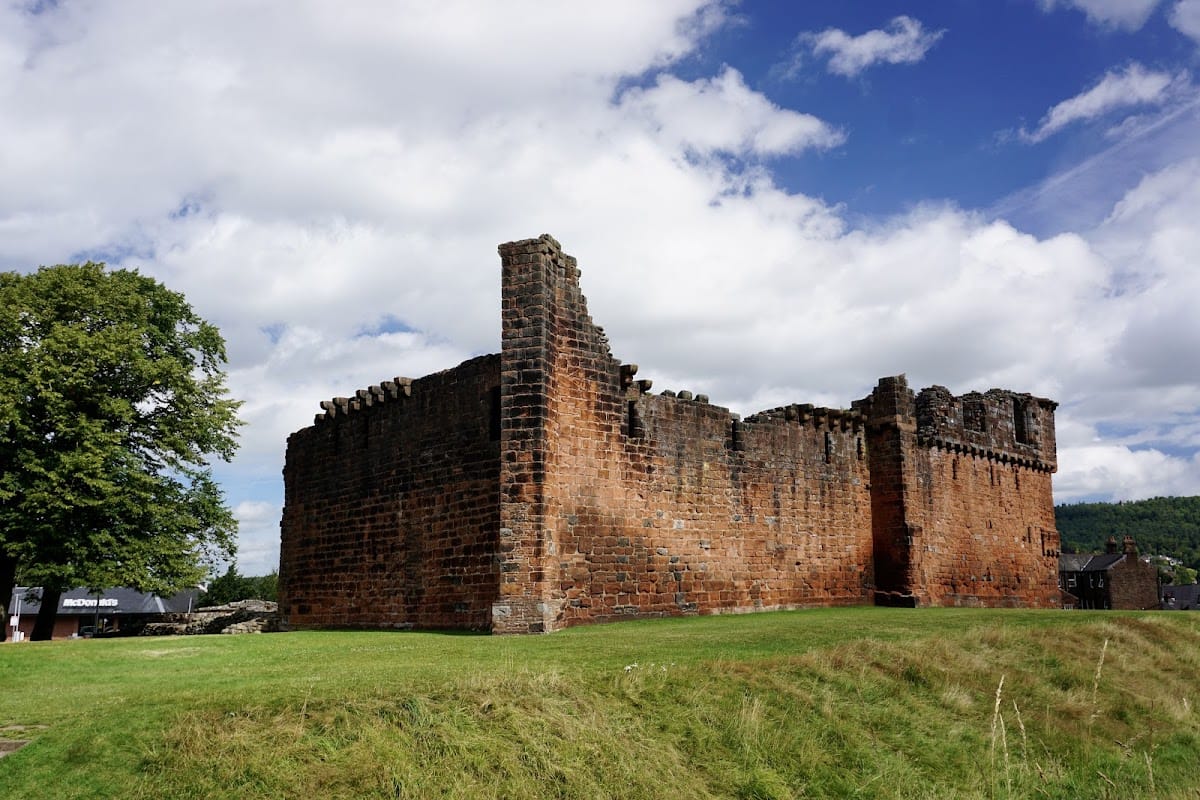
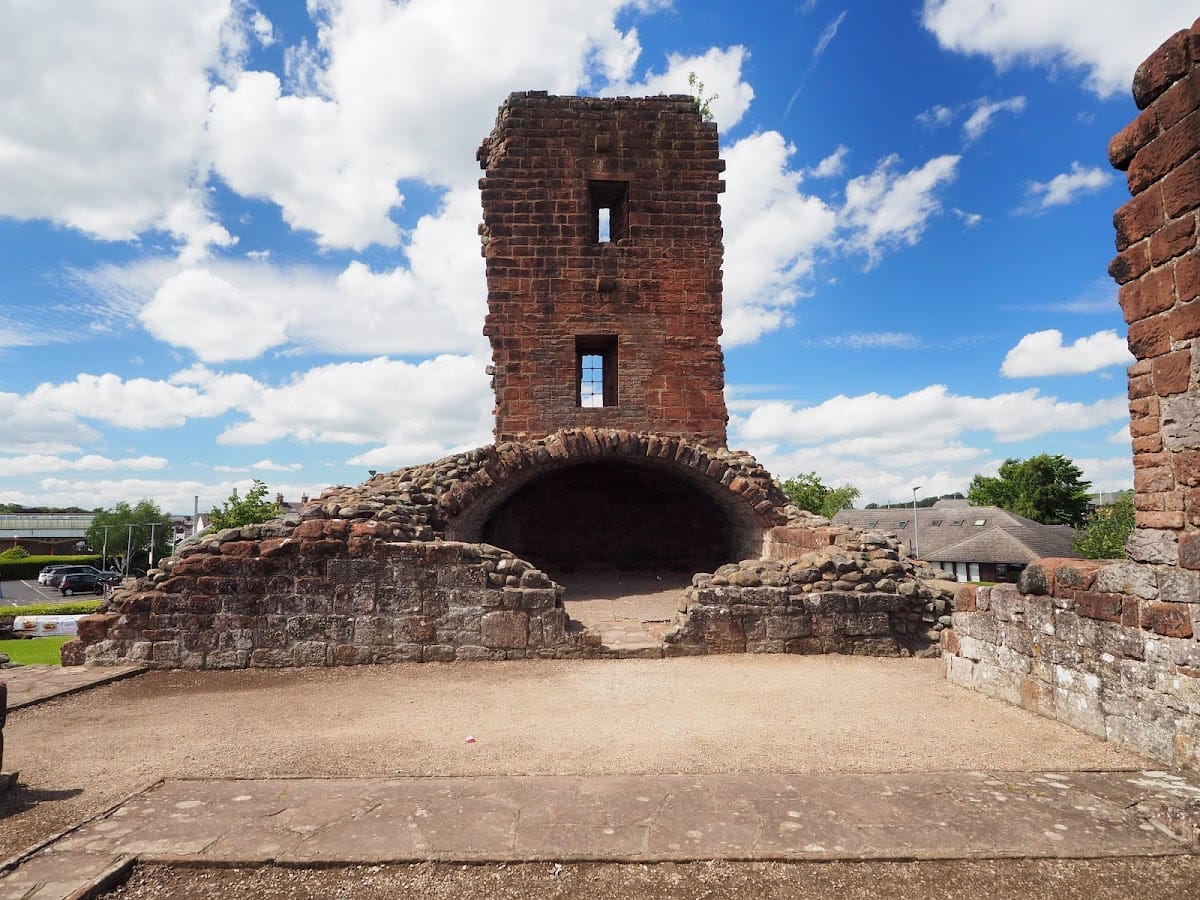
The ruins stand in the western part of Penrith, opposite the railway station. The castle occupied an irregular quadrilateral site, which was likely used earlier by a Roman military encampment. Its principal surviving material is New Red Sandstone, a red sedimentary stone widely used for building in northern England.
Broken walling, window openings, large vaulted spaces, and parts of a moat survive. Projecting corbels on the eastern front appear to have supported an open corridor. Several of the large vaulted areas probably served as prisons, although that interpretation is not certain.
The surviving walls produce markedly different perspectives from different directions. The ruins are considered more notable for their extent than for magnificence or present appearance, while their remaining fabric conveys the scale and defensive character of the medieval castle.