Castello Aragonese: A Renaissance Fortress in Baia, Italy


Site at a Glance
- Rating
- 4.5
- Popularity
- Medium
- Country
- Italy
- Primary era
- Early Modern
- External website
- Open
- Eras represented
- Classical, Early Modern, Modern
- Civilizations
- Italian, Kingdom of Naples, Roman, Spanish
- Site type
- Military
- Remains
- Fort
On this page8 sections
History
Castello Aragonese is a late-fifteenth-century Renaissance fortress in Baia, Italy, built under the Aragonese rulers of the Kingdom of Naples. Construction began in 1495 under Alfonso II of Naples, shortly before the French invasion led by King Charles VIII. The fortress became part of the kingdom’s coastal defenses and occupied a strategic position overlooking the Gulf of Pozzuoli toward Procida, Ischia, and Cumae.
Aragonese foundation
The fortress was intended to prevent enemy fleets from approaching the coast and troops from landing for a surprise advance on Naples. It also belonged to a wider defensive network designed to resist incursions by Saracen and Turkish forces and to limit the power of local barons. Alfonso II sought advice from Francesco di Giorgio Martini, a Sienese architect, engineer, and military theorist known for developing new approaches to fortress design. Martini advised on the overall defensive system and on individual strongholds.
The hill had previously contained a substantial Roman residential complex, possibly the villa of Julius Caesar. The Roman historian Tacitus placed Caesar’s villa on an elevation overlooking the Gulf of Baia, although the identification remains tentative. The fortress’s construction therefore transformed a location already associated with an important Roman coastal landscape.
Sixteenth-century rebuilding
The Monte Nuovo eruption of 1538 seriously damaged the fortress while work was still underway. Pedro Álvarez de Toledo, the Spanish viceroy of Naples from 1532 to 1553, then ordered a major renovation and enlargement as part of a broader coastal-defense program. Completed in 1550, these works gave the fortress its present star-shaped plan, with projecting defenses and angled walls arranged to provide overlapping fields of fire.
Castello Aragonese retained its military role under the Spanish viceroyalty from 1503 to 1707, Habsburg rule from 1707 to 1734, and the Bourbon Kingdom from 1734 to 1860. In 1670, the Spanish court engineer Francesco Antonio Picchiati inspected the fortress and began urgent maintenance after finding that several retaining walls were bowing.
War, decline, and changing uses
The fortress suffered severe damage during the 1734 war between Austrian and Bourbon forces. King Charles III, the Bourbon ruler of Naples and Sicily, ordered its restoration and further fortification. In 1799, during the short-lived French-backed Parthenopean Republic in Naples, an English fleet unsuccessfully attempted to capture the fortress from the French and Neapolitan Republican forces occupying it.
Following Italian unification in 1861, the fortress lost its strategic value and entered a period of decline. It was considered militarily obsolete and came under successive ministerial administrations from 1887, including those of the navy, interior, and defense. In 1927, the state granted the Royal Military Orphanage perpetual usufruct of the complex. Alterations and additions made for this new purpose between 1927 and 1930 changed parts of the fortress, and the orphanage remained there until it was dissolved in 1975.
During the Second World War, Castello Aragonese served as a military prison and as an internment facility for prisoners of war. After 1975, it passed to the Region of Campania and was partly occupied for several years by families displaced by the 1980 Irpinia earthquake. In 1984, the fortress was transferred permanently to the Archaeological Superintendency of Naples and Caserta to become the seat of the Archaeological Museum of the Phlegraean Fields. Its central position among the archaeological sites of Baiae, Cumae, and Pozzuoli helped determine this choice. Castello Aragonese is recognized as Italian national heritage.
Remains
Fortress setting and defenses
The fortress stands about 51 metres above sea level on a promontory in the Phlegraean Fields, a volcanic region west of Naples. A high cliff of tuff, a porous volcanic stone widely used in the region, falls toward the sea on the eastern side. To the west lies the deep depression called Fondi di Baia, formed by volcanic calderas, which are large depressions created when part of a volcano collapses or is removed during an eruption. Walls, moats, and drawbridges reinforce the position. The substantially altered but well-preserved complex has high defensive walls, corner towers, and the watchtower known as Torre Tenaglia. Three drawbridges once provided access for troops.
Roman remains around the fortress
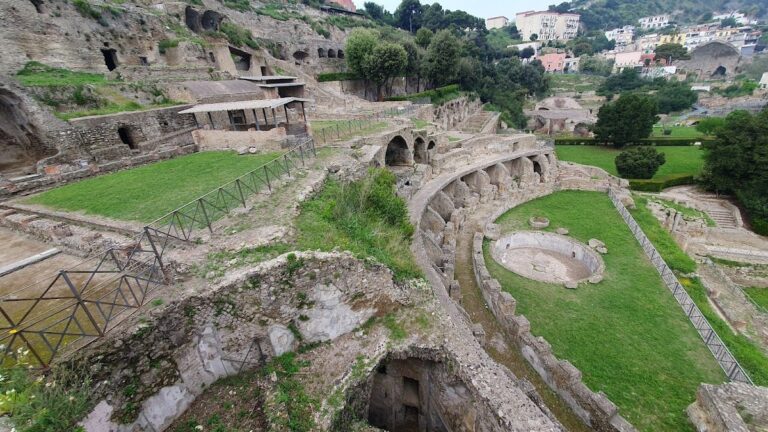
Remains of Roman villas survive around the fortress along the coast and on the landward side near the sports field. Restoration work exposed additional structures in the upper parts of the complex, including the area around Torre Cavaliere, while clearance of vegetation revealed remains lower down along the seaward slopes. Archaeological work outside the fortress also uncovered part of an approach road and a fishpond. Some Roman structures were incorporated into the later stronghold, while others were destroyed during its development.
Archaeological museum
The Archaeological Museum of the Phlegraean Fields occupies the fortress and presents a topographical collection of material from the surrounding volcanic region. Its displays include finds from the Sacellum of the Augustales at Misenum, a small sacred precinct associated with Roman civic priesthoods connected to the imperial cult. They also include plaster casts from the Baths of Baiae and remains associated with the Nymphaeum of Punta Epitaffio at Baiae, a monumental structure linked with water display or the worship of water nymphs. The terraces and bastions overlook archaeological sites including the Baths of Baiae and locations between Cumae and Pozzuoli, while the museum brings material from these places together within the former fortress.