Château de Lœwenstein: A Medieval Rock Castle in France


Site at a Glance
- Rating
- 4.7
- Popularity
- Low
- Country
- France
- Primary era
- Medieval
- Eras represented
- Medieval
- Civilizations
- Holy Roman Empire
- Site type
- Military
- Remains
- Castle
On this page7 sections
History
Château de Lœwenstein is a medieval rock castle in Wingen, France, built in the twelfth century. Its first appearance in records dates to the thirteenth century, when it was a fief of the Holy Roman Empire, a politically fragmented Central European polity that lasted from the Middle Ages until 1806. The lordship was then held by Wolfram von Löwenstein.
Imperial Fief and Noble Ownership
The castle is traditionally associated with the lords of Fleckenstein. In 1283, Rudolf I of Habsburg, King of the Romans from 1273 to 1291, granted it to Johann Ochsenstein. By 1380, ownership was shared with Hensel Streif von Landenberg. Three years later, half of the castle was pledged to Johannes, also called Hanemann, I of Bitche, a member of the County of Zweibrücken-Bitsch.
Destruction and Later Claims
In 1386, the imperial vicar Johann von Lichtenberg destroyed the castle after it had become a refuge for robber knights. An imperial vicar was an official exercising delegated authority for the emperor or the empire in a particular region. Château de Lœwenstein was probably never rebuilt after this attack.
The ruins passed through several lines of ownership. They belonged to the Puller family of Hohenburg in 1482, the Counts of Zweibrücken-Bitsch in 1485, the Counts of Hanau-Lichtenberg in 1570, and the Landgraviate of Hesse-Darmstadt in 1736. French troops commanded by General Monclar destroyed the remaining structures in 1676 and 1677.
Lindenschmidt and Modern Protection
The castle is also known as Lindenschmidt, a name found on nineteenth-century German maps, including the 1879 general staff map. It may be a variation of Linkenschmidt, the name connected with a robber knight who was said to have shod his horses backwards to confuse the trails of his raids. A regional legend says that the knight, his son, and his servant were captured by troops of the Bishop of Strasbourg, condemned at Schönau, and hanged together. According to the story, the servant was executed even though he had acted under compulsion.
Château de Lœwenstein has been classified as a French historic monument since 1898. This protection reflects the surviving remains and the castle’s place in the medieval history of the area.
Remains
Two-Rock Layout
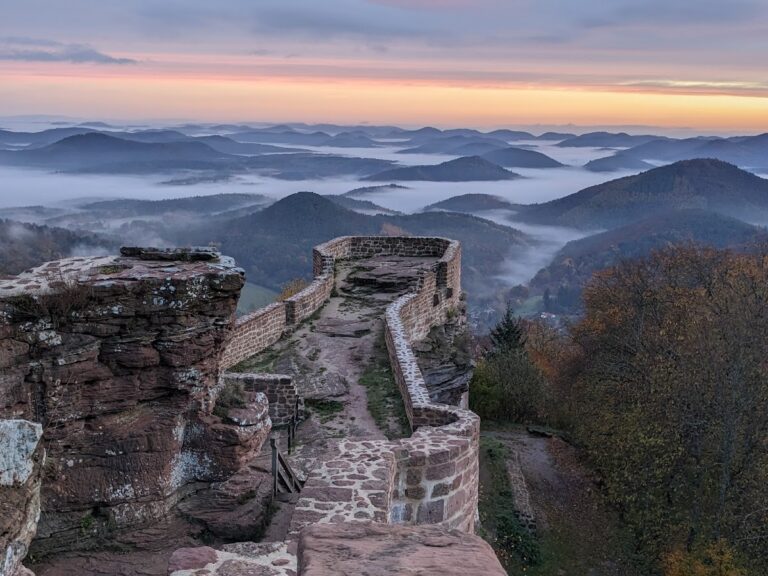
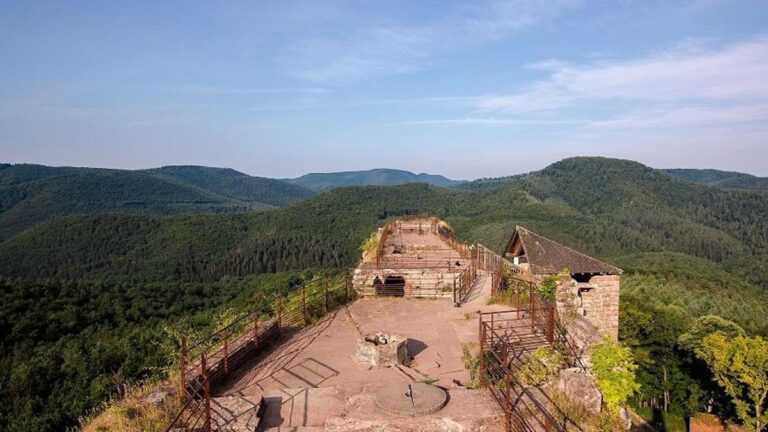
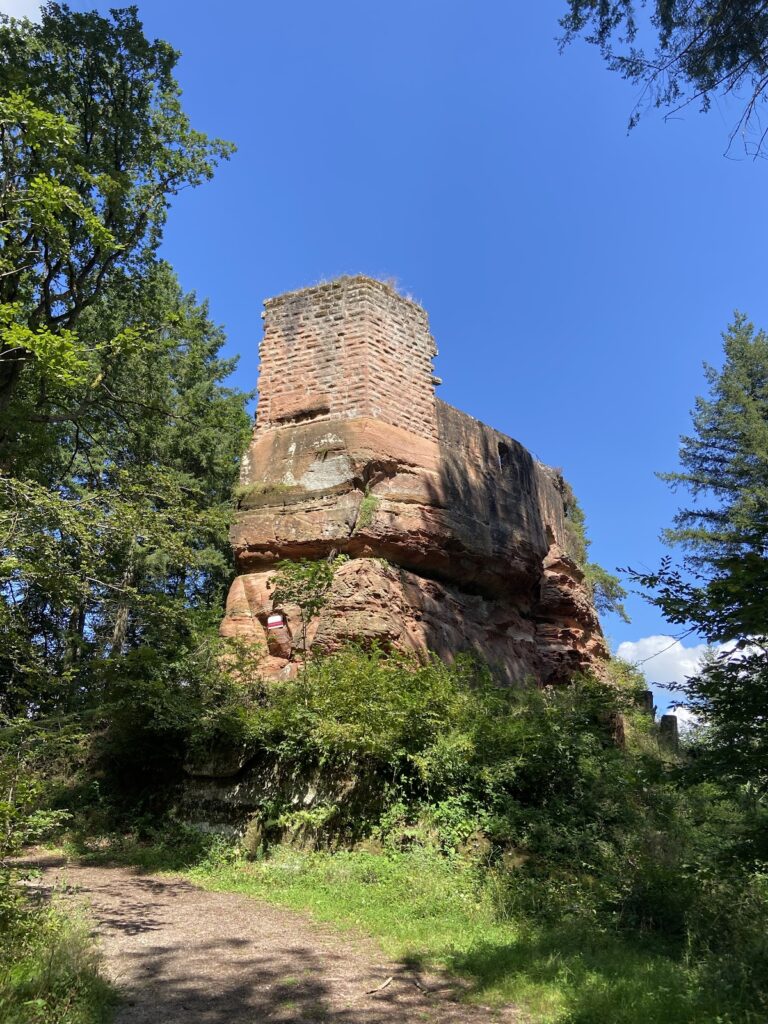
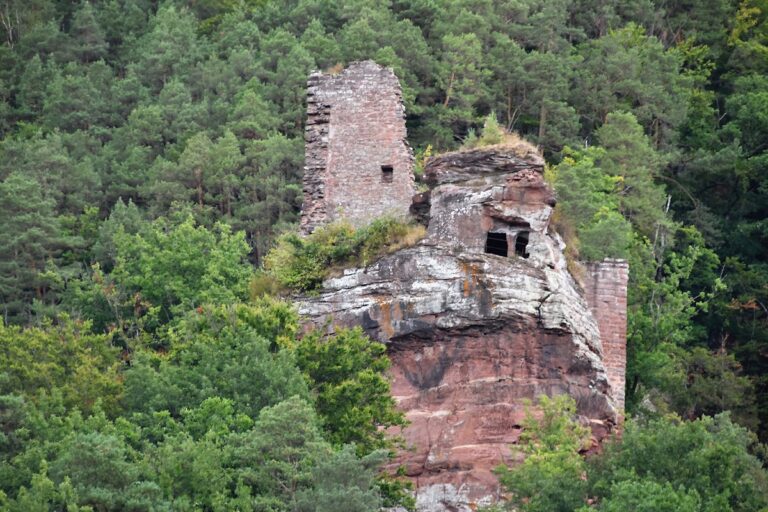
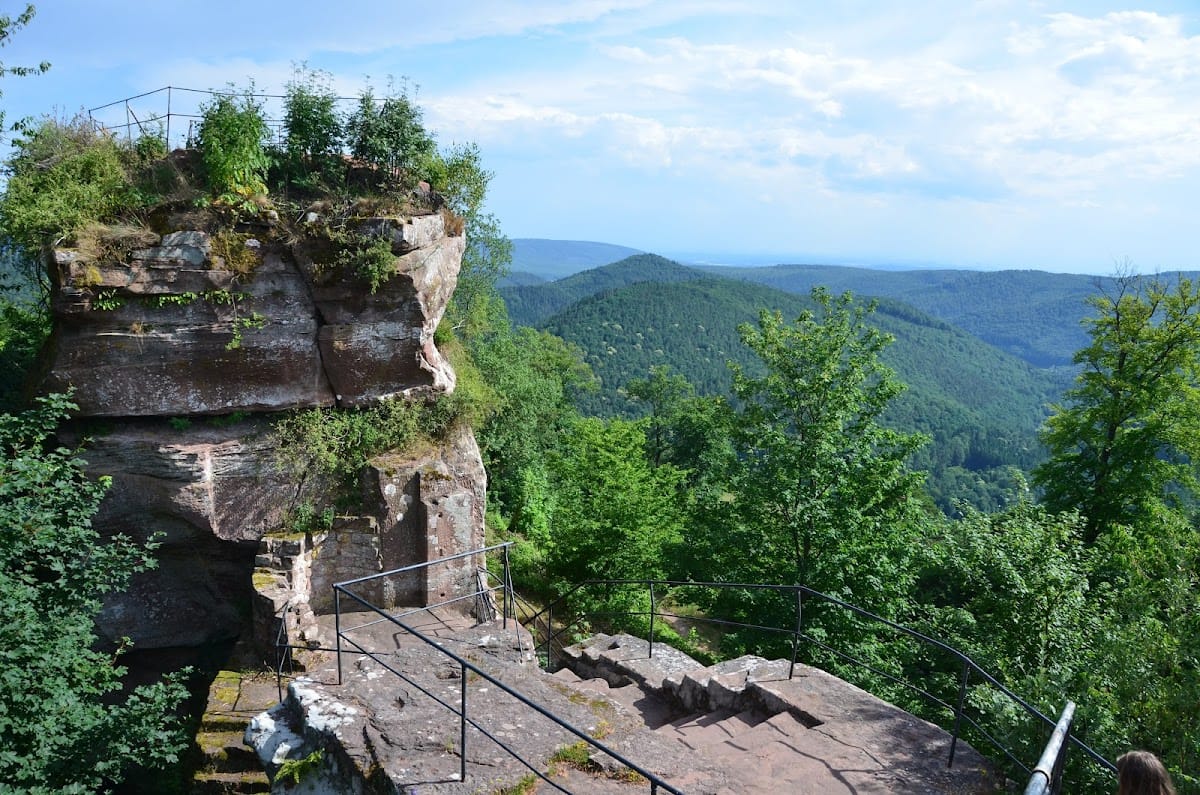
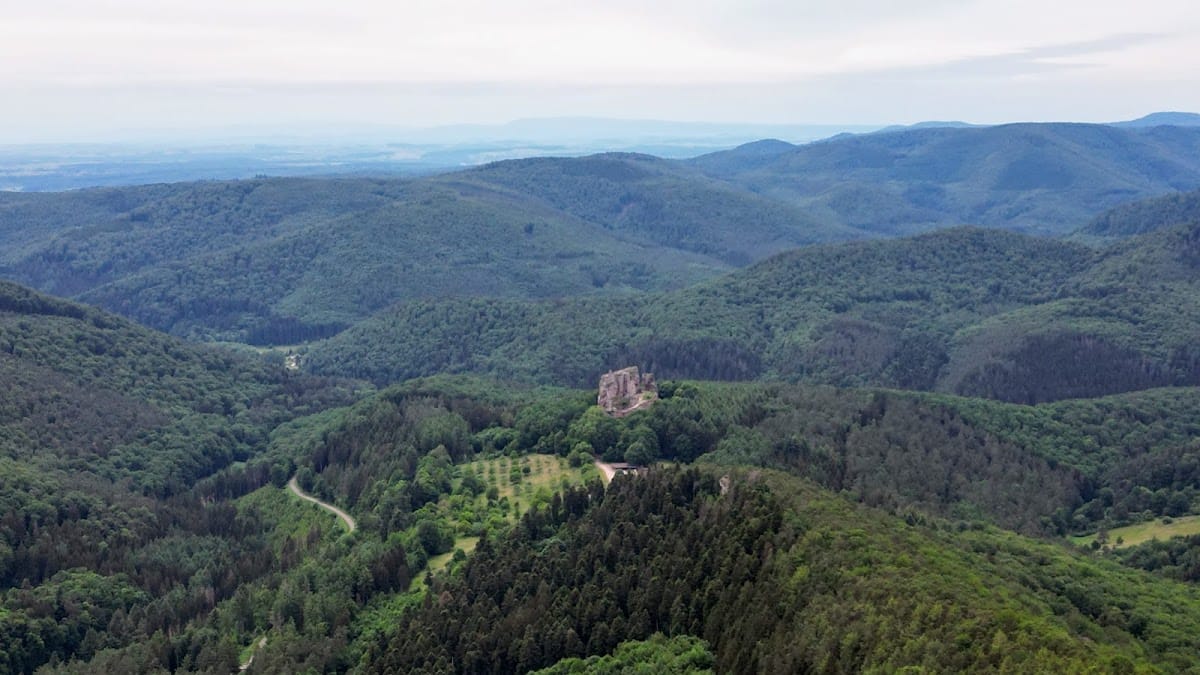
Château de Lœwenstein is a rock castle, or fortification built directly on and into a rocky outcrop, at approximately 530 metres above sea level on a southern spur of Schlossberg. Its position lies near Hohenburg, Wegelnburg, and Fleckenstein. The fortifications occupied two closely adjacent rocks. The main castle stood on the eastern rock, while the outer bailey, the castle’s associated fortified enclosure, occupied the western rock. The complex was also divided into two adjoining parts that belonged to different lords at a stage in its history.
Rock-Cut Features and Surviving Masonry
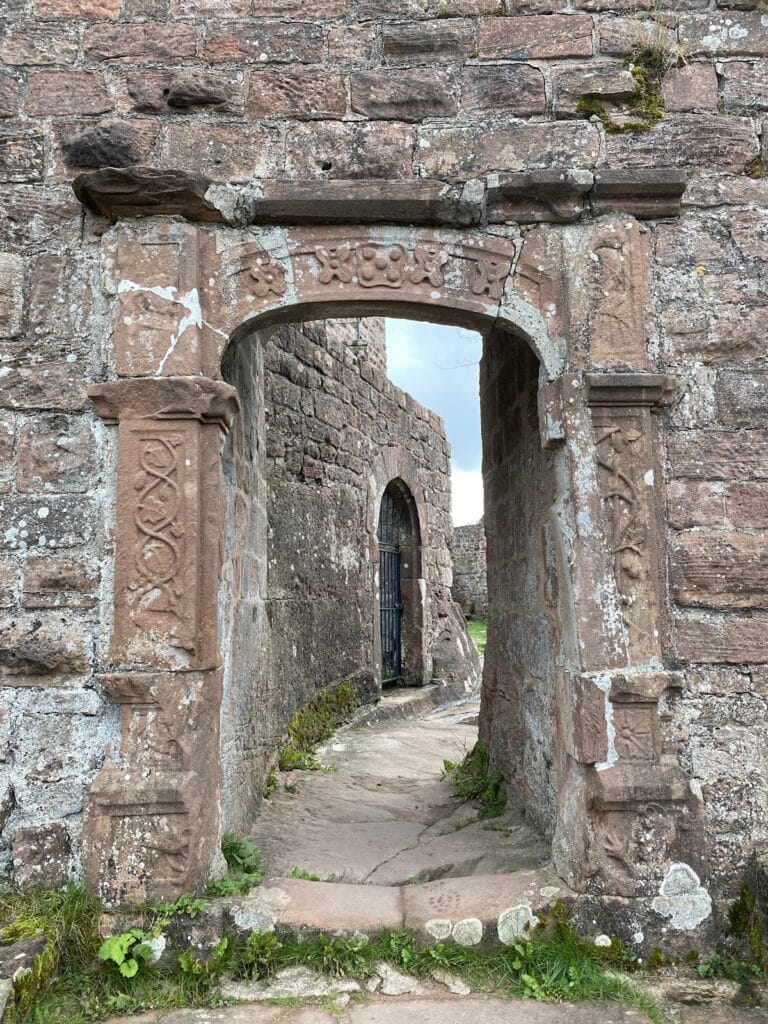
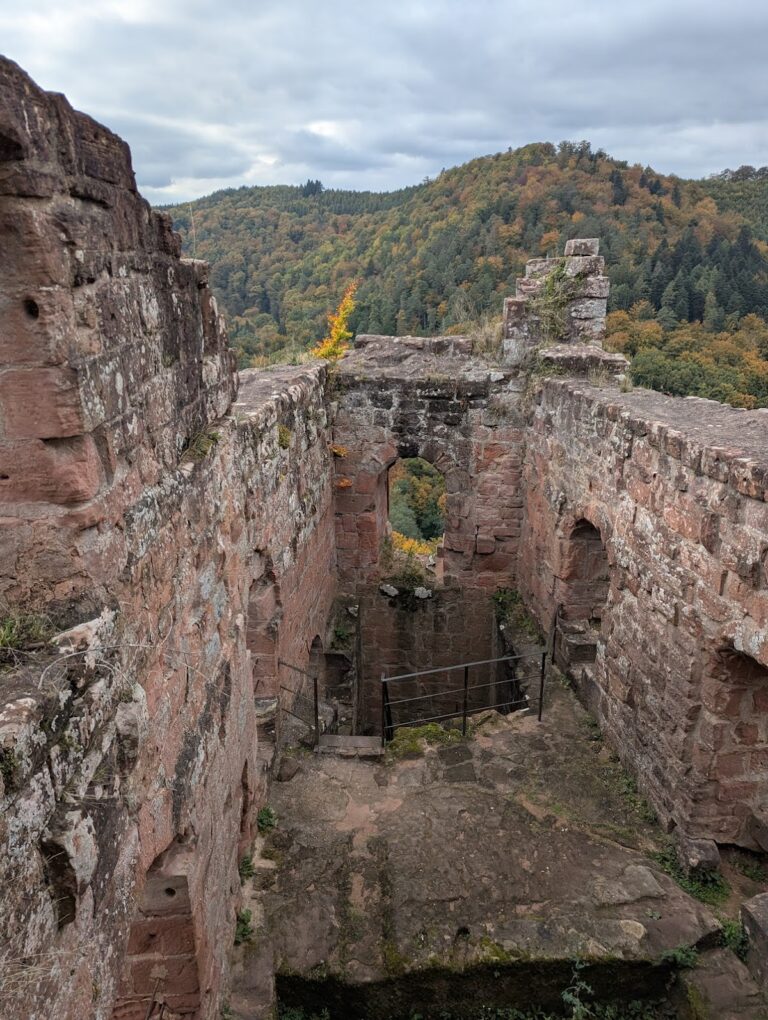
The ruins preserve parts of a stair tower, several stairways cut into the rock, small sections of masonry, and rooms and passageways carved directly into the stone. A cistern remains visible among these features. Together, the rock-cut spaces and surviving masonry show how the castle used the natural outcrop as part of its defensive and structural system. The site is now in ruins, and its former function as a castle has ended.