Château de Hohenbourg: A Medieval Rock Fortress in France

Site at a Glance
- Rating
- 4.7
- Popularity
- Low
- Country
- France
- Primary era
- Medieval
- External website
- Open
- Eras represented
- Medieval, Early Modern
- Civilizations
- Holy Roman Empire
- Site type
- Military
- Remains
- Castle
On this page10 sections
History
Château de Hohenbourg is a medieval rock castle in Wingen, France, probably established during the 13th century as a fortress by the Hohenbourg family. Standing in the French part of the Wasgau near the German border, it formed part of a group of castles that included Wegelnburg, Löwenstein, and Fleckenstein.
Origins and Hohenbourg Lordship
The castle’s beginnings are uncertain, but its earliest known occupants were the Pullers, who were also called the Hohenbourgs. One tradition identifies Gottfried Puller, later known as Gottfried von Fleckenstein, as the family’s first representative. In 1236, Gottfried served Frederick II, the medieval Holy Roman Emperor and King of Sicily, in Italy and is believed to have received permission to build the castle.
Konrad and Heinrich von Hohenburg possessed Château de Hohenbourg in 1262. Rivalry followed from the shared lordships of the Hohenbourgs and Fleckensteins. Their conflict lasted from 1273 to 1289 and ended when Landvogt Otto von Ochsenstein, a territorial governor in the Holy Roman Empire, captured the siege castles of Löwenstein and the rock below Wegelnburg.
Transfers and Family Rivalries
After Wilrich I died, his widow Vye von Wasigenstein transferred the castle to Rupert I, Elector Palatine, in 1389. The Elector Palatine was the ruler of the Electoral Palatinate, a major principality of the Holy Roman Empire. Rupert III later granted Château de Hohenbourg to Konrad Puller von Hohenburg in 1401.
Wilrich II von Hohenburg transferred the castle to his wife, Jutta von Schöneck, in 1434. Their son Richard later quarrelled with the Elector Palatine, who captured the castle. Richard was burned in Zurich in 1482 after being accused of sodomy, although he had previously received asylum and civic rights there.
Richard’s sister had married Swicker VIII von Sickingen in 1475, and the castle passed to Swicker after Richard’s death. Franz von Sickingen strengthened its fortifications in 1504, beginning a phase of military improvement that included defenses designed for firearms and Renaissance rebuilding.
Destruction and Rebuilding
In 1523, allied forces led by Elector Louis V, Archbishop Richard of Trier, and Landgrave Philip I of Hesse captured Château de Hohenbourg and largely destroyed it. The Sickingen family rebuilt the castle in Renaissance style in 1542.
Swedish troops heavily damaged it during the Thirty Years’ War, the European conflict from 1618 to 1648 that began within the Holy Roman Empire and caused widespread military and demographic disruption. In 1680, French troops under Joseph de Montclar completely destroyed the castle during the Wars of the Reunions, conflicts in which Louis XIV’s France sought to expand its territory by asserting claims connected with earlier French possessions or rights.
Ruins and Protection
Following its destruction, Château de Hohenbourg remained in French possession. The Congress of Vienna confirmed this position, although the Sickingen-Hohenburg family made a final claim to ownership in 1836. Uncontrolled or improperly directed excavations took place repeatedly from the mid-19th century onward. The ruins were declared a protected historic monument in December 1898, and partial restoration was carried out during the 1970s.
Remains
Rock Fortress and Central Outcrop
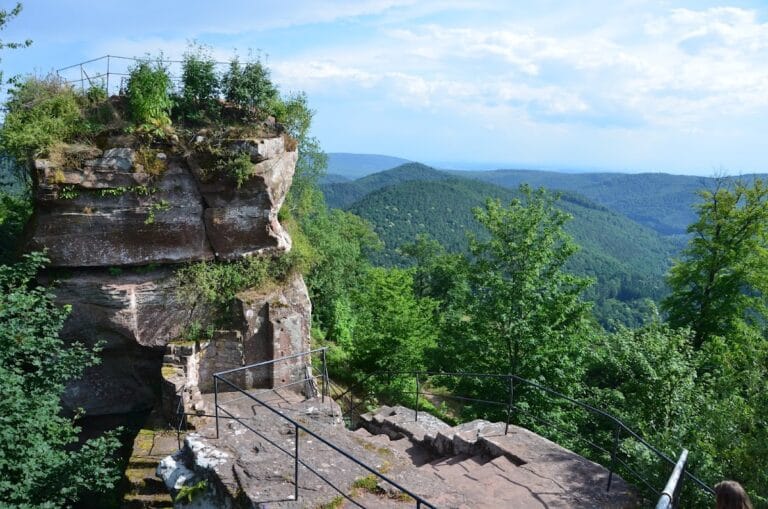
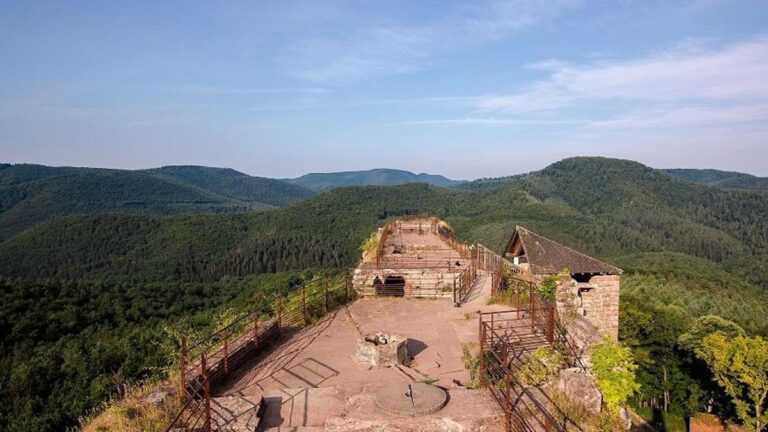
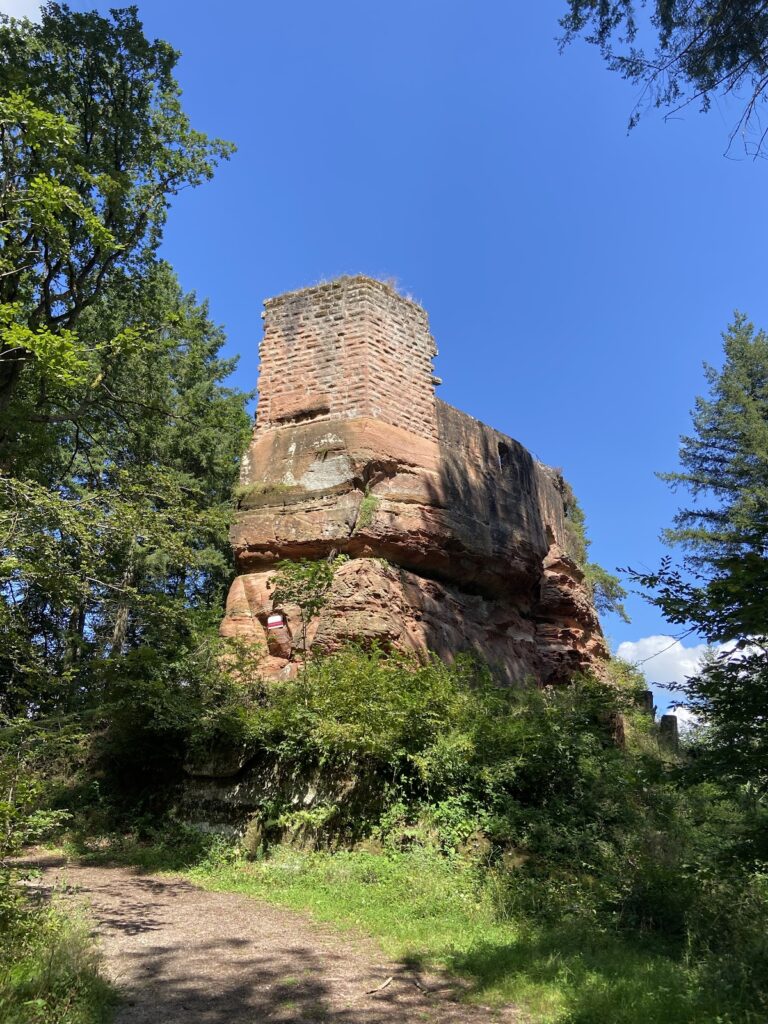
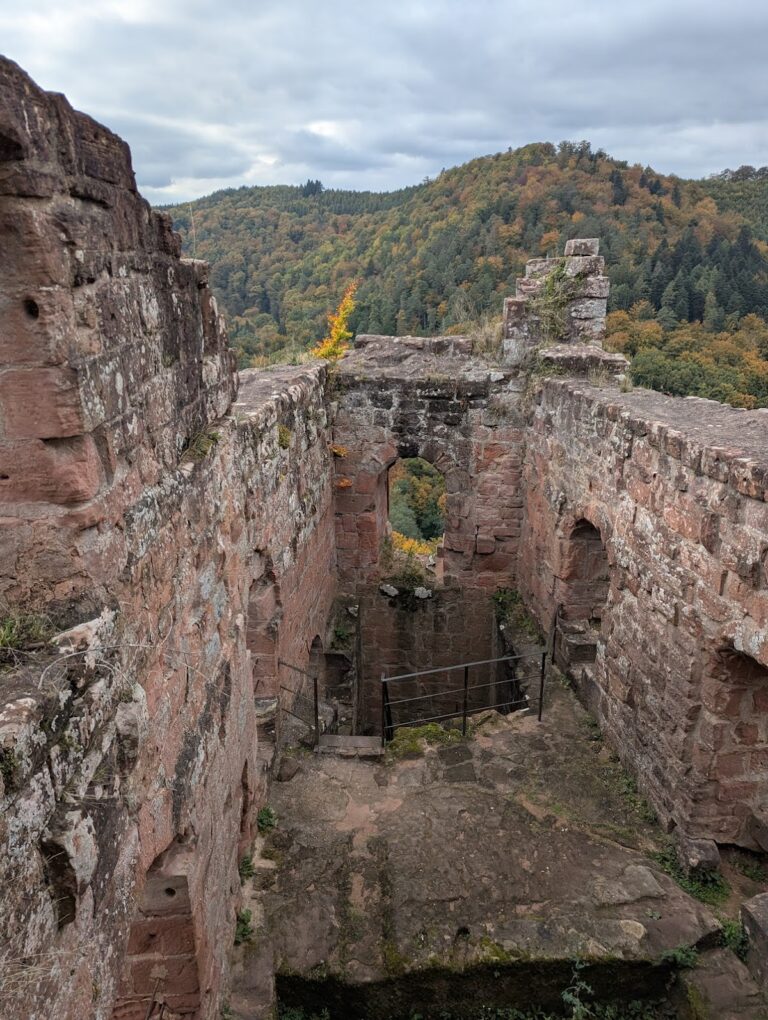
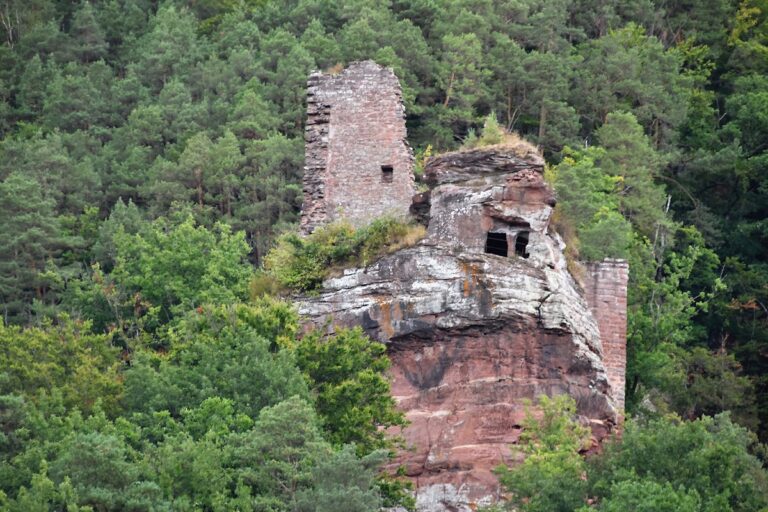
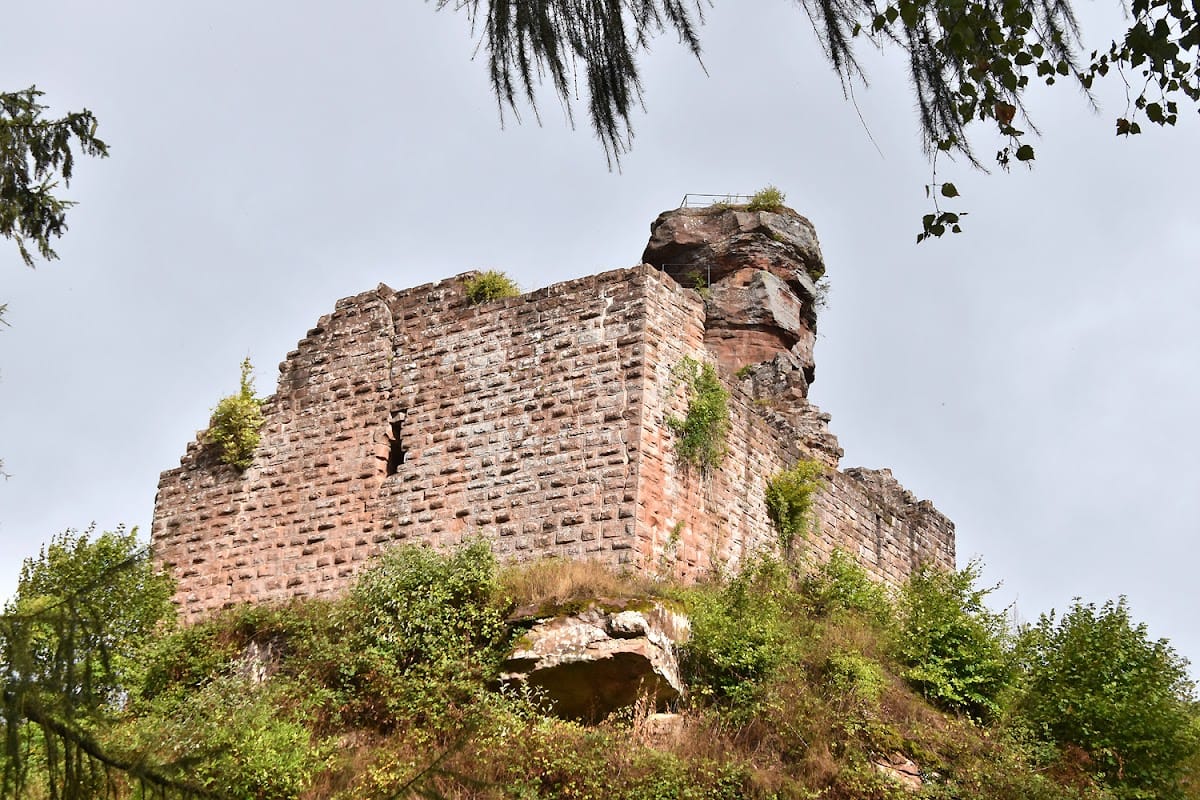
Château de Hohenbourg is a semi-troglodytic fortress, meaning that part of the castle was built directly into the rock. It stands at about 551 metres above sea level on the Schlossberg. The surviving structures are arranged around a rocky outcrop that probably supported a residential tower. A castle well remains visible in the rock, while substantial ruins survive around this central formation.
Early Firearms Defenses
An artillery rondel, a rounded fortification built for firearms and intended to absorb or deflect attacks, was added at the entrance in the early 16th century. It has two broad entrances and two gun openings. Its walls are approximately 3.60 to 4.60 metres thick, reflecting the defensive changes made when artillery became an important part of castle warfare.
Renaissance Features
The early-16th-century improvements also included an artillery bastion and Renaissance portal surrounds. A Renaissance doorway survives among the ruins, while other parts of the portal surrounds have increasingly suffered vandalism. The castle is preserved as a ruin, with its remaining masonry concentrated around the rocky core.
Terrace and Landscape Setting
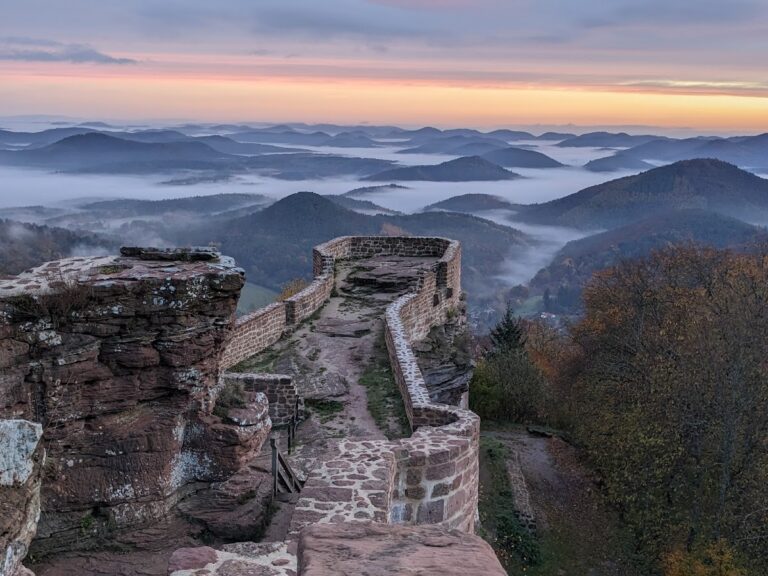
A terrace provides broad views across the Northern Vosges and the Palatinate. In clear weather, the view extends across the Upper Rhine Plain toward Karlsruhe. This elevated position forms part of the castle’s physical setting alongside the nearby rocky strongholds of Wegelnburg, Löwenstein, and Fleckenstein.