Villanueva de Cañedo Castle: A Renaissance Palace in Spain


Site at a Glance
- Rating
- 4.7
- Popularity
- Medium
- Country
- Spain
- Primary era
- Medieval
- External website
- Open
- Eras represented
- Medieval
- Civilizations
- Crown of Castile, Kingdom of León, Spanish
- Site type
- Domestic
- Remains
- Castle
On this page8 sections
History
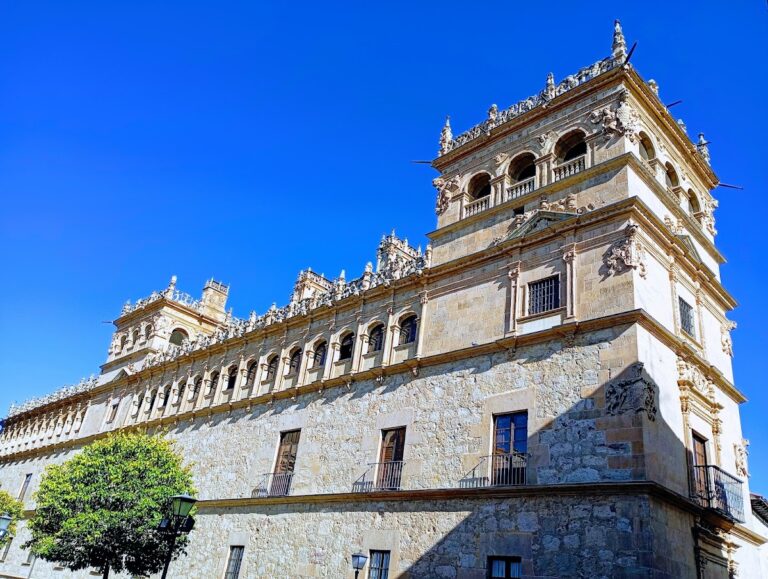
Villanueva de Cañedo Castle is a fifteenth-century Renaissance-style castle in Spain, located at Villanueva de Cañedo in the municipality of Topas, Salamanca. Authorized by Juan II of Castile at the initiative of the House of Alba, it was built over the remains of an earlier eleventh-century castle.
Medieval Foundations and Royal Connections
The castle and the locality were handed over to the Catholic Monarchs, Ferdinand II of Aragon and Isabella I of Castile, in 1475. During the war involving Juana la Beltraneja, a claimant in the Castilian succession conflict, Ferdinand stayed at the castle while travelling toward the Battle of Toro.
In 1476, the property was granted to Alfonso de Valencia y Bracamonte, Marshal of Castile. A marshal held a senior military office at the medieval Castilian court. The following year, the castle passed to Alonso Ulloa de Fonseca Quijada, Bishop of Ávila, a senior Christian officeholder responsible for a diocese.
Fonseca Residence and the County
Fonseca rebuilt the medieval stronghold as a Renaissance palace and made it his regular residence. He shared it with Teresa de las Cuevas, and his enduring relationship with her became associated with the name Buen Amor, meaning “Good Love.” The alternate name Buen Amor Castle therefore reflects a tradition connected with the bishop’s personal life.
During the sixteenth century, Philip II, king of Spain, established the County of Villanueva de Cañedo around the castle for Antonio de Fonseca Enríquez, a descendant of Alonso Ulloa de Fonseca Quijada. The property remained with the counts until José Isidro Osorio y Silva-Bazán, Duke of Sesto and tenth Count of Villanueva de Cañedo, sold it in the early twentieth century.
Modern Ownership and Protection
After the sale, the castle belonged to Ricardo Soriano Scholtz von Hermensdorff, Marquis of Ivanrey, and then to the livestock owner Tabernero de Paz. Tabernero de Paz sold it to the current owners in 1958. The Fernández de Trocóniz family restored the castle between 1958 and 1960.
The castle was declared a Historic-Artistic Monument on 3 June 1931 and is protected as an Asset of Cultural Interest in the Monument category. Since 18 July 2003, the owners have used the restored building as a hotel containing 41 rooms.
Remains
The surviving complex combines the fabric of an earlier eleventh-century castle with the fifteenth-century building that was later reconstructed as a Renaissance palace. Its physical history is therefore visible in the relationship between the earlier basement and the later residential structure at Villanueva de Cañedo.
Castle and Palace Structure
Renaissance Palace
The present castle is a Renaissance-style building dating from the fifteenth century. Its reconstruction as a palace followed the transfer of the property to Alonso Ulloa de Fonseca Quijada. Renaissance principles shaped the rebuilt residence, emphasizing ordered design, classical forms, and the display appropriate to a high-status home.
Eleventh-Century Basement
The fifteenth-century structure stands over an earlier castle from the eleventh century. The basement of that earlier building survives beneath the later palace, preserving a physical layer from the site’s medieval defensive phase.
Nearby sites