Monterrey Palace: An Unfinished Renaissance Palace in Salamanca


Site at a Glance
- Rating
- 4.4
- Popularity
- Medium
- Country
- Spain
- Primary era
- Early Modern
- External website
- Open
- Eras represented
- Early Modern
- Civilizations
- Spanish
- Site type
- Domestic
- Remains
- Palace
On this page6 sections
History
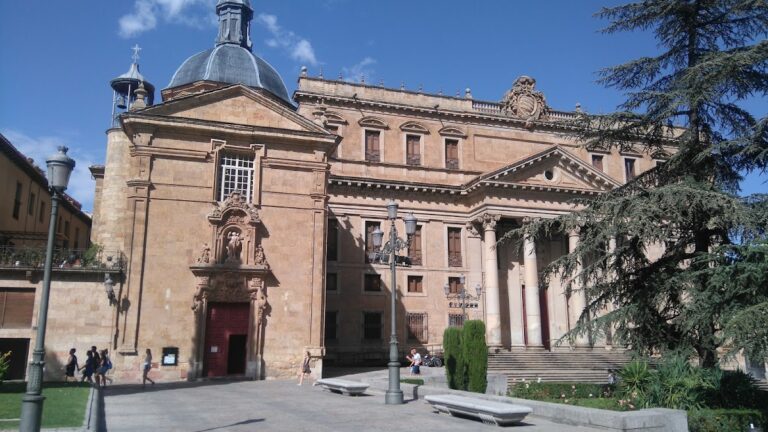
Monterrey Palace is an unfinished Italian Renaissance palace in Salamanca, Spain, commissioned by Alonso de Zúñiga y Acevedo Fonseca, 3rd Count of Monterrey, during the Spanish Golden Age. Construction began on 18 January 1539, with plans prepared by Rodrigo Gil de Hontañón and Friar Martín de Santiago. The count was also viceroy of Naples, a high-ranking representative who governed that territory for the Spanish monarch.
Renaissance commission
The project was conceived as a residence on a much larger scale than the building that survives. It was intended to express the authority and wealth of the high Spanish nobility during the period when Spain held major cultural, artistic, and political prominence across the sixteenth and seventeenth centuries. Pedro de Ibarra and Pedro de Miguel y Aguirre began the work, but the full design was never completed.
Monterrey Palace stands in central Salamanca on Plaza de las Agustinas, about 200 metres west of the Plaza Mayor. Its Italian Renaissance conception was combined with richly ornamental upper sections in the Plateresque style, a Spanish architectural mode whose decoration resembles the detailed work of silversmiths. This combination helped establish the palace as an influential model for later Spanish architecture.
Later influence and ownership
The building strongly influenced Spanish architecture in the nineteenth and twentieth centuries and contributed to the revival known as Neo-Plateresque. This later style drew on the ornamental language of late Gothic and Renaissance Spain. Examples influenced by the palace include the Palace of the Provincial Council of Palencia, designed by Jerónimo Arroyo in 1916, Seville’s Archaeological Museum, designed by Aníbal González in 1919, and the Cavalry Academy of Valladolid, designed by Adolfo Pierrad in 1924.
Monterrey Palace was declared a National Historic Monument, a status equivalent to a Monument of Cultural Interest, on 6 May 1929. It is now owned by the House of Alba, one of Spain’s principal aristocratic houses, which holds the hereditary title associated with Monterrey. Following restoration, part of the interior has been maintained as a museum-like space, while the collection remains private. Most of the family’s ducal collections are kept at Liria Palace in Madrid, the principal residence of the Alba family.
Remains
Planned palace and surviving wing
The intended palace was a large quadrangular or rectangular structure arranged around a central courtyard. The design called for three storeys, towers at each corner, and additional towers at the centre of each wing. Only the southern wing was built, together with its two corner towers, leaving the present palace as an incomplete portion of the original scheme.
The surviving wing is a Renaissance structure whose upper levels carry elaborate Plateresque ornament. Its top-storey gallery contains Renaissance arches, while the balconies and windows are framed by detailed decorative work. At the corners, lions and mythical animals designed by Friar Martín de Santiago support shields bearing the arms of the Zúñiga, Acevedo, Ulloa, Sotomayor, and Fonseca families.
Art and furnishings
The palace contains artworks, furniture, tapestries, and porcelain belonging to the House of Alba. Among the paintings are Jason with the Dragon by Salvator Rosa, a portrait of the Grand Duke of Alba by Alonso Sánchez Coello, and a portrait of Teresa of Ávila by Juan Carreño de Miranda. The collection also includes a work attributed to Annibale Carracci, a sculpture by Mariano Benlliure, and oil paintings by Manuel Benedito.
Two landscapes identified as original works by the Valencian painter José de Ribera are dated 1639. They are described as the only independent landscapes in his entire production, giving these paintings a particular place within the palace’s art collection.
Nearby sites