Belvedere: A Baroque Palace Complex and Art Museum in Vienna
Site at a Glance
- Rating
- 4.7
- Popularity
- Medium
- Country
- Austria
- Primary era
- Early Modern
- Eras represented
- Early Modern, Modern
- Civilizations
- Austria-Hungary, Austrian Empire, Habsburg
- Site type
- Domestic
- Remains
- Elite Residence
On this page17 sections
History
The Belvedere is an early eighteenth-century Baroque palace complex in Vienna, Austria, built for Prince Eugene of Savoy as a summer residence and setting for representation. Its Lower Palace took shape from 1712, and construction of the Upper Palace continued from 1717 to 1723. Baroque was an ornate European artistic style prominent in the seventeenth and eighteenth centuries.
Eugene’s residence
Eugene acquired land southeast of Vienna’s centre in 1697 and added neighbouring plots in 1708, 1716, and 1717–18. His military service in Habsburg forces, including the defence of Vienna against the Ottomans in 1683 and later campaigns, brought him substantial rewards from Emperor Leopold I. The Habsburgs were the dynasty that ruled the Austrian lands.
Work on the Lower Belvedere began in 1712, adapting an earlier pleasure building erected between 1694 and 1697. Johann Lukas von Hildebrandt carried out the adaptation between 1712 and 1717. Construction of the Upper Belvedere began in 1717 and continued until 1723. Eugene generally lived in the Lower Palace, while the Upper Palace was chiefly intended for receptions, display, and formal representation. He received the Ottoman ambassador Ibrahim Pasha at the Upper Belvedere in 1719, while its interior decoration was still under way.
Garden designer Dominique Girard, who had trained at Versailles, began work on the grounds around 1700. The garden was under development by 1717 and complete by 1725. Together, palace and garden expressed Eugene’s wealth and status. Their sculpture also associated him with Apollo and represented his ascent to power. Eugene commissioned painters and sculptors to develop the decorative schemes of both palaces.
After Eugene died in 1736, his niece Princess Maria Anna Victoria of Savoy inherited the estate. She moved into the palace but soon sought to sell it. Three Roman sculptures originally installed in the Lower Belvedere’s Marble Gallery were sold to the Dresden court after Eugene’s death.
Imperial residence and public gallery
Empress Maria Theresa acquired the complex in 1752. The name Belvedere, meaning “beautiful view,” appears in the purchase contract. After a period of limited use, Maria Theresa established a gallery of Habsburg ancestors in the Lower Belvedere. In April 1770, a masked ball for 16,000 guests celebrated the marriage of her daughter Maria Antonia, later Marie Antoinette, to the French Dauphin, the heir to the French throne who later became Louis XVI.
Maria Theresa and her son Joseph II decided in 1776 to move the Imperial Picture Gallery to the Upper Belvedere. The plan reflected Joseph’s support for public access to the collection as part of enlightened absolutism, a form of monarchy that adopted some Enlightenment ideas while retaining sovereign authority. The gallery was inaugurated in 1777, and its opening to the public is dated to 1781. It became one of the world’s earliest public art museums.
In the early nineteenth century, members of the Habsburg family, including Marie Thérèse Charlotte, the surviving child of Marie Antoinette and Louis XVI, and Archduke Ferdinand, formerly governor of Milan, lived in the Lower Belvedere. After Tyrol passed to Bavaria under the 1805 Treaty of Pressburg, the imperial collection from Ambras Castle was transferred there. Egyptian antiquities and another antiquities collection were added in 1833. In 1888–89, the imperial collections moved to the newly built Kunsthistorisches Museum.
Residence, state gallery, and war
Archduke Franz Ferdinand, heir to the throne, took up residence in the Upper Belvedere in 1894. Emperor Franz Joseph I had designated it as the heir’s residence in 1896, and Franz Ferdinand commissioned its remodelling. He displayed more than 18,000 ethnographic objects there and kept a military office in the Lower Belvedere. After his assassination in 1914, the complex was no longer used as a residence.
The Moderne Galerie opened in the Lower Belvedere in 1903, with support in part from the Vienna Secession, an association of modernist artists formed in Vienna in the late nineteenth century. It was Austria’s first state collection devoted to modern art. Renamed the Austrian State Gallery in 1912, it presented Austrian art from the Middle Ages to the present. The complex passed to the Austrian Republic in 1918, and the palaces were assigned to the State Gallery the following year.
During the interwar years, Chancellor Kurt Schuschnigg lived in the Upper Belvedere. When Nazi Germany annexed Austria in March 1938, Schuschnigg was held there under house arrest and Gestapo surveillance before being arrested. The Nazi regime used the Upper Palace for conferences and receptions, including the Vienna Dictate in 1938 and 1940. The Moderne Galerie closed in March 1938, and its twentieth-century artworks were put into storage. The nineteenth-century gallery and Baroque Museum remained open at first, then closed in 1944.
The Second World War damaged the complex, including the Upper Belvedere’s Marble Hall and the Lower Belvedere’s Hall of Grotesques. A fire in the Upper Palace’s Golden Cabinet in 1950 caused further damage to rooms and artworks; several state rooms were destroyed and never rebuilt. Restoration work continued after 1945. The Austrian Gallery reopened in 1953, followed by the Baroque Museum and the Museum of Medieval Austrian Art in the Orangery.
The State Treaty and the Belvedere today
On 15 May 1955, Austria and the four Allied powers signed the Austrian State Treaty in the Upper Belvedere’s Marble Hall. The agreement restored Austria’s independence and sovereignty after the Allied occupation. Foreign Minister Leopold Figl displayed the signed treaty from the balcony, then spoke the words “Austria is free” in the hall. Since 1955, the complex has housed the Austrian Gallery Belvedere.
The museum’s collection spans Austrian art from the Middle Ages to the present. The Upper Belvedere holds the permanent collection, while the Lower Belvedere and Orangery host temporary exhibitions. The museum also operates Belvedere 21 for contemporary art, film, and music. In 2007–08, the medieval and Baroque collections moved to the Upper Palace, allowing exhibition spaces in the Lower Palace and Orangery to be reorganised. Since 2007, the Palace Stables have housed a study collection of 150 works and objects dating from the Romanesque to the Gothic periods, broad styles of medieval European art and architecture.
The garden ensemble forms part of the UNESCO World Heritage property of the Historic Centre of Vienna, a designation recognising places of outstanding cultural or natural significance. In 1996, the World Monuments Fund placed the gardens on its Watch List because restoration was needed for the historic garden and parts of the architectural fabric. The Belvedere has also conducted provenance research, tracing the ownership of works made before 1945 and acquired since 1933, in accordance with Austria’s 1998 Art Restitution Act. The research covers roughly 5,400 paintings, sculptures, and works on paper, with dossiers submitted to Austria’s Commission for Provenance Research and the Art Restitution Advisory Board since 1999.
In 2006, Austria returned five Gustav Klimt paintings, including Portrait of Adele Bloch-Bauer I, to the heirs of Ferdinand and Adele Bloch-Bauer. That year, Edvard Munch’s Summer Night at the Beach was returned to Alma Mahler’s granddaughter, while an arbitration panel decided that Klimt’s unfinished Portrait of Amalie Zuckerkandl should remain at the Belvedere. After the Second World War, Egon Schiele’s Portrait of Wally was mistakenly returned to the Belvedere as part of another dealer’s collection before later passing to Rudolf Leopold. In 2014, Wilhelm Leibl’s Farmer’s Kitchen was ordered restituted to the heirs of Martha Liebermann. In 2020, the advisory board recommended restitution of Schiele’s Four Trees to the heirs of Josef Morgenstern.
Remains
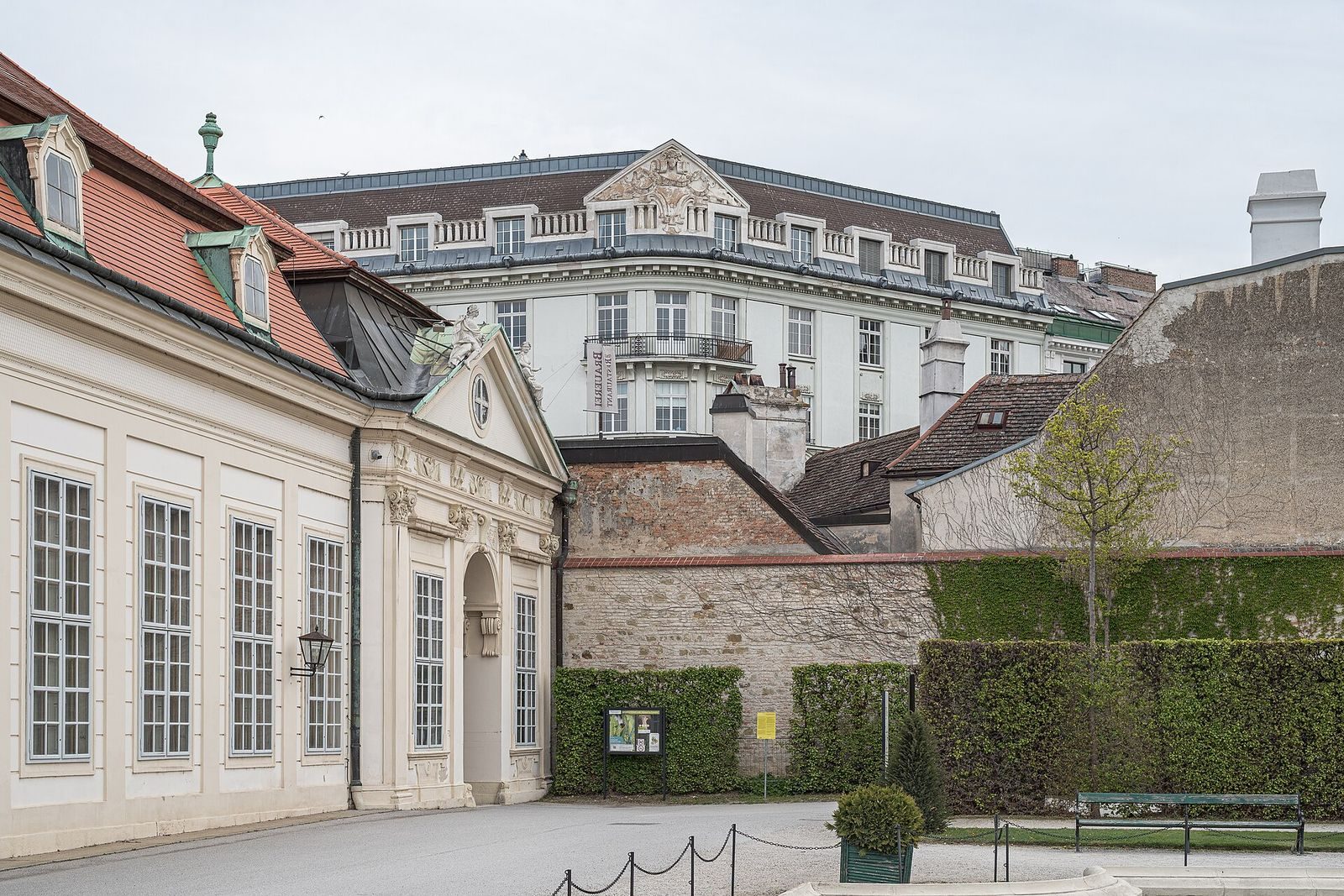
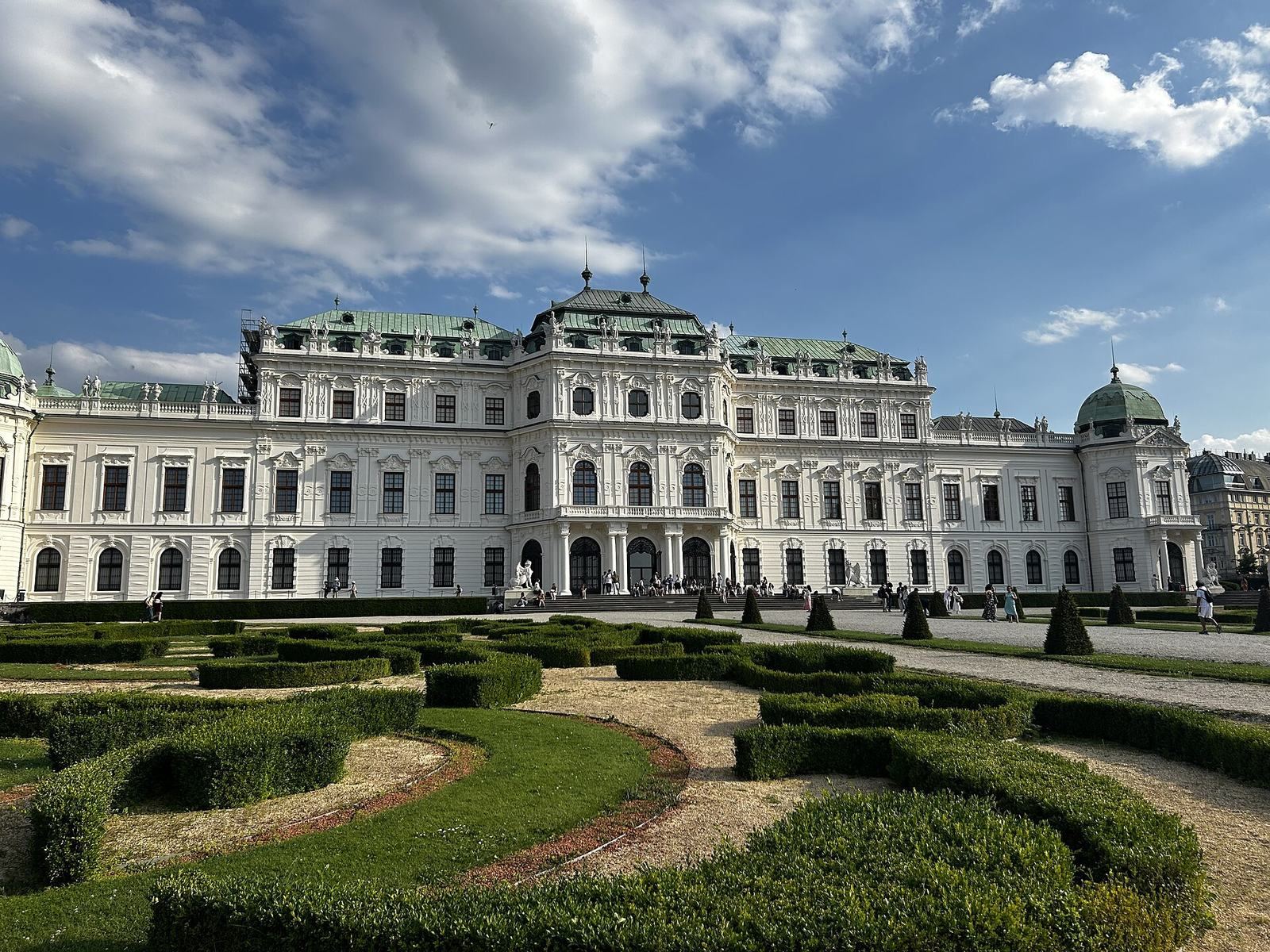
The Belvedere occupies rising ground southeast of Vienna’s historic centre. Its principal buildings, the Upper and Lower Belvedere, stand about 23 metres apart in elevation and are linked by formal gardens. The complex also includes the Orangery and Palace Stables. Its Baroque architecture and garden design combine ceremonial rooms, landscaped terraces, water features, and sculpture.
The palaces and their interiors
Lower Belvedere
The Lower Belvedere was adapted from an earlier pleasure building. Few of its rooms were planned as living quarters, while the Orangery and a ceremonial stable occupied much of the complex. The Marble Hall was designed as a central reception space, with a state bedroom to the west and dining room to the east.
A two-storey marble vestibule imitates a triumphal arch. War trophies and captive figures refer to Eugene’s military victories, while oval stucco medallions show episodes from Apollo’s life. Martino Altomonte’s ceiling fresco depicts Apollo in his sun chariot, with Eugene represented as a nude hero and Hermes announcing papal gifts associated with Eugene’s victory at Petrovaradin in 1716.
The Marble Gallery has richly decorated stucco walls and niches for statues. After the three Roman sculptures first placed there were sold to the Dresden court in 1736, Domenico Parodi made three replacements; he had also made nine comparable statues for other niches. The stucco decoration refers to Eugene’s victories, and the ceiling shows him enthroned in armour while Peace drives away Envy and Hatred.
In the Hall of Grotesques, Jonas Drentwett’s ceiling depicts the Four Seasons, with the Four Elements in the corners. The wall paintings include the forge of Hephaestus, the god of fire and metalworking, and the Three Graces. Most of the paintings survive. A garden-facing wall damaged by a bomb in 1945 was restored.
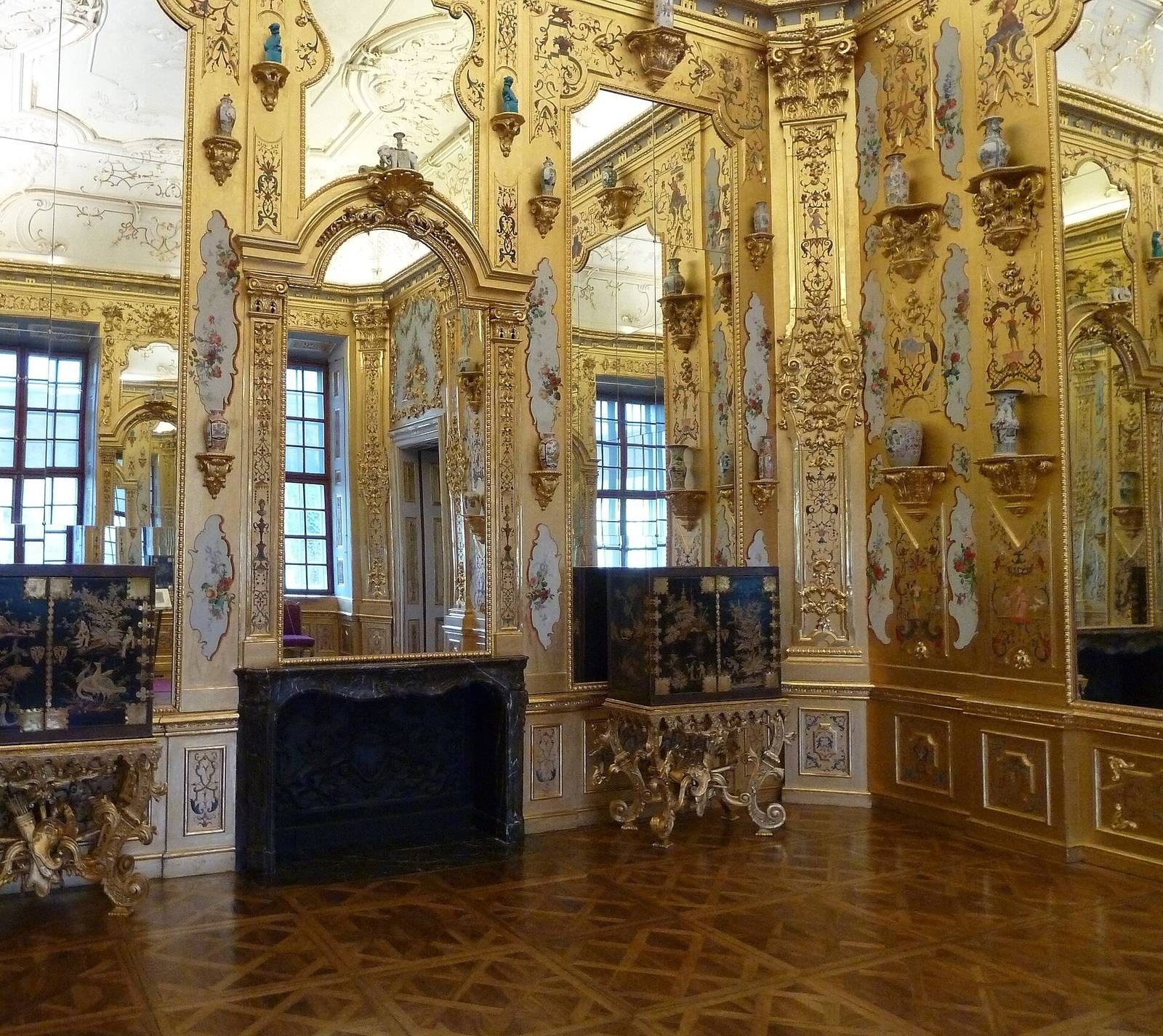
The Gold Cabinet, also called the Mirror Room, was formed from a former sitting room decorated with branches and birds. Maria Theresa’s renovation, apparently complete by 1765, gave it its present form; some of its decoration came from Eugene’s winter palace.
Orangery
The Orangery began as a heated winter garden for orange trees. Its roof and south-facing side could be removed to admit summer sunlight, and it had sliding doors and a movable roof. After the trees were transferred to Schönbrunn, the building was converted into stables. A false ceiling replaced its original sliding roof in 1805. The building later housed modern and medieval art collections and now provides exhibition space linked to the Lower Belvedere.
Upper Belvedere
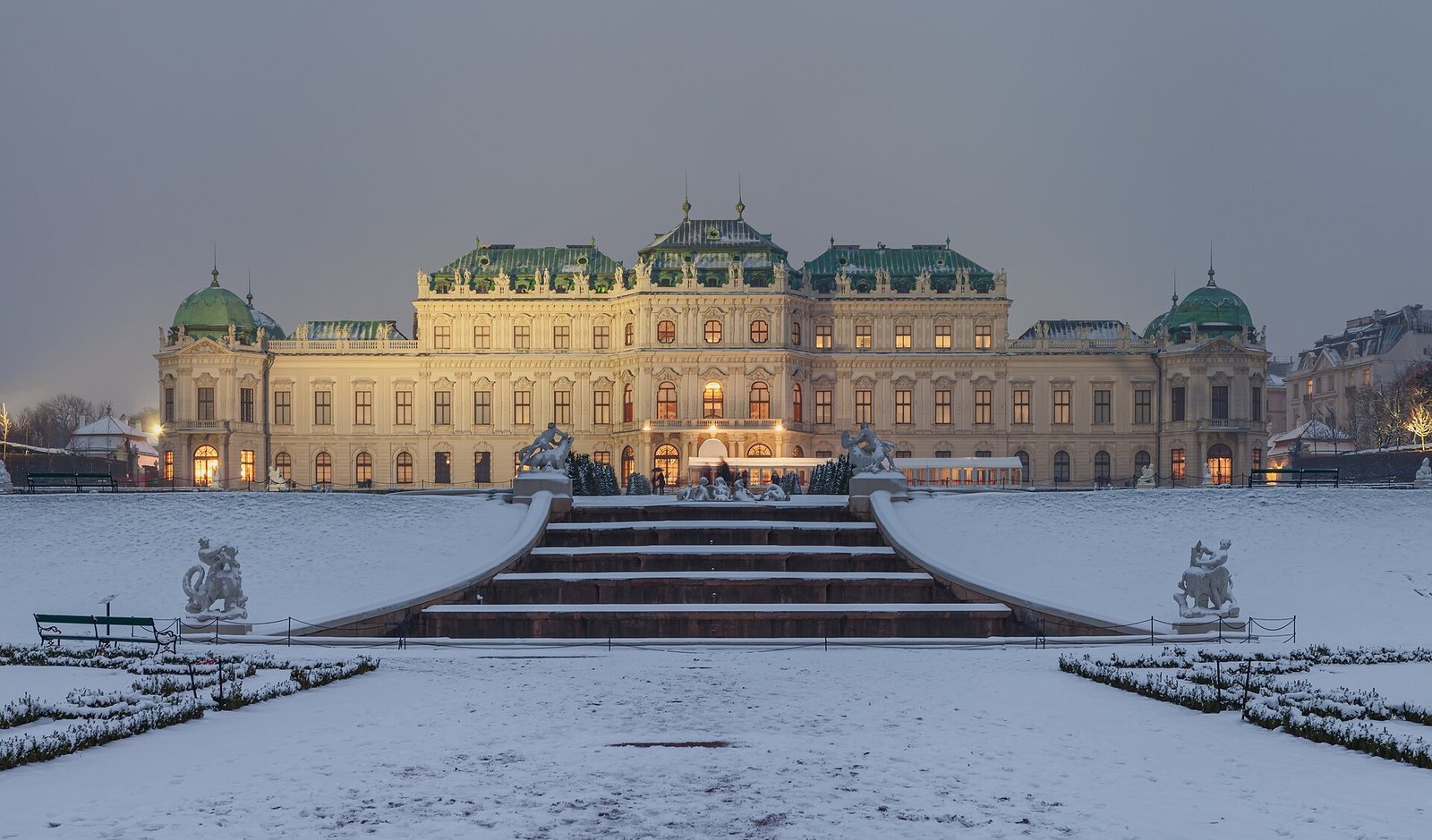
The Upper Belvedere grew from a smaller planned building at the garden’s far end into a palace of its present extent. Its separate blocks and distinct roof structures give the building a varied outline. A large basin before the southern entrance reflects the façade.
The Sala Terrena, a ground-floor garden hall that also serves as a vestibule, connects the garden with the grand staircase. Glazed openings surround its projecting sides. Structural problems led Hildebrandt to install a vaulted ceiling in 1732–33, supported by four atlantes, sculpted male figures used as architectural supports. The figures are made of Zogelsdorf stone, with bases of Kaiserstein.
The grand staircase rises from the southern entrance to the principal floor. Stucco reliefs show Alexander the Great’s victory over Darius on the right and Darius’s women before Alexander on the left. A ceiling scene of Alexander cutting the Gordian Knot was removed in the nineteenth century because of roof problems; a rosette now occupies its place. The staircase uses Zogelsdorf, Kaiserstein, and Mannersdorf stone, as well as Savonnières limestone. It was open on both sides until glazed doors and windows were added in 1904.
The Carlone Hall takes its name from Carlo Innocenzo Carlone, who painted its ceiling fresco, The Triumph of Eos, in 1722–23. Marcantonio Chiarini and Gaetano Fanti created the hall’s illusionistic architectural decoration, which gives painted surfaces the appearance of real architectural space.
The Upper Belvedere’s two-storey Marble Hall is its largest and most elaborate room and was probably used as a vestibule. Brown-red marble cladding and gilded decoration cover its interior. Ignaz von Heinitz painted animals above the fireplaces. Carlone’s ceiling fresco presents Eugene’s eternal glory among princely virtues, with History defending his deeds and Fame rewarding him; Chiarini’s illusionistic architecture surrounds the scene. The stonework includes Adnet marble and artificial marble.
An octagonal chapel occupies the southeastern corner tower. Its two levels reflected household rank: staff gathered below, while the owner and guests used the first-floor balcony. Eight herms, sculpted pillars often bearing a head or bust, support the structure, and broad square windows light the interior. Brown-red marble and gilded stucco relate its decoration to the Marble Hall. Francesco Solimena’s altarpiece depicts the Resurrection; monumental statues of the apostles Peter and John are attributed to Parodi or his assistants. Carlone painted the ceiling fresco of the Holy Trinity. An engraving made around 1730 shows the chapel’s original form.
Other stones used in the palace interiors include St. Margarethen stone, Eggenburg stone, Kaiserstein from Kaisersteinbruch, Mannersdorf stone, Savonnières oolitic limestone, and Adnet limestone.
Formal gardens and grounds
Terraces and water features
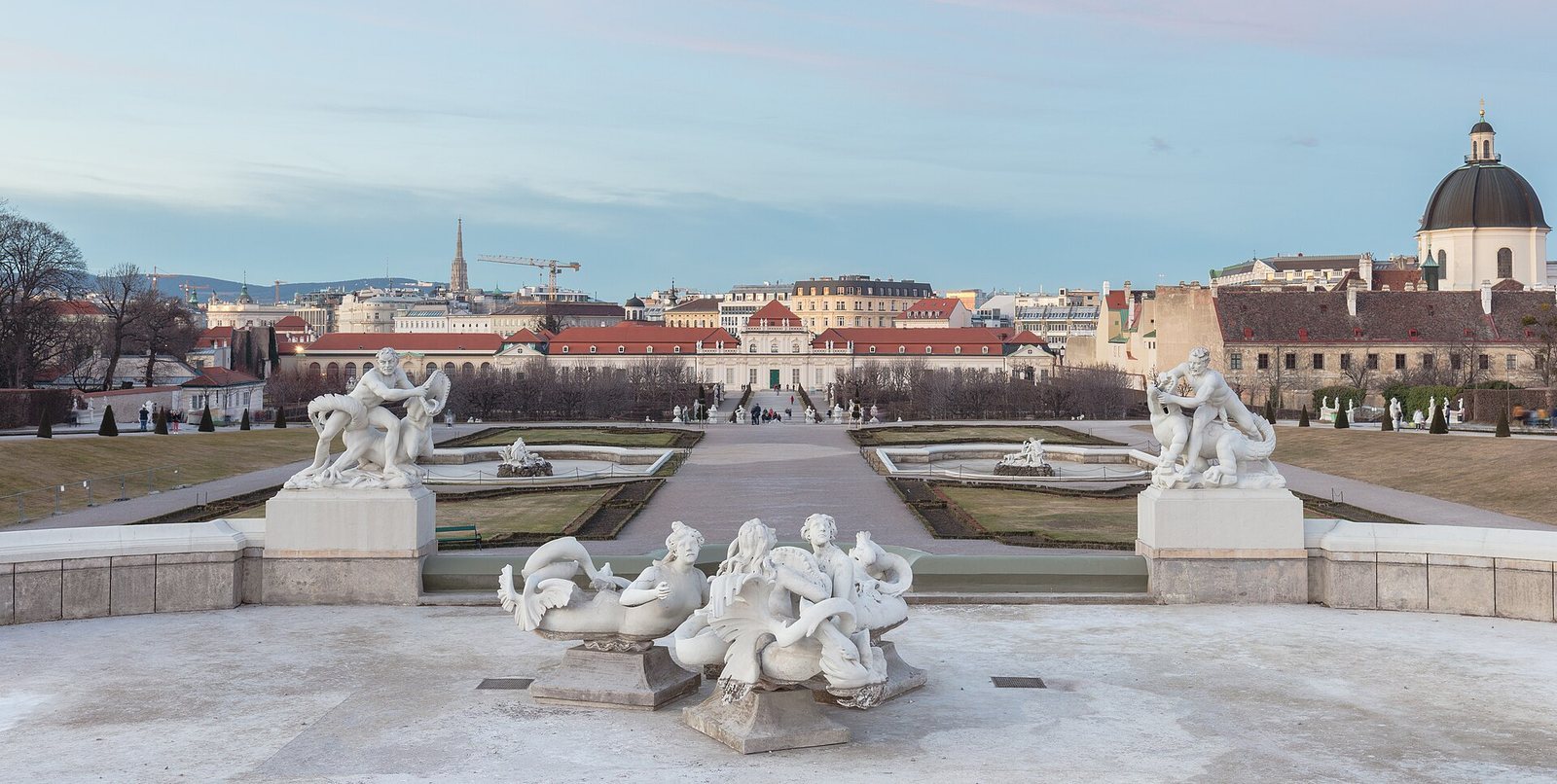
The formal French-style garden extends between the palaces across three main terraces. Symmetrical flower beds, basins, steps, cascades, clipped hedges, and sculpture shape its layout. The levels symbolise Olympus, Parnassus, and the Four Elements. Some of the original patterned beds have become lawns, while the large basin in the upper parterre, a level formal garden area, and the stairs and cascades connecting the levels survive.
Fountains mark the changes in elevation. The upper Cascade Fountain has two basins joined by a five-step cascade. Below it, the Shell Fountain has Tritons supporting a shell-decorated basin. Smaller fountains with putti and nymphs occupy the three parterres and the private garden. The group also includes a wall fountain at the Orangery and a large pond in the Teichhof, south of the Upper Belvedere. A separate large basin behind the palace, in front of the Sala Terrena, reflects its façade. The fountains were out of operation from 1994 because of water loss and were restored between 2005 and 2010.
Garden sculpture and private grounds
Sphinxes stand in the upper parterre. Giovanni Stanetti’s sculptures in the lower parterre include eight Muses, Calliope with Hercules, allegories of Fire and Water, and Apollo and Daphne. Ramps and balustrades at the edges of the middle parterre carry putti representing the months. Made in 1852, these figures replaced earlier ones.
The private garden beside the Lower Belvedere, known as the Kammergarten, was reserved for Eugene and his close companions. Divided into two levels, it lay between the Orangery to the north and bird cages to the south. Fountains, ornamental pavilions, pergolas, and flower beds formed its decoration.
Menagerie and Alpine Garden
East of the Upper Belvedere are remains of a semicircular menagerie, a collection of animals kept for display. Its curved wall includes seven niches containing statues of gods. The grounds had extended east to include the menagerie by 1726; its animals later moved to the imperial zoo at Schönbrunn. A geometric kitchen garden to the south occupied the area now taken by Vienna’s Botanical Garden.
The Alpine Garden beside the Upper Belvedere covers about 2,500 square metres and is devoted to alpine plants. Its collection began at Schönbrunn in 1803 and moved to the Belvedere gardens in 1865. It includes rhododendrons, about 300 varieties of houseleeks, and more than 100 bonsai.
Collections on display
Medieval and Baroque works
The Belvedere collection includes about 220 medieval works, of which roughly 60 are displayed. Among them are the Madonna of Sonntagberg, Conrad Laib’s Crucifixion, Michael Pacher’s Pope Sixtus II Bids Farewell to Saint Lawrence and Flagellation of Christ, Hans Klocker’s carved figures of the Virgin Mary and Joseph, and the Znaim Altarpiece.
Baroque works include Johann Michael Rottmayr’s Lamentation for Abel, Martino Altomonte’s Susanna and the Elders, Balthasar Permoser’s sculpture Apotheosis of Prince Eugene, and Franz Xaver Messerschmidt’s busts. The collection also includes Daniel Gran’s Artemis Welcomed on Olympus, Paul Troger’s Apostle Andrew, and Martin van Meytens’s portrait of Emperor Francis I.
Later Austrian and European art
Works from later periods include Jacques-Louis David’s Napoleon Crossing the Alps, Angelica Kauffmann’s John Simpson, and Ferdinand Georg Waldmüller’s The Grandmother’s Departure. Biedermeier, an early nineteenth-century Central European artistic and cultural period, is represented by Michael Neder’s Coachmen’s Quarrel, Johann Baptist Reiter’s Sleeping Woman, and a view of Vienna’s St. Stephen’s Cathedral by Rudolf von Alt.
The collection ranges from Historicist works, which draw on earlier styles, to Impressionist paintings, an approach associated with depicting light and momentary effects. Examples include Hans Makart’s Venice Pays Homage to Caterina Cornaro, Édouard Manet’s Lady with Fur, Claude Monet’s The Cook and Path in Monet’s Garden at Giverny, and Vincent van Gogh’s The Plain of Auvers. Later works include paintings by Gustav Klimt, Egon Schiele, Oskar Kokoschka, and Helene Funke. Klimt’s The Kiss is among the collection’s best-known works.
Bernardo Bellotto’s Vienna, Seen from the Belvedere, painted in 1759–60 and now in the Kunsthistorisches Museum, depicts Vienna from the Belvedere. The view became known as the Canaletto View and has also featured in debates about the skyline of Vienna’s historic centre.