Hurst Castle: A Coastal Fort Guarding the Solent
Site at a Glance
- Rating
- 4.6
- Popularity
- Medium
- Country
- United Kingdom
- Primary era
- Modern
- External website
- Open
- Eras represented
- Early Modern, Modern
- Civilizations
- British, English
- Site type
- Military
- Remains
- Fort
On this page16 sections
History
Hurst Castle is a coastal artillery fort on Hurst Spit at Milford on Sea, in the United Kingdom, built for Henry VIII between 1541 and 1544 to guard the western entrance to the Solent and the approaches to Portsmouth and Southampton. It formed part of England’s Tudor coastal defences, raised amid fears of invasion during tensions with France and the Holy Roman Empire.
Construction and Tudor service
Henry’s coastal fortification programme began in 1539. Hurst was one of four proposed forts intended to protect the Solent, recommended by Lord High Admiral William Fitzwilliam, the Crown’s senior naval administrator, and William Paulet. The other proposed sites were East Cowes, West Cowes and Calshot. Temporary earthworks preceded the stone fort. Financial controller John Mille directed the work, probably with master mason Thomas Bertie, a senior masonry craftsperson. Bertie became Hurst’s captain in 1542, and construction was complete by January 1544.
The fort was designed to hold up to 71 guns. In 1547 it had 26, including four brass pieces and 22 iron ones. A survey in 1559 recorded eleven usable guns and nine broken ones, along with handguns, bows and arrows, pikes and bills. The survey described Hurst as important for sending reinforcements from the mainland to the Isle of Wight, but faulted its rounded walls and limited protection against attacks along their sides. It also noted the cost of maintaining a captain, deputy, twelve gunners, nine soldiers and a porter. Despite the shortcomings, the fort’s armament made it one of the south’s most powerful defences, although its guns were lighter than desired for attacking ships.
After peace with France in 1558, government attention shifted towards the Spanish threat in southwest England. By 1569, when Thomas Carew was captain, Hurst had fewer than ten guns, though its garrison remained similar in size. Sir Thomas Gorges later succeeded Carew. In 1593, Gorges reported that the gun platforms needed urgent repairs.
Neglect, civil war and royal restoration
Hurst was neglected during the early seventeenth century. Sir Edward Gorges became captain in 1610 and received money to repair breaches in the spit the following year. By 1628, only four or five of the fort’s 27 guns could be fired, and the garrison lacked ammunition and gunpowder. In 1635, the government replaced the fort’s brass guns with iron ones.
When the English Civil War between supporters of the king and Parliament began in 1642, Parliament held Hurst under Captain Richard Swanley. In December 1648 the fort detained Charles I before his trial and execution in 1649. Under Colonel Thomas Eyre during the Interregnum, the period between Charles I’s execution and the restoration of the monarchy, Hurst remained in military use. It was strengthened in 1650 against the threat of a Royalist invasion.
After Charles II returned to the throne in 1660, Eyre was dismissed and Edward Strange became captain. Charles ordered the garrison disbanded and briefly considered demolishing the fort. In 1666, officials decided to assign troops from a unit on the Isle of Wight, under the island’s governor Robert Holmes. Hurst’s poor condition delayed their arrival until 1671. Repairs followed, and by 1675 the fort had a regular garrison and nearly thirty guns.
Prison, smuggling and renewed defences
Hurst continued in military use during the eighteenth century and also held the Franciscan priest Father Paul Atkinson. Under a 1700 law intended to restrict the growth of Roman Catholicism, the Privy Council chose the fort as a prison for convicted priests. Atkinson was probably the only person held there under the measure. He remained at Hurst from 1700 until his death in 1729.
Smuggling around the spit became a concern from the 1670s. In 1729 the Revenue service hired the Hurst, a broad, heavy yacht, to help counter smuggling from Southampton. The activity continued, and later in the century John Streeter led smugglers who used the site as a meeting place. Fishermen and gardeners also made use of the spit.
By 1793 the fort was in very poor repair, with water passing through the walls and decayed bastions unable to support their guns. Repairs and a review of the defences followed the outbreak of war with France. In 1795, two new batteries beside the older fort each received five 36-pound guns, while the older works were fitted with eighteen 9-pound guns. The weapons used in these works had been captured from the French.
As another conflict with France appeared likely in 1803, the keep was adapted to carry six 24-pound guns. Soldiers and civilian contractors completed the work by the end of 1806. Hurst did not take an active part in the Napoleonic Wars, but it served as a hospital in 1809 for soldiers wounded in the Peninsular War.
Victorian expansion and changing naval warfare
In the 1840s, shell-firing guns and steamships raised new concerns about an attack on the south coast. Steamships could pass Hurst quickly, unlike sailing vessels moving against the tide. Military assessments in 1850 and 1851 called for a much heavier armament. Work carried out from 1852 to 1856 strengthened the fort and added new gun batteries and a defensible barracks. The resulting armament included fourteen 32-pound guns, fifteen 8-inch shell guns and two 32-pound carronades. Wartime operation required 440 men, while the peacetime garrison numbered 105. Fort Albert, built across the water on the Isle of Wight, provided supporting fire.
Communications improved alongside the defences. An armoured telegraph cable connected Hurst with Keyhaven on the mainland and Sconce Point on the Isle of Wight in 1852; a further link to Southampton followed in 1854. Flags were also used to communicate with ships entering the Solent.
New guns loaded from the breech and armoured warships soon made the defences inadequate. In 1859, a Royal Commission, a government-appointed inquiry, recommended Hurst for priority improvements among the forts protecting Portsmouth. A major rebuilding phase began in 1861 and was mostly complete by 1870, with further iron protection finished by 1874. The fort never received its full planned complement. By the late nineteenth century, however, its arsenal included ten 12.5-inch, 38-ton guns, fifteen 10-inch, 18-ton guns, five 9-inch, 12-ton guns and three 64-pound guns. The large guns were rifled muzzle-loaders, loaded through the barrel and given spin by grooves inside it. The peacetime force numbered about 131 officers and men, and wartime service would have required substantial reinforcements.
Faster ships and stronger naval guns prompted more work in 1888–93. The changes reinforced the keep’s ammunition magazine and the south bastion, and added quick-firing guns and machine-gun support against fast vessels, particularly torpedo boats. A narrow-gauge railway brought supplies to the fort, while new lights were established around the spit.
Twentieth-century service and conservation
By the First World War, the guns installed in the 1870s were outdated. Hurst retained seventeen of them but relied chiefly on newer quick-firing weapons. Control of the fort’s guns was coordinated from a fire-control post at Needles Battery. After the war, guns were removed from the sixteenth-century part of Hurst, which joined the Ministry of Works’ national collection in 1933. Other parts of the fort were modernised during the 1930s.
In 1940, during the Second World War, Hurst received two 12-pound guns and a unit of the Isle of Wight Rifles. Searchlights and two additional 6-pound guns followed the next year. The 37-person detachment became the 129 Coastal Battery, Royal Artillery, and Bofors automatic anti-aircraft guns were later installed. A Director Tower was built along the west wing. The battery closed in July 1945, and most of its weapons were removed after the war.
The military decommissioned Hurst in 1956 and placed it in the guardianship of the Ministry of Works. English Heritage took over the castle in 1983. Since 1996, the Friends of Hurst Castle have handled day-to-day management, while English Heritage has continued to manage other aspects of the site. Hurst Castle and its lighthouse were designated a scheduled monument in 1981, a legal protection for historic and archaeological sites. The High Lighthouse is a Grade II listed building, a category for buildings of special architectural or historic interest, and Hurst Spit and adjoining coast are protected as a Site of Special Scientific Interest for their natural or scientific features. The castle was included in the World Monuments Watch list of endangered sites in 2022.
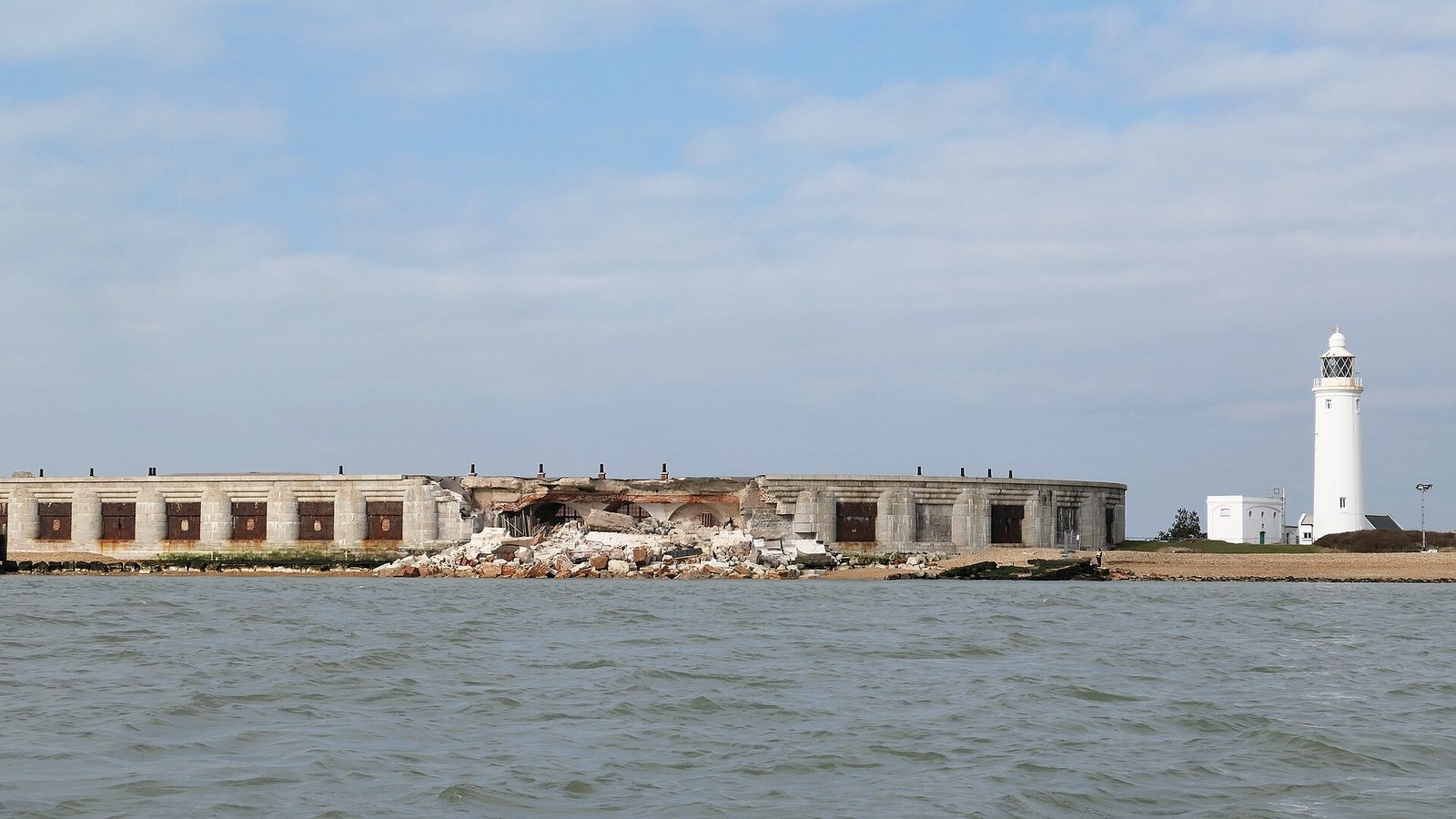
Erosion has gradually shifted the spit towards the shore, damaging remains of the 1852 west battery and barracks and sometimes exposing foundations of later fortifications. The erosion intensified after the 1940s, when groynes at Bournemouth and Christchurch interrupted the natural movement of shingle from local cliffs. Stabilisation work began in the 1960s to protect the castle and nearby towns. More than 900,000 tonnes of gravel were laid in the 1990s, with further work in later years. Erosion damaged the eastern end of the castle in 2013, and compromised foundations led to the collapse of part of the eastern wing’s wall on 26 February 2021. Repairs began the next month, using shingle and granite to secure the surviving wall and construct a protective barrier, completed in June.
Remains
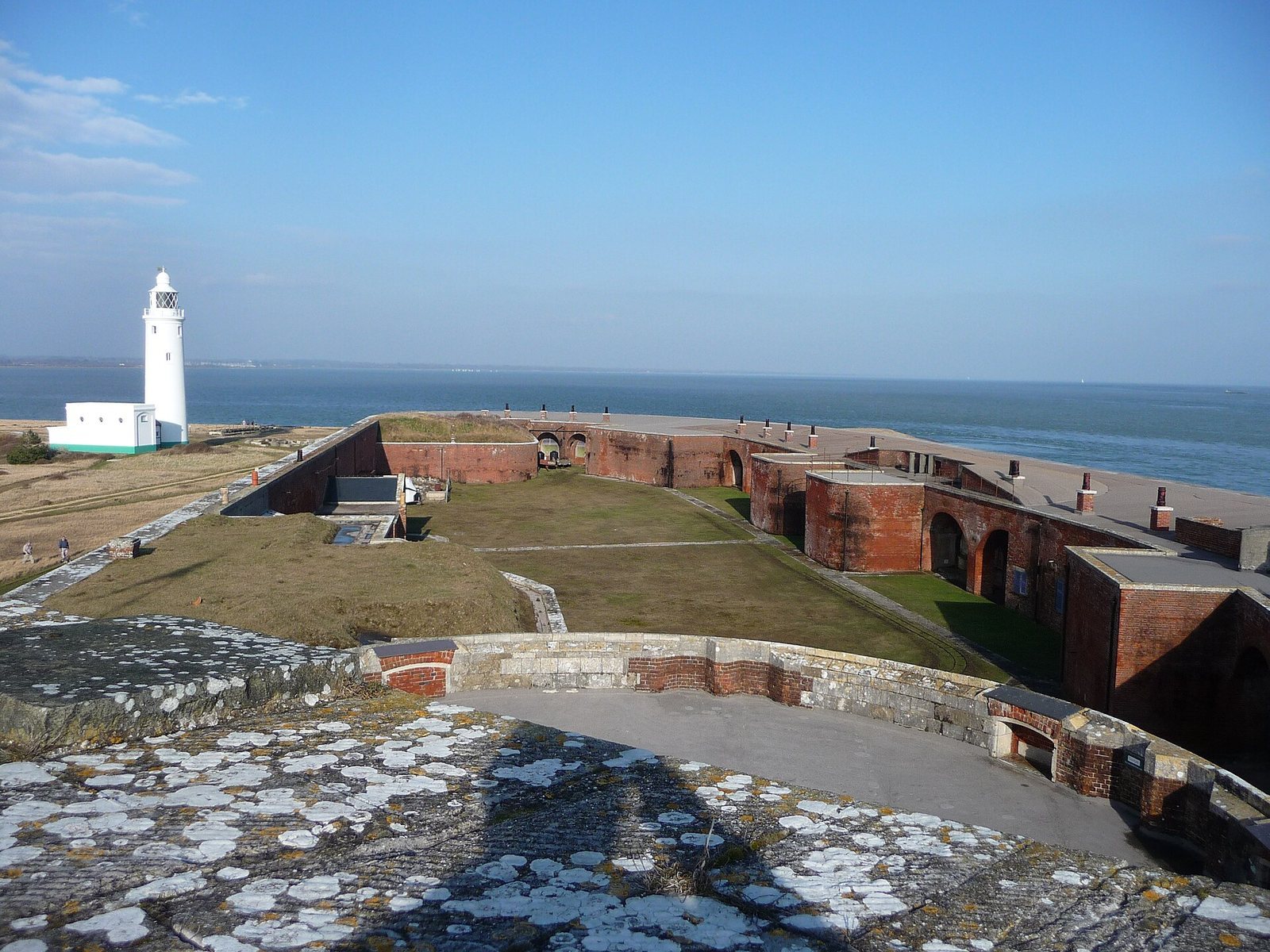
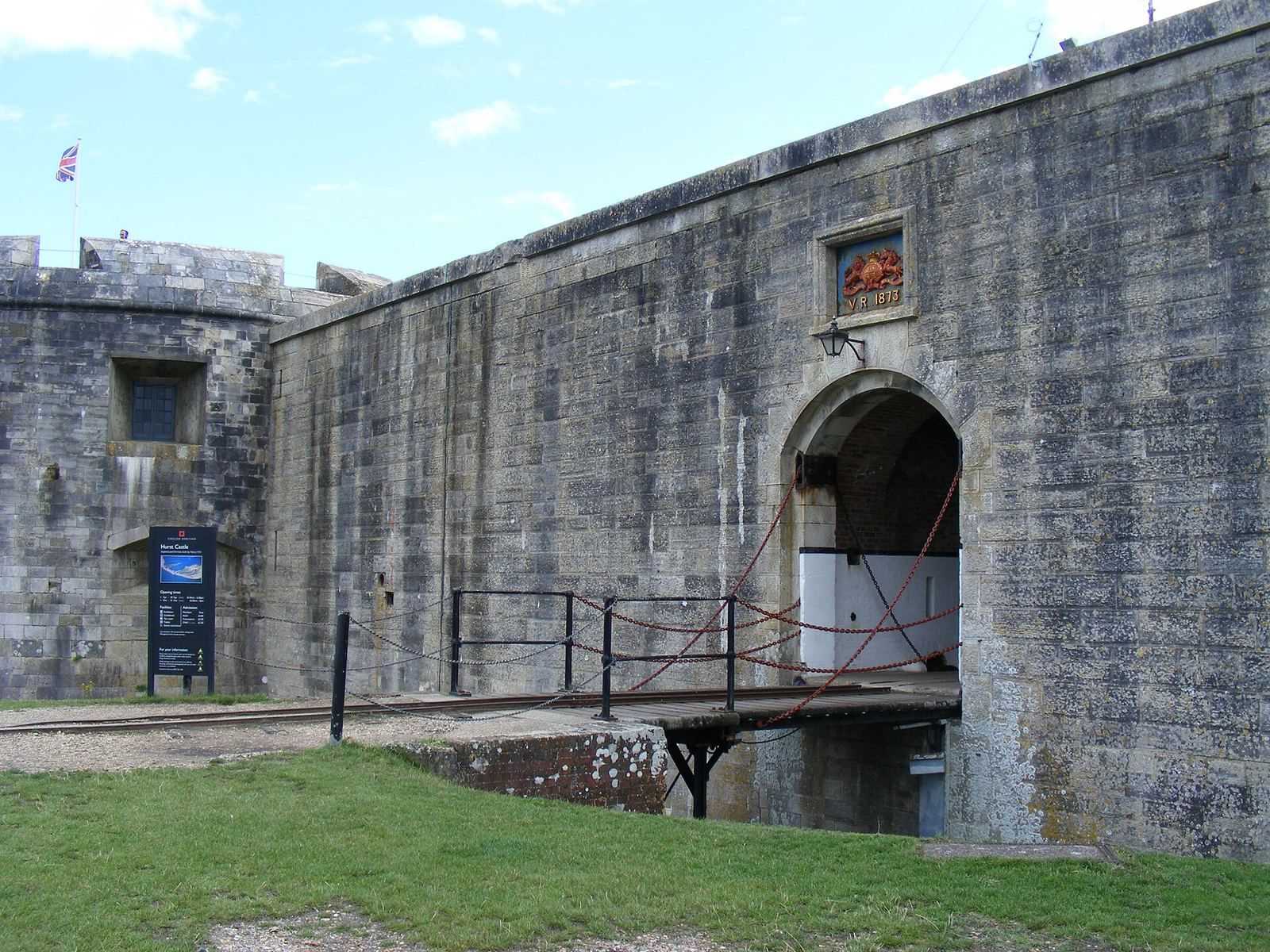
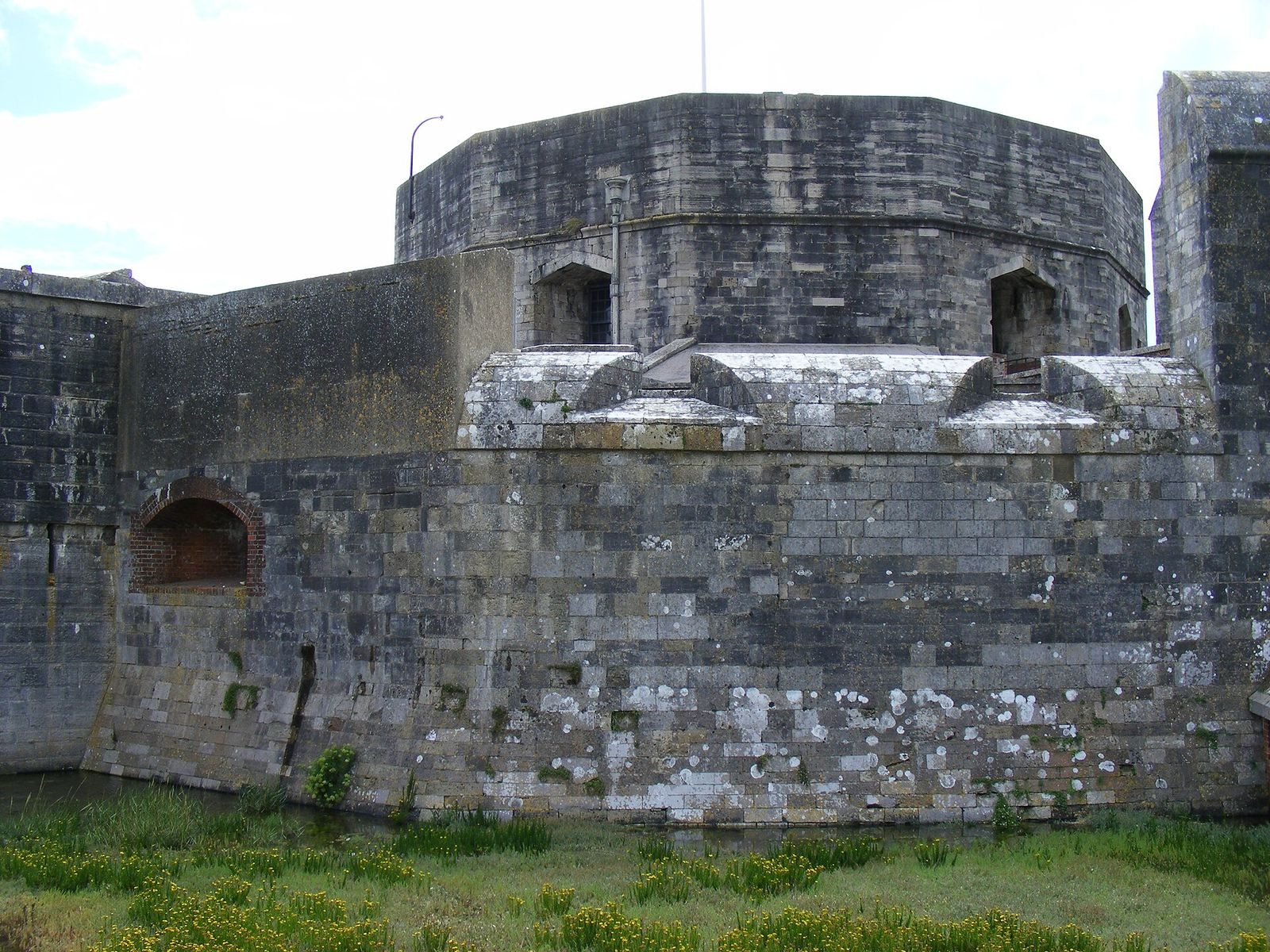
Hurst Castle occupies a shingle barrier beside saltmarsh and mudflats, about 0.75 miles (1.21 km) across the water from the Isle of Wight. Its central stone fort forms the entrance to a larger complex. The core is about 52 metres across and combines a central tower with three projecting gun platforms, or bastions, originally joined by a defensive wall. Later walls and chambers increased the structure’s depth. A gateway dating to 1873 provides access, and the moat that once encircled the Tudor fort was filled during the 1860s.
The central castle
The keep
The keep, the castle’s principal fortified tower, is twelve-sided and about 20 metres across. It has two storeys above a basement, with a circular interior and a spiral staircase rising through a central pillar. The ground and first floors once held garrison living quarters; both are now open spaces. Each floor has eight embrasures, openings in the walls through which weapons could be fired. The first-floor room may have been high enough for guns to fire over the outer walls. Gun positions dating to the 1850s survive on the roof. Three bridges originally connected the keep with the outer bastions.
Bastions and close-defence passage
The two-storey north-west bastion guarded the approach along the spit from the mainland. It contained the original portcullis, a heavy gate lowered across an entrance, as well as garrison accommodation and gun positions on its floors and roof. In the nineteenth century these positions were adapted for heavier guns and to shelter riflemen. An external caponier, a covered passage with openings for defending a fort’s approaches, connects to the bastion. Built in 1852, it has rifle loops for close defence. The other two bastions are each one storey high. Their original gun positions, on the ground and roof levels, were also modified for heavier weapons.
The gun wings
West wing
The west wing is about 215 metres long. It contains 37 heavy-gun positions, two main magazines and auxiliary rooms that included canteens, stores and detention facilities. The wings were built of brick and stone, with granite-fronted casemates, protected gun chambers, and wrought-iron shields around the gun positions. Removable screens allowed some positions to be used as accommodation for gun crews of up to twelve, and small magazines sat behind the protected chambers.
The west wing’s roof has positions for 12- and 6-pound quick-firing guns, a Bofors gun and associated directing equipment. A garden recreates the wing’s Second World War appearance. One gun position contains a small theatre made by gunners during that war, along with wall paintings that may have been used in performances.
East wing
The east wing is about 150 metres long and has 24 heavy-gun positions and two main magazines. Its roof retains the original gun-directing position and a Bofors position added during the Second World War. A gateway in the north-east bastion leads into the wing. Just beyond the entrance are three positions built in 1893 for 6-pound quick-firing guns. Ammunition was supplied to them from the wing through an opening in its outer wall.
Lighthouses and other associated features
Lighthouses
Several lighthouses were built at Hurst from the eighteenth century onward. Hurst Tower dates to 1786, and a High Lighthouse followed in 1812. At the end of the spit, the later High Light, also called Hurst Point Lighthouse, was built between 1865 and 1867 and remains in service. The west wing is associated with two further lights: a tower dating to 1865 that is now disused, and an iron, gas-lit light that remains in use. The Low Light was built into the rear wall of the west wing and was replaced by a new iron lighthouse in 1911.
Supply and service structures
A narrow-gauge railway built in the 1880s served the fort’s supply needs. The Shipwright’s Arms, established beside the castle, later served as a garrison canteen, while the Castle Inn was established at the north end of the spit.