Royal Abbey of Saint-Corneille: A Royal Church in Compiègne
Site at a Glance
- Popularity
- Low
- Country
- France
- Primary era
- Medieval
- Eras represented
- Medieval, Early Modern
- Civilizations
- Carolingian, French
- Site type
- Religious
- Remains
- Monastery
On this page16 sections
History
Royal foundation and Carolingian Compiègne
The Royal Abbey of Saint-Corneille in Compiègne, France, was founded in 876 by Charles the Bald, a ruler of the Carolingian dynasty, the Frankish royal house that included Charlemagne and his descendants. Established as a royal church and imperial chapel, it was intended to succeed or rival the palace chapel at Aachen. Compiègne became an important royal and imperial seat, though it was not a centralized capital. Charles founded the abbey after his imperial coronation in Rome in 875, on the site of an earlier Merovingian palace, and built a new palace closer to the Oise River.
The royal setting had a longer history. In 757, Charles’s grandfather Pepin the Short, a Frankish king, held a council at Compiègne. An organ sent by the Byzantine emperor Constantine V was installed in the palace chapel and is described as the first organ known in France.
In 877, Pope John VIII presided over a gathering of 72 bishops for the church’s consecration. Charles shaved his head as a sign of submission to the Church, departing from the Frankish custom of kings wearing long hair. He transferred relics to the church and sought privileges from the pope. Hincmar, later archbishop of Reims and a leading church figure, became the first abbot, and Charles installed 100 canons, clerics serving the church as a chapter.
Royal church and regional authority
Saint-Corneille became a royal coronation and burial church. Louis the Stammerer was enthroned and consecrated there in 877, then buried there in 879. Odo was crowned at Compiègne in 888. Lothair arranged for his son Louis V to be crowned there in 979; Louis was buried in the abbey church in 987. That year, an assembly at the abbey recognized Hugh Capet as king. Hugh of France, a Capetian prince crowned in 1017 but never a ruler, was buried there in 1025.
The abbey accumulated wealth and influence under the Carolingians as the town grew around it. Its canons held a right to part of the revenue from coinage, or perhaps the right to produce an equivalent quantity of deniers and oboles, medieval coins of different values. No coins bearing the name of Saint-Corneille or an abbot are known. The abbey also exercised religious, judicial, and seigneurial authority, meaning local rights over land and its inhabitants. Its holdings included villages, tithes, lands, and fiefs, property or rights held in exchange for service. Over time, some holdings were lost through warfare, neglect, or the actions of vassals.
The abbey’s religious and economic role extended into the town and the Oise valley. Its canons were chiefly responsible for urban infrastructure, a leprosarium, and clearing land. Pilgrims drawn by the abbey’s relics and privileges for local fairs also supported Compiègne. In 1048, Henry I granted the royal provostship, the office and jurisdiction of a local royal administrator, to the clerics of Sainte-Marie after complaints that the provosts were pillaging. Philip I convened a council in 1085 over the bishop of Soissons’s objections to the abbey’s immunities. In 1092, the king and the archbishop of Reims confirmed its privileges, including a right to prevent towers or fortifications on its Compiègne lands. Philip also required six farms to be returned and confirmed the abbey’s road rights at Longueil and Sacy.
War and fire repeatedly damaged the complex. Vikings partly destroyed the abbey in 882, and fires damaged it in 912 and 916. Charles the Simple began its restoration in 917. The abbey subsequently sought protection from the counts of Champagne, members of the Vermandois family, and later the lords of Roucy. In 978, the Holy Roman Emperor Otto II sacked the palace and abbey in retaliation for an attack on his palace at Aachen.
After 987, Saint-Corneille’s influence in national politics declined and became more regional. French kings thereafter were generally crowned in cathedrals, but the abbey retained royal standing and received royal gifts. Its religious authority and privileges remained a source of repeated disputes with bishops, local lords, and townspeople.
Monastic reform, civic rights, and disputes
A papal bull, a formal document issued by a pope, in 1118 declared the church of Compiègne directly subject to Rome and affirmed the chapter’s right to excommunicate people who violated its rights. Excommunication is formal exclusion from the Church. Louis VI, known as Louis the Fat, reaffirmed the abbey’s coinage right in 1120. Later papal privileges gave the abbot judicial authority over local clergy and confirmed the abbey’s jurisdiction over its hospital.
After the Council of Reims in 1148, Pope Eugenius III asked Gossuin of Anchin to reform the monastery. In 1150, Suger, abbot of Saint-Denis and a royal adviser, replaced the canons with Benedictine monks, who followed the Rule of Saint Benedict. A dispute over the treasury was settled after Pope Adrian IV and Henry of France urged Philip of France, a canon and treasurer, to surrender it. The canons kept their prebends, income assigned to a cleric, for life, while the abbey retained its property and privileges. Adrian confirmed those privileges in 1159.
Local authority remained contested. In 1153, Louis VII established a commune, a town community with formally recognized self-government, after canons detained abbots and townspeople rescued them. In 1160, Pope Alexander III made the abbot a judge of the city’s clergy. A papal letter in 1170 called for protection against encroachments by townspeople, the abbot of Saint-Memmie, and the lord of La Tournelle, threatening excommunication. In 1199, the abbey’s jurisdiction over Compiègne and its churches was confirmed, except for parish churches’ care of souls. An inquiry in 1214 described the abbot’s authority over city clergy, including the power to impose an interdict, a Church sanction restricting religious services, and to control the admission of preachers.
The abbey also secured rights over trade and justice. Philip Augustus allowed Compiègne’s annual fair to run for 15 days in 1185. An agreement confirmed in 1201 reserved the abbey’s jurisdiction over the Cour du Roi during the three days of the Mid-Lent fair and set an annual payment of 100 Parisian sous, a medieval French monetary unit. In 1206, townspeople challenged the abbey’s toll on the Oise riverbank and accepted liability only for wine. Councils met at the abbey in 1201, 1277, 1301, 1304, and 1329.
Eight feudal barons held fiefs established under Abbot Guillaume de Flogny with Louis VII’s support. They were responsible for defending the abbey’s interests, guarding its abbots, and attending formal ceremonies in distinctive clothing. In 1220, an arbitration exempted the barons and abbey servants from the authority of the bishop of Soissons and parish priests. The abbey’s exempt parish, called the Parish of the Crucifix, continued until the Revolution. Conflicts with municipal authorities and local clergy continued over clerics’ arrests, taxes, streets, and property. In 1259, Pope Alexander IV intervened after the mayor and jurors imprisoned clerics. Saint Louis made substantial gifts to the abbey, although the royal domain was alienated during his reign.
War, royal ceremonies, and changing leadership
In 1374, Charles V bought abbey land to develop the Palace of Compiègne. Houses on the site were demolished, but the palace work remained unfinished when the king died in 1380. During the Hundred Years’ War, a series of conflicts between England and France conventionally dated from 1337 to 1453, Compiègne came under English occupation. The Dauphin Jean, heir to the French throne, was buried in the abbey church after his death in 1417. Abbot Jean Dacier attended one session of Joan of Arc’s trial on 9 May 1431 but was not consulted about its verdict. Charles VII later confiscated Dacier’s worldly property.
In the 16th century, the monks lost the right to elect their abbots. Under the commendatory system, abbey revenues and administration passed to an abbot who might not live in the monastery; the office went to cardinals and then powerful aristocrats. Louis de Bourbon-Vendôme restored the church and provided a grand portal in 1516. Jacques Amyot, a scholar who had tutored Charles IX, became abbot with his former pupil’s support, and Henry III appointed him grand almoner in 1561. After Henry III was assassinated in 1589, his body was brought to the abbey for burial. Following the defeat of Catholic League forces at Senlis, residents of Compiègne brought captured banners to the church. The Catholic League was a French Catholic political and military association active during the Wars of Religion.
Benedictines of the Congregation of Saint-Maur took over in 1626. After the death of Simon Legras, appointed abbot in 1656, Anne of Austria ended the abbey title in 1658 and united its revenues with those of the royal abbey of Val-de-Grâce. Saint-Corneille thereafter had no abbot of its own. A settlement with the bishop of Soissons in 1674 reduced some of the abbey’s jurisdictional rights, but it continued to defend its property and took charge of Compiègne’s college in 1772.
The church continued to host royal and religious ceremonies. A funeral oration for Philippe of France, duke of Orléans and brother of Louis XIV, was delivered there in 1701. A Te Deum, a Christian hymn of praise and thanksgiving, marked celebrations for Louis XV’s recovery in 1744, and a funeral oration for the Dauphin was delivered in 1766. Shortly before the Revolution, the abbey library was described as one of Picardy’s richest collections of manuscripts.
Revolution and later use
A 1789 decree transferred Church property to the nation, and the abbey was declared national property in 1791. Its church briefly served as a parish seat before the parish was suppressed that year. The complex was pillaged on 10 August 1793. The former abbey church became a saltpeter factory in 1794 and a fodder store in 1804. In 1806, the Ministry of War transferred it to the town on condition that it be demolished to open a street. Demolition stopped in 1811, and the remaining ruins were sold in 1824 for the creation of Rue Saint-Corneille.
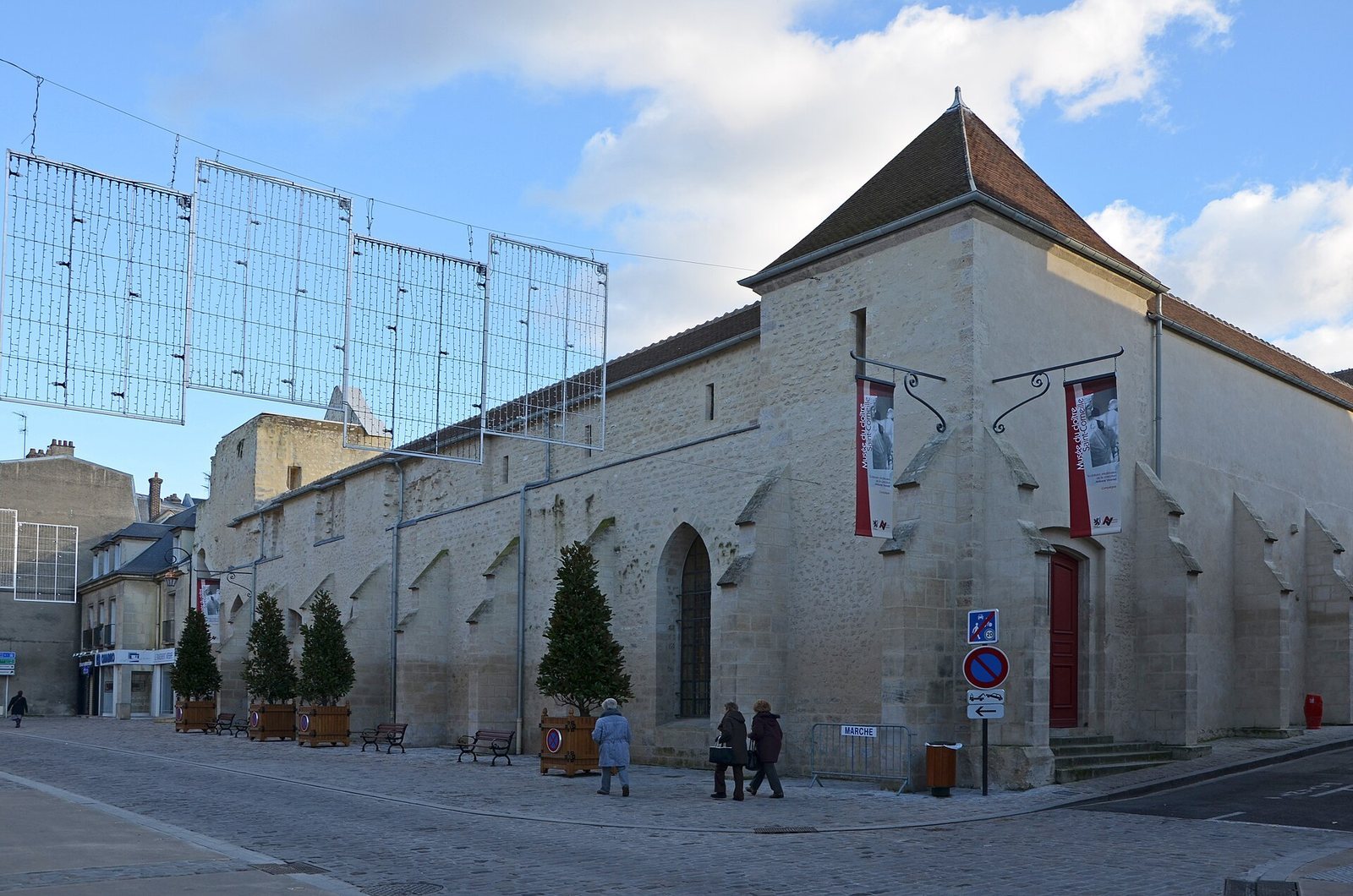
The remaining abbey buildings were almost entirely burned in 1940 during bombing by the German air force. Since 1959, the former abbey has housed one of Compiègne’s municipal libraries. The basement rooms of the former refectory were listed as historic monuments in 1944; the cloister and remains of the bell tower were classified in 1964.
Remains
The abbey occupied a site between the later town-hall square, Rue des Bonnetiers, Rue des Clochettes, Place du Change, and Rue de l’Étoile. It stood on the former Merovingian palace site, while Charles the Bald’s new palace lay toward the Oise. Rebuilding over many centuries altered the complex, and the surviving fabric comprises parts of the later abbey rather than a single unchanged building.
Church and early complex
Church plan and construction
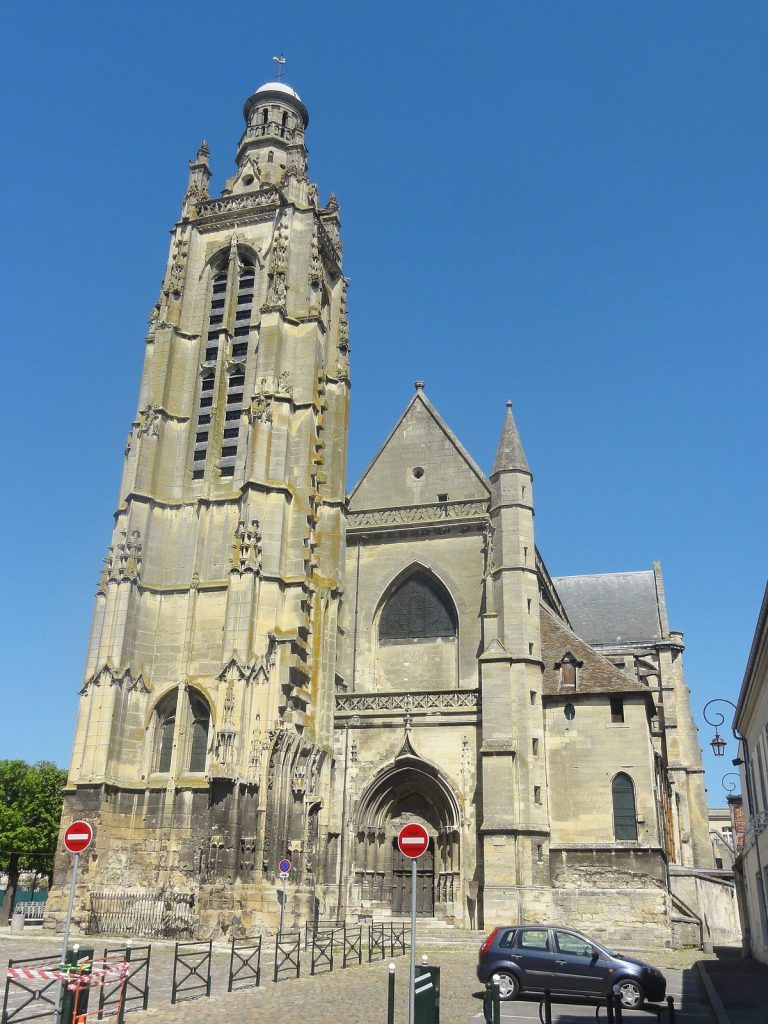
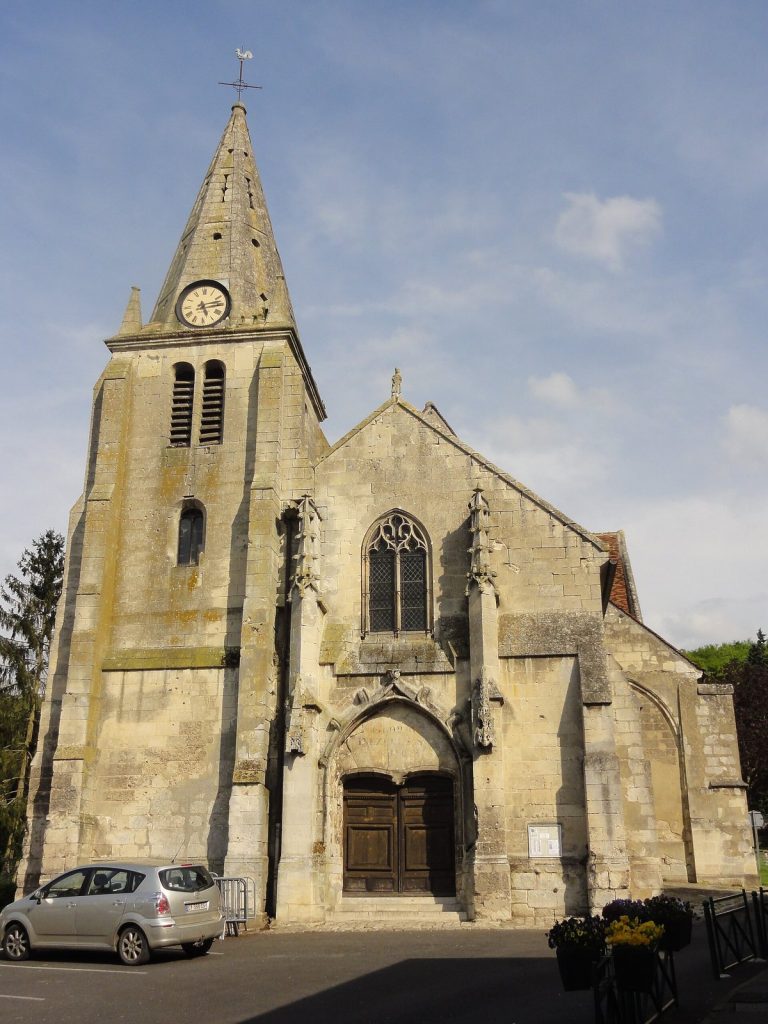
The plan of the first church is uncertain. It has been described as an octagon resembling the Palatine Chapel at Aachen. One interpretation proposes that the restoration begun in 917 added a basilical nave, meaning a long main church space, along with underground chambers called crypts and an entrance vestibule, or narthex. The later abbey church was a 12th-century building, substantially altered, particularly in the 14th century. Its long nave had ten structural bays, no crosswise transept, and two five-storey towers beside the eastern end. A new facade was added in the 16th century, followed by classical-style additions in the 18th. The church burned in 1300 and was rebuilt about a century later, so later depictions show a much-changed building rather than Charles the Bald’s original church.
Enclosure and Mint Tower
Charles the Simple surrounded Saint-Corneille with a wall and ditch, and Compiègne probably had a fortified enclosure by 917. Textual descriptions and engravings show a Mint Tower at the corner of the collegiate church’s kitchen garden, beyond a row of houses belonging to the canons.
Surviving medieval fabric
Cloister and library
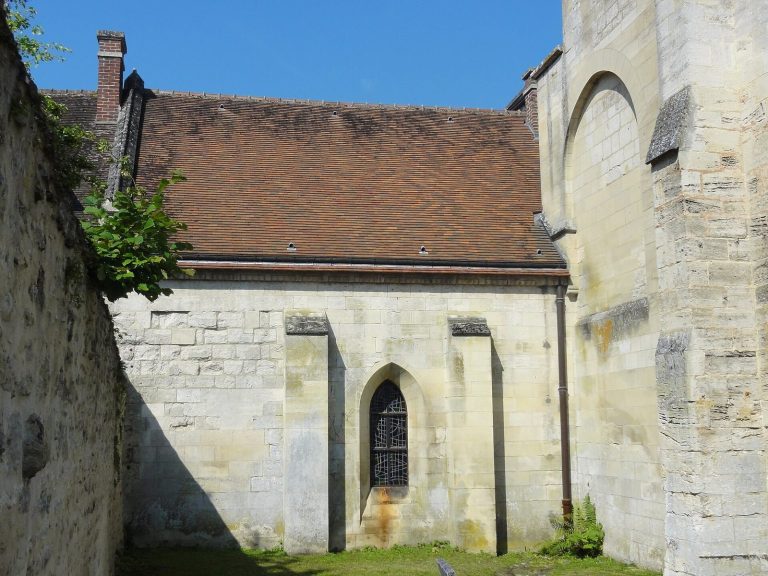
A substantial part of the 13th-century cloister survives and has been restored to its 14th-century appearance. It now forms part of the municipal library housed in the former abbey.
Church and wall fragments
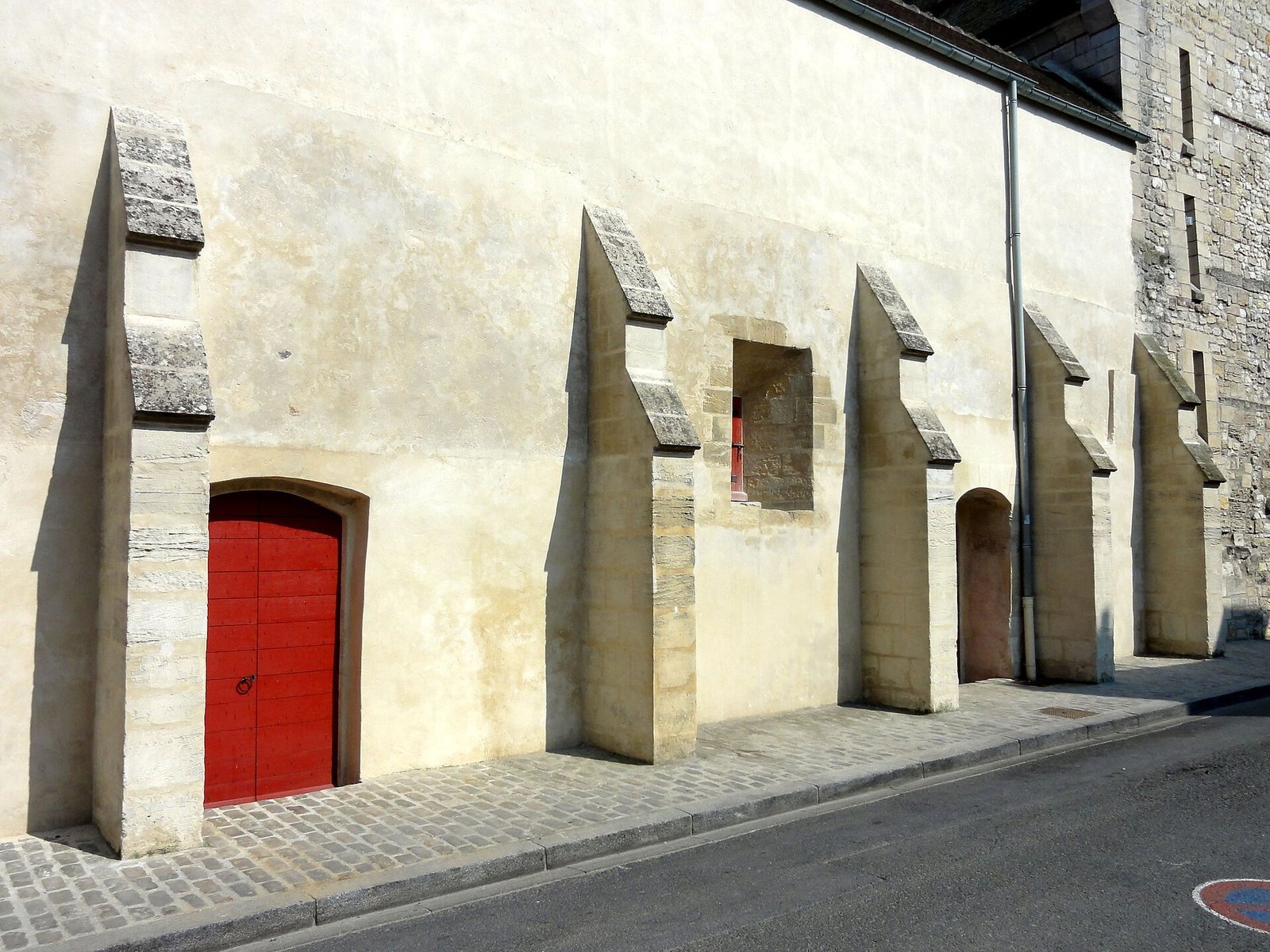
Surviving church fabric includes the base of the south tower, part of the north wall incorporated into other buildings, and remnants of the bell tower and narthex. A section of the abbey wall, with two carved waterspouts known as gargoyles, can be seen from Place du Marché aux Herbes.
Objects and relics
Baptismal font
An ancient sarcophagus was reused as a baptismal font. It measures 5 feet 8 inches across the top and 5 feet 4 inches across the bottom, and is just under 3 feet wide, with an interior 4 inches narrower. Spiral grooves decorate its surface, and winged heads on its front and back were thought to represent Mercury. Its origin is unknown. Water was blessed in it on the vigils of Easter and Pentecost.
Relics and ivory diptych
Tradition credited Charles the Bald with bringing the body of Saint Cornelius and remains of Saint Cyprian from Lyon, along with relics from Aachen, including a cloth believed to have wrapped Jesus’ body, known as the Holy Shroud. A gold reliquary set with precious stones, donated by Queen Matilda of England, later replaced an ivory container for the shroud and other relics of Christ. The shroud and a veil of the Virgin attracted pilgrims. Another relic associated with Jesus’ circumcision was identified as the knife used in the rite.
An ivory diptych, an object made of two hinged panels, is associated with Theodorus Philoxenus Sotericus, a consul, or high-ranking civic officeholder, at Constantinople in 525. Its gilded, embossed metal mounting dates to 13th-century France, and the diptych was reused as the binding cover of a manuscript belonging to Saint-Corneille.