Ibersheim Castle: A Palatine Hunting Lodge and Administrative Estate
Site at a Glance
- Rating
- 4
- Popularity
- Very Low
- Country
- Germany
- Primary era
- Medieval
- Eras represented
- Medieval, Early Modern, Modern
- Civilizations
- Electoral Palatinate, French, Holy Roman Empire
- Site type
- Domestic
- Remains
- Castle
On this page9 sections
History
Ibersheim Castle is a former hunting lodge and administrative estate in Worms, Germany. Its principal building has a core from the second half of the fifteenth century, and it is described as the oldest of Worms’s four castles. The Electors Palatine used it as a hunting lodge and as an office of the Electoral Palatinate, a territory of the Holy Roman Empire ruled by a prince entitled to help choose the emperor.
Origins and Palatine rule
A deed dated 22 August 1417 allowed Louis III, Elector Palatine, to build a castle and dwelling at Ibersheim. The collegiate foundation of St Paul in Worms, a body of clergy attached to a collegiate church, transferred half the local court jurisdiction and the common land to him. It retained the bailiwick, tithe, church jurisdiction, and the right to appoint the village magistrate.
Earlier Ibersheim history is associated with the Hausen family. Walter von Hausen held the hereditary bailiff’s office, an inherited local authority, and died in 1173; his son Heinrich lived around 1170 to 1240 and also held that office. Walter’s son Friedrich von Hausen, who lived around 1150 to 1190, owned property in Ibersheim. He travelled with Emperor Frederick I Barbarossa as a retainer and courtly poet-singer. In 1451, three priests of a local commandery of the Teutonic Order, a Catholic religious and military order, were associated with Ibersheim.
In 1465 the Teutonic Order was compelled to sell its Ibersheim property to Hesso, a landgrave, or territorial count, of Leiningen-Dagsburg. The Order had held property there for more than two centuries. Hesso died in 1467 before paying, leading to a prolonged inheritance dispute. A settlement in 1481 resolved the matter between the Order and the Counts of Leiningen, after which the Palatinate succeeded to the property.
Expansion and estate life
Major alterations may have taken place around 1469 under Frederick the Victorious, followed by further expansion in 1481 under Philip the Upright. After 1550, farm buildings surrounded the castle, and the road was probably diverted behind it.
After the Thirty Years’ War, Karl I Ludwig stopped managing the estate directly and leased it. Its first tenant, Heinrich von Mauderich, was a nobleman from Gelderland. Fourteen families from Gelderland and elsewhere settled there as economic migrants and refugees of the Reformed faith. Cultivating the land again proved difficult, making farming, sheep raising, and fishing hard to turn into a profit. Heinrich also ran an illegal toll station and, with the Steiners, ambushed merchants. Signals from a watch-and-flag tower beside the castle could be sent over the treetops and across the Rhine to the mouth of the Weschnitz, about two kilometres away. The robberies ended when Karl I Ludwig found new tenants and Heinrich and his followers had to leave. Heinrich’s daughter Marie was baptised at the castle on 7 October 1656.
From 1661, Swiss settlers held the estate under a hereditary lease, renewed several times and maintained until the French Revolution. They included Reformed Christians and Anabaptists, whose Christian tradition later became known as Mennonite. Settlers came from the Zurich region and its uplands; about a decade later, many more Mennonites arrived from the Bernese Oberland. In 1690, Catholic officials were assigned to the Electoral hunting lodge, which also attracted frequent princely visits for duck hunting.
During the War of the Palatine Succession, a late-seventeenth-century conflict between France and a coalition of European powers, the Ibersheim Mennonites fled together to Friedrichstadt, where fellow believers lived. They returned in 1698 after the conflict ended and thereafter formed the village’s sole religious community. The Reformed inhabitants probably dispersed to places on the right bank of the Rhine.
Revolutionary era and private ownership
During the Revolutionary and Liberation Wars, Ibersheim supplied large quantities of bread. In the second half of 1796, it sent 600 portions weighing 2½ pounds each to the French headquarters at Sprendlingen, followed by 108 portions to the imperial supply depot at Bretzenheim. In early 1797, supplies for Nierstein and Oppenheim included 35 hundredweight of flour, with the unit specified as 120 pounds, and 138 loaves weighing four pounds each. A large bakery may have stood near the castle.
Church and secular property on the left bank of the Rhine was confiscated and leased in 1795. In 1801, the leased holdings were declared French national property, and such property was auctioned into private ownership between 1803 and 1806. The former Palatinate estate at Ibersheim probably passed to a local private buyer before 1803.
Later owners included Jakob Käge IV (1833 to 1880), Friedrich Heckmann and his wife Elisabeth Flath (1893 to 1911), and Peter Flath, associated with the property from 1898. Leonhard Heinrich Schroth was linked to it around 1927. Rina Schroth, wife of Georg Dehn, who died in 2018, is also identified among its owners.
Remains
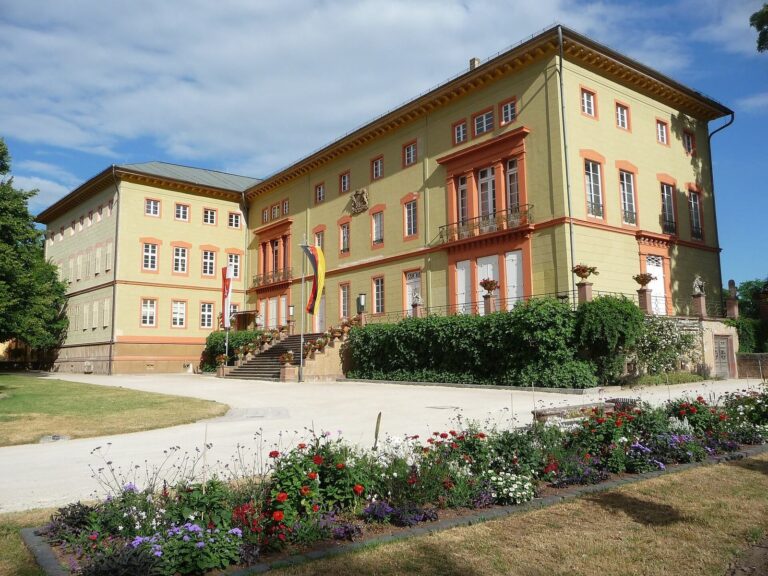
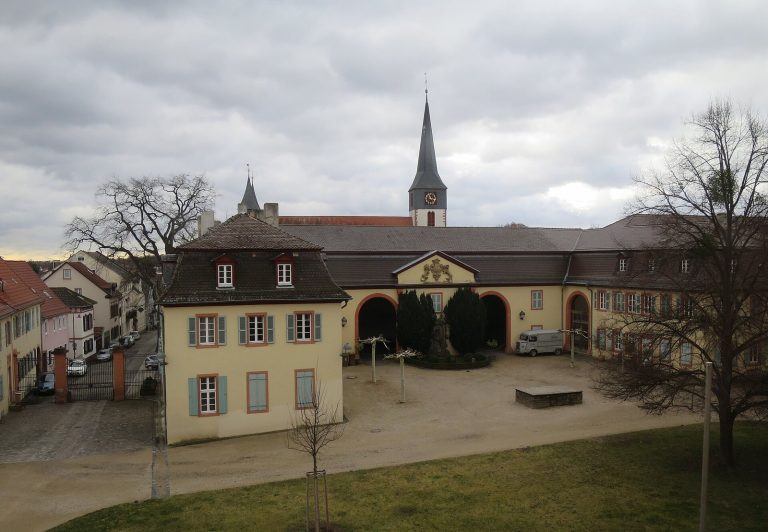
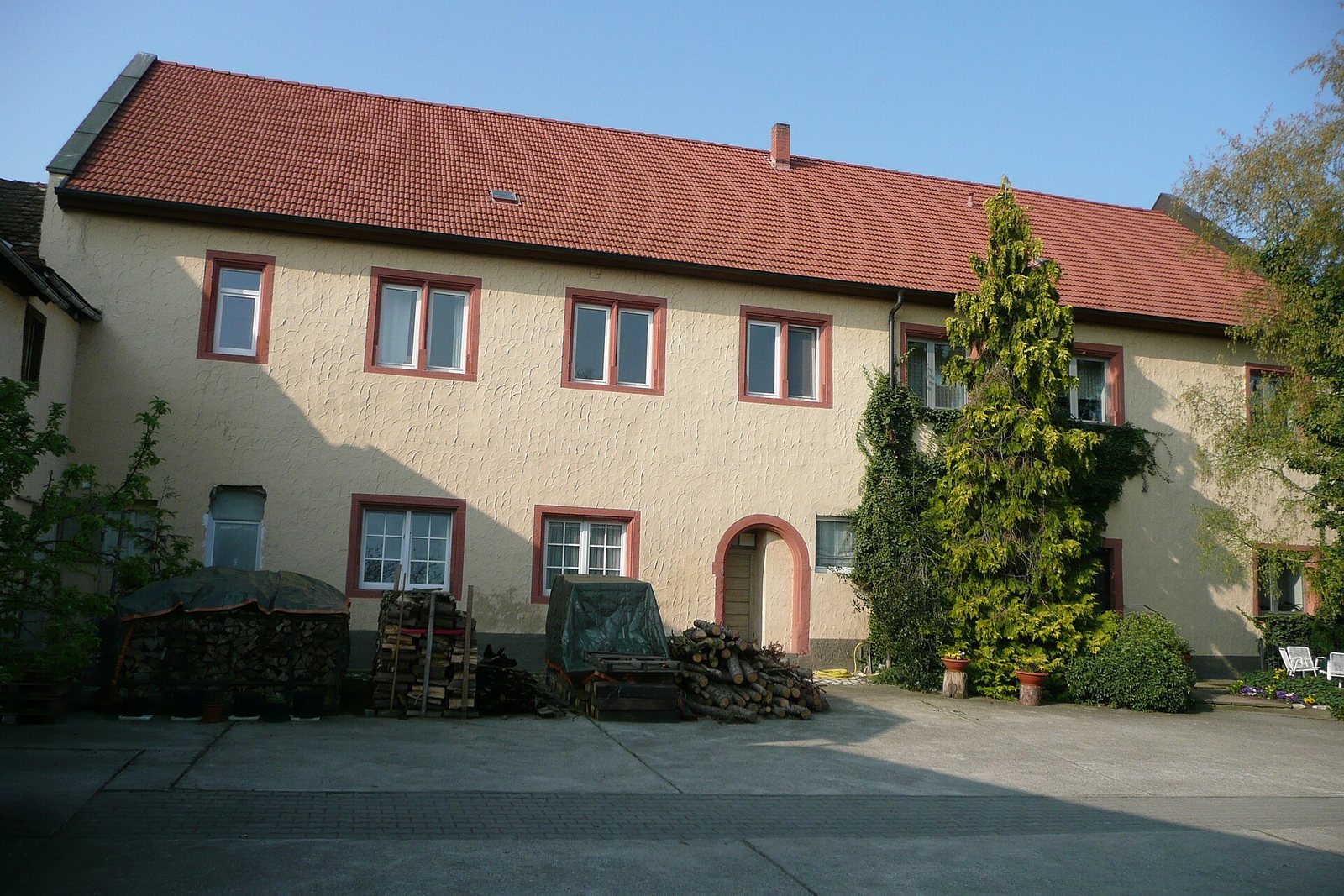
Ibersheim Castle is a lowland castle arranged around a courtyard. Its principal structure is a rectangular, two-storey manor house, with farm buildings to the north and a watchtower on the Rhine-facing side. The surviving complex has been altered over time.
Manor house and chapel
The manor house’s core dates to the second half of the fifteenth century, and the building was remodelled and enlarged in the eighteenth century. On the ground floor, the kitchen and castle chapel were located together. A 1496 church register names the chapel as dedicated to Saint Elizabeth, though the identity of the intended saint is uncertain. A wooden spiral staircase leads to the upper floor. The cellar has a shallow ceiling formed where two curved vaults cross.
Courtyard buildings and watchtower
Farm buildings occupied the north side of the courtyard. The rectangular watchtower stood on the Rhine-facing side and had small openings for defence. It could be reached from the manor’s upper floor or by a staircase; the connection from the upper floor is now partly blocked. Daniel and Heinrich Stauffer renovated the tower in 1771.
Village-side dwelling and distillery
On the side toward the village centre, a dwelling and an attached schnapps distillery were added in 1811. Abraham Forrer and Elisabeth Bergtold built the distillery.
West-side mural
A mural on the castle’s west side, along Menno-Simons Street, was designed and painted by Ibersheim artist Fritz Kehr (1908 to 1985). It depicts salmon fishing in Bachert, a former branch of the Rhine recorded in 1285.