Barking Abbey: A Royal Religious House in England
Site at a Glance
- Rating
- 4.4
- Popularity
- Medium
- Country
- United Kingdom
- Primary era
- Medieval
- Eras represented
- Medieval, Modern
- Civilizations
- British, English, Norman
- Site type
- Religious
- Remains
- Monastery
On this page16 sections
History
Foundation and early community
Barking Abbey, also known as the Abbey of St Mary and St Ethelburga, was a religious house in Barking, United Kingdom, founded around 666 by Earconwald for his sister Ethelburga. Earconwald was a seventh-century bishop of London. The community began as a double monastery, an institution with communities of both monks and nuns, and received gifts from East Saxon princes. Its original dedication was to the Virgin Mary and was later extended to Mary and Ethelburga. The abbey’s estates grew during Ethelburga’s lifetime through the Hodilred Charter and possibly the Earconwald Charter.
Ethelburga served as the first abbess, followed by Hildelith, who had taught her and led the community into the early eighth century. Barking became a centre of learning: around 700, the churchman and writer Aldhelm dedicated his work De virginitate to its nuns. Evidence of the abbey’s prosperity belongs to Hildelith’s leadership. A tradition says Ethelburga entered religious life to avoid marrying Edwin of Northumbria, but this story is considered doubtful and may confuse her with Æthelburg of Kent. The historian Bede associated miracles with the early abbey.
Viking attack and tenth-century refoundation
Vikings burned the abbey around 870–871, and the nuns fled to their London estate, probably the church of All Hallows Barking by the Tower. A later account by Goscelin, a monk who wrote saints’ lives, tells how Ethelburga called animals to defend the deserted monastery. It also describes an attack in which the abbess and nuns barricaded themselves inside before the raiders set the buildings alight.
The community was re-established as a nunnery during the tenth century. Around 963, King Edgar appointed Wulfhilda as abbess and gave the abbey substantial estates. Wulfhilda also granted it 20 villages and founded a monastery at Horton in Kent. Edgar had pursued her while she was at Wilton Abbey, but she refused him and chose religious life. Queen Ælfthryth later removed her from office. It is uncertain whether Edgar’s son Æthelred restored Wulfhilda or whether Ælfthryth did so about 20 years later.
Late in the tenth century, Dunstan, Archbishop of Canterbury, introduced the Rule of St Benedict, a set of monastic guidelines. The community may previously have followed either that rule or the earlier Rule of St Columbanus. Barking may also have had a particular devotion to Martha, the sister of Mary of Bethany and Lazarus. Around 1156, the monk and writer Osbert of Clare asked Abbess Adelzia and the nuns to pray for him. The abbey was producing glass in the first half of the tenth century, and a bequest dated 946–951 provides further evidence of its activity.
Norman reconstruction and royal status
During the Norman Conquest, Abbess Æfgiva received a royal charter from William the Conqueror in November or December 1066, confirming her rights and control of the abbey. William stayed there while the Tower of London was being built. At Barking, Morcar, Earl of Northumbria, and Edwin, Earl of Mercia, submitted to him. Their sister Ealdgyth was the widow of Harold II, the king defeated in 1066.
Æfgiva expanded and rebuilt the abbey after the conquest. She commissioned Goscelin to write lives of Ethelburga, Hildelith and Wulfhilda, completed around 1087. The abbey and its lands appear in the Domesday Book, William I’s 1086 survey of England’s land and resources. Under Norman rule, women from the high nobility joined the community.
Barking was a royal monastery, giving the Crown rights over aspects of its leadership, and its abbess held precedence over other English abbesses. The king chose the abbess until 1214, when, following papal pressure, King John allowed the nuns to elect her. The Crown later asserted a right to nominate a nun whenever a new monarch took the throne. It exercised this privilege for Alice de Belhus in 1307, Margaret Swinford in 1377, Maud Kylet in 1404 and Goda Hapton in 1430. The abbess also held land directly from the king under baronial tenure, which carried military obligations. Abbesses performed this service under Henry III and Edward I.
Medieval community and royal connections
Queen Matilda, wife of Henry I, paid for two stone bridges and a causeway across branches of the River Lea at Stratford-by-Bow. Barking was responsible for their upkeep and received land to support the work. After Stratford Langthorne Abbey was founded closer to the crossings in 1135, Barking transferred the responsibility to it. A dispute between the abbeys ended in 1315: Barking received £200, while Stratford agreed to maintain the bridges and causeway and pay an annual rent of four marks.
Mary Becket, sister of Archbishop Thomas Becket, became abbess in 1173 as reparation for her brother’s murder in 1170. The abbey also fostered women’s writing. In the twelfth century, the nun Clemence of Barking wrote a life of Catherine of Alexandria, and another nun wrote a life of King Edward the Confessor. Barking has been described as perhaps the longest-lasting institutional centre of women’s literary culture in British history.
The abbey’s royal and political connections brought other prominent people into its history. In 1322, Elizabeth de Clare was confined there in an effort to make her surrender Welsh estates to Hugh Despenser the Younger. Valuable possessions were taken from her during her imprisonment, but she later recovered them. In 1381, Elizabeth Chaucer, daughter of the poet Geoffrey Chaucer and Philippa de Roet, entered the community as a nun. John of Gaunt paid £51 8s 2d for expenses and gifts associated with her entry.
During Abbess Katherine de la Pole’s tenure, the council of Henry VI entrusted the young Edmund and Jasper Tudor to her care. They were raised and educated at Barking, with £52 12s allowed for their upkeep. Edmund later became the father of Henry VII. In 1404, the abbey had a librarian, a distinction shared by only two other monasteries in the British Isles. When the abbey’s water conduit failed in 1462, John Rigby of Cranbrook Manor repaired it and demanded an annual payment for the supply. Katherine sought an independent source from the abbey’s own spring.
Economic crisis, dissolution and later use
A major flood in 1377 covered about 720 acres of abbey land, including 600 acres of Dagenham Marsh. The land was not reclaimed, and the cost of repairing the dykes deepened the abbey’s financial problems. Its income was recorded as 400 marks in 1382, and by 1409 it had spent more than £2,000 trying to recover the land. The Crown offered various forms of relief: it released the abbey from some charges in 1380, allowed it to compel labour on Dagenham Marsh in 1384, granted liberties in Becontree hundred, a local administrative district, in 1392 and 1462, and exempted it from tithes for ten years from 1409. Under Henry VII, the flooded land was exempted from a statute extending the Mayor of London’s authority as an official responsible for the Thames.
A 1291 assessment put the abbey’s income at £300 13s 1¼d. Its gross income in 1535 was £1,084 6s 2¼d, making it the third-wealthiest nunnery in England after Syon and Shaftesbury. Henry VIII dissolved the abbey in 1539. On 14 November, the abbess and 30 nuns formally surrendered it in the chapter house, the room where the community met. Twelve days later, they received annual pensions, including 200 marks for the abbess. Some pensions continued to be paid under Mary I.
At the Dissolution, the abbey held manors and other estates across Essex. Demolition began in June 1540 and took about 18 months. The sales included lead for £744, eleven bells for £122 13s, and other goods, grain and cattle for £182 2s 10d. The bells weighed 12,912 pounds in total, and the abbey also possessed 3,586 ounces of silver. Some lead was reused on the roof of Greenwich Palace, while some stone went into Henry VIII’s new manor at Dartford. In 1551, Edward VI granted the abbey site and its demesne, land retained for the owner’s use, to Edward Clinton, later Earl of Lincoln. The grounds subsequently served as a quarry and farm.
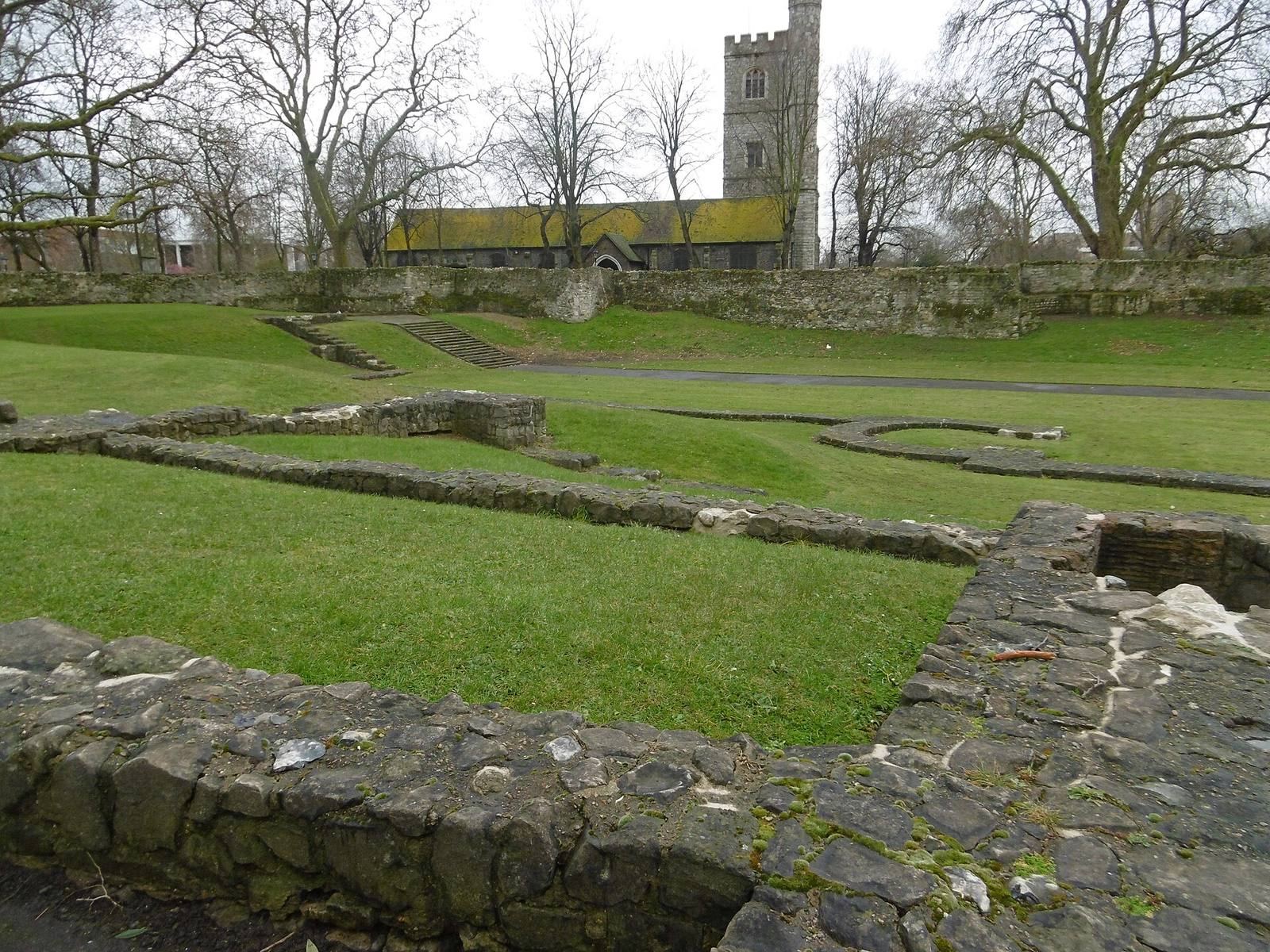
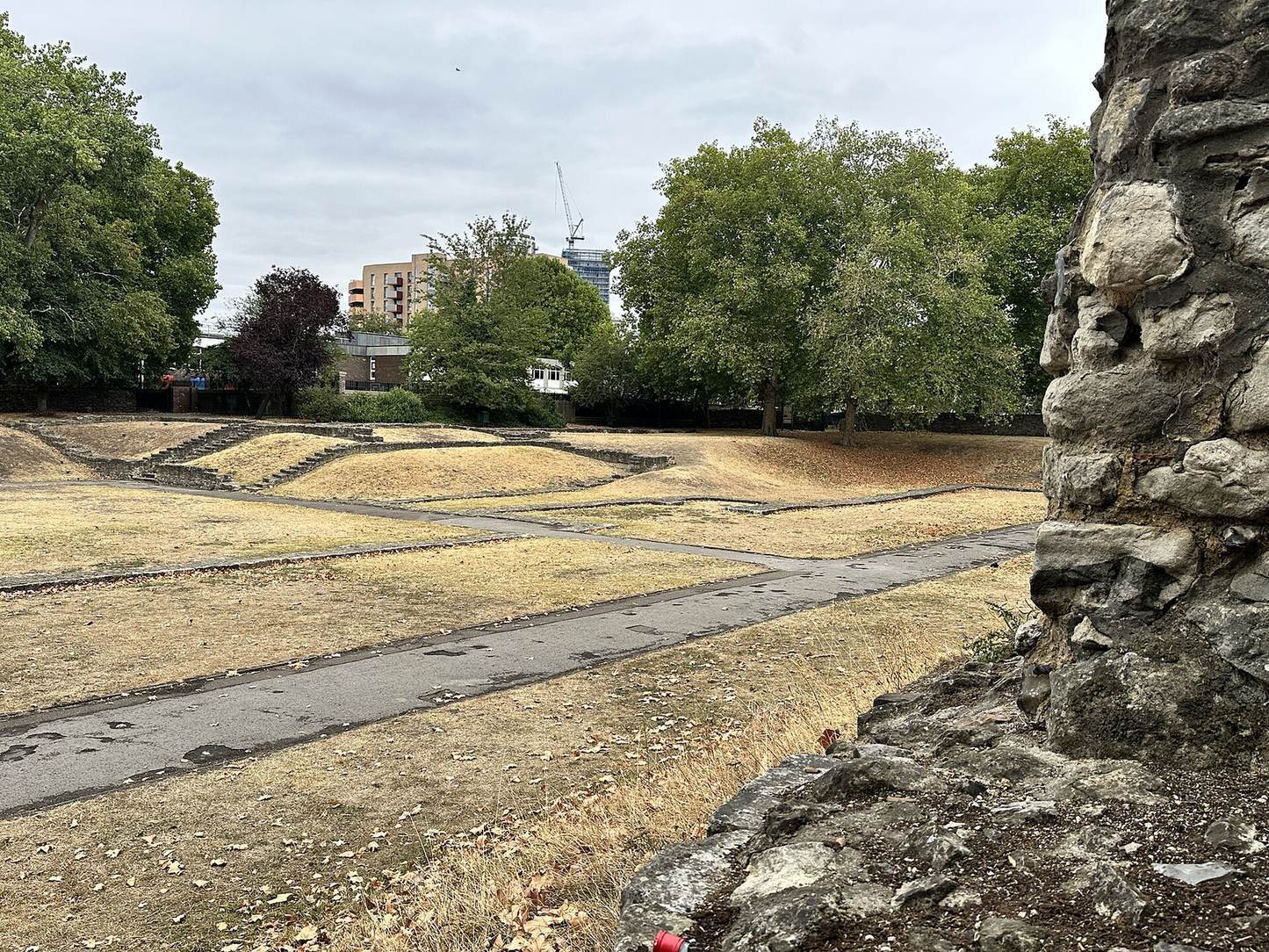
The ruins now form part of Abbey Green. The site became a Scheduled Monument, a nationally protected archaeological or historic site, in 1954; the Fire Bell Gate received Grade II* listed status, a high level of protection for a historic building, in the same year. Members of the Eastern Orthodox Church continue to make an annual pilgrimage to the ruins.
Remains
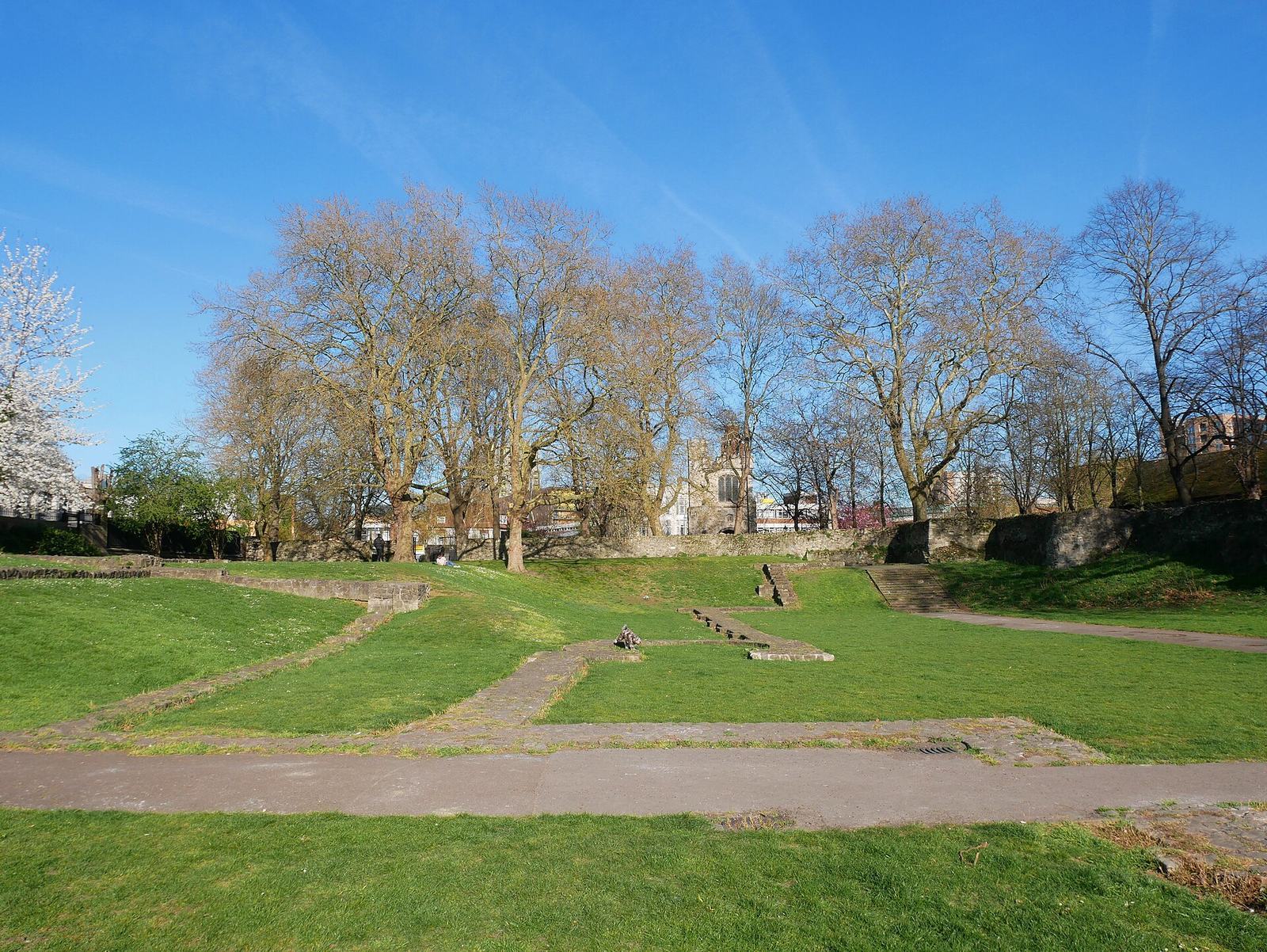
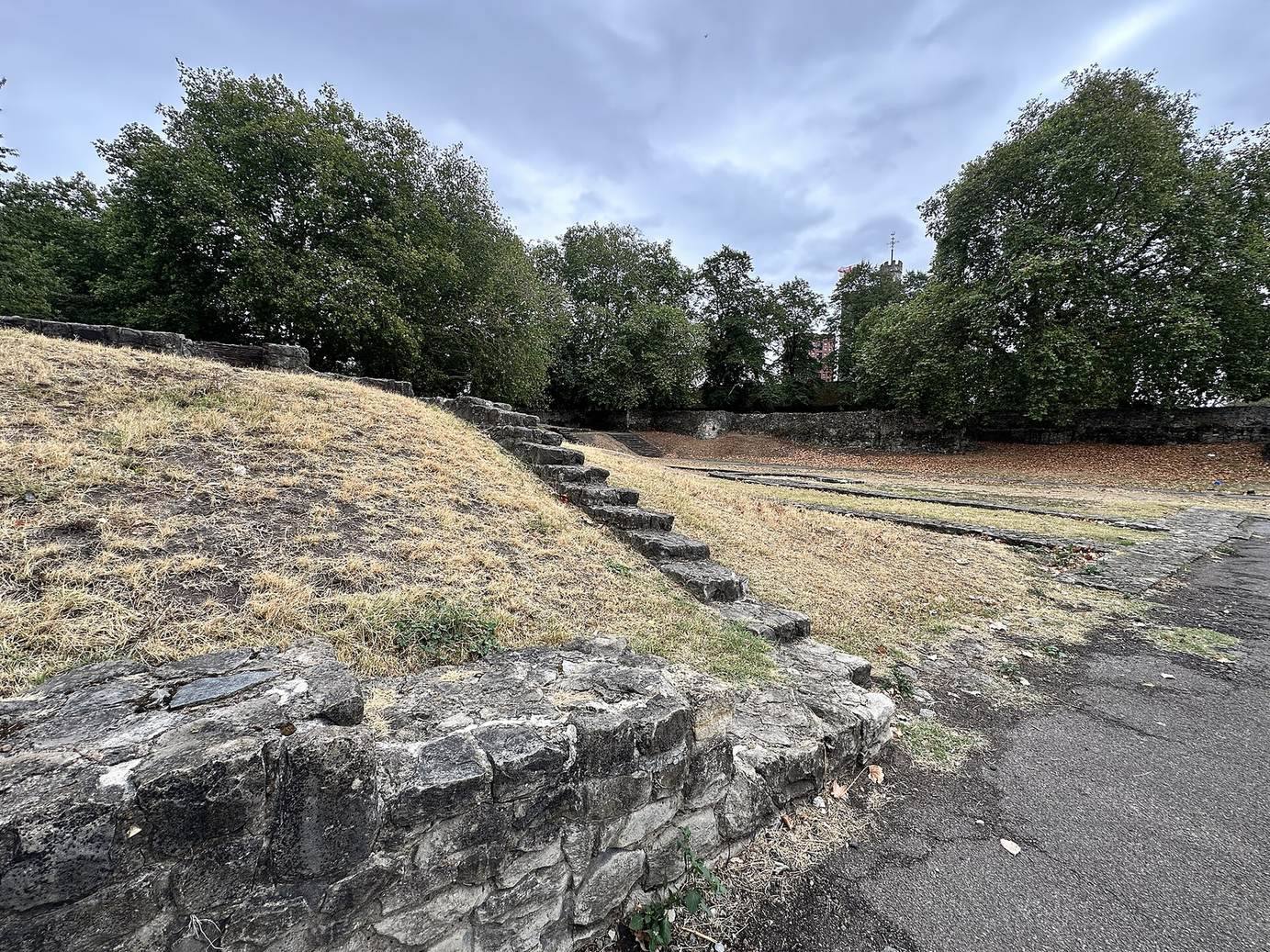
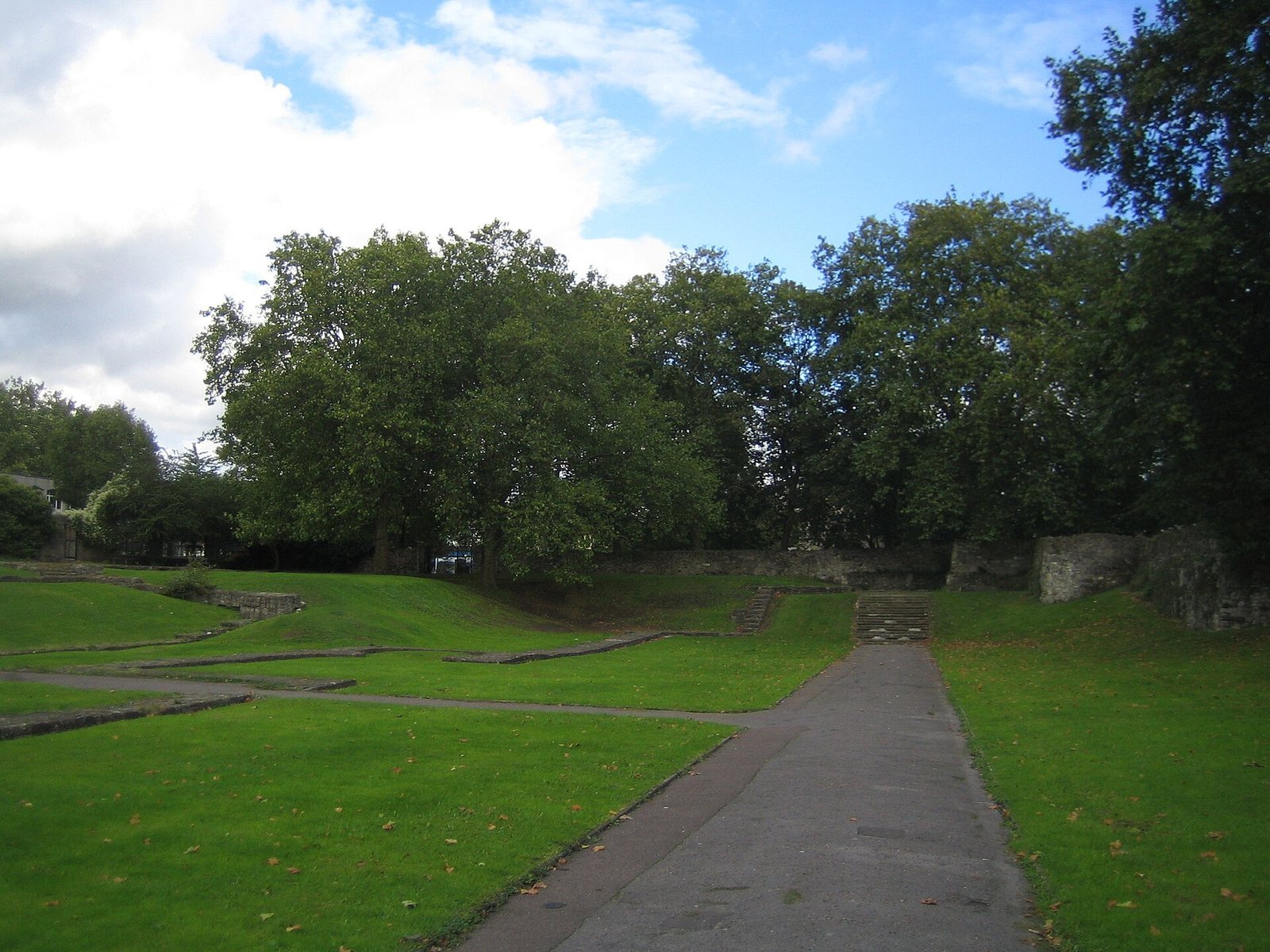
Barking Abbey’s footprint is largely underground. Excavations in 1910–11 revealed its remains, and sections constructed during the twentieth century indicate the layout. Original church walls still rise several feet in places, while footings and other traces of the buildings survive around them. The earliest structures were made of wood, with woven branches coated in clay or plaster, and incorporated reused Roman tile.
Church and monastic buildings
Abbey church
After the Norman Conquest, Æfgiva replaced the earlier church with a new building described as rivaling the tallest churches in the country. The church’s choir held the reburied relics of Ethelburga, Hildelith and Wulfhilda. The surviving walls and buried footings form part of the remains that help indicate the abbey’s former plan.
Saints’ chapel
In the early thirteenth century, the church was extended at its eastern end to create a chapel for the saints. This gave greater prominence to the relics of the three abbesses, and the church was rededicated under Abbess Mabel de Bosham.
Gateway and chapel
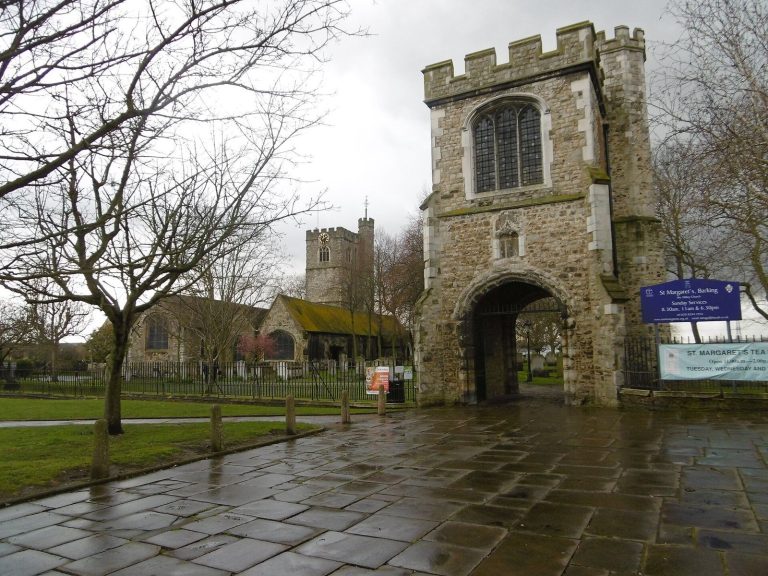
The Curfew Tower, also called the Fire Bell Gate, is a complete surviving abbey building and was one of the abbey’s three gateways. An earlier tower stood there in 1370; the present tower dates to around 1460. Above its gateway is the Chapel of the Holy Rood, named for a stone crucifix dating to the twelfth century that was displayed inside. The chapel was redecorated and its windows repaired in 1955–56. Repairs in 2005–06 replaced the staircase roof and main roof covering, repointed the masonry, renewed stone too damaged to repair, and redecorated the chapel interior.
Books, seal and associated buildings
Manuscripts
Several fifteenth-century manuscripts used at Barking survive, including a hymnal and an Ordinale and Customary. The latter combines the order of religious services with instructions for the community’s observances. Its commemorations include the abbey’s three saintly abbesses, Ethelburga, Hildelith and Wulfhilda.
Abbey seal
One seal used from the thirteenth century until the Dissolution depicts the Virgin Mary with the infant Christ, the apostles Paul and Peter, and the three abbesses venerated as saints at Barking: Ethelburga, Hildelith and Wulfhilda.
St Margaret’s Church
The adjacent St Margaret’s Church was built within the abbey grounds in the thirteenth century. It is described as the abbey’s Anglican successor.
London Bridge sculpture
In 2007, two small stones from the remains of medieval London Bridge were joined to form a sculpture. Artist Joost Van Santen’s work was placed in front of St Margaret’s Church, facing the abbey ruins, as part of a group of public artworks in Barking town centre.