The Liberei: A Medieval Library Building in Braunschweig
Site at a Glance
- Popularity
- Medium
- Country
- Germany
- Primary era
- Medieval
- Eras represented
- Medieval, Modern
- Civilizations
- German, Holy Roman Empire
- Site type
- Civic
- Remains
- Library
On this page8 sections
History
The Liberei is a medieval library building in Braunschweig, Germany, constructed for St. Andreas Church in the early fifteenth century in the North German Brick Gothic style, a regional medieval tradition of brick architecture. It served as an early library for public use, although access was limited, and housed a substantial collection of books and manuscripts. It is regarded as the oldest freestanding library building north of the Alps and probably the oldest surviving building in Germany built exclusively for use as a library.
From church collection to purpose-built library
The library began with a bequest made in late 1309 by Jordanus, the parish priest of St. Andreas. He left 18 manuscripts for the use of his successors and chaplains, stipulating that they remain with the church. On 18 May 1310, his successor, the educated cleric Bruno Luckemann, signed an agreement listing the books and requiring their preservation. The agreement prohibited their sale and included a financial guarantee. A later inventory, signed by Ortghisus in 1336, recorded four further titles. Clergy who followed him continued to take responsibility for the collection.
Johann Ember, parish priest from about 1399, arranged for a separate library building in 1412 and agreed to pay the construction costs beyond a contribution of ten marks from the church elders. A contract dated 25 September that year set out the building work. Ember also undertook to enlarge the collection. His rules allowed city clergy and other approved readers to consult the books, but generally barred them from borrowing or removing them. Manuscripts were to be chained to reading stands, while the town council and church elders were to check the inventory several times each year. Ember could borrow up to two books at once after notifying the elders. The parish priest held the key, and Ember’s endowment required memorial services for him and his parents twice a year.
The building shell was probably ready around Pentecost in 1413, but completion was delayed by the Braunschweig Priests’ War, a nonmilitary struggle between the Blasiusstift, a foundation of clergy attached to a collegiate church, and the Common Council, the city’s governing body. It began over a vacant parish position at St. Ulrici and continued amid disagreement about establishing two Latin schools. Church authorities and civic leaders imposed bans on one another, and churches including St. Andreas closed. An ecclesiastical ban drove Ember from Braunschweig in 1413 to the papal court of John XXIII, a rival claimant to the papacy during the Western Schism. Ember returned in 1420.
An agreement of 25 April 1422 set out work still to be finished. By the middle of that year the roof had been covered and furnishings installed. In early 1424, Ember’s successor, Ludolf Quirre, took over 52 of Ember’s volumes and signed the latest surviving inventory. A renewed guarantee document from March 1424 identifies Ember as deceased.
Expansion, disputes, and decline
Purchases and gifts enlarged the collection over roughly three centuries. By the late fifteenth century it included manuscripts and early printed books, and was known beyond Braunschweig as one of northern Germany’s important collections of books and manuscripts. In 1495 Gerwin von Hameln, the town clerk for more than fifty years, left his personal collection to the Liberei. His books focused largely on theology, church law, and Roman law. The gift marked a high point, but also placed pressure on the small library. Gerwin’s will permitted members of his family to borrow books, a privilege that contributed to losses. The council disputed the will’s validity, though it deposited the document in 1496 and left the collection in the Liberei.
In 1531, Johannes Bugenhagen’s church order for Braunschweig called for the library to be maintained and its collection enlarged. Around 1555, the Protestant theologian Matthias Flacius noted that books had gone missing. A further major gift arrived in 1579 from the estate of Johannes Alßhausen, a secretary to the council; it included books and world maps. In the late sixteenth and early seventeenth centuries, the council, church elders, and Gerwin von Hameln’s heirs disputed responsibility for the building and its collection. In 1585 the council proposed turning the Liberei into two houses for sheet-makers, but Heinrich Wittekop, a descendant of Gerwin’s appointed heir, prevented the plan. He also objected around 1600 to a proposed latrine beside the building. After the council demanded repairs in December 1602 because of broken windows and rain damage, Wittekop denied responsibility the following month. The family subsequently lost its patronage rights, and its renewed claims were rejected in 1609. The library appears to have closed for several years.
Neglect and theft diminished both the building and its holdings. The Liberei passed to the Neustadt council around 1700. In 1695, Hermann von der Hardt, a professor and librarian at Helmstedt, complained about the poor condition of the building and collection while researching the councils of Constance and Basel. Most of the remaining books were probably transferred between 1702 and 1706 to Duke Rudolf August’s private library. Other portions went to the Helmstedt University Library, and a smaller group may have entered Hardt’s own collection.
Dissolution, reuse, and restoration
In 1753 Duke Charles I of Brunswick-Wolfenbüttel ordered the city’s church libraries to be dissolved and their holdings gathered in the library of the Spiritual Ministry at the Church of the Brothers. The Liberei’s remaining books were removed, effectively ending the institution. The building was later used as a washhouse and then as a home for a parish widow. City architect Carl Tappe restored it in 1862, after which St. Andreas Church used it as a registry. Around 1941 it became a store for garden tools.
Air raids on 10 and 15 February 1944 badly damaged the Liberei. The interior burned, the vaults collapsed, the roof was destroyed, and both gables suffered severe damage; part of the south gable fell into Kröppelstraße. After the war, a proposal to retain only the north gable and rebuild the rest with different materials was rejected because of the building’s historical importance. The structure was secured in 1947. Its exterior was restored in simplified form in 1963–64, followed by restoration of the interior in 1984–85.
Remains
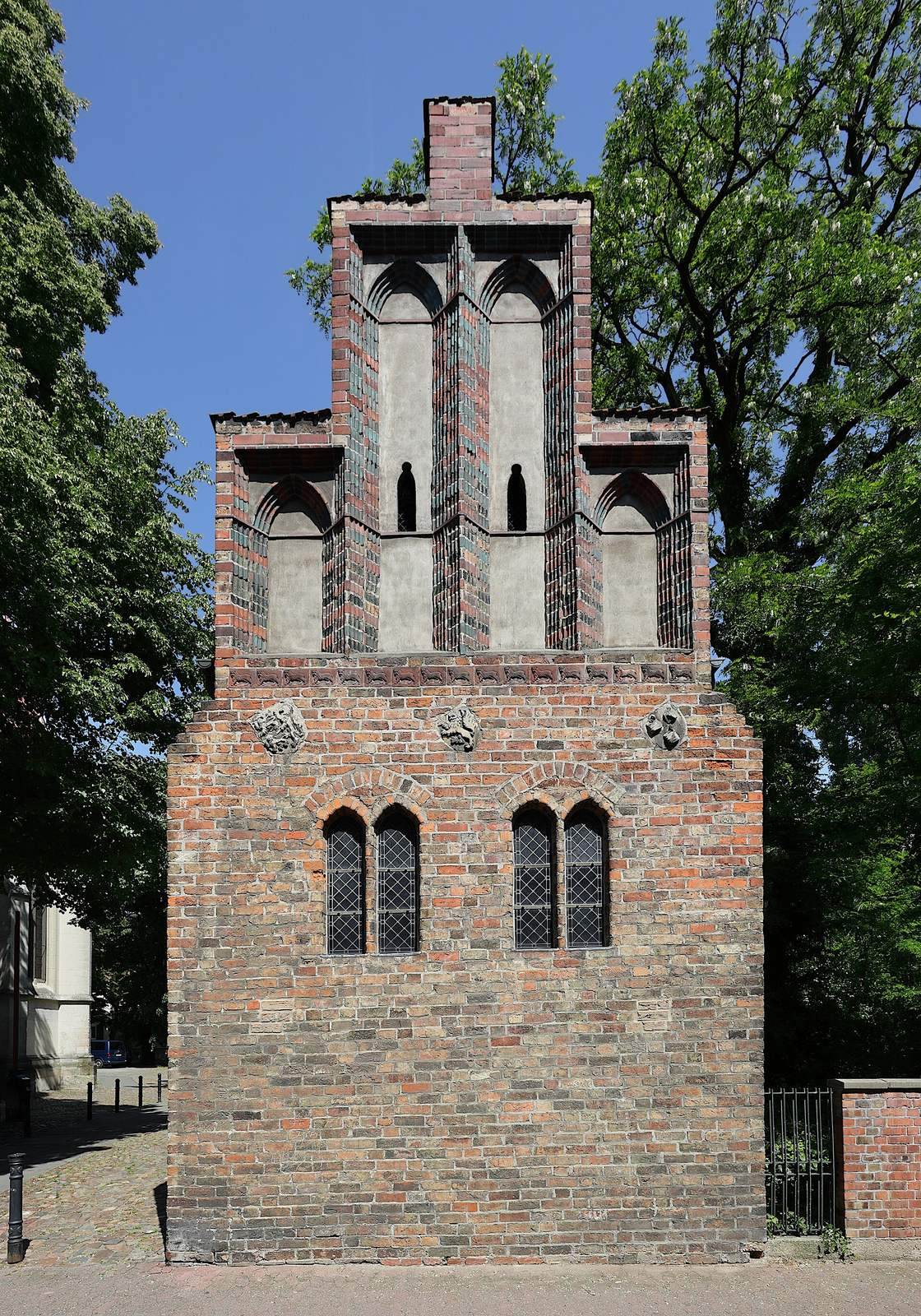
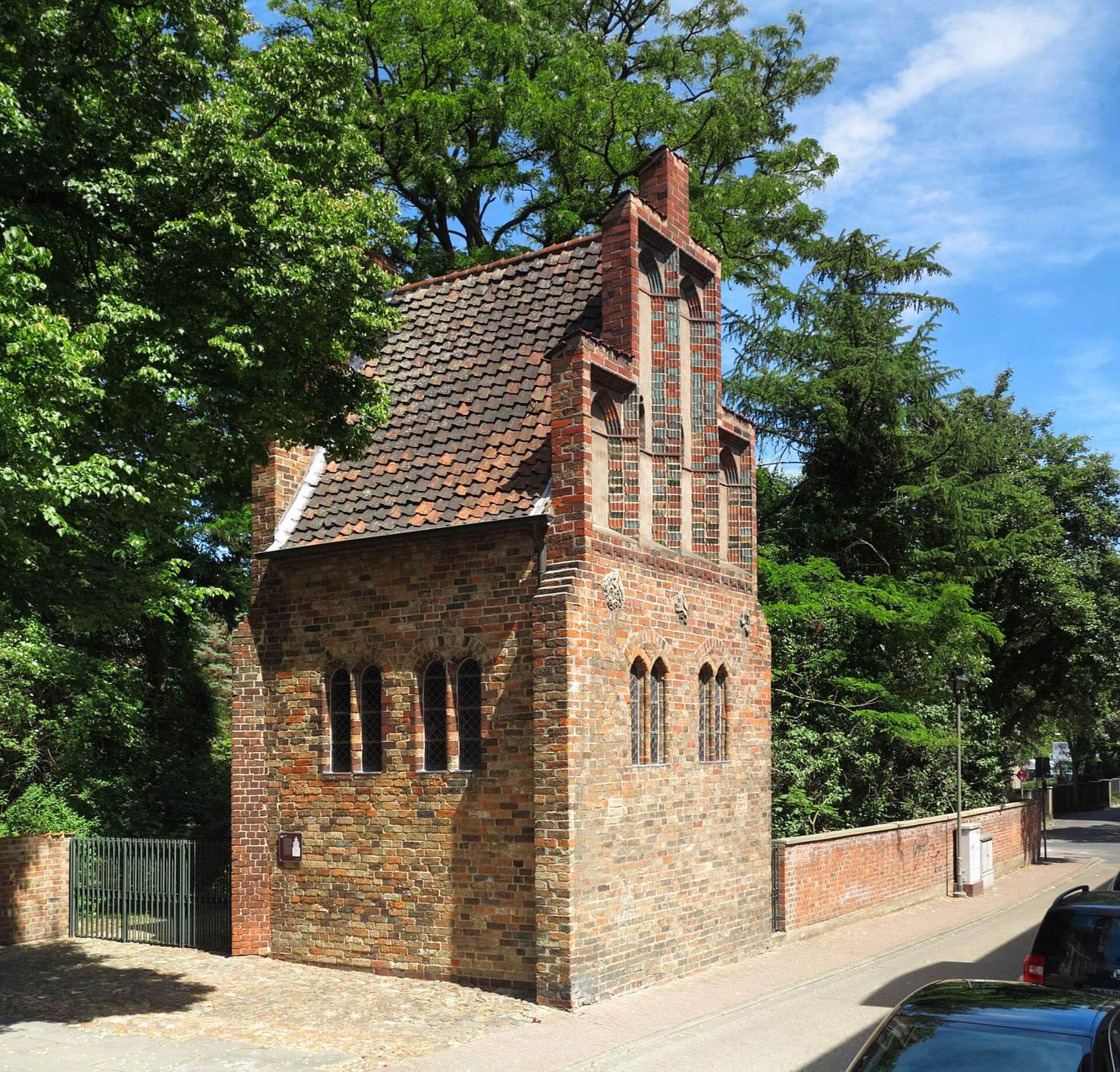
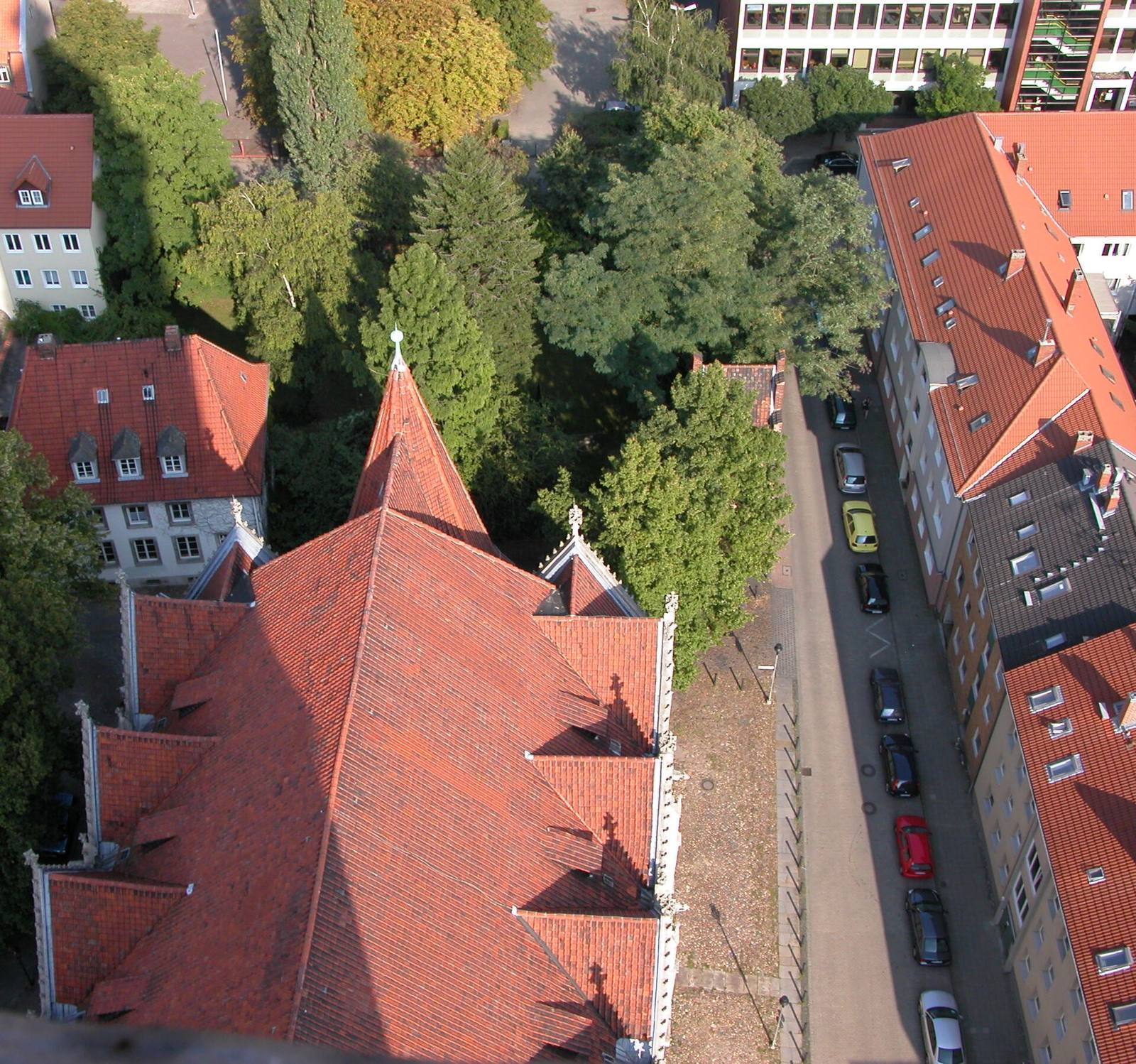
The Liberei stands on Kröppelstraße in Braunschweig’s Neustadt, a few metres southeast of St. Andreas Church. Its chapel-like brick form has a floor plan of 5.50 by 5.14 metres and two storeys. Brick was unusual in a city where timber-framed houses predominated. The building is an example of North German Brick Gothic and the only surviving evidence of medieval brick Gothic in Braunschweig.
Storeys and access
Each storey has a rib-vaulted ceiling, a structure supported by intersecting ribs, and is accessible from outside. The lower level lies partly below ground; small paired windows on its east side provide light. The 1412 building contract called for an interior stone staircase. A steel exterior staircase on the north side was installed during the interior restoration.
Gables and south façade
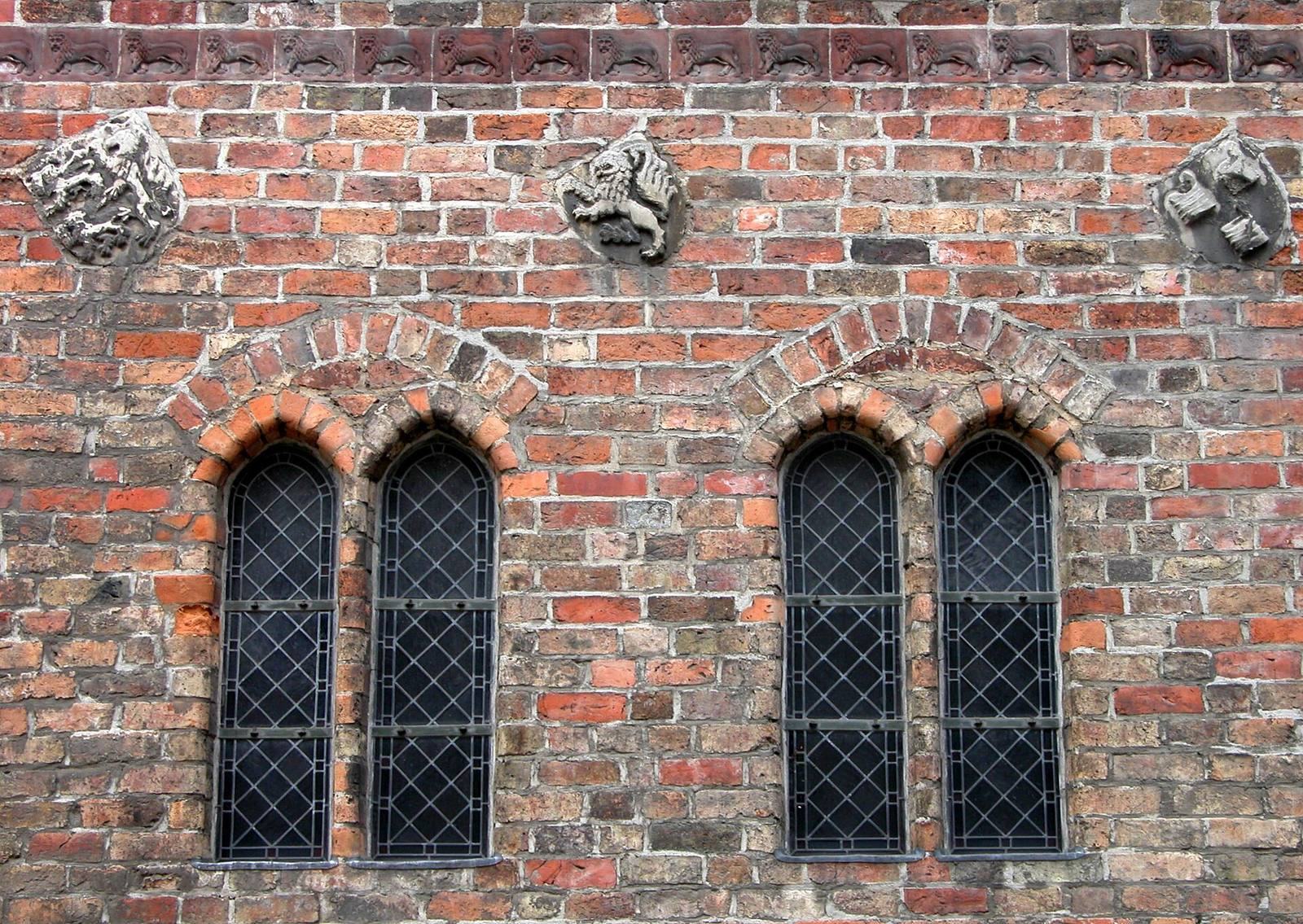
The north and south ends have staircase-shaped Gothic gables. Glazed shaped bricks and relief bricks emphasize their vertical lines. On the south side, pointed-arch blind niches, shallow recesses that do not open into a room, sit above a decorative band. The band shows 17 lions moving from right to left and facing outward. Whether they refer to the Brunswick Lion, and what the image means, remain uncertain.
Three coats of arms appear below the band. The left shield has been attributed, with uncertainty, either to Duke Bernhard I or to the Blasiusstift. The central shield represents the Brunswick Lion and the council. The right shield belongs to Johann Ember and shows three buckets, a reference to the meaning of his name. The purpose of the group of shields has not been established.
Surviving books from Gerwin von Hameln’s gift
Of the 336 volumes Gerwin von Hameln gave to the Liberei, 137, or 41 percent, are known to survive. The largest groups are now held by the Braunschweig City Library and the Herzog August Library in Wolfenbüttel; smaller groups are in libraries in Göttingen, Stuttgart, Karlsruhe, and Dessau-Roßlau. Gerwin’s books can be identified by labels on their edges and by his family coat of arms, a white half-ibex on a blue field with red tongue, horns, and hooves. Many also contain his handwritten notes in the margins.