Brunswick Cathedral: A Welf Dynastic and Protestant Church in Germany


Site at a Glance
- Rating
- 4.6
- Popularity
- Medium
- Country
- Germany
- Primary era
- Medieval
- External website
- Open
- Eras represented
- Medieval, Early Modern, Modern
- Civilizations
- German, Holy Roman Empire
- Site type
- Religious
- Remains
- Church
On this page21 sections
History
Brunswick Cathedral, officially the Evangelical-Lutheran Cathedral Church of Saint Blaise in Brunswick, Germany, was founded in 1173 by Henry the Lion as a Romanesque collegiate church. The Welf ruler, who held the duchies of Saxony and Bavaria and made Brunswick a principal centre of his power, established it opposite Dankwarderode Castle after his pilgrimage to the Holy Land. Dedicated to Saint Blaise and Saint John the Baptist, the church was intended as the burial place of Henry and his second wife, Matilda of England.
Foundation and medieval completion
A predecessor church connected with the Brunswick palatium had been founded by Duke Brunon and consecrated in 1030. Henry’s building was nevertheless a new monumental foundation rather than a straightforward continuation of that earlier church. Construction was probably interrupted during Henry’s exile in England from 1182 to 1185. The eastern part, including the high choir, was probably complete by about 1188, when Bishop Adelog of Hildesheim consecrated the Marian altar at Henry’s request and that of Matilda.
The roof burned in 1195, but work on the nave, transept, and parts of the westwork had probably progressed far enough for Henry to be buried in the unfinished church after his death that year. Matilda, who had died in 1189, was buried beside him. The church was formally consecrated on 29 December 1226, when Thomas Becket was added as its third patron. Becket, the archbishop of Canterbury murdered in 1170 and later venerated as a martyr, joined Saint Blaise and Saint John the Baptist in the church’s dedication.
The building probably began to be called a cathedral in the fourteenth or fifteenth century. Until the nineteenth century, it was generally known as the Collegiate Church of Saint Blaise and Saint John the Baptist. In 1543 Brunswick adopted the Reformation, the collegiate institution was dissolved, and the church became Protestant. In German usage, the word Dom can refer both to a cathedral and to a major collegiate church, helping to explain the building’s later name.
Dynastic church and later alterations
The church became a burial place for the Welfs, a major German princely dynasty, and especially for the Brunswick and Brunswick-Wolfenbüttel branches. The crypt beneath the choir and transept received many rulers and family members from the seventeenth to the nineteenth century. Among those associated with the burial history are Gertrude the Elder, Margrave Egbert II of Meissen, Gertrude the Younger, Emperor Otto IV and Beatrice of Swabia, as well as later Brunswick rulers.
Later burials included Charles I, who founded the Collegium Carolinum and the Fürstenberg porcelain manufactory; Charles William Ferdinand, who died from wounds after the Battle of Jena-Auerstedt; Frederick William, the “Black Duke,” who was killed at Quatre-Bras; and William, the last descendant of the Brunswick-Bevern line. Around 1700, Duke Rudolf August established a crypt for himself and his wives in the northern transept. Duke Anton Ulrich had the remains of earlier ancestors exhumed in 1707 and placed together in the monumental Welf Tumba.
Major changes took place under Rudolf August around 1687 and Anton Ulrich around 1700. The convent buildings beside the southern transept were demolished after 1829, exposing the formerly enclosed south gable. A large restoration and remodelling campaign followed between 1866 and 1910 under Ernst Wiehe, the municipal building official. The work gave parts of the cathedral a Historicist appearance, and a Neo-Romanesque baptismal chapel was added south of the transept in 1889.
Wall paintings and nineteenth-century interpretation
Medieval wall paintings were rediscovered beneath later overpainting in 1845. Their restoration and completion continued for decades under Heinrich Brandes, Adolf Quensen, and August Essenwein. A complete repainting in 1880 and 1881 incorporated extensive nineteenth-century additions. The paintings on the nave pillars by Johann Georg Loosen were probably not medieval, even though they formed part of the historicist interior presented at that time.
National Socialist appropriation
During the National Socialist period, the cathedral and the memory of Henry the Lion were appropriated for racial and expansionist propaganda. Between 1935 and 1940, nineteenth-century furnishings were removed and the building was altered for use as a national or “folk” shrine rather than as a place of Christian worship. The intended cult site presented Henry as a precursor of Nazi expansion into eastern territories.
The tomb of Henry and Matilda was opened for archaeological examination in 1935 at the initiative of Dietrich Klagges, the Nazi-era minister-president of Brunswick. The excavation began on 24 June under an initially informal team and was later directed by Hermann Hofmeister, the state archaeologist. It officially ended on 6 July. Adolf Hitler visited the excavation on 17 July and subsequently claimed decisive authority over the planned transformation of the cathedral.
The investigation found a large stone sarcophagus containing a largely decomposed body, a smaller child’s sarcophagus, and a wooden coffin with a leather-wrapped skeleton. The first identification assigned the large body to Matilda and the wooden coffin to Henry, but a 1974 reinterpretation reversed those assignments. The identities remain uncertain. The remains have been interpreted as belonging to Henry, Matilda, or another woman, and the excavation was later criticised for weak scientific documentation and ideological interference.
The large body measured about 1.62 metres and had a shortened left leg and severe hip damage. These features were once connected with Henry’s documented riding accident in 1194. The skeleton in the wooden coffin was enclosed in a leather case about 2.05 metres long, while the child’s skeleton measured about 70 centimetres and was interpreted as the couple’s son Henry. The difference in length between the adult remains is now attributed to compression and distortion of the wooden coffin, so body length cannot establish sex or identity.
Between 1936 and 1938, Walter and Johannes Krüger created a new granite burial chamber and altered the interior for National Socialist use. The reburial arrangement and the positions of the tomb figures were manipulated during this work and later restored. The planned shrine included a stylised lion’s head by Arno Breker, coats of arms associated with Henry’s foundation towns and residence, and a swastika on the west wall. The swastika was removed after the war.
Wilhelm Dohme painted eight monumental sgraffito scenes in the nave between 1937 and 1940. Sgraffito is a technique in which layers of surface material are scratched to reveal contrasting layers beneath. Directed eastward and centred on Henry’s supposed “conquest of the East,” the scenes portrayed him as a forerunner of Hitler. On 23 November 1940, Alfred Rosenberg ceremonially designated the building a national cult site and “Hall of Henry the Lion.” It consequently became known as a “state cathedral.”
War damage and post-war conservation
More than forty heavy air raids struck Brunswick between 1940 and 1945. The cathedral suffered comparatively little damage, although its roof, windows, and the vaults of the northern vestibule were affected while much of the surrounding city centre was destroyed. Important artworks had been evacuated. After the war, most National Socialist alterations were removed, the twentieth-century nave paintings were whitewashed, and the building again served as a Protestant church.
A state-church treaty in 1954 transferred the cathedral and its artworks to the Foundation of the Cathedral Church of Saint Blaise in Brunswick, administered by Brunswick church authorities. The foundation also assumed responsibility for the cathedral cemetery and associated buildings. Fundamental repairs in the 1960s corrected severe foundation damage caused by the 1936 burial-chamber construction. The southern transept was restored between 1954 and 1956 by Fritz Herzig, who also investigated the medieval secco technique, a method of painting on dry plaster rather than fresh plaster. Later examination prepared the way for conservation intended to remove later overpaint and preserve the medieval cycle. In 2005, the visible Elmkalkstein masonry inside was covered with a glossy acrylic-like coating.
The cathedral’s medieval relic collection developed into the Welf Treasure, a group of ecclesiastical artworks and reliquaries associated with the dynasty. The collection was removed from the cathedral in 1671, dispersed through princely and royal collections, and partly sold in 1929. Forty-two works were declared a national treasure of Germany in 2015. They are now held mainly in museums, including the Bode Museum in Berlin and the Cleveland Museum of Art. The relic of Saint Blaise remains in a gilded hand-shaped reliquary at Dankwarderode Castle.
Brunswick Cathedral continues to function as a Lutheran church under the administration of the Evangelical-Lutheran Church in Brunswick. Its history therefore combines a twelfth-century dynastic foundation, medieval religious and artistic traditions, Protestant use, ideological abuse under National Socialism, and continuing conservation of a complex historic interior.
Remains
Romanesque plan and Gothic additions
The cathedral’s surviving medieval core consists chiefly of the nave, transept, and choir. The original building was a three-aisled Romanesque pillar basilica constructed mainly from limestone, including Elmkalkstein from the Elm and Brunswick Rogenstein from the Nussberg. It had a transept, three apses, an eastern high choir above a crypt, and a Saxon westwork. The present church is a five-aisled basilica, meaning that its central nave rises above lower side aisles and receives light through clerestory windows. It retains a transept, a one-bay choir ending in a separate semicircular apse, eastern apses in both transept arms, and a two-towered westwork.
The original bound-system plan has four bays in the main nave and eight in the side aisles. Later additions changed parts of the building without destroying this basic spatial arrangement. The Romanesque arcades use piers and wall supports with engaged edge columns and cubical capitals. Pointed groin vaults with keystones cover the main spaces, but transverse belt arches do not separate the bays, an unusual arrangement that distinguishes these vaults from those at Königslutter. Belt arches occur in the choir and parts of the southern aisle.
Southern aisles
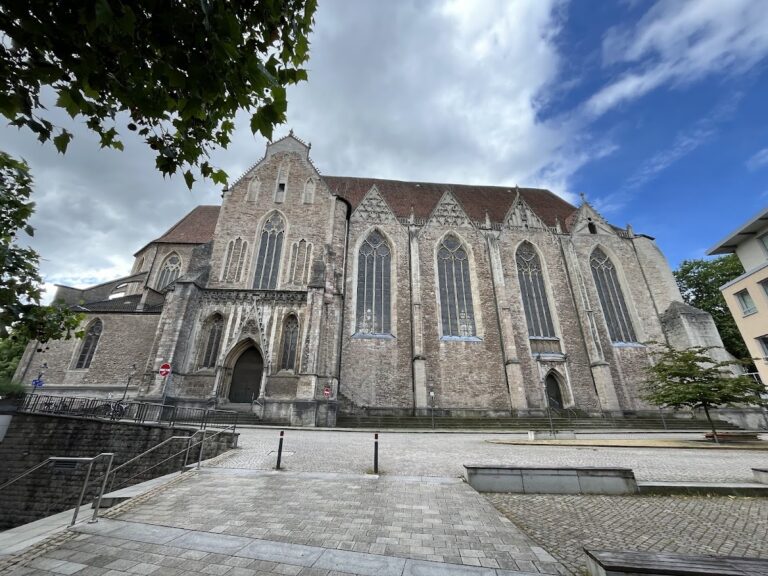
Between 1322 and 1346, an additional aisle was built on the south. Its inner aisle retains cross-groin vaults, while its outer aisle has pointed rib vaults, octagonal supports, large pointed tracery windows, and Gothic carved bosses with vegetal and zoomorphic motifs, including an eagle and a lion. The southern exterior has a sequence of pointed-window bays beneath a separate roof and triangular gables with finials. Buttresses carry small sculptural details.
Northern aisles
The Romanesque northern side aisle was demolished under Duke William “the Victorious” and replaced in 1472 by two late Gothic aisles. Their Tudor-arched windows, spiral supports, and alternating star- and net-patterned rib vaults follow the English Perpendicular style. The aisles are equal in height and together resemble a hall church, although both remain lower than the nave. Glazing depicting Brunswick dukes and duchesses, removed in 1687, had made the space resemble a dynastic hall of fame.
Westwork and entrances
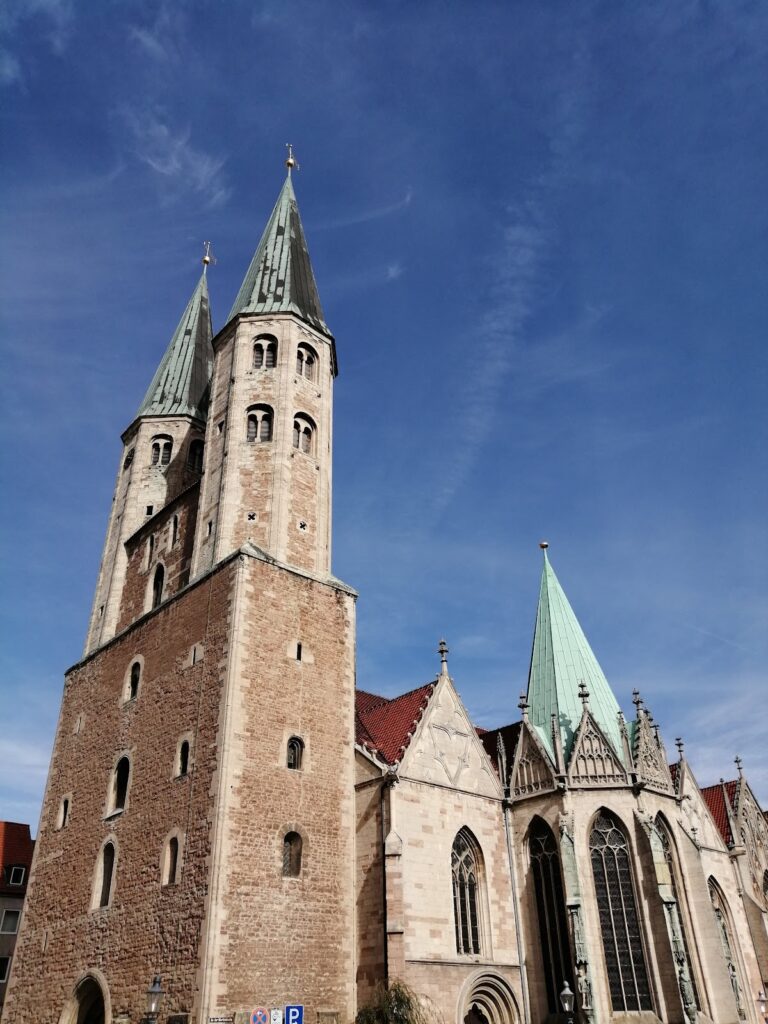
The westwork, a monumental western entrance and tower block, has three levels. A lower rectangular vestibule supports a middle storey with a western rose window and small tracery windows. The upper level contains two octagonal towers and a rectangular Gothic bell house. The towers have plain stone walls, low pyramidal roofs, and profiled ashlar corners. The southern tower is slightly higher and carries a small lantern. Around 1300, the towers were linked by the bell house, whose enormous pointed openings contain High Gothic tracery.
Portals
The cathedral has five entrances, two on the north, two on the south, and one on the west. The Löwenportal, beside the entrance to Dankwarderode Castle, is the only surviving Romanesque cathedral portal. Its semicircular arch has severe profiled jambs and archivolts, a trefoil-shaped archivolt, and doors with fittings decorated by a stylised spiral motif. Deep scratches in the stone jambs are traditionally attributed to Henry the Lion’s lion. They are more probably weapon-sharpening marks or traces of medieval attempts to obtain supposedly healing or empowering stone powder.
The main northern portal faces Burgplatz and bears the arms of Ludolf Quirre, a Welf chancellor and canon, together with the date 1469. The southern portal has profiled jambs, a donkey-back-shaped gable, and two finials. On the west side of the nave, paired pointed arches rise above the entrance portal, while a stone balustrade with rich tracery crowns the elevation.
Medieval wall paintings
The medieval secco paintings were applied between about 1230 and 1250 in the transept, the rear part of the nave, the choir, and the apses. About 80 percent survives across the cathedral, while roughly 40 percent of the original decoration remains in the southern transept. Later restoration and additions altered parts of the cycle, and the enlargement of the Gothic windows reduced the survival of some Romanesque paintings.
The cycle includes the Tree of Jesse, the Heavenly Jerusalem, the discovery of the True Cross by Saint Helena, and scenes concerning Saints Blaise, John the Baptist, and Thomas Becket. The central apse shows Christ Pantocrator on a rainbow, the Lamb of God, the twelve Apostles, scenes of Christ’s birth, the women at the empty tomb, the meal at Emmaus, and Pentecost. The choir vault presents Christ’s genealogy from King David to Mary. The southern transept contains the True Cross cycle, the Wise and Foolish Virgins, apocalyptic scenes, Christ and Mary, the twenty-four elders, angels, and seraphim.
Inscriptions on the northwesternmost nave pier and in the crossing identify the medieval painter as Johannes Wale or Johannes Gallicus. The paintings show probable French influence and belong to the Zackenstil, or zigzag style, a transitional Romanesque-Gothic manner marked by angular, sharply folded drapery.
Altars, tombs, and major furnishings
Marian altar
The Marian altar stands at the eastern end of the nave. Its polished stone slab measures 168 by 89 centimetres and rests on five bronze columns, each 95 centimetres high. A lead reliquary container occupies the central column. An inscription states that Bishop Adelog of Hildesheim consecrated the altar on 8 September 1188 at the request of Henry the Lion and Matilda. It is described as the only historic altar in the cathedral to have survived more than eight centuries.
Imervard Cross
The Imervard Cross is a Romanesque wooden four-nail crucifix probably made around 1150, before the cathedral was founded. It belongs to the Volto Santo type, which depicts Christ crucified with four nails as an upright and triumphant figure rather than as a suffering one. The cross probably served as a processional cross, and a small compartment in the back of Christ’s head held relics. The belt bears the inscription “IMERVARD ME FECIT.” Christ has no crown of thorns and is shown as a triumphant king.
Tomb of Henry the Lion and Matilda
The joint tomb of Henry and Matilda stands before the Marian altar. Its over-life-size limestone figures portray the couple as idealised youthful adults. Henry holds a model of the cathedral and a sword wrapped in its belt, referring to his judicial authority and his role in initiating the building. Matilda’s folded hands express piety. The naturalistic treatment of their bodies and drapery is associated with early Gothic funerary sculpture and is discussed in relation to the Plantagenet tombs at Fontevraud.
The present joint tomb was commissioned around 1230, although its exact date remains debated. Proposed dates range from before 1200 to about 1260, while a chronicle from 1210 already records a notable tomb for the couple. Henry and Matilda now rest in simple granite tombs within the special granite burial chamber built between 1936 and 1938. The earlier position of Emperor Otto IV and Beatrice of Swabia in front of Henry and Matilda’s tomb is commemorated by a floor plaque installed in 2009.
Welf Tumba and crypt
The Welf Tumba is a monumental limestone burial structure covered by a bronze inscription plate naming, among others, Emperor Otto IV and his first wife, Beatrice of Swabia. It reflects Duke Anton Ulrich’s arrangement of ancestral remains in 1707. The crypt beneath the choir and transept contains the burial places of many Welf rulers and members of the Brunswick line. The crypt for Rudolf August and his wives, created around 1700 in the northern transept, was removed in 1934.
Seven-branched candlestick
A bronze seven-branched candlestick, probably made around 1190 and certainly present by 1196, stands near the steps to the choir and crossing. It consists of 77 separately cast bronze parts, is almost five metres high, spans about four metres or slightly more, and weighs more than 400 kilograms. Its symbolism relates to the menorah, the Tree of Life, Solomon’s Temple, burial, and resurrection.
The richly decorated square base has lions and fantastical winged dragons as feet. Openwork between them includes personifications of the four cardinal virtues, the prophets Isaiah, Jeremiah, Ezekiel, and Daniel, and the four rivers of Paradise. One node retains enamel decoration with medallions of the four Evangelists and their symbols. Other nodes received rock-crystal decoration in the nineteenth century.
Sculpture and memorials
The cathedral preserves Gothic sculptures dating from the thirteenth to the sixteenth century. Two late Gothic statues near the eastern apse, made around 1500, represent Saint Blaise as a bishop and Saint John the Evangelist. Beneath the chancel arch stands a statue from about 1270 to 1280 of a duke, possibly Henry the Lion, holding an upraised sword. A statue made in 1370 represents Henry III, Bishop of Hildesheim.
The southern transept apse contains Christ at Rest and a Passion column bearing the Arma Christi, the objects associated with Christ’s Passion. It includes the severed ear of Malchus, Saint Veronica holding the Vera Icon, and smaller busts of Annas, Caiaphas, and Simon of Cyrene. A rooster at the top represents Peter’s denial. The southern aisle contains statues identified as Duke Otto the Mild of Brunswick and Göttingen and his wife Agnes of Brandenburg. The cathedral also preserves the oldest surviving wooden representation of Christ at Rest, dating from the end of the fourteenth century.
Epitaphs, mainly in Dutch Mannerist and Baroque styles, remain distributed through the side aisles. They commemorate Elisabeth von Schulenburg, Wilhelm von Ow, Dean Valerius Möller and his wife Margaretha, and Caspar von Völcker and his wife Catherina. Their painted scenes, reliefs, portraits, coats of arms, panoplies, and ornamental architectural frames form part of the later interior furnishings.
Bells, organs, and other features
The cathedral’s bell ensemble comprises twelve instruments, including ten medieval bells, one made in 1700, and one cast in 1990. The oldest, the small Adämchen or Blasius minimus, is probably fifteenth-century and has an unknown founder. The three largest historic bells, Salvator, Maria, and Johannes, were cast in 1502 by Gerhard van Wou. Six further medieval bells were cast in 1506 by his assistant Heinrich von Kampen.
A Thomas bell attributed to van Wou fell in 1660. A replacement cast in 1989 by the Rincker foundry was installed in 1990 under the name Thomas of Canterbury. During the Second World War, the three largest bells remained in the bell house, while the others were removed and later recovered undamaged from a bell cemetery. In 2006, the three largest bells were removed for welding repairs and returned two months later after cracks caused by material fatigue had been filled with matching bronze.
The oldest known cathedral organ was built in 1499 by Heinrich Kranz and converted into a Baroque organ in the early seventeenth century. A Neo-Romanesque organ gallery was built during the nineteenth-century restoration, and a new organ with 85 stops and 5,863 pipes was installed there in 1895. That instrument was sold to Saint Mary’s Church in Hanover in 1960.
The present main organ is based on an instrument built by Karl Schuke in 1962 with 55 stops on four manuals and pedal. It was rebuilt in 1992 and completely revoiced in 2002 and 2003. It now has 57 stops, mechanical action, and electric stop action. A three-part choir organ by Freiburger Orgelbau Hartwig and Tilmann Späth was inaugurated in December 2023. It has 26 sounding stops and 2,222 pipes on three manuals and pedal, with additional extended manual stops and pedal transmissions. Its paired swellable cases resemble angel wings and flank the seven-branched candlestick, while its installation obscures part of the choir wall paintings.
Four sundials are attached to the cathedral, dated 1334, 1346, 1518, and 1723, although the large sundial may have been installed in 1716. The two oldest have semicircular faces with hour rays cut into stone blocks. The large sundial was originally made in Augsburg by Georg Hertel for the municipal mint at Kohlmarkt. It also displays astronomical information, a calendar, and zodiac signs.
A cannonball embedded in the eastern wall is traditionally associated with the siege of Brunswick by troops of Duke Friedrich Ulrich in 1615. The date 20 August 1615 is carved beneath it in Roman numerals.
Nearby sites