Hegne Castle: A Former Summer Residence of the Bishops of Constance
Site at a Glance
- Rating
- 4.5
- Popularity
- Very Low
- Country
- Germany
- Primary era
- Early Modern
- Eras represented
- Medieval, Early Modern, Modern
- Civilizations
- German, Grand Duchy of Baden, Holy Roman Empire
- Site type
- Domestic
- Remains
- Castle
On this page11 sections
History
Hegne Castle stands beside Hegne, now part of Allensbach in Baden-Württemberg, Germany. Its exact construction date is unknown, though it probably originated in the sixteenth century. In 1591, the Prince-Bishopric of Constance acquired the estate and converted its existing castle into a Renaissance summer residence for the bishops.
From private estate to episcopal residence
The estate first appears in a record from 1570, when Hans Christoph von Knöringen sold it to Sebastian von Roth. In 1580, Sebastian’s widow, Corona von Habsberg, and their three daughters transferred it to Stefan Wohlgmuet zu Mutburg, chief bailiff of the Prince-Bishopric of Constance. This was an ecclesiastical territory in which the bishop also held secular political authority. The castle building is described as medieval, but its precise age remains uncertain.
In 1591, during Andreas of Austria’s rule as bishop, the estate passed to the prince-bishopric. The castle was adapted as a summer residence, while the grounds were expanded and a park laid out. An enclosed collection of animals, or menagerie, was also established. The cathedral chapter ended the costly menagerie in early 1601, shortly after Andreas’s death.
War and secularization
In 1642, Protestant troops from the Duchy of Württemberg plundered the castle during the Thirty Years’ War, a major Central European conflict fought from 1618 to 1648. Based at nearby Hohentwiel fortress, they had previously made several unsuccessful surprise attempts to capture Constance, then ruled by the Catholic Habsburgs. Repairs and alterations to the castle followed the war.
The Prince-Bishopric retained the estate until 1803. That year, the Final Recess of the Imperial Deputation, a settlement that reorganized the Holy Roman Empire and transferred many church territories to secular control, brought the castle and its lands into secular ownership. They were first used as a state domain of the Grand Duchy of Baden, then passed through several owners.
New owners and changing uses
In 1863, the Basel firm Isaac Dreyfus Söhne & Cie. bought the estate as an investment, divided it, and sold its parts. The castle and farm buildings went to the District Association of Constance in 1866. For the next twelve years, the castle housed a district orphanage, while the farm building accommodated an agricultural school.
Werner de Weerth purchased the castle in 1879 and substantially remodelled it by 1882 in the Neo-Renaissance style, a revival of Renaissance architectural forms and ornament. The work also removed the castle chapel, consecrated in 1595, which had served as the village church. A replacement chapel dedicated to the Virgin Mary was built for the village and consecrated on 8 September 1879.
Monastery and twentieth-century use
The Sisters of Mercy of the Holy Cross acquired the castle in 1892 and established a monastery there. In 1895, it became the seat of their Baden-Hohenzollern religious province, an administrative branch of the congregation, now known as the Baden-Württemberg province. The castle briefly accommodated a household school and its boarding section from 1925 to 1927. During the Second World War, it housed mothers and children evacuated from industrial areas in northwestern Germany through the Caritas Association.
From 1949 to 1976, the castle served as a training house for candidates and, later, novices preparing to enter the religious order. Training moved temporarily to the congregation’s motherhouse in Ingenbohl, Switzerland, and the castle resumed use as a novitiate in 1985.
Restoration and present role
Exterior restoration in 1965–66 exposed older masonry and prompted suggestions that an earlier aristocratic residence had stood on the site. Proposed predecessors have included an early medieval Alemannic residence, a medieval castle, and a late medieval manor, but these possibilities remain unproven. In 1996–97, the foundations were repaired and a new chapel was created in the basement on the park side. The castle is now part of a larger complex that includes the monastery and educational and charitable institutions. Pilgrims visit the tomb of Blessed Ulrika of Hegne, a member of the congregation, in the crypt, or burial chamber, beneath the monastery church of St. Konrad.
Remains
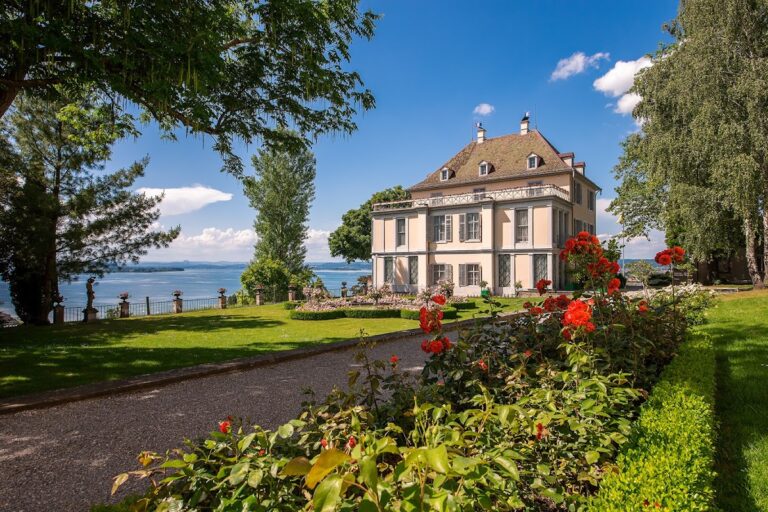
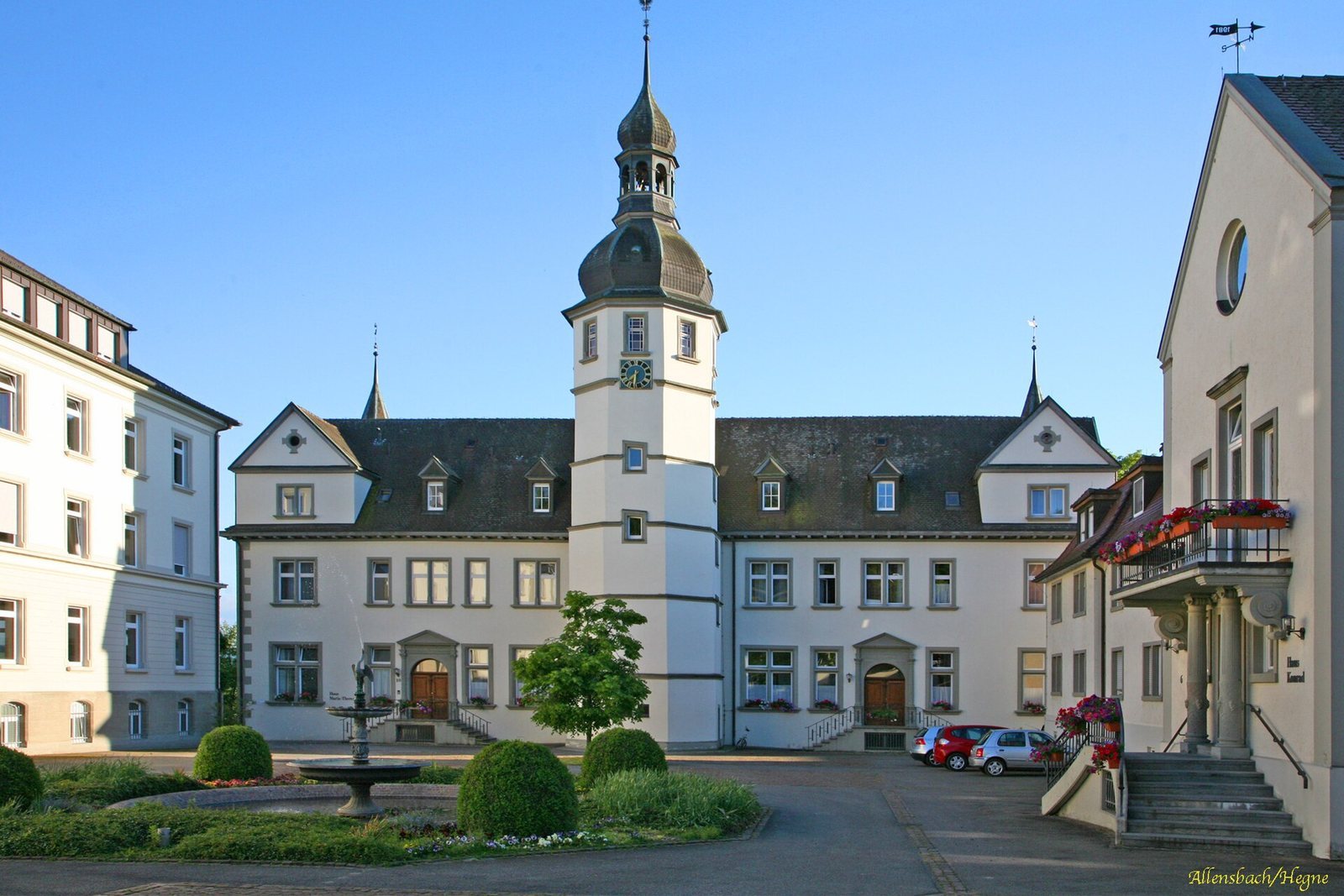
The castle has a lake-facing side and a courtyard side, with towers on both elevations. Its exterior combines retained walls and towers with Neo-Renaissance alterations, while the interior is arranged on two unusually high floors. A later reorganization divided large rooms into smaller ones.
Castle exterior and interior
Lake and courtyard elevations
Two corner towers stand on the lake-facing side, opposite an octagonal stair tower on the courtyard side. During the remodelling completed by 1882, the outer walls and towers were largely kept, but the two formerly round corner towers received octagonal outer forms. A loggia, an open-sided gallery used as a winter garden, was added at the centre of the lake-facing façade. The roof was ornamented with a volute gable, a gable decorated with scroll-shaped forms.
Interior
The refitting reduced the castle’s three existing floors to two much higher ones. In a reorganization carried out in 1976–78, large interior spaces were divided into smaller, modern rooms.
Park-side chapel
The chapel established in the park-side basement in 1996–97 was artistically designed by Elmar Hillebrand. He had previously designed the monastery church of St. Konrad in 1963 and its crypt in 1991.