Abbey of Reichenau: A Benedictine Monastery on Lake Constance
Site at a Glance
- Popularity
- Very High
- Country
- Germany
- Primary era
- Medieval
- Eras represented
- Medieval, Early Modern
- Civilizations
- Carolingian, Holy Roman Empire
- Site type
- Religious
- Remains
- Monastery
On this page15 sections
History
The Abbey of Reichenau was a Benedictine monastery founded in 724 on Reichenau Island in Lake Constance, Germany, by the missionary bishop Pirmin. Its foundation was linked to efforts to bring Christianity to the Alemanni, a group of Germanic peoples whose territory included much of southwestern Europe, and received Frankish patronage that included Charles Martel, a senior official in the Frankish royal court.
Foundation and Carolingian growth
A foundation legend says that Pirmin arrived with 40 monks, selected the island for a chapel and monastery, and cleared its woodland. According to the story, a spring appeared at his landing place and vermin fled across the lake over three days. The legend connects the island with Sintlas, an Alemannian noble associated with Sandeck on the opposite shore, now in Switzerland. Archaeological evidence supports the tradition that the island had been uninhabited before the monastery was established.
Pirmin left in 727 after a conflict with the Alemannian duke Hnabi, but the monastery continued to serve as a center for Christianization in the region. It was among the earliest communities linked to Irish or Scottish monastic traditions. Under Abbot Waldo, Reichenau developed into a Carolingian abbey supported by Frankish court officials and kings. Its abbots advised Charlemagne and his successor Louis the Pious, and Charlemagne visited in 780.
The monastery received royal favor and extensive privileges, including exemption from customs duties, ecclesiastical immunity from certain forms of secular jurisdiction, and the right to choose its abbot. It also held the rank of an imperial principality, a territory within the Holy Roman Empire whose ruler or institution ranked directly under the emperor, and was exempt from episcopal authority. Reichenau was among the leading monasteries of the Carolingian period, alongside St Gall and Fulda, and maintained close intellectual ties with St Gall.
Waldo established a monastic school, and the abbey developed a library, a workshop for producing manuscripts, and a community of artists. It also became a center for medical learning and care around Lake Constance, with physicians and facilities for bathing and treating the sick. Reichenau’s library was regarded as one of the world’s largest from the early ninth century until about 1100. Its early catalogues include entries dated 821 and 822.
Among the writers associated with the abbey were Wetti, who wrote the earliest surviving life of Gallus, and Abbot Walahfrid Strabo, a monk and scholar who composed the Visio Wettini and Liber de cultura hortorum at Reichenau. Abbot Reginbert enlarged the book collection. The monastery also produced a book listing its members and supporters, known as a confraternity book, and the ninth-century plan of St Gall.
Ottonian patronage and scholarship
A second cultural flowering came around the turn of the first millennium, under the Ottonian dynasty that shaped early medieval politics in central Europe. Henry I, Otto I, and Otto II granted the abbey privileges and gifts, and their visits further supported it. The period is associated with Abbot Witigowo and the reforming abbots Immo and Berno, as well as with Reichenau’s writing school and its celebrated illuminated manuscripts.
Abbot Hatto III, who also served as archbishop of Mainz and imperial chancellor, received a relic of St George from Pope Formosus in Rome. This probably prompted the construction of St George’s church. After the death of Arnulf of Carinthia, Hatto became guardian to the young king Louis IV; in 911, he crowned Conrad I, king of the East Frankish kingdom.
Intellectual work and decline
Reichenau’s scholarly life continued into the eleventh century. Hermann of Reichenau wrote on history and other subjects, and Berthold of Reichenau continued his chronicle. In the twelfth century, the abbey’s manuscript workshop also produced forged documents for Reichenau and other monasteries in Upper Swabia. These texts aimed to defend monastic property against claims by secular rulers. One prominent forgery falsely attributed to Charlemagne a grant of the royal estate at Ulm.
From the late twelfth century, under Abbot Diethelm of Krenkingen, the community entered a prolonged material and intellectual decline amid social and economic change. Repeated attempts at reform failed. In the second half of the fourteenth century the abbey’s whole estate was at times pledged, and in 1367 Abbot Eberhard of Brandis sold its lands and rights to his relatives. By 1402, only the abbot and two high-born members of the community remained as monks.
Monastic life briefly revived at the end of the Middle Ages. The Minster was enlarged, and a chronicler wrote a history of the abbey. In 1540 Abbot Markus of Knöringen surrendered its leadership to the Bishop of Constance. Reichenau became a priory, a religious house governed under a larger church institution, with twelve monks and an administrative role in the diocese. Efforts to regain independence ended when the abbey was suppressed in 1757. Secularization, the transfer of church property or authority to secular control, followed in 1803, and the last monks left the island.
Manuscripts and the modern community
The abbey’s library had suffered losses through war and plunder, as well as during the Council of Constance. After a building collapsed, Prior Maurus rescued the collection. In 1760, the Benedictine scholar Martin Gerbert described the manuscripts and introduced a classification system that remains in use. In 1805, the remaining collection passed to the Karlsruhe court library, while some items may have gone to Heidelberg.
Reichenau Island was added to the UNESCO World Heritage List in 2000. Ten illuminated manuscripts from the abbey entered UNESCO’s Memory of the World register in 2003, a programme for documentary heritage. A small Benedictine community returned to the island in 2001. The Cella St Benedict, a small monastic house subordinate to Beuron’s Archabbey of St Martin, was formally established in 2004 with support from the Archdiocese of Freiburg and serves local parishes. Two Benedictine nuns have lived near it since 2017. In April 2024, Pope Francis granted the former abbey church the honorary Catholic title of minor basilica.
Remains
The abbey was centered at Mittelzell, while associated churches stand at Oberzell in the east and Niederzell at the island’s western tip. The earliest monastery buildings were wooden, but they had been built of stone by 746. The later arrangement of the monastic buildings was associated with the ninth-century plan of St Gall, a design that became a model for a standard Benedictine monastery.
The Minster at Mittelzell
Church structure
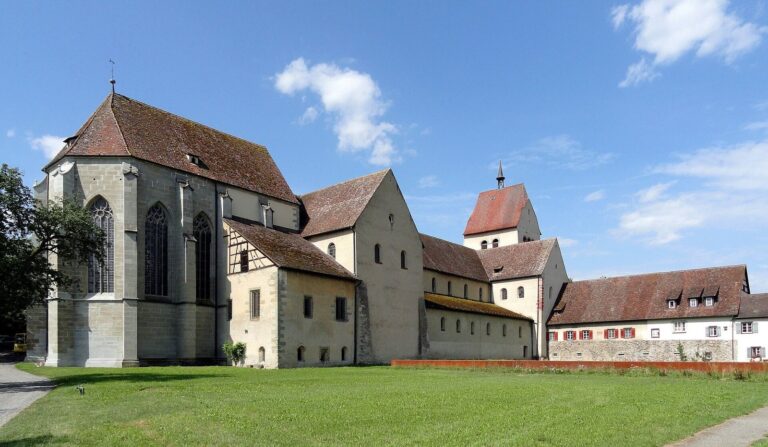
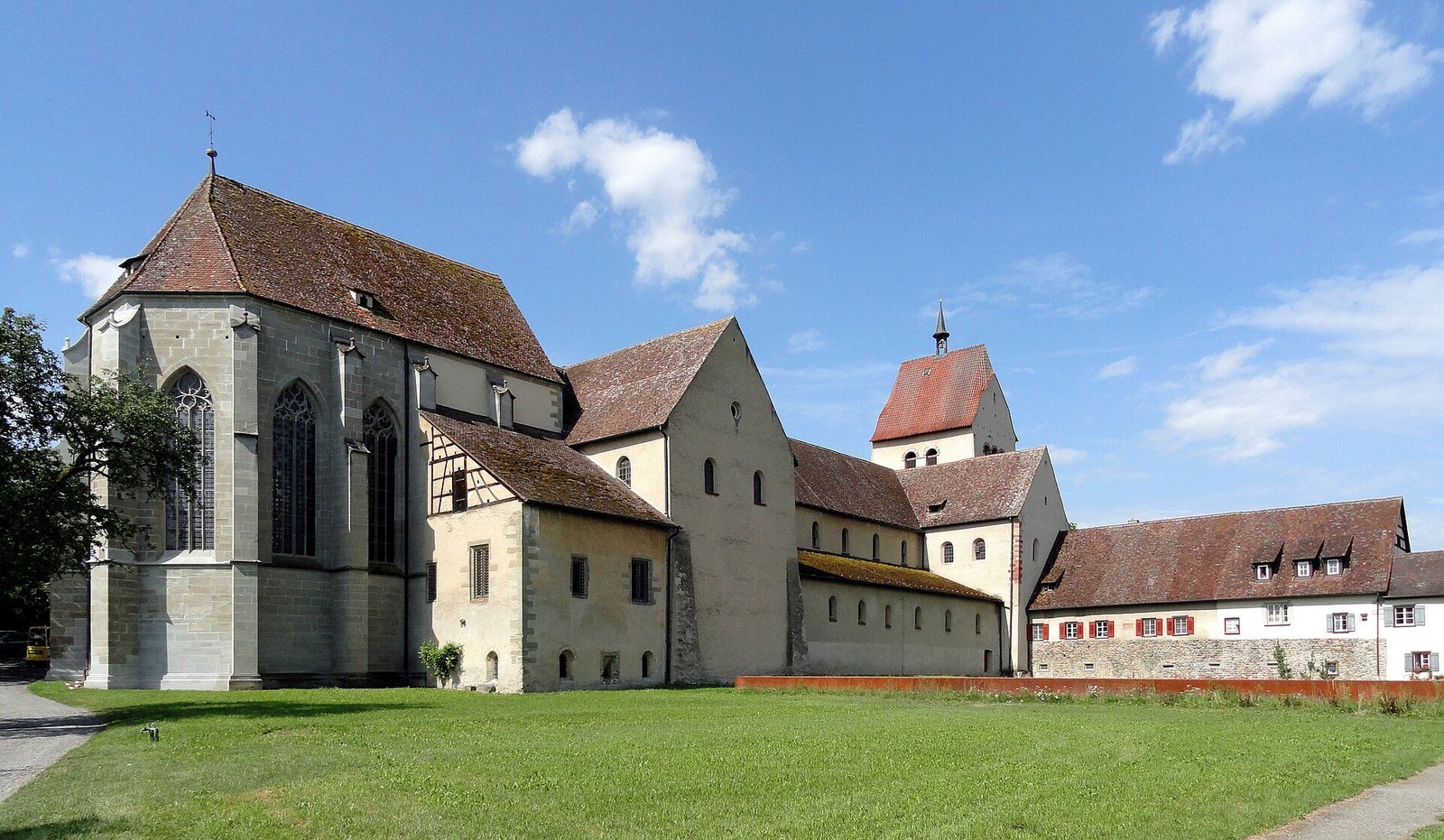
In the early ninth century, Abbot Haito rebuilt the church at Mittelzell with a cross-shaped plan, three aisles, and a transept, the crosswise arm of a church. A later rebuilding under Abbot Hatto III gave it a square western choir and a broad transept ending in two towers. The western church was dedicated to St Mark, and a round Chapel of the Holy Cross stood beside the eastern choir.
Abbot Berno later replaced the western part of the church with the present transept, which opens onto an apse, the rounded end of the church, beneath a tower. The apse has shallow vertical wall bands called pilaster strips and a horizontal decorative band of small arches. The Minster also has a late-Gothic choir with Renaissance wall paintings made on wet plaster.
Chapel and treasury
The Minster treasury contains reliquary shrines, containers made to hold sacred relics, associated with Saints John and Paul, St Fortunatus, and St Mark. The St Mark shrine is connected with relics brought from Venice in 830. The treasury also displays an Evangelistary, a liturgical book containing Gospel passages selected for worship. Other relics associated with the church include a pitcher linked to the wedding at Cana and a cross containing a relic of Christ’s blood, associated with the Chapel of the Holy Cross.
Churches at Oberzell and Niederzell
St George’s Church
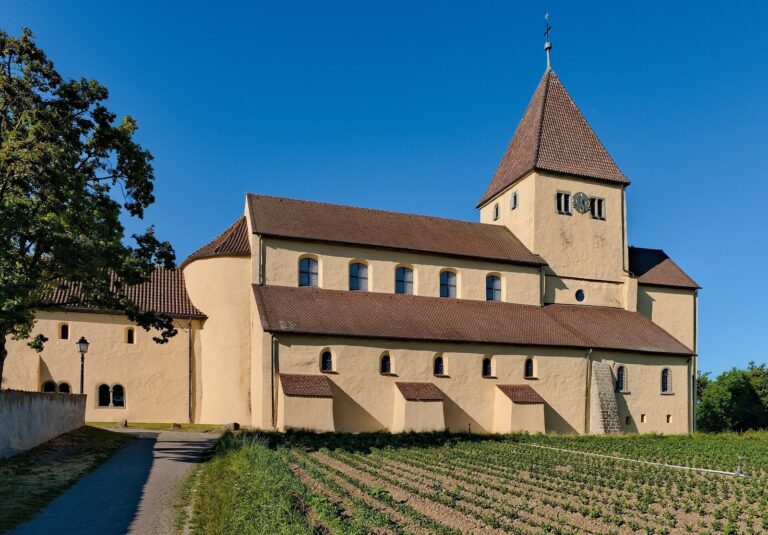
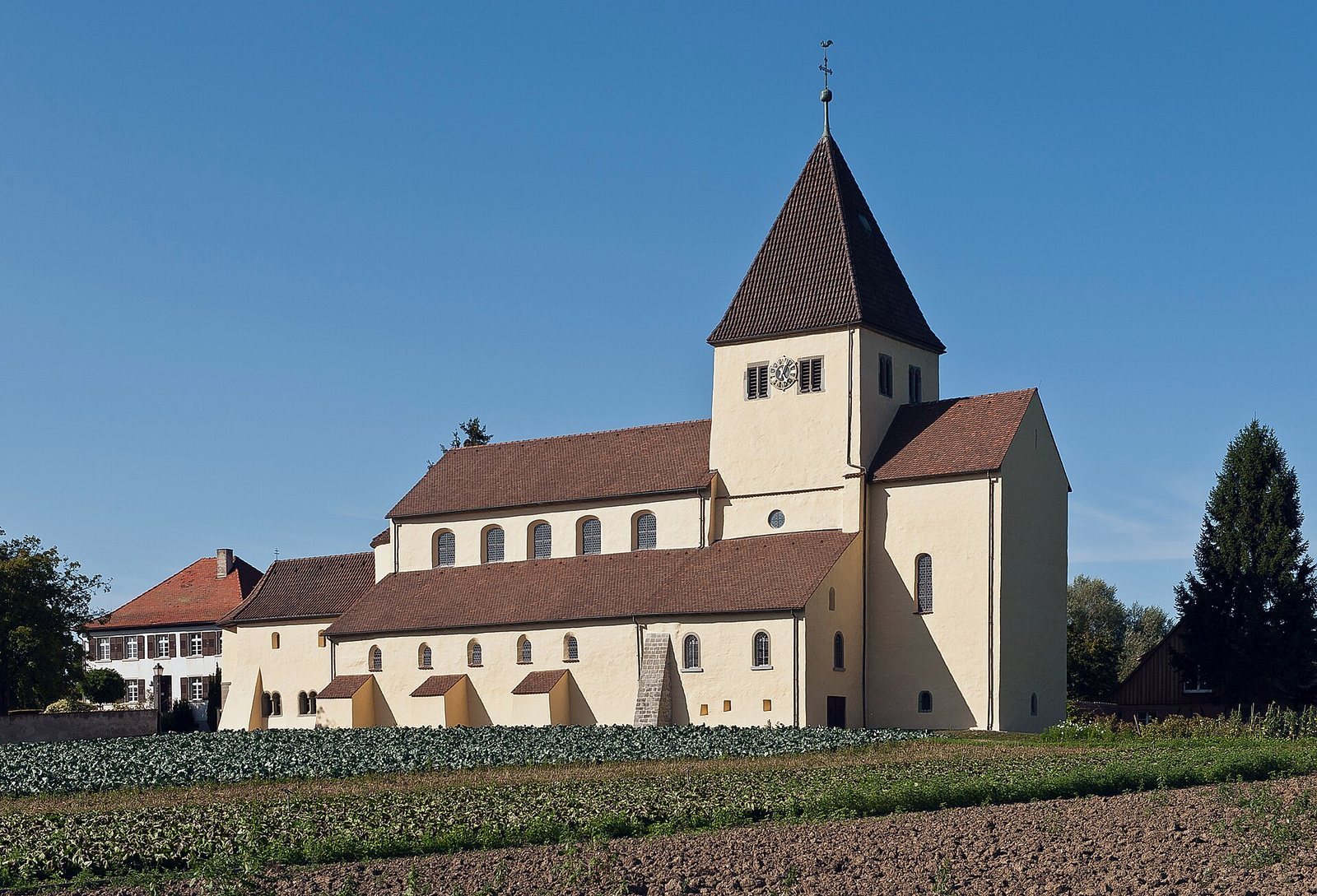
St George’s stands at Oberzell in the eastern part of the island. Its eight tenth-century frescoes are wall paintings made on wet plaster. A fragment of the saint’s head was kept in the church.
St Peter and Paul
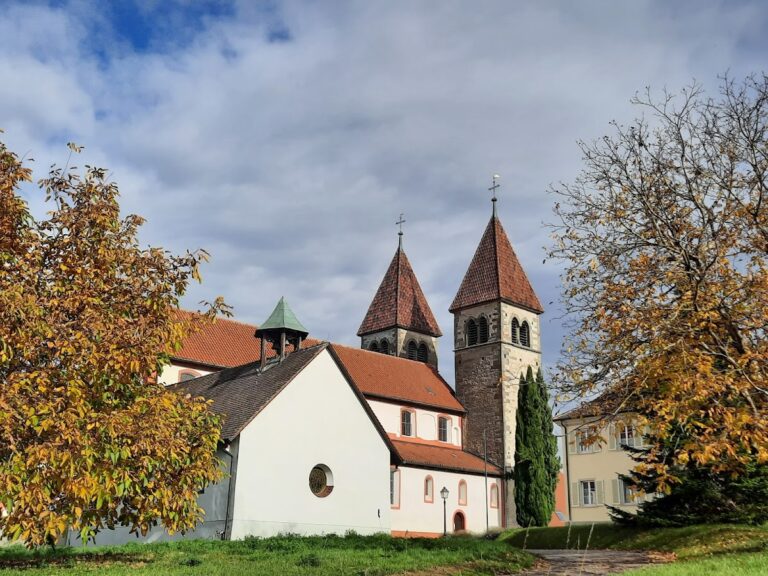
At Niederzell, on the island’s western tip, the church of St Peter and Paul is a small Romanesque basilica, a church in a medieval European style characterized by substantial masonry and rounded arches. It has two towers, and its frescoes date to the first half of the eleventh century.
Monastic facilities and manuscripts
Bathhouse and care for the sick
The monastery included a bathhouse and facilities for treating the sick. The bathhouse was identified as a balnearum domus.
Manuscript production and surviving works
Reichenau’s manuscript workshop produced the Gospel Book of Otto III, the Gospel Book from Bamberg Cathedral, the Pericopes of Henry II, a collection of passages selected for religious services, and the Codex Egberti. The Gospel Book of Otto III, the Bamberg Gospel Book, and the Pericopes of Henry II are held in Munich.
The surviving collection comprises 267 parchment manuscripts, 162 paper manuscripts, 212 fragments, and a selection of books printed before 1501. Most of the collection is now at the Badische Landesbibliothek in Karlsruhe, with documents and manuscripts also held elsewhere, including in Munich.