Grünhain Abbey: A Cistercian Monastery in the Saxon Ore Mountains
Site at a Glance
- Popularity
- Medium
- Country
- Germany
- Primary era
- Medieval
- Eras represented
- Medieval
- Civilizations
- Holy Roman Empire
- Site type
- Religious
- Remains
- Fortified Monastery
On this page13 sections
History
Grünhain Abbey was a Cistercian monastery in the Saxon Ore Mountains of Germany, founded in 1230 under the patronage of Meinher II, Count of Hartenstein and Burgrave of Meissen. The Cistercians were a monastic order that followed the Rule of Saint Benedict. Grünhain was connected to Morimond, one of the order’s major abbeys, and founded from Sittichenbach, its immediate mother house. Meinher invited monks in 1226 to help cultivate a forested district where farmers from Main-Franconia had recently settled.
Foundation and monastic community
Building work was complete by 1230, but the permanent community arrived from Sittichenbach on 20 September 1235. Another tradition linked the first community with Buch. Brüning, appointed to oversee construction around 1232–33, acquired land from the knight Heidenreich of Stein for 200 silver marks, probably before 1231. He is thought to have joined the house with eight monks in 1235. Brüning led the abbey and issued records of land purchases in 1238 and 1240. On Easter Monday 1236, Engelhard, Bishop of Naumburg, consecrated the church.
The monks observed the Cistercian Carta Caritatis, a set of principles for order-wide relations and discipline. An abbot, elected for life, governed the community and its property, assisted by a prior and sometimes a subprior. Lay brothers, who were not clergy, carried out manual work. Other monks held responsibilities that included caring for the sick, managing supplies, maintaining the church, and receiving guests.
Landholding and regional influence
During construction, the abbey received the village of Grünhain as a fief. In 1240 Meinher transferred ten villages from his Hartenstein lands. The surviving deeds provide the earliest written records for some of these places. The abbey’s core holdings also included the abandoned village of Holzinhain, fields at Kühnhaide, Burgstädtel, and Zwönitz, and the state forest between them.
Its estates later extended across several districts. In the Zwickau area, holdings included Crossen, Königswalde, Hartmannsdorf, Marienthal, and Bockwa; the abbey also possessed lands in the Altenburg region and vineyards near Jena. It acquired the Schlettau administrative district and estates in Bohemia, including ten villages around Saaz and Kaaden. In 1261 King Přemysl Otakar II granted the abbey Vernéřov, which became the center of an estate managed from Bystřice. Further Bohemian acquisitions followed, including part of the lands of Waldsassen Abbey in the second half of the fourteenth century. By the early fifteenth century, the Bohemian domain comprised seventeen localities and the small town of Schlettau. At its height, Grünhain held three towns and 56 villages.
The monks established outlying estates partly to collect tithes, traditional levies on produce or income. They served people in nearby communities and advised on farming and livestock keeping, as well as conducting church services in places such as Raschau. Their income also came from brown-coal mining, metalworking, and annual pilgrimages to the abbey’s relics. Grünhain itself had developed into a small town by 1267.
Grünhain also maintained an urban estate in Zwickau and a monastic estate at Schlettau. A chronicle attributed to the monk Conrad Feiner describes the Schlettau house as growing out of an earlier, independent small monastery. It recounts that the local religious head, Provost Jacobus, died in 1304 and that Abbot Burchard appointed Hermann to succeed him. In 1327, according to the chronicle, Otto of Bosckowicz expelled the monks and killed Provost Hermann, accusing him of having wronged Otto’s sister. Pope may have authorized Abbot Conrad of Grünhain to establish an estate there in 1335, when the local monastery of St. Peter had no monks.
In the 1290s, Grünhain hosted a meeting between Wenceslaus II, king of Bohemia, and Adolf of Nassau, elected king of the Romans. They agreed on a marriage between their children, and Adolf renewed a promise to review Wenceslaus’s claims to Meissen.
War, revolt, and dissolution
In 1429, Hussites, followers of the religious reform movement associated with Jan Hus, stormed and burned the abbey and the settlement. Abbot Eberhard and some monks escaped to Zwickau. The damaged house had to pledge its Schlettau possessions, which it recovered in 1460. To protect their interests in Bohemia, the monks sought an accommodation with the Hussites. Pope Paul II condemned their cooperation as heresy, imposed an ecclesiastical ban on the abbey and its estates, excommunicated the monks, and deposed the abbot. In 1469, mediation by Rudolf, Bishop of Breslau, secured the lifting of the ban. The monks renewed their oath of allegiance, and trade with the Hussites was permitted.
In 1455, during the kidnapping of the Saxon princes led by Kunz von Kauffungen, Kunz was captured near the abbey and was reportedly held for several days in the Fuchsturm. Abbot Liborius was then in office.
Pressure on the abbey grew during the Reformation, the sixteenth-century movement that broke with Roman Catholic authority and established Protestant churches. In 1522, sixteen monks reportedly abandoned their habits and turned against Abbot Gregor. That year, insurgents also attacked the abbey’s Zwickau estate, where a peasant was imprisoned; a monk was reportedly made to carry a piece of torture equipment on his shoulder.
In 1525, peasants from Schönburg and Grünhain attacked the abbey and nearby villages. As Ernst II of Schönburg led Duke George of Saxony’s troops toward the fighting at Frankenhausen, about 3,000 peasants gathered between Zwickau and Stollberg on 6 May and set out for Grünhain the next day. Others joined them from Tilgen, Wildbach, Langenbach, and Beutha. They stormed both Grünhain and the smaller monastery of Cella in der Aue. Warned in advance, the abbot and monks fled to Annaberg.
Catholic worship was prohibited at Grünhain in 1533, and the monks were required to receive both bread and wine in the Eucharist. A commission acting for the Saxon elector sought the abbey’s dissolution. In 1535 the elector gave the new mining town of Platten a small bell, a liturgical vestment, and a chalice from the abbey. The following year, the estates passed to the elector and were reorganized, with some lands removed, as the Electoral Office of Grünhain.
The last abbot, Johannes Göpfert, formally resigned at Torgau on 2 July 1536. He received a house in Schlettau and an annual allowance with provisions. He later became Protestant, married his cook, and died in 1548. The few monks who remained loyal to the order left for Bohemia, reportedly taking the archive and valuables to Osek. Excavations in the 1930s and 1990s partly uncovered the buried foundations of the abbey church.
Remains
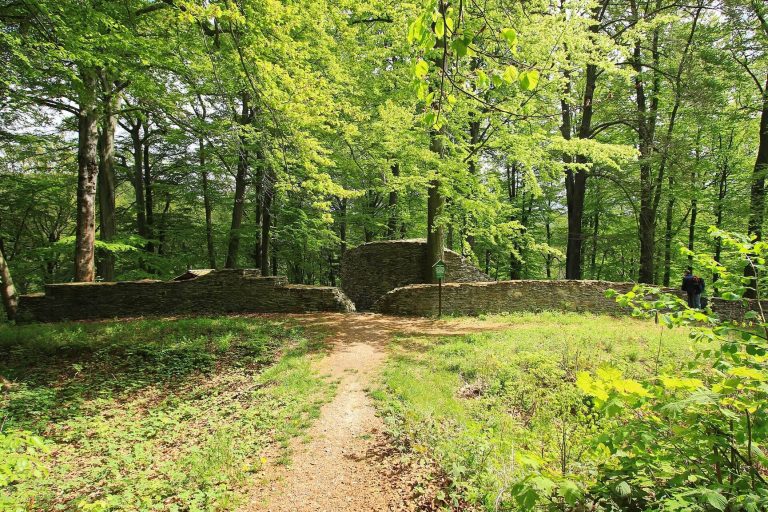
The abbey occupied a walled enclosure containing the church, administrative and service buildings, and a garden. A second wall divided the eastern monastic precinct, reserved for the monks, from the rest of the complex. The church stood on the highest ground within the cloister. Foundations and surviving buildings preserve parts of this layout.
Enclosure and church
Enclosure
A high outer wall surrounded the abbey buildings and garden. Inside it, a second wall marked off the eastern monastic area from the other parts of the complex. The Fuchsturm gate tower stood at this division, linking the two enclosed areas.
Church
Dedicated to the Virgin Mary and Saint Nicholas, the church was a three-aisled building with a cross-shaped plan, a rectangular sanctuary, a passage around the sanctuary, and chapels. It measured about 80 metres in length and more than 20 metres in width, with other buildings attached. Its simple plan followed a scheme associated with early Cistercian churches. Fragments from its vaulted ceiling point to a High Gothic design.
Parts of the church’s foundations survive, and the remaining masonry allows its approximate form to be reconstructed. After the abbey declined, stones from the building were released for reuse. A wooden cross bearing the Latin motto Ora et Labora, meaning “Pray and work,” marks the former altar site.
Surviving buildings and gardens
Administrative building and Langschuppen
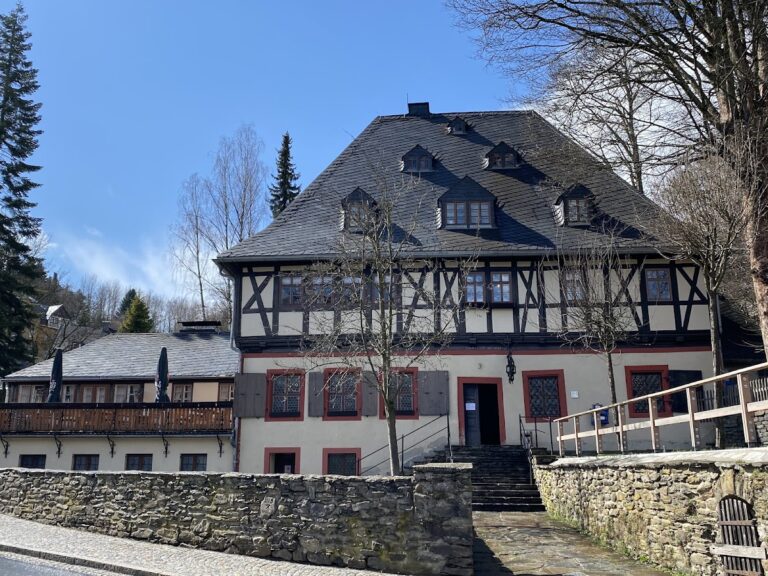
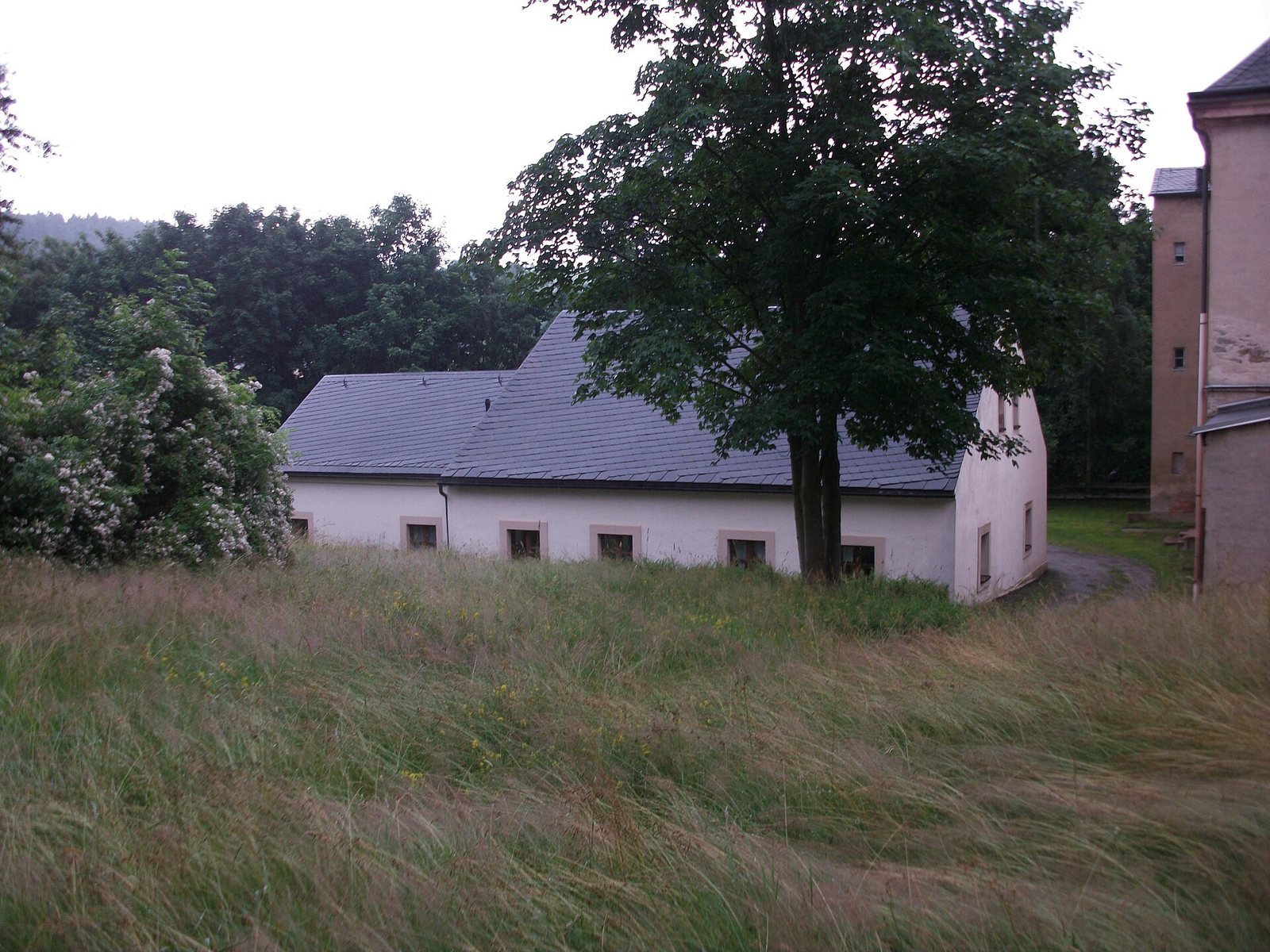
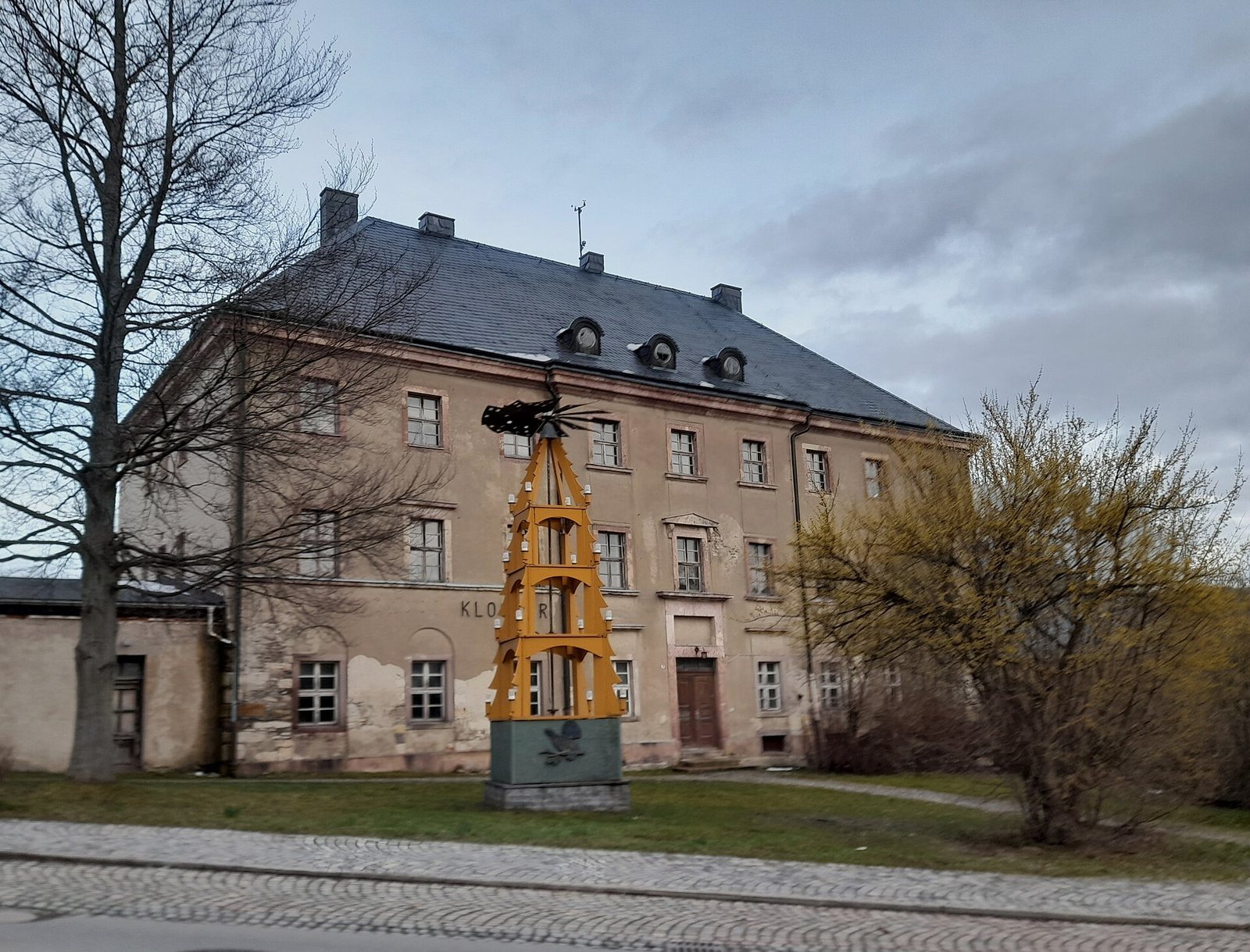
The former administrative building stood against the western abbey wall. Altered from its original form, it remains by the entrance to the grounds. About 50 metres inside the entrance, the Langschuppen retains foundations from the monastic period. It served mainly as a grain store and is now used as a dwelling.
Fuchsturm
Built in the second half of the thirteenth century, the Fuchsturm served as a gate between the two parts of the abbey. Its upper storey was used as a prison. A drawing by Dilich shows it in ruins, and it may have burned after the abbey’s dissolution. The Electoral Office of Grünhain rebuilt the tower after the Thirty Years’ War, the European conflict fought from 1618 to 1648, probably for use during electoral hunts. It now houses an exhibition space and a workshop used by the local woodcarving and nativity-scene association.
Herb garden
A small herb garden recalls the monks’ botanical work. A sign identifies the plants grown there and describes their uses.
Zwickau property and memorial
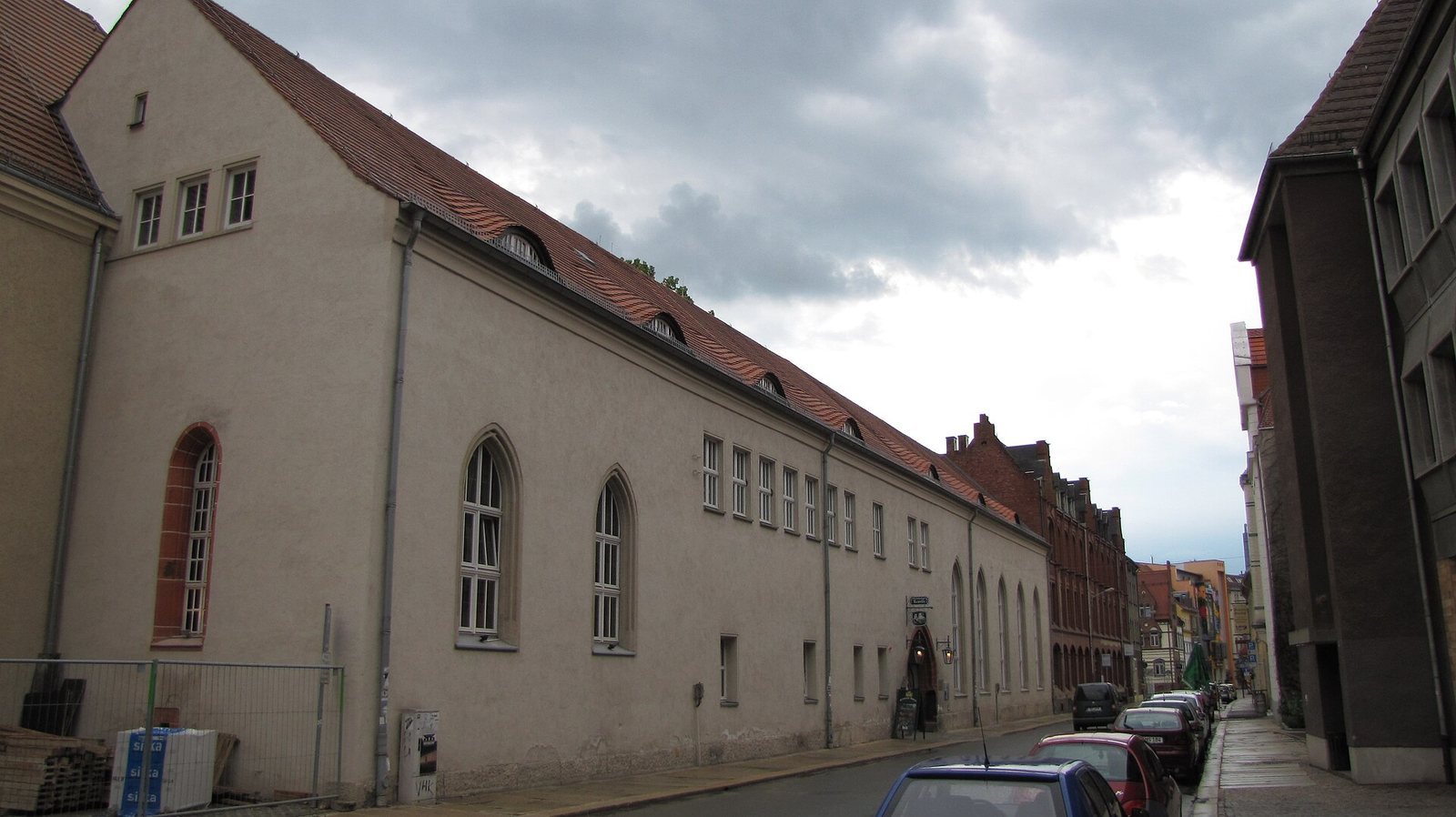
In Zwickau’s old town, the abbey’s urban estate, the Grünhainer Hof, stood on the site of what is now Peter-Breuer-Straße. Its associated Grünhainer Chapel is now used as a restaurant. The Mönchsbrunnen monument on Schwarzenberger Straße in Grünhain commemorates the former abbey.