Mortuary Temple of Amenhotep III: A New Kingdom Royal Temple in Thebes
Site at a Glance
- Rating
- 4.6
- Popularity
- Very High
- Country
- Egypt
- Primary era
- Bronze Age
- Eras represented
- Bronze Age, Modern
- Civilizations
- Egyptian
- Site type
- Religious
- Remains
- Temple
On this page18 sections
History
Construction and royal cult
The Mortuary Temple of Amenhotep III was built at Thebes-West, opposite Luxor on the west bank of the Nile in Egypt, for the pharaoh Amenhotep III of the Eighteenth Dynasty. Construction is dated to around 1385 BCE; the main building was completed in 1358 BCE, while additions and statue installations continued until the king’s death in 1351 BCE. Its chief architect was Amenhotep, son of Hapu, a royal official and architect. In its day, the temple was the largest funerary complex at Thebes.
Dedicated to Amenhotep III and Amun, whom the king regarded as his divine father, the temple served as a “house of millions of years,” a place for the enduring worship of a king. Its principal purpose was to receive offerings to Amenhotep after his death and his passage into the Egyptian afterlife. The king also intended to be revered as a god on earth and to secure a lasting royal legacy. The temple’s religious conception connected it with the primeval mound believed to have emerged from the waters of creation. Its setting was understood to embody that creation story when the Nile flooded.
The complex was also associated with Amenhotep III’s Sed Festival, a royal jubilee intended to renew the king’s authority and representing the unification of Egypt. Relief fragments indicate that the temple was not yet standing for his first celebration. Later festivals were held in a courtyard during the final decade of his reign.
Changes and destruction
During the reign of Amenhotep III’s son Akhenaten, the temple fell out of use and Amun’s name was erased from its inscriptions. The damage was later repaired. A major earthquake around 1200 BCE is thought to have destroyed much of the complex. Poor foundations and the possible liquefaction of waterlogged ground may also have contributed, and further earthquakes remain possible. Nile floods and the removal of stone for reuse caused additional damage. Because the temple stood on raised ground, flooding at its western end would generally have required exceptionally high water.
A granite stele of Amenhotep III was later reused at the nearby Temple of Merenptah, about 100 metres northwest of the complex. It is now in the Egyptian Museum in Cairo.
Rediscovery and conservation
During excavations commissioned by British consul Henry Salt, Jannis Atanasios found two sphinxes at the temple entrance in 1825. The Russian state acquired them in 1830 following the efforts of church historian Andrei Nikolajewitsch Murawjow, and they were installed in St Petersburg in 1832. The ruins were investigated by the Swiss Institute for Egyptian Building Research and Antiquities in the 1960s and excavated later in the twentieth century. Since 1998, work has been carried out under the German Archaeological Institute in Cairo and Egypt’s antiquities administration. Hourig Sourouzian led excavations in the early 2000s; Laurent Bavay examined pottery from the 1999–2002 seasons, and Myriam Alvarez cleared the Hypostyle Hall.
The World Monuments Fund placed the temple on its list of the world’s 100 most endangered cultural monuments in 1998 and 2004. The Colossi of Memnon and Amenhotep III Temple Project has also contributed to conservation.
Remains
Setting and overall plan
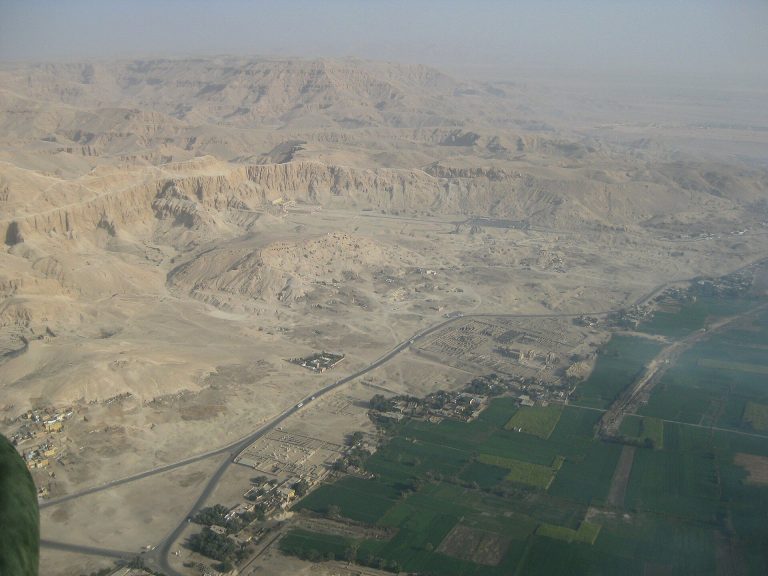
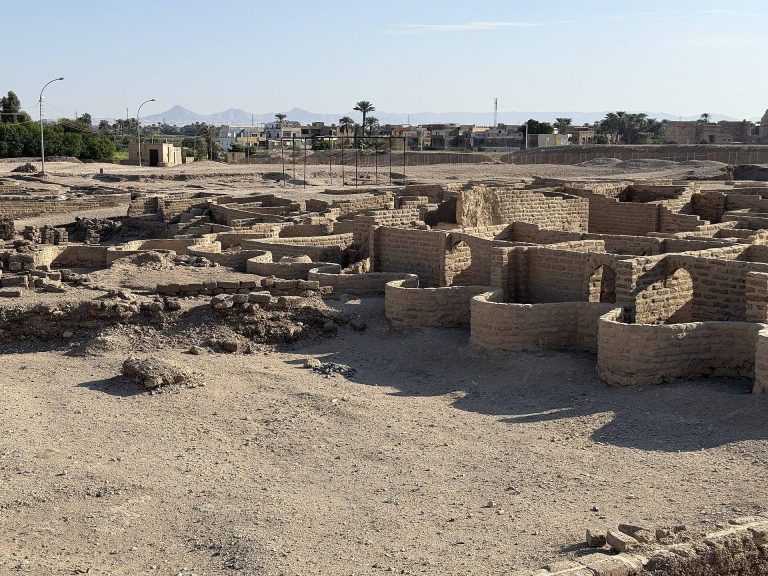
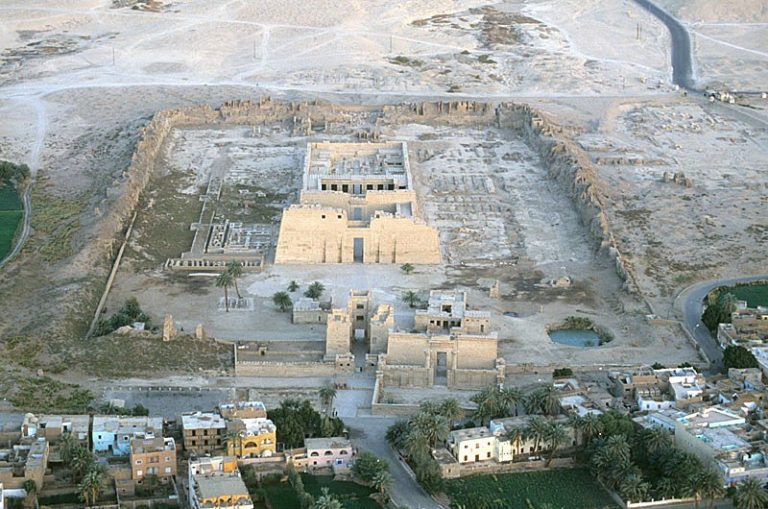
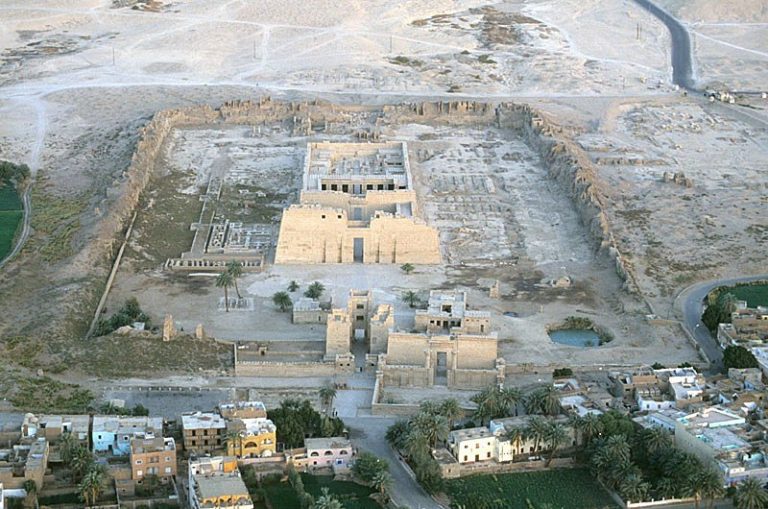
The complex covered about 385,000 square metres and occupied an area roughly 700 metres long and 550 metres wide, enclosed by a mud-brick wall about 8.5 metres thick. It stood about three kilometres west of the Nile’s main channel and faced east, probably in relation to sunrise and Amenhotep III’s reverence for Amun, a solar deity. A natural, elongated mound ran beneath the main axis and rose above the New Kingdom floodplain, keeping the western end high and dry except during rare, exceptionally high floods. A branch of the Nile ran roughly south to north along the western side of the valley. The Colossi of Memnon stood on its western bank; the channel continued past the Ramesseum and other mortuary temples before turning east and rejoining the main Nile opposite Karnak.
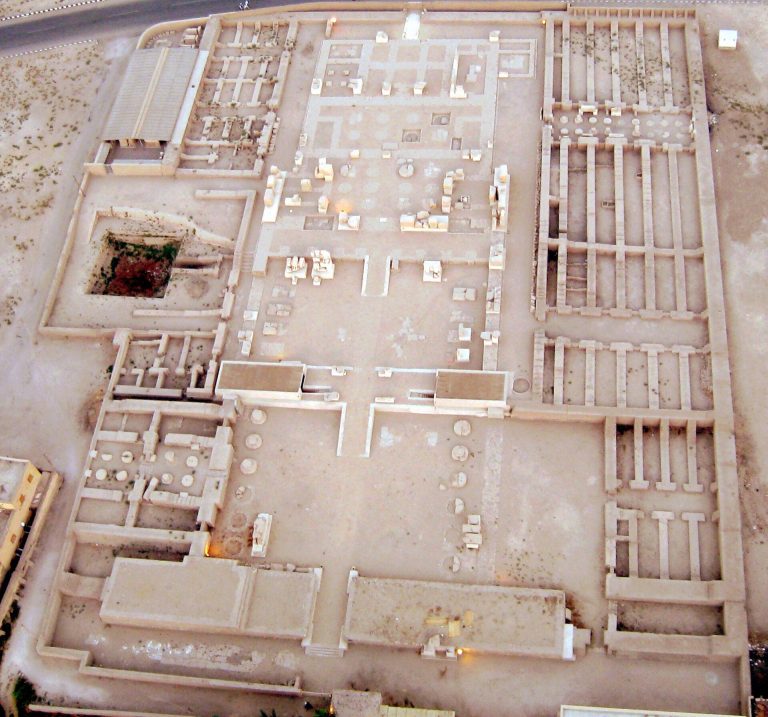
The compound was divided into separate areas, with the main temple in the south. It also contained mud-brick subsidiary buildings, gardens, lakes, and a smaller temple dedicated to Ptah-Sokar-Osiris, a combined deity associated with creation, funerary rites, and the afterlife. That temple lay north of the main one and had its own entrance through the enclosure wall. Two quartzite statues of Amenhotep III flanked its northern entrance.
Approach and temple courts
Gateways and approach
The main approach entered from the southeast, passing three pylons, or monumental gateways, and an avenue of sphinxes. A fourth gate opened onto the forecourt. Four cedar flagpoles, originally gilded, stood in front of each pylon; excavators found traces of gilding near the second. Each gateway passage was flanked by two larger-than-life seated statues of the pharaoh. Those at the second pylon were quartzite, while the statues at the third were alabaster on black-granite bases.
Peristyle Sun Court
The forecourt was the Peristyle Sun Court, an open court surrounded by columns, also known as the Sed Festival Court. It measured about 86 by 85 metres and was paved with sandstone slabs. Roofed colonnades with columns about 14.2 metres high enclosed all four sides and formed a walkway. Most sides had three rows of columns, while the western side had four. The court was divided into northern and southern halves. Brown quartzite statues from Lower Egypt stood on the north side, while the south side had red-granite statues from Aswan in Upper Egypt. Eight-metre standing statues of Amenhotep III stood between papyrus-bundle columns on the east and west sides; those in the north were quartzite and those in the south were granite.
Hall and sanctuary
A long Hypostyle Hall, a hall with a roof supported by columns, formed part of the temple complex. The sanctuary lay beyond the temple house.
Colossal statues and sculpture
Colossi of Memnon
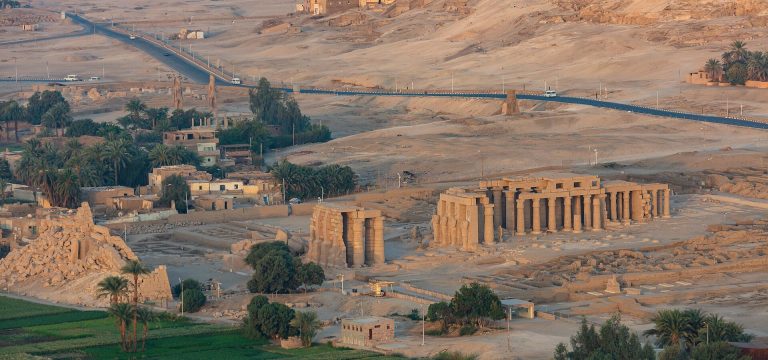
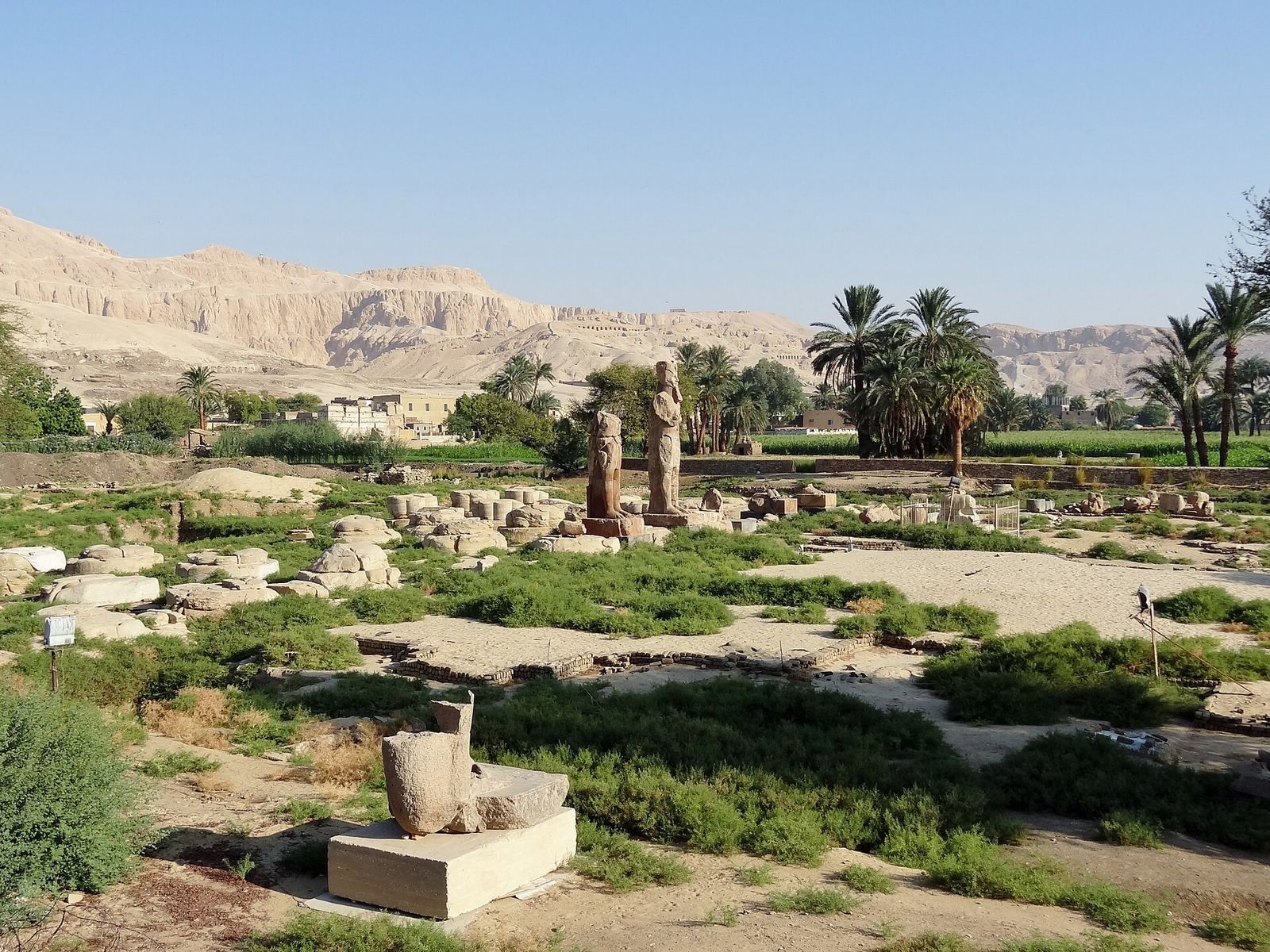
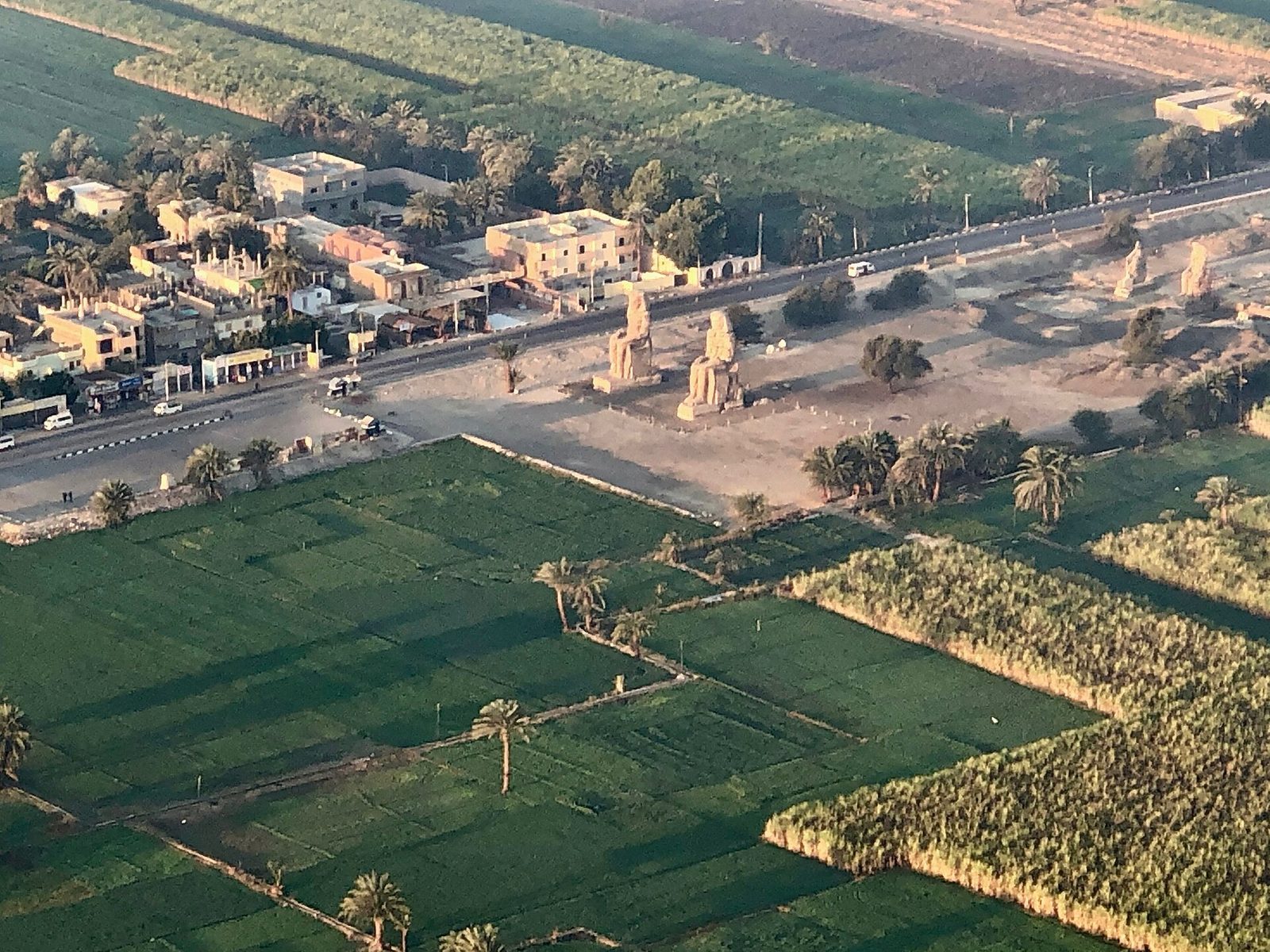
The two Colossi of Memnon remain where they originally stood before the first pylon. These seated statues depict Amenhotep III with members of his family. They were carved from red quartzite traced to Gebel Gulab or Gebel Tingar near Aswan. They were formerly described as about 40 cubits, or 21 metres, tall. After losing their crowns, they measured 14.76 and 13.97 metres to the headcloth, or 18.36 and 17.27 metres including their bases. Images on the bases represent the unification of Egypt and foreign lands under Egyptian rule.
Other royal statues
A second single-block quartzite statue of Amenhotep III was found near the second pylon. Fragments of another quartzite colossus, including a chest, a fallen torso, and a knee, were recovered behind the Colossi of Memnon. Excavations around the pylons also uncovered colossal red-granite statues, undecorated granite pieces, and part of the north wall.
Gods and animal figures
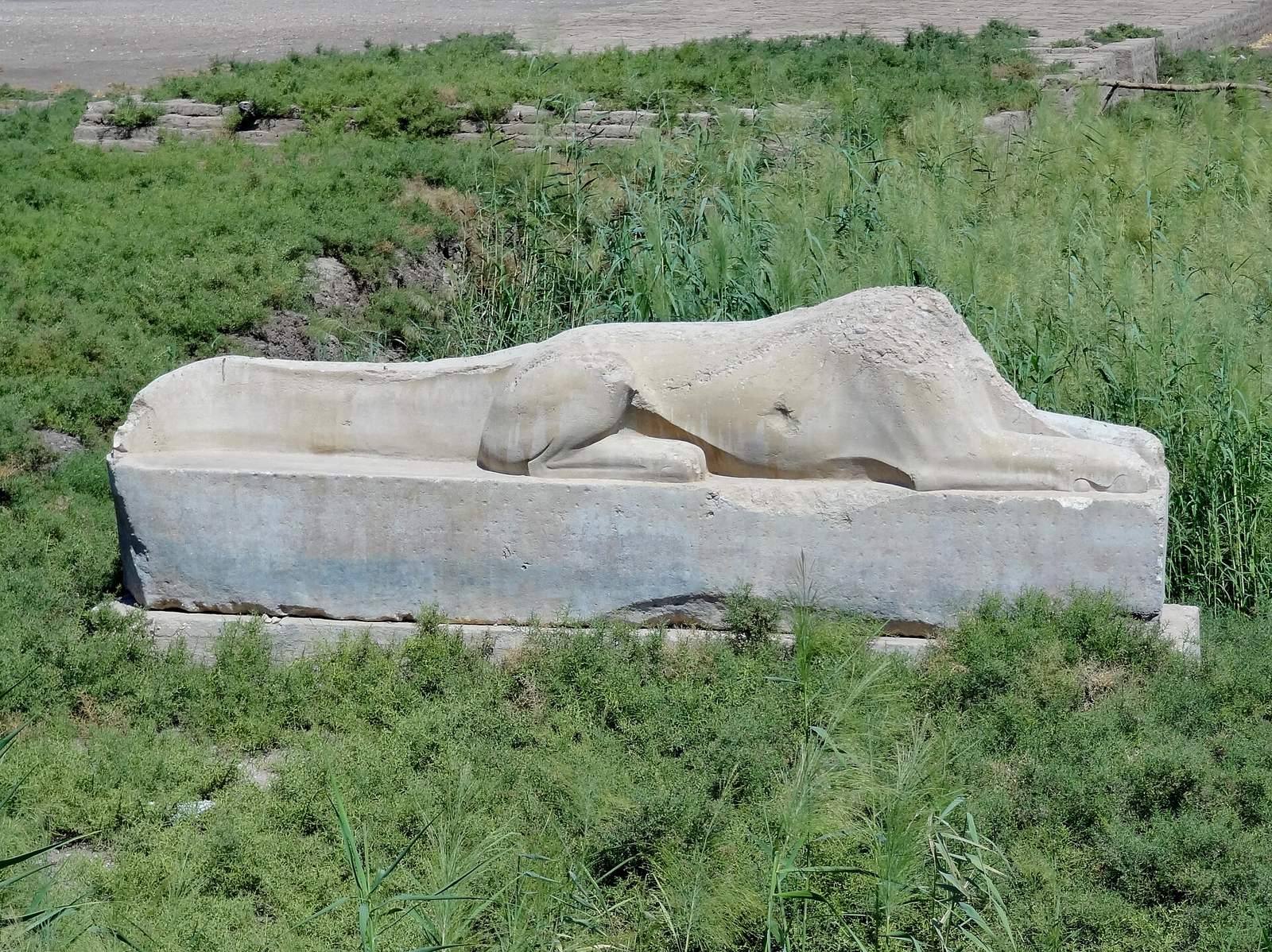
The temple contained hundreds, perhaps thousands, of statues of Amenhotep III, Egyptian gods, and animals. Sekhmet, a lioness-headed goddess associated with destructive and protective powers, appears both standing and seated. Some of her statues hold a papyrus sceptre in the left hand and the symbol of life in the right. Other figures include jackals, scarabs, a lion-crocodile sphinx, a white hippopotamus, alabaster sphinxes with crocodile tails, sandstone sphinxes with Anubis heads, and a life-size alabaster hippopotamus.
Statues of Sekhmet, the lion-crocodile sphinx, hippopotamuses, and a bull were associated with the creation of a map of the sky. The white hippopotamus may have served in a ritual also known from the reign of Thutmose III. Figures identified as Asbet, Maat, Hu, Horus, and Isis were linked with a solar festival and different times of day. Images of bound foreign captives and animals expressed royal control over foreign lands and fauna. They also conveyed the triumph of Maat, justice and order, over Isfet, disorder or chaos. Finds include evidence of bound Kushite captives and lists of Nubian towns along the Nile.
A colossal statue of Amenhotep III was excavated in 2009, and its associated head, more than two metres high, was found in early 2010. In December 2017, excavators uncovered 27 partly damaged statues of Sekhmet. Further Sekhmet statues and remains of two colossal sphinxes were found in later years.
Entrance sphinxes now in St Petersburg
The two sphinxes found at the entrance in 1825 are made of syenite, a granite-like stone. Each has the pharaoh’s head and the double crown of Egypt. They were installed at the University Embankment in St Petersburg.
Stelae and excavated finds
Northern and Southern Stelae
The Northern Stele stands in full form in the Peristyle Court and underwent conservation between 2010 and 2012. The Southern Stele was erected in the mid-twentieth century. It preserves Amenhotep III’s description of the temple as “magnified.”
Other inscriptions and pottery
In 1896, Flinders Petrie found a large stele west of the former temple site. Its inscription presents the pharaoh’s description of the temple as a “fortress of eternity,” built of sandstone, clad in gold, with silver floors and richly furnished with statues.
Pottery from the New Kingdom and the Late Roman Period includes ring-based cups, beer jars, and wine amphorae found in the Peristyle Sun Court and at the Third Pylon. Sherds from the eroded north wall provide evidence of earthquake damage.