Theban Necropolis: The Royal and Funerary Landscape of Ancient Thebes
Site at a Glance
- Rating
- 4.2
- Popularity
- Very Low
- Country
- Egypt
- Primary era
- Bronze Age
- Eras represented
- Bronze Age, Iron Age, Classical
- Civilizations
- Egyptian, Ptolemaic
- Site type
- Burial
- Remains
- Necropolis
On this page23 sections
History
The Theban Necropolis is a vast ancient Egyptian funerary landscape on the west bank of the Nile opposite Luxor, Egypt. Used for ritual burials from the end of the First Intermediate Period through much of the pharaonic era, it became especially important during the New Kingdom, from approximately 1552 to 1069 BC. The necropolis is not a single archaeological point but an interconnected zone containing royal and non-royal cemeteries, workers’ burial grounds, mortuary temples, settlements, and funerary cult complexes.
The Sacred West Bank
Ancient Egyptians associated the western bank of the Nile with the afterlife, known as the Duat. The area was called “That which is before its Lord,” a reference to the royal palaces and principal temples on the eastern bank, and was also known as the West of Thebes, Western Thebes, or the City of the Dead. Its cemeteries and temples formed a ritual counterpart to ancient Thebes, the city now called Luxor.
Burials began in the Theban area by the end of the First Intermediate Period. El-Tarif is regarded as the oldest cemetery in the region, although some of its mastabas, rectangular tombs with sloping sides and flat roofs, are attributed to local princes of the Fourth and Fifth Dynasties. The cemetery also contains burials from the Middle Kingdom and Second Intermediate Period, preserving earlier forms of Egyptian funerary architecture.
Royal Burials in the New Kingdom
During the Eighteenth, Nineteenth, and Twentieth Dynasties, which together formed the New Kingdom, royal burial practices were concentrated in the Valley of the Kings. From approximately 1552 to 1069 BC, rulers and members of the royal household were placed in underground or rock-cut tomb complexes known as hypogea. The Valley of the Queens served royal wives, princes, princesses, and other members of the royal household, particularly during the same dynastic period.
The Valley of the Kings contained both royal and non-royal burials from the Eighteenth through Twentieth Dynasties. Its eastern and western branches were catalogued separately, with most discovered tombs in the Eastern Valley. The conventional prefix KV identifies tombs there, while QV identifies tombs in the Valley of the Queens and TT identifies Theban Tombs elsewhere in the necropolis. Tombs near Deir el-Bahari may also carry the prefix DB.
Royal tombs were separated from the mortuary temples where the deceased ruler’s funerary cult was maintained. These New Kingdom institutions were called “houses” or “temples of millions of years.” Unlike earlier temple-tomb complexes, they functioned as autonomous establishments and were developed particularly from the Eighteenth Dynasty onward. The wider mortuary-temple zone included complexes dedicated to rulers such as Mentuhotep II, Hatshepsut, Thutmose III, Amenhotep III, Seti I, Ramesses II, Ramesses III, and others.
Cemeteries of Officials and Artisans
Sheikh Abd el-Qurna was selected for the tombs of nobles, officials, and artisans connected with the royal court. More than 400 non-royal tombs lay outside the Valleys of the Kings and Queens, including burial places for officials and cemeteries associated with the artisans who built and maintained royal tombs. At Sheikh Abd el-Qurna, tomb decoration preserves information about administration, agriculture, military affairs, religion, craft production, and diplomacy during the New Kingdom.
The tombs of artisans and royal-tomb workers were concentrated particularly around Deir el-Medina. Established during the Eighteenth Dynasty, the settlement was called Set Maat, or “Place of Truth,” during the New Kingdom. Its residents were free and specially privileged, and they received relatively high wages as well as access to medical and legal services. Their settlement, written records, work sketches, construction notes, objects, and tombs provide unusually detailed evidence for daily life and for the construction of royal hypogea.
During the reign of Ramesses III, economic recession and failures to provide promised provisions caused the workers of Deir el-Medina to stop work. This action is identified as the earliest known labor strike. The same period included documented thefts from royal tombs, showing the pressures that affected the royal necropolis and the community responsible for its maintenance.
Later Discovery and Heritage Recognition
In 1881, a cache found in the Deir el-Bahari area, designated TT320, contained more than fifty royal mummies and associated objects. A family of tomb robbers had used the hiding place, and information secured by Gaston Maspero, then director of the Egyptian Antiquities Service, led to its recovery. In 1922, Howard Carter discovered the tomb of Tutankhamun, KV62, in the Valley of the Kings. It became the best-known tomb in the valley.
The Theban Necropolis was inscribed on the UNESCO World Heritage List in 1979 as “Ancient Thebes with its Necropolis,” under cultural criteria i, iii, and vi. The designated landscape includes the Valleys of the Kings and Queens, Deir el-Bahari, the cemeteries of Sheikh Abd el-Qurna, Qurnet Murai, el-Assasif, el-Khokha, Dra Abu el-Naga, and el-Tarif, Deir el-Medina and its workers’ cemetery, and the mortuary-temple areas of Medinet Habu, Gurna, and Kom el-Hetan.
Remains
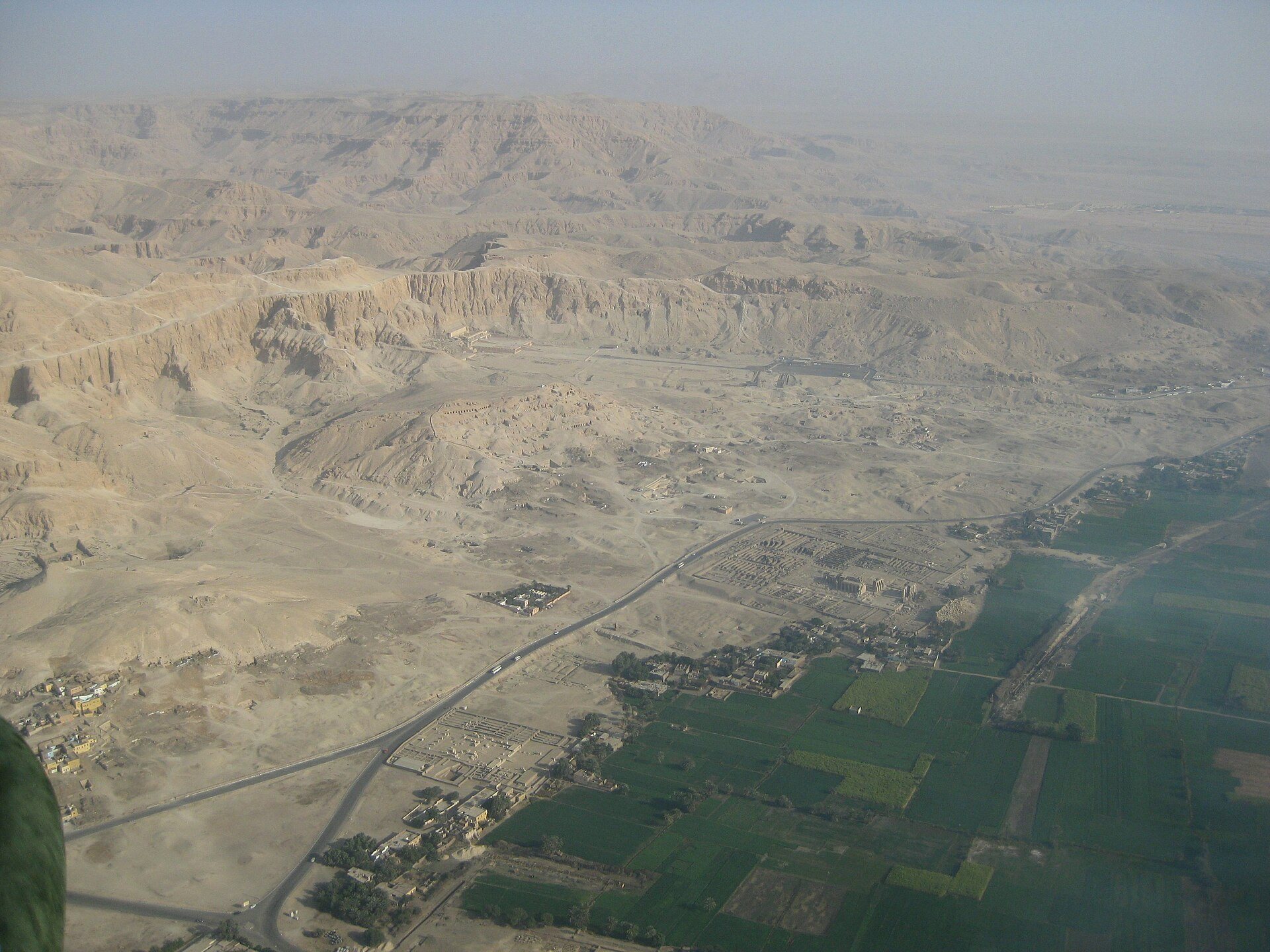
The necropolis extends across the west bank from the Nile through Gurna and the mortuary-temple zone toward Deir el-Bahari, the Valley of the Kings, the Valley of the Queens, Medinet Habu, and the southern temple complexes. The mountain of el-Qurn lies between Deir el-Bahari and the Valley of the Kings. The Valleys of the Kings and Queens occupy the mountain zone, the Valley of the Nobles lies east of the Valley of the Kings, and Deir el-Medina lies between the royal valleys and the mortuary-temple area.
Royal Valleys
Valley of the Kings
Anciently called Ta-sekhet-maat, “the Great Field,” or simply “the Valley,” the Valley of the Kings contains 65 royal and non-royal burials as recorded in 2017. Tombs were cut manually into the valley’s rock walls. Their remains include underground corridors, chambers, burial rooms, chapels, painted walls, reliefs, and architectural spaces associated with royal funerary rites. Royal and non-royal burials from the Eighteenth, Nineteenth, and Twentieth Dynasties occupy both the Eastern and Western Valleys.
Valley of the Queens
The Valley of the Queens, anciently called Ta-Set-Neferu, “the Place of the Children of the King,” contains more than 70 tombs. Its burials belong to royal wives, princes, princesses, and some nobles. The most famous is QV66, the tomb of Nefertari, Great Royal Wife of Ramesses II, who lived approximately from 1290 to 1224 BC. Its wall reliefs are especially valuable. The choice of rock-cut hypogea has been associated with the abandonment of pyramids by New Kingdom rulers, possibly because earlier, more visible tombs were vulnerable to robbery.
Elite Cemeteries
Sheikh Abd el-Qurna
Sheikh Abd el-Qurna occupies high ground overlooking the Deir el-Bahari plain and the mortuary temples of Mentuhotep II, Thutmose III, and Hatshepsut. It contains a few tombs from the Eleventh and Twelfth Dynasties and approximately 150 from the Eighteenth through Twentieth Dynasties. The cemetery is divided into large, small, and village sectors. Important tombs include those of Nakht, Min, Userhat, Menna, Rekhmire, Horemheb, Kenamun, Antefoker, Ramose, Chaemhat, and Nedjemger.
The tomb of Nakht, TT52, contains well-preserved paintings of Nakht and his wife supervising agricultural work, hunting, and a banquet. A painted cat eats a fish beneath a table. The tomb of Menna, TT69, has a principal offering hall and chapel decorated with scenes of surveying fields, recording harvests, punishing dishonest farmers, receiving offerings, hunting, fishing, family life, and pilgrimage to Abydos. Osiris, the principal Egyptian god of the dead and regeneration, and Hathor, a goddess associated with motherhood, music, and funerary protection, accompany the offering scenes.
The tomb of Rekhmire, TT100, contains approximately 700 square metres of painted decoration. Its scenes portray religious and funerary practices, family rituals, foreign delegations, tribute, prisoners, craft production, and official audiences. They also show the preparation of mud bricks, the construction of ramps, the transport of stone blocks on sledges, stoneworking, sculpture, leatherworking, rope-making, goldworking, and the manufacture of alabaster vessels. Rekhmire was a vizier, the highest-ranking administrative official under the king.
The tomb of Ramose, TT55, has two large pillared halls and a chapel reached by a long, steep corridor. Its decoration combines a classical style with the Amarna style associated with Akhenaten’s religious reforms. Flowing outlines, elongated heads, and deliberately altered bodily proportions appear in scenes of Ramose and his family with Amenhotep IV, Akhenaten, Nefertiti, and the Aten, the solar deity emphasized during Akhenaten’s reign.
Other tombs at Sheikh Abd el-Qurna preserve scenes of military recruitment, chariot units, New Year offerings, ritual ceremonies, agriculture, hunting, gardens, irrigation, and official administration. The tomb of Nedjemger, TT138, includes detailed depictions of gardens behind the Ramesseum and their irrigation system. Some tombs in the wider elite cemeteries also had funerary cones bearing an occupant’s name, title, and sometimes short prayers. Approximately 80 such cones have been recovered from a total of about 400.
El-Assasif
El-Assasif lies south of Dra Abu el-Naga in the Deir el-Bahari plain. It contains burials from the Eighteenth, Twenty-fifth, and Twenty-sixth Dynasties, including large multi-level tombs with underground courtyards, halls, and corridors. The tomb of Montuemhat, TT34, had an outer mud-brick wall and a monumental pylon, a gateway formed by two massive tapering towers. The tomb of Pedamenopet, TT33, is the largest private tomb in the Theban Necropolis. Tomb decoration in the cemetery records ritual practices, craft production, social life, and elite administration.
El-Khokha
El-Khokha is a small hill in the Deir el-Bahari plain near el-Assasif. It contains more than 50 tombs from the Eighteenth, Nineteenth, and Twentieth Dynasties, together with three tombs from the First Intermediate Period. Its tombs are generally more modest than those of the larger elite cemeteries. Their decoration includes the work of the sculptors Nebamun and Ipuky, the manufacture of chariots, metalworking, the production of hard-stone vessels, and goldsmithing and jewelry manufacture.
El-Tarif and Dra Abu el-Naga
El-Tarif lies near the entrance to the Valley of the Kings and is the oldest Theban cemetery. Its remains include late First Intermediate Period, Middle Kingdom, and Second Intermediate Period burials, as well as mastabas attributed to local princes of the Fourth and Fifth Dynasties. These mastabas follow burial forms associated with the Old Kingdom.
Dra Abu el-Naga contains more than 150 burials, divided between a Middle Kingdom group of approximately 100 tombs and a New Kingdom group of about 60. The cemetery includes royal burials associated with the Seventeenth Dynasty, including Kamose, Ahmose I, Ahmose-Nefertari, and possibly Amenhotep I, as well as tombs of high officials. The tomb designated AN-B is believed to have belonged either to Amenhotep I or to his mother, Ahmose-Nefertari, but the attribution remains uncertain.
Qurnet Murai
Qurnet Murai is a small cemetery near Deir el-Medina. It contains tombs of officials from the Eighteenth, Nineteenth, and Twentieth Dynasties, together with one Ptolemaic tomb and one tomb from the Twenty-sixth Dynasty, also known as the Saite period.
Workers’ Settlement and Cemetery
Deir el-Medina
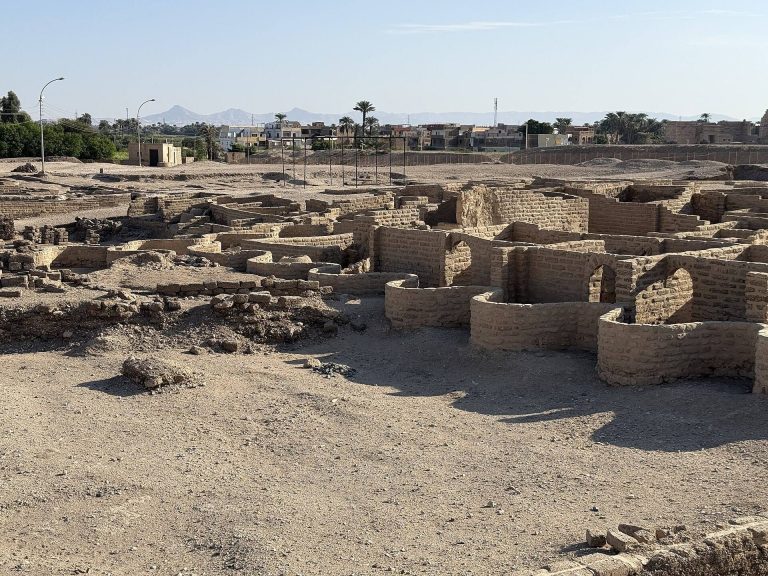
Deir el-Medina was a planned and fortified settlement with family houses, religious buildings, a cemetery, and facilities that kept the royal-tomb workforce close to its work. The workers’ tombs had a composite design, with a small pyramid-like superstructure made from poor and perishable materials above an underground chamber roofed with brick vaulting. Objects, written documents, work sketches, and construction notes from the settlement illuminate working conditions, household life, legal affairs, and the techniques used to create royal tombs.
Temple of Meretseger
A rock-cut temple of Meretseger stood above Deir el-Medina. Meretseger was associated with the Theban necropolis and its mountain landscape, and her name can be translated as “She Who Loves Silence” or “She Who Loves the One Who Loves Silence.” The temple is in poor condition because its vaults collapsed. Its remains formed part of the religious landscape surrounding the workers’ settlement and the royal valleys.
Mortuary Temples and Palaces
Deir el-Bahari
The Deir el-Bahari complex contains the mortuary temples of Mentuhotep II, Hatshepsut, and Thutmose III. Mentuhotep II’s Eleventh Dynasty temple was larger than Hatshepsut’s temple but survives in limited ruins. Hatshepsut’s temple, called Djeser-Djeseru, “Holy of Holies,” stands at the foot of the cliffs separating the Deir el-Bahari plain from the Valley of the Kings. It has been extensively restored through anastylosis, the reconstruction of a building by reassembling surviving architectural elements in their original or historically supported positions.
Senenmut, a high official who served Hatshepsut, designed the temple. It may be the only mortuary temple to follow closely an axis extending from Karnak through the temple toward Hatshepsut’s tomb beneath el-Qurn. Its reliefs include scenes of the expedition to Punt. The temple of Thutmose III lies behind the temples of Hatshepsut and Mentuhotep II in the Deir el-Bahari plain.
Medinet Habu and the Ramesseum
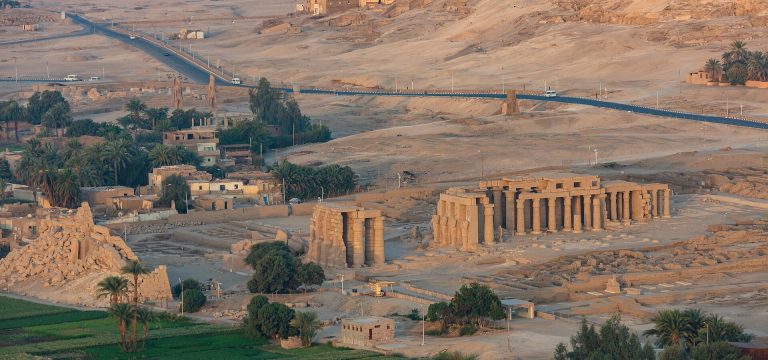
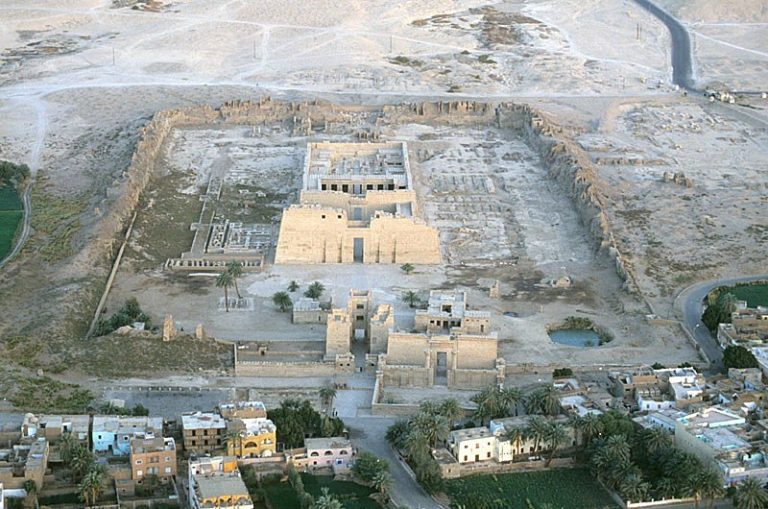
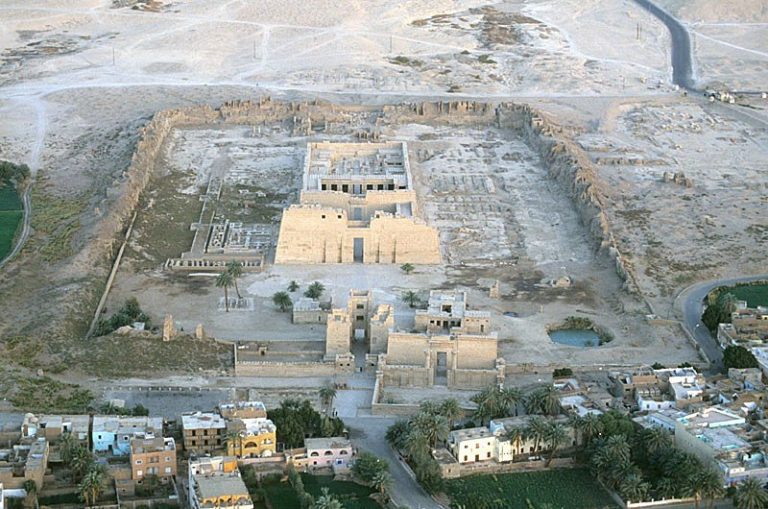
Medinet Habu comprised the mortuary temple and royal palace of Ramesses III. Its reliefs record the king’s victory over the Sea Peoples in the eighth year of his reign. The Ramesseum was the mortuary temple of Ramesses II, and its temple remains and associated decoration form part of the central Theban funerary landscape.
Kom el-Hetan and Malqata
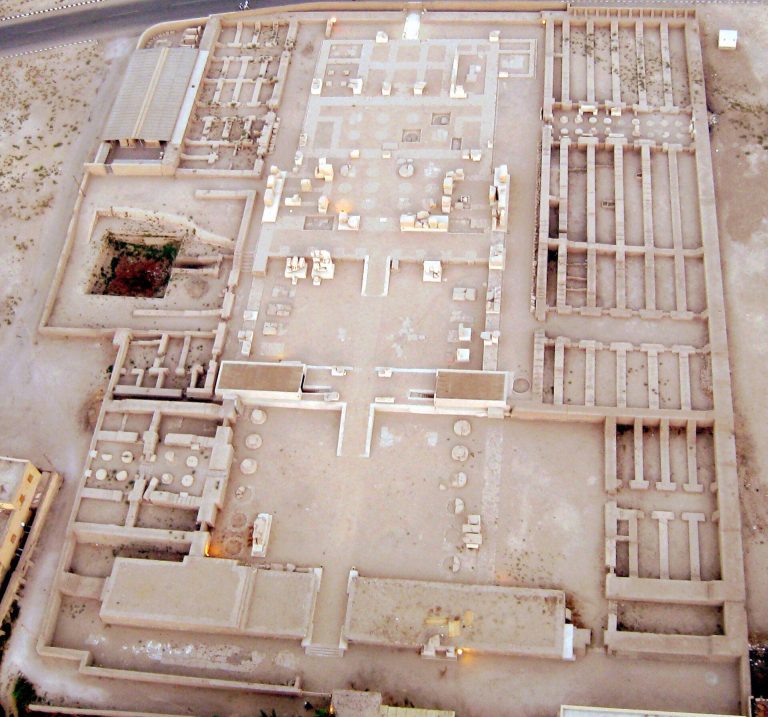
The mortuary temple of Amenhotep III stood at Kom el-Hetan, also called Malqata, and covered more than 350,000 square metres. By 2017, its principal surviving entrance elements were the two Colossi of Memnon, monumental statues that formed part of the entrance decoration. Five statue bases in the solar court bear reliefs naming lands, localities, and peoples under Egyptian jurisdiction or involved in Egypt’s commercial and diplomatic relations, including the Aegean islands.
The palace of Malqata was built by Amenhotep III and remains distinct from the mortuary temple at Kom el-Hetan, although both belong to the broader west-bank complex. The palace later served as a lesser residence during the Amarna and Ramesside periods, after the royal capital moved to Pi-Ramesses in the Delta.
Other documented mortuary temples include those of Ay and Horemheb, Amenhotep I, Amenhotep II, Amenhotep III, Amenhotep son of Hapu, Merenptah, Merenptah-Siptah, Ramesses IV, Seti I at Gurna, Thutmose IV, Twosret, Nebwenenef, and Ramesses II.
Burial Decoration and Funerary Practice
Across the necropolis, rock-cut chambers, underground corridors, chapels, pillared halls, offering rooms, burial chambers, pyramidal superstructures, mud-brick walls, pylons, brick vaults, painted walls, and reliefs form a varied architectural record. Painted and carved scenes depict agricultural labor, hunting, fishing, banquets, family rituals, religious ceremonies, military activity, foreign delegations, craft manufacture, irrigation, construction, and funerary processions.
The funerary landscape was associated with the cults of Osiris, Hathor, and Meretseger. Together, the tombs, temples, settlements, and cemeteries preserve the religious practices and social organization of ancient Thebes, while the arrangement of royal valleys, elite burial grounds, workers’ quarters, and mortuary establishments shows how Egyptian funerary institutions occupied the west-bank landscape.