Austrian Palace (Österreichisches Schlösschen): A Civic Building in Radolfzell
Site at a Glance
- Rating
- 4.3
- Popularity
- Very Low
- Country
- Germany
- Primary era
- Early Modern
- Eras represented
- Early Modern
- Civilizations
- Habsburg, Holy Roman Empire
- Site type
- Civic
- Remains
- Town Hall
On this page6 sections
History
Begun for Archduke Leopold V
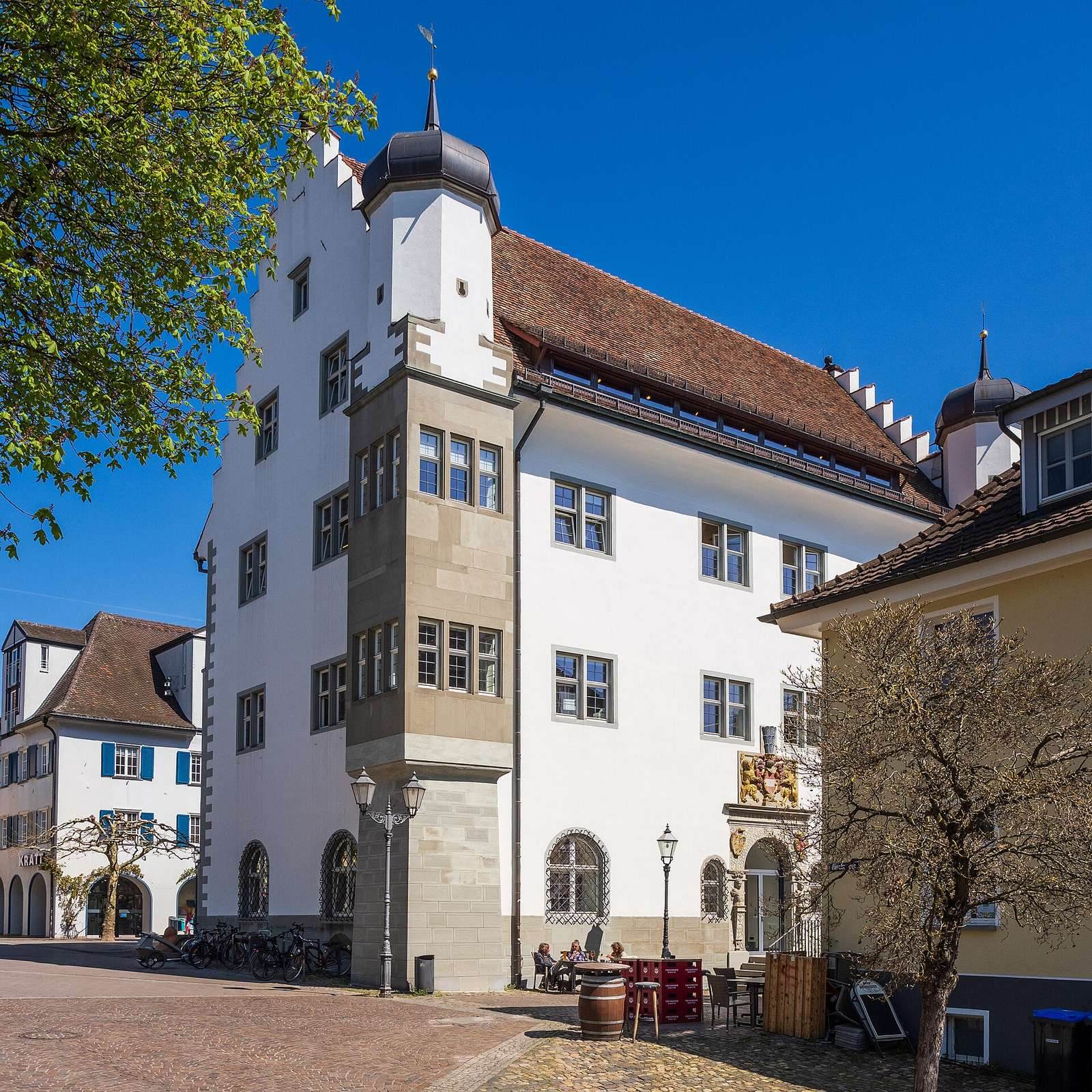
The Austrian Palace (Österreichisches Schlösschen) is a freestanding civic building on the east side of the market square in Radolfzell am Bodensee, Germany. Construction began in 1619 as a city palace for Habsburg Archduke Leopold V of Austria. It occupied the site of two medieval houses belonging to canons, clergy who lived under an ecclesiastical rule and served a church. Work stopped in 1621 amid the Thirty Years’ War, the major European conflict fought from 1618 to 1648.
Completion and civic uses
When construction halted, the cellar, ground floor, enclosing walls, and portal were complete. The unfinished building was used for decades to store wine and other goods. Work resumed, and the palace was completed in the first quarter of the eighteenth century with some changes to its original plan. It became Radolfzell’s town hall in 1734, served as a school from 1825, and housed the town’s antiquities collection from 1909 to 1950.
The Radolfzell City Library, founded in 1938 and named for German poet Joseph Victor von Scheffel, has occupied the building since 1973. Initially based on the upper floor, it expanded into the ground and second floors in 1984. Major alterations for library use followed in 2013 and 2014.
Remains
Exterior and setting
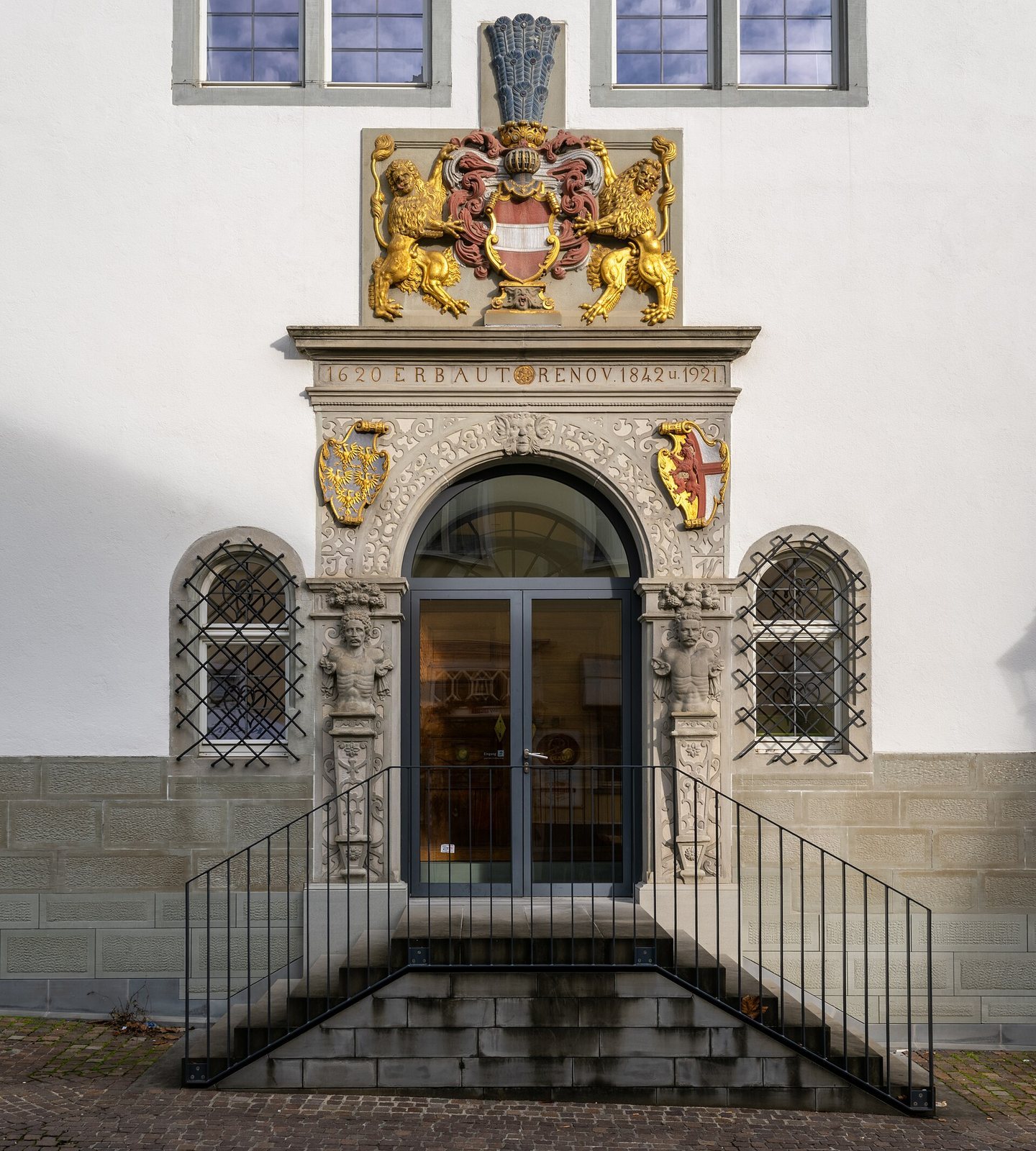
The freestanding building stands on the east side of Radolfzell’s market square, where the minster and town hall are also located. Its exterior includes a stepped gable, paired windows framed by curved, recessed mouldings, and a high storage roof partly fitted with ventilation dormers. The design may have envisaged four towers, but only two square towers projecting from the south side were built. On that side, the Renaissance entrance portal bears the arms of Old Austria, now used as the coat of arms of Lower Austria, Radolfzell’s arms on the right, and Austria’s shield with a horizontal band.
Interior
The ground-floor rooms retain early seventeenth-century groin vaults, ceilings formed where two barrel vaults cross. On the upper floors, ceilings are decorated with stucco in ribbonwork patterns, an ornament of interlacing ribbon-like forms dating to around 1735.