Helike: An Ancient Greek City-State in Achaea
Site at a Glance
- Popularity
- Very High
- Country
- Greece
- Primary era
- Classical
- Eras represented
- Bronze Age, Iron Age, Classical
- Civilizations
- Ancient Greek, Mycenaean, Roman
- Site type
- City
On this page19 sections
History
Helike was an ancient Greek city-state in Achaea, near modern Rizomylos on the coastal plain of the Gulf of Corinth in Greece. Archaeological evidence places occupation there in the Early Bronze Age, but the city’s foundation story is a tradition rather than a verified account. Pausanias related that Selinous, king of the Aigialeans, married his daughter Helike to Ion and adopted him. Ion, said to be the son of Xuthus and a grandson of Hellen, supposedly founded the city, named it for his wife and called its inhabitants Ionians after himself.
Origins and early traditions
Traditions about the region’s settlement say that the Achaeans later displaced the Ionians and took their lands. One account links the Ionians’ departure to a migration to Attica. Helike subsequently became an important Achaean city. The Iliad, an ancient Greek epic, includes Helike’s warriors among the forces led by Agamemnon in the story of the Trojan War and refers to sacrifices to Poseidon at the city. These are literary traditions, not archaeological evidence for the events described.
Achaean leadership and religious centre
In the Classical period, Helike belonged to the Achaean League, a federation of cities in Achaea, and hosted its meetings. It was counted among the leading cities of the league of twelve. The city was especially important to Ionians as a religious and cultural centre. Its sanctuary honoured Poseidon, the Greek god associated with the sea and earthquakes, under the title Helikonian Poseidon. The sanctuary was regarded as second only to Delphi in religious importance, and people came to Helike for worship and trade. The city also issued its own coinage.
Other traditions connect Helike with the Achaean king Tisamenus, son of Orestes, who was said to have died in conflict with the Ionians and been buried there. Helike was also credited with founding colonies, including Sybaris in southern Italy and Priene in Asia Minor.
The disaster of 373 BC
In the winter of 373 BC, an earthquake and tsunami struck Helike and nearby Boura. Geological research estimates the earthquake’s magnitude at 6.4. Stories of the disaster say that animals fled Helike five days beforehand and that great columns of flame appeared. The catastrophe was said to have killed the city’s inhabitants and covered Helike and land extending twelve stadia with the sea. An attempt by 2,000 Achaeans to recover bodies failed, while ten Spartan ships in the harbour were swept away.
One explanation blamed Poseidon’s anger. In this tradition, Helike had refused Ionian envoys a statue of the god or a copy. The negotiations are placed around 378–377 BC, several years before the disaster. Later tellings added that the envoys had been murdered, and regional tensions between Achaean cities and Ionia may have shaped the story. Ancient writers also proposed natural causes: Callisthenes explained earthquakes as air moving through the earth, an idea preserved by Seneca, while Aristotle connected the disaster with a celestial phenomenon, perhaps a comet. Modern geological and archaeological interpretation points to shaking and soil liquefaction, when waterlogged ground loses strength and settles or collapses. A tsunami inundated the area and probably caused further damage as the water withdrew.
Recovery, memory and rediscovery
The destruction did not end Helike’s history. The city was re-established on ground that survived or nearby, and remained inhabited in Hellenistic and Roman times. After the disaster, neighbouring cities divided its remaining territory, with part passing to Aigion. Aigion later took over the Achaean League’s meetings and became the region’s principal city. The destruction of Helike also entered later reflection: the Roman emperor and philosopher Marcus Aurelius compared it with the burial of Pompeii and Herculaneum when considering the passing of life and power.
Visitors could still see submerged remains for centuries. Eratosthenes visited about 150 years after the disaster. Writing in the second century AD, Pausanias said that salt water had made the underwater walls less distinct. The site later became buried beneath accumulating sediment and slipped from memory. A further earthquake and sudden rise of the sea in the region in 1817 sent water up the Selinous River and over land below Aigio. The event killed about 65 people, destroyed two-thirds of Aigio’s buildings and levelled five nearby villages; the retreating water also swept away artillery stores on the shore.
Searches for Helike continued from the late eighteenth century. A French School of Athens underwater expedition in 1950 was obstructed by shifting mud, and later searches by Jacques Cousteau also failed. In 1967, Harold Eugene Edgerton and Peter Throckmorton pursued a sonar search in the Gulf of Corinth, but Greek authorities did not grant permission. In 1979, undersea explorer Alexis Papadopoulos described a submerged town in the wider gulf area, though its identification as Helike remained unconfirmed.
In 1988, archaeologist Dora Katsonopoulou and researcher Steven Soter began the Helike Project. They proposed that the city lay in an inland lagoon later filled by river sediment, rather than beneath the open Gulf of Corinth. Surveys and excavations led to the rediscovery of Helike in 2001, buried near Rizomylos. A railway extension between Patras and Corinth threatened the archaeological site, and the World Monuments Fund listed Helike among the world’s 100 most endangered sites in 2004 and 2006. Excavations in 2012 identified a layer associated with the 373 BC disaster.
Research published in 2025 reconstructed nearly three millennia of seismic activity along the Helike Fault. It identified previously unknown earthquakes and a pattern of major disasters at roughly 300-year intervals between the Geometric period, an early phase of Greek history, and Roman times. The findings suggest repeated settlement in the hazard-prone area, with people adjusting settlement locations and building methods as conditions changed. Historian Adalberto Giovannini has proposed that Helike’s destruction may have influenced Plato’s story of Atlantis, but this remains a hypothesis.
Remains
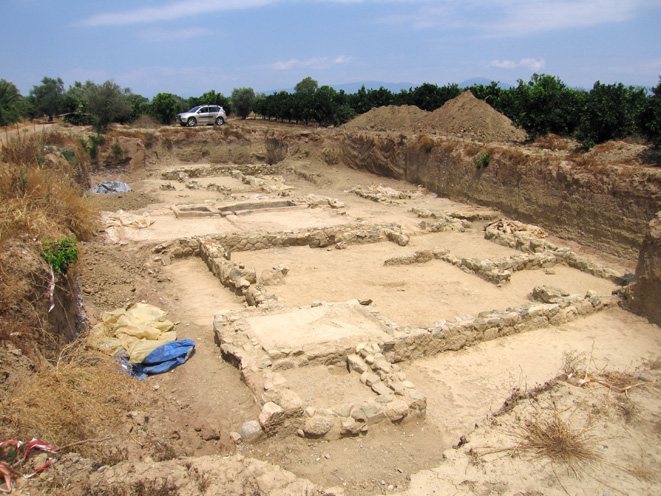
The remains of Helike lie on the coastal plain, about 2.2 km from the sea and 7.4 km from Aigio, within an ancient lagoon now filled with sediment near Rizomylos. Excavated deposits extend from about 0.4 m to 12 m below the present ground surface. They include remains from the Byzantine period, including the ninth century AD, as well as Roman, Hellenistic, Classical, Mycenaean and Bronze Age phases. The Corinthian Gulf lies in a rift zone, where the Earth’s crust is pulling apart, between the African and Eurasian plates. Movement along the Helike East and Helike West faults, changing coastal levels and sediment carried by the Selinous and Kerinitis rivers have shaped the landscape and buried or exposed parts of the site.
Bronze Age settlement
Early Bronze Age remains include a well-preserved, town-like settlement with large rectangular buildings and cobbled streets. The oldest objects date broadly to about 3000–2200 BC, while evidence indicates occupation around 2500–2300 BC. Sediments and microscopic fossil remains also point to an earlier submergence of an occupied phase, possibly after an earthquake roughly 2,000 years before the 373 BC disaster. Mycenaean-period occupation is represented by walls, layers of habitation and pottery.
Early Greek buildings and ritual activity
Altar and temple
Buildings of the eighth century BC include a brick altar dated to 760–750 BC and a temple with a vaulted roof dated to 710–700 BC. These structures form part of the excavated evidence for Helike’s early Greek religious activity.
Other eighth-century building
A separate eighth-century building had floors with a parquet-like pattern. Its wall was built in three phases and may have reached 19 m in height.
Later building and associated finds
A building dated to the seventh or sixth century BC stood on a stone foundation slab shaped like a temple. Finds associated with these buildings include Archaic pottery, clay figurines, a clay wing and a bronze serpent’s head.
Ritual area east of the buildings
Objects found east of the buildings indicate religious activity there from at least 850 BC. They include clay and bronze figurines, clay chariot wheels, bronze fasteners and brooches, iron weapons and part of a gold necklace. Excavators also recovered remains of sacrificed goats, sheep and pigs, together with grapevine remains.
Classical sanctuary and disaster deposits
Poseidon sanctuary
The sanctuary of Poseidon included a temple. Pausanias described it as monumental and reported an unusually large statue of the god. Eratosthenes recorded ferrymen’s report of an underwater bronze statue of Poseidon in a body of water they called a poros, a term that could mean a lagoon, lake or narrow strait. They described the god as holding a hippocamp, a mythical sea creature with the forepart of a horse and the tail of a fish, which they said endangered their nets.
Coins
Two copper coins of the fifth century BC associated with Helike are held by the Bode Museum in Berlin. One has Poseidon’s head on the front and, on the reverse, a trident between two dolphins, enclosed by a laurel wreath and accompanied by the letters ELIK.
Destruction deposits
The layer associated with the 373 BC disaster contains cobblestones, clay roof tiles and pottery. The positions of fallen stones and the microscopic fossils in the deposits support the interpretation that a wave carried away walls and left brackish water over the site. Debris returned by the retreating wave may also have struck buildings that were still standing.
Roman and Byzantine remains
Road, cemeteries and dyeing activity
A Roman road connected Helike with Patras and Corinth. Roman and Byzantine cemeteries also form part of the later remains, alongside evidence of dyeing activity in the Roman period.
Building at Klonis
Excavations at the Klonis site uncovered a large Roman building whose walls still stand.