Atxurra Cave: A Palaeolithic Rock-Art Site in Spain
Site at a Glance
- Popularity
- Low
- Country
- Spain
- Primary era
- Stone Age
- Eras represented
- Stone Age, Modern
- Civilizations
- Spanish
- Site type
- Civic
- Remains
- Rock Art
On this page20 sections
History
Prehistoric occupation
Atxurra Cave in Bizkaia, Spain, preserves evidence of human occupation from about 29,000 to 12,400 years ago. People used it for everyday subsistence activities, including processing and eating animals, especially goats and deer. Finds from the upper entrance also record later prehistoric use, extending through the Eneolithic, or Copper Age, into the Bronze Age.
Excavations at the upper entrance revealed occupations associated with several named prehistoric phases. These include the Solutrean and Magdalenian, cultural phases of the Upper Palaeolithic, followed by the Azilian, a later prehistoric phase. A separate modern investigation identified occupation from the Gravettian through the Magdalenian in a sequence described as unique in the Lea River basin. Some of its levels contained abundant animal remains, stone implements, and bone tools.
Opening, naming, and archaeological study
The upper entrance was known before 1882. Blasting during construction of the road between Lekeitio and Markina-Xemein opened the lower entrance that year. The new access brought heavy visitation, followed by rapid looting and deterioration. Geologists Ramón Adán de Yarza and José María Solano Eulate made the first scientific visit in 1882, collecting fossils and recording hydrogeological and barometric information. Manuel Martínez de la Escalera gathered cave-fauna specimens in 1892, and mining engineer Augusto Gálvez Cañero later carried out test excavations in the lower galleries.
Early publications used several different names for the cave. From about 1917, archaeologist José Miguel Barandiarán used Armiña, the name of a more distant farmhouse, for the lower gallery. Because other caves also bore that name, the more precise description lower gallery of Atxurra was proposed. Gálvez Cañero recorded Magdalenian remains from the lower galleries in 1912. Barandiarán began visiting the cave in 1919, returned to Gálvez Cañero’s test pits in 1926, and collected two flint blades as well as other remains.
Barandiarán identified an archaeological site at the upper entrance in 1929 and excavated it with Telesforo Aranzadi in 1934–35. They found four occupation levels, spanning the Solutrean, Magdalenian V–VI, Azilian, and Eneolithic–Bronze Age. Archaeologists Diego Garate and Joseba Ríos-Garaizar re-examined the upper-entrance site in 2014–15. Finds from the lower galleries, by contrast, point to brief Magdalenian visits, perhaps expeditions into the cave for an undetermined purpose. The galleries’ form and position indicate that the lower entrance was formed later.
Rock-art discovery and protection
The caving group ADES began a new exploration and provisional survey in 2009. Two cavers saw a prehistoric horse image that year but mistook it for modern graffiti. During the archaeological review begun in 2014, ADES caver Iñaki Intxaurbe guided Garate into the inner main gallery on 25 September 2015. After travelling a little over 200 metres, Intxaurbe recognized an engraving in an elevated side chamber. They found several dozen more over the next three hours and notified the Biscay provincial archaeological authority so the images could be recorded, protected, and studied.
The discoveries helped challenge the idea of a prehistoric-art “Basque void,” an apparent scarcity once attributed to archaeologists’ difficulty reaching deep cave areas and cavers’ lack of training in recognizing the art. Atxurra’s images and archaeological evidence have been associated culturally with the Cantabrian region and the northwestern Pyrenees. Following the discovery, the provincial government added closures at all entrances, and other cave-exploration and biological work was suspended.
The Aranzadi Science Society studied the cave’s bats in the 1990s. In the 2010s, the Basque Country University Bat Research Group began monitoring the colony after ADES drew attention to its regional importance. Researchers detected several species at high risk of extinction, and at the group’s request the Basque government closed the lower entrance in 2013. Monitoring ended in 2018 amid poor coordination between research teams; the effects of the later closures intended to protect the engravings remained to be assessed. Atxurra is designated an Asset of Cultural Interest in Spain as an archaeological zone.
Remains
Geological setting and drainage
Atxurra lies in the eastern part of the Mereludi karst, a limestone landscape shaped by the dissolving of rock, at the foot of Atxarre (267 metres) and Gaztelukoatxa (183 metres), within the Lea River basin near Lekeitio. The cave formed in Lower Cretaceous limestone, whose fractures run mainly east–west and southeast–northwest. It belongs to the area’s drainage system. Its main recharge area is east of the cave, in the enclosed Mereludi valley, where streams flow to the Kurutzerreka sinkhole and the Zubitxuta shaft near Elizburu farmhouse. Underground water is thought to drain toward Lamiñas Cave and the Arrakala resurgence, a place where groundwater emerges at the surface. Both outlets flow into the Zulueta River.
Entrances and passage system
Lower entrance and gallery
The provisional survey measures the cave at 1,085 metres, making it the second-longest of the 20 caves catalogued in the Mereludi karst. Its lower entrance is 5 by 7 metres across and opens into a passage of similar dimensions. This passage, formed below the water table, runs mainly southeast, with short bends toward the northeast and southwest. Two passages rise to the upper level, the first only a few metres from the entrance. After roughly 300 metres, the lower gallery narrows and reaches a broad, circular chamber, where a large collapse opening connects the two levels.
Upper entrance and gallery
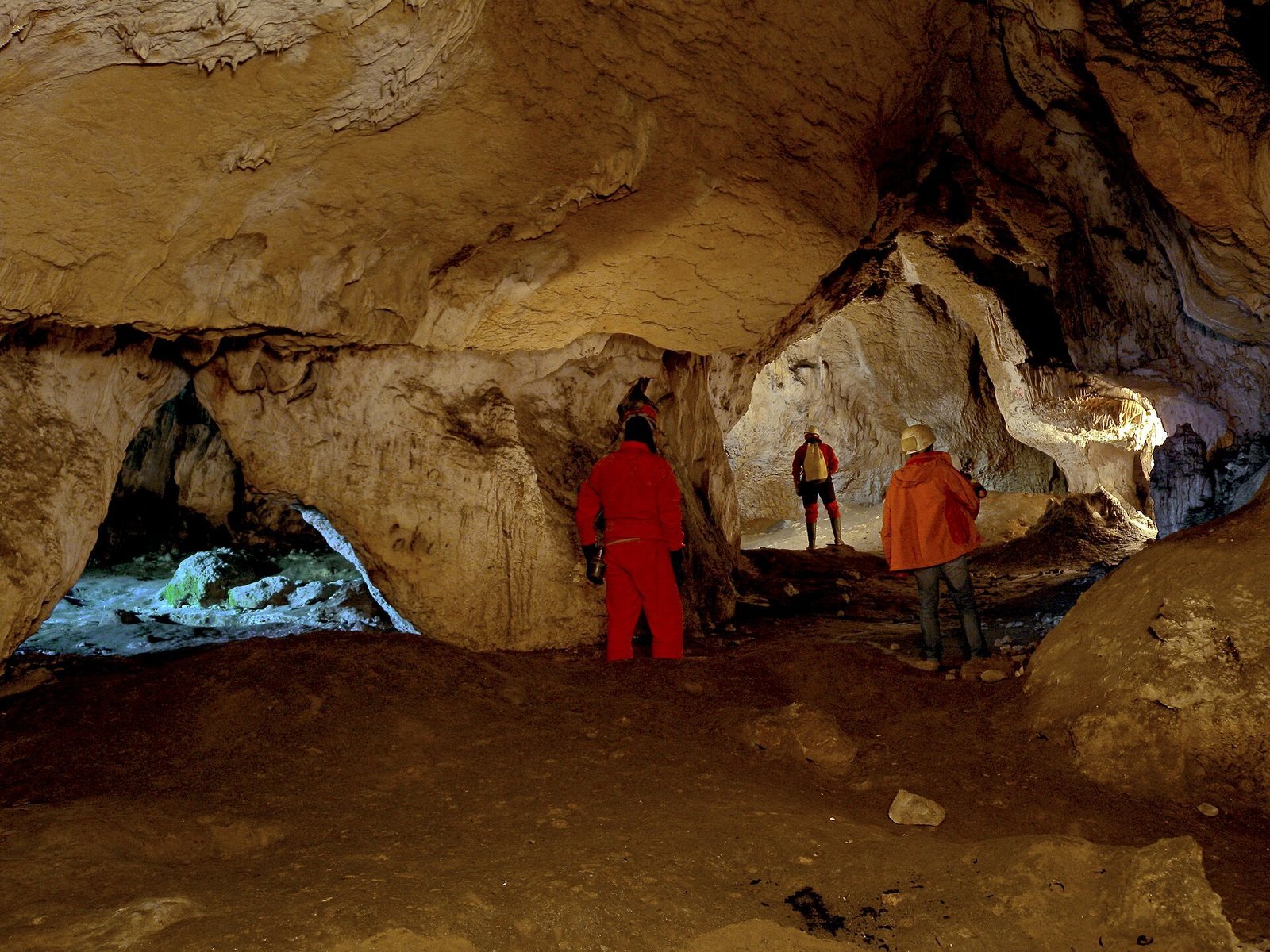
The natural upper entrance measures 1.5 by 2.5 metres and lies seven metres above the lower one. Its gallery begins with small chambers arranged in a maze near the first connection from below. Narrow passages and low crawlways lead to a larger, winding gallery that generally heads southeast. Fallen ceiling blocks have left fractures and cavities visible in its broken walls and roof; routes also lead upward toward higher levels.
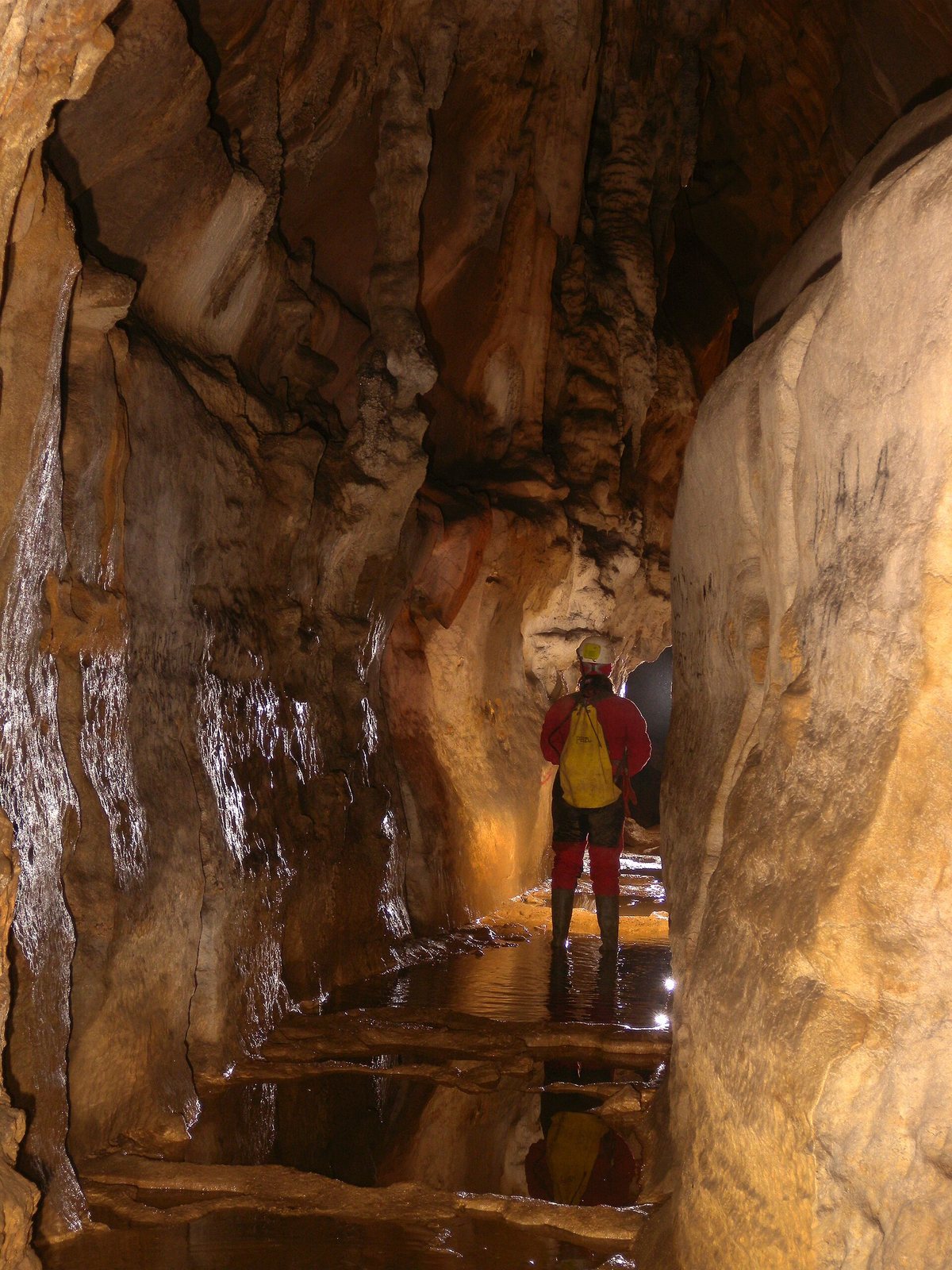
About 350 metres along the upper gallery, a second connection meets the lower level, to the left of the route from the lower chamber. Beyond it, meanders, deep pits, and side passages reflect an earlier phase of water erosion, followed by calcite deposits. A high, narrow gallery continues for about 200 metres through meanders and partly flooded pools held behind low mineral rims before reaching the decorated sector. Past the art, a narrow stretch can be crossed by a crawlway or a raised passage, and the route continues for a further 200 metres. A small gallery branches left to a narrow access into a partly active lower level, ending after about 20 metres in a chamber beneath compacted fallen blocks. Farther on, water falls from elevated openings into a canyon about 17 metres high, where a large pool floods periodically. The surveyed route ends at a narrow meander that prevents further horizontal passage.
Decorated chambers and images
Bison Room
The first decorated sector, known as the Bison Room, lies 235 metres from the entrance and is reached by a raised passage. The cave’s animal images include bison and horses as their most numerous subjects, alongside goats, deer, reindeer, and aurochs. One difficult-to-identify figure combines features resembling a bear and a reindeer.
Horse Platform
At 330 metres from the entrance, the Horse Platform is an 11-metre-long ledge four metres above the floor. It bears more than 40 animal figures, mainly horses. Four lighting points there consist of hearths that used juniper and oak.
Images and techniques
At least 113 animal figures occupy 14 decorated sectors. By figure count, this is the largest assemblage in Biscay and Euskal Herria, exceeding those at Armintxe, Santimamiñe, Altxerri, and Erberua. Atxurra is also described as the Basque Country’s largest Palaeolithic rock-art sanctuary and an international reference site. The images are attributed to the Middle and Upper Magdalenian. Engraving predominates, using scraping and fine or deep cuts. Some figures combine engraving with poorly preserved black paint, and red rubbing marks appear in places.
The images range from two large horses to smaller animals, with some superimposed or placed within other figures. Artists used conventions for showing the perspective of horns and lower limbs, although some goats face forward. Other details include fur, internal anatomy, and scraped areas within figures. Some animals appear struck by projectiles; one bison has about twenty represented within its body.
Evidence of artistic work
Elevated parts of the cave helped preserve deposits on the floor. Flint tools, including burins, chisel-like implements used for carving, and blades provide evidence of the materials and tools used by the artists and of the engraving process. About 500 carbonaceous remains have been recorded and analyzed. In the Bison Room, a portable lamp was made from a sandstone pebble hollowed on one face to hold fuel. Charcoal dispersed through decorated chambers also indicates the use of portable wooden torches.
Mineral formations and later damage
Vandalism since 1882 has removed most of the stalactites and stalagmites. The largest columns and flowstone formations are among the surviving mineral features, and thousands of graffiti marks have been made on them, including over Palaeolithic images.
Palaeontological finds
Adán de Yarza and Solano collected cave-bear bones in 1882 at the deepest junction between the two levels. Gálvez Cañero recovered further fossils in the lower galleries in the early twentieth century and deposited them at the National Museum of Natural Sciences in Madrid. Study of these finds identified reindeer remains, the first recorded in Biscay, and a fifth metacarpal, or hand bone, of a cave bear. Barandiarán found additional bear bones in the same level in 1926.
A survey by archaeologist and palaeontologist Jesús Altuna around 1972 recovered many more cave-bear remains from the lower galleries. Other finds included part of a deer upper-arm bone, a chamois toe bone, a red fox tooth, and a badger tooth.
Cave fauna
Invertebrates
Recorded cave invertebrates include the beetle Bathyscia cantabrica, later referred to as Speocharis noltei, and the arachnids Chorizomma subterraneum, Ischyropsalis hellwigii ssp. lucantei, Meta menardi, Ischyropsalis superba, and Nemastoma bacilliferum. The bat parasite Nycteribia biarticulata has also been recorded. Martínez de la Escalera collected about 300 Bathyscia cantabrica specimens between Lumentxa and Atxurra.
Bats
Recorded bat species include Rhinolophus ferrumequinum and Rhinolophus euryale. Atxurra supports one of Biscay’s principal cave-bat colonies and one of the largest colonies in its local area.
Snail shells
Over five years beginning in 1929, Barandiarán recorded 58 naturally dead Helix nemoralis snails within a single square metre of the upper-entrance floor. The observation showed that concentrations of this snail’s shells in archaeological layers can result from natural deaths rather than human consumption.