Municipal Scientific Library Mainz: A Municipal Research Library
Site at a Glance
- Popularity
- Medium
- Country
- Germany
- Primary era
- Modern
- Eras represented
- Modern
- Civilizations
- German
- Site type
- Civic
- Remains
- Library
On this page25 sections
History
The Municipal Scientific Library Mainz is a municipal research library in Germany, with institutional roots in the library of the Electoral University of Mainz, founded in 1477. The purpose-built library building on Rheinallee was completed in 1912. Its history reflects the transfer of university and monastic collections into civic care and the library’s continuing regional research role.
Early library and inherited collections
The Electoral University was Mainz’s university under the prince-electors. Its library later became the foundation of the municipal institution. The French government dissolved the university in 1798 during the Revolutionary Wars. The library had been housed from 1744 at the Burse, a university building associated with teaching and student life. It remained there until about 1842 to 1845, before moving to the Electoral Palace.
Much of the older collection came from Mainz’s Jesuit establishment, a house of the Catholic Society of Jesus, which was dissolved in 1773. Books also came from three monasteries suppressed in 1781: the Carthusian monastery, the Reichklara convent, and Altmünster Abbey. Further holdings came from the libraries of the Augustinian Hermits, Franciscans, Carmelites, and Capuchins as church institutions and their property passed under secular authority.
City custody and growing collections
On 5 October 1805, French Interior Minister Jean-Baptiste Nompère de Champagny ordered the former university library and collections from dissolved monasteries transferred to the City of Mainz. The city took responsibility for maintaining the holdings and paying the officials retained to manage them. The library’s collections grew through gifts and bequests from residents, clergy, university members, and people in the surrounding region. In the nineteenth and early twentieth centuries, donors included Mainz medical councillor Carl Wenzel and his son Heinrich, a scholar of the languages and cultures of the Indian subcontinent.
Purpose-built home and shared institutions
The library moved from the Electoral Palace into its new Rheinallee building in 1912. Its construction was completed that year, and the library opened on 14 November. The project was advanced largely through the efforts of municipal official Karl Göttelmann. It received support from the Sparkasse Mainz savings bank, the German Empire, and the Grand Duchy of Hesse. Grand Duke Ernst Ludwig of Hesse served as patron. Lifts and pneumatic dispatch tubes, which carry documents by air pressure, were incorporated to speed communication within the building.
The Mainz City Archive shared the building with the library from its opening. The Association for the Plastic Arts also housed its collection there until 1925, while the Gutenberg Museum used the building for its collections. The museum moved its holdings out in stages from 1927. After wartime destruction of its own premises, it stored collections in the library again until 1962. That year, the library’s incunabula, books printed in Europe before 1501, moved to the museum, initially on permanent loan. They became part of the museum’s own holdings in 2005.
Reorganization and regional role
Since 1980, the City Archive and library have had separate management, although they continue to share the building and some storage. Conservation remains part of the library’s work. A project called A Book in Need Seeks a Sponsor ran from 2006 to 2018, linking preservation with research into the ownership history, or provenance, of older books.
In 2011 the city considered selling the building and distributing the library across three sites, but withdrew the plan after public opposition. Later austerity measures brought staffing and acquisition cuts, reduced services, and a major restructuring. The library focused its collecting and research on regional material, manuscripts and early printed books, and the cultural history of the Middle Ages and the early modern period, which followed the Middle Ages and preceded the modern era. It collects publications about Mainz and Rheinhessen, a region in southwestern Germany around Mainz, including works on former Mainz districts east of the Rhine and territories once ruled by the Electorate of Mainz. Legal-deposit rules, which require publishers to provide copies to designated libraries, support this regional role.
Remains
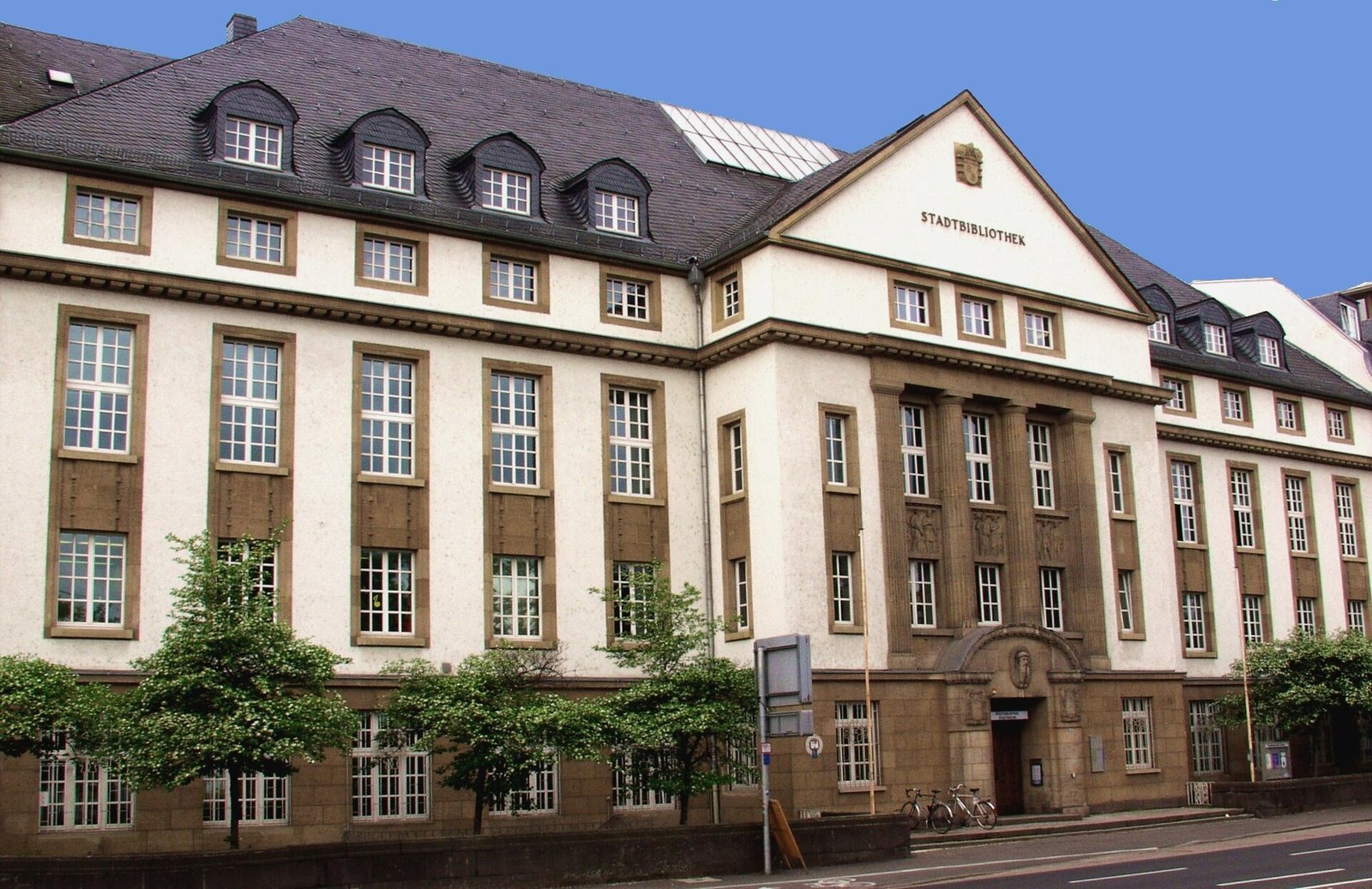
The four-storey library stands on Rheinallee, facing the Rhine and west of the Theodor-Heuss Bridge. Its plan combines a set-back street block with two wings and a central projection, alongside a rear book-stack building that forms a third wing. Limestone is a prominent building material. The street façade combines Neoclassical forms, drawing on classical Greek and Roman design, with sculptural decoration influenced by late Art Nouveau, an ornamental style popular around 1900.
Building layout
Street-facing block
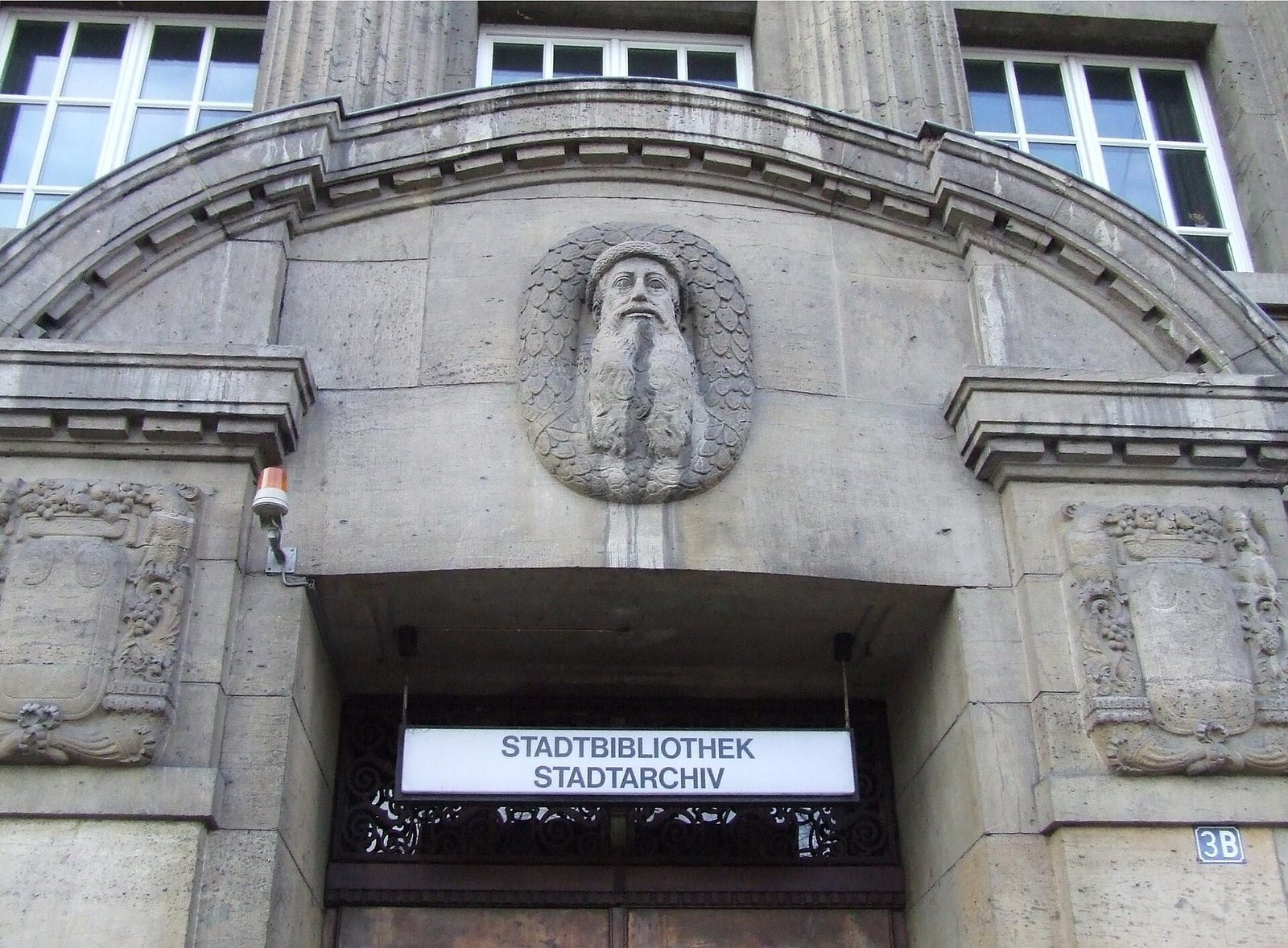
The central projection is framed by two half-columns attached to the wall and two flat pilasters, shallow wall supports. They rise beneath a triangular crown. Above the main entrance, a half-relief depicts Johannes Gutenberg, the Mainz printer associated with the spread of movable type in Europe. Gutenberg’s coat of arms also appears in the staircase. Both features reflect the building’s former use by the Gutenberg Museum. The sculptor is believed to have been Johannes Lipp.
Book-stack wing
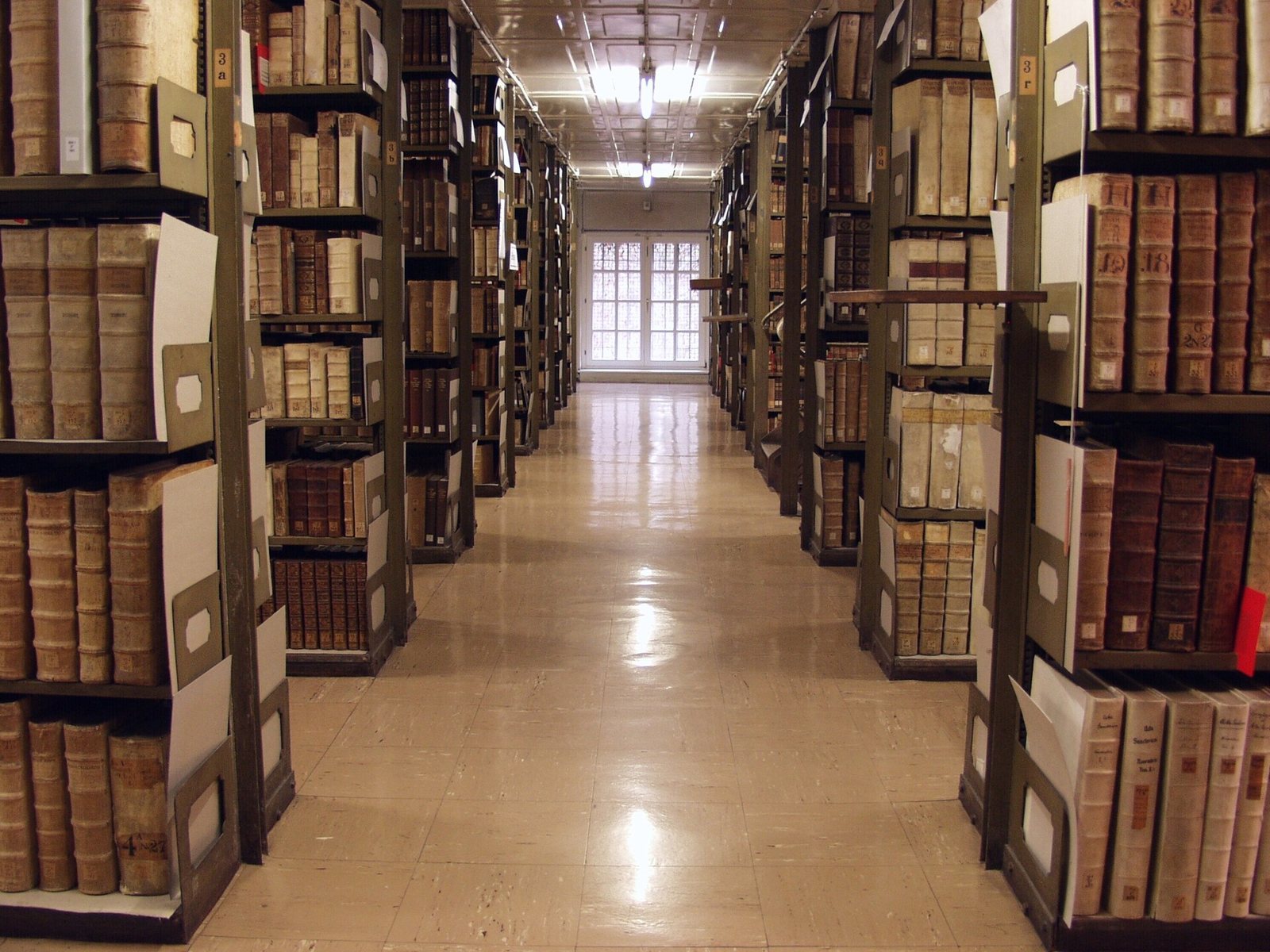
The rear stack building encloses and provides access to the Lipman shelving system, a method of storing and organizing books that has remained in use since the library opened. Its floor levels do not align with those of the main building. A planned extension that would have doubled the stack building’s length was never completed.
Staircase and interiors
Grand staircase
The nearly square grand staircase has broad stone flights, a gallery along three sides of the second floor, and a large open space above its final section. A dome-like glass vault admits light and gives the stairwell the character of a light court, an interior space lit from above. The staircase design draws on Baroque palace architecture.
Interior alterations and surviving features
Parts of the interior were changed from 1962 onward. The foyer received wood panelling, and later work adapted rooms to new uses and conservation needs. The director’s room and portions of the staircase and reading rooms retain their original design. Most wooden doors from the first floor upward are also original.
Printed collections
Rare books and ownership history
The library holds about 700,000 media units at Rheinallee and in auxiliary storage. Its separately kept rare-book collection contains about 9,200 volumes and was expanded continuously from 1985 to 2019. The books include rare and first editions, presentation copies, bibliophile editions, notable bindings, and works valued for their printing or artistic qualities. Some bindings reuse earlier materials. Ownership research has identified books once owned by Ottheinrich, a ruler and elector of the Palatinate, the physician Achilles Pirminius Gasser of Lindau, and the humanist Ulricus Fugger. Humanists were Renaissance scholars who drew on classical Greek and Roman learning.
The collection also preserves substantial remains of the Bibliotheca Palatina, the historic library associated with the Palatine electors and centered at Heidelberg. These books reached Mainz in the seventeenth century through the Heidelberg Jesuit establishment.
Regional print and newspapers
Mainz Carnival newspapers, many of them unique, provide material for studying regional and wider cultural and social history. They have been filmed, and rare Mainz prints and other works related to the city are also available in digital form. The library’s newspaper holdings extend back to the eighteenth century. For conservation reasons, use of original newspapers is restricted, while filmed copies can be consulted. Sixteenth- to eighteenth-century printed works trace the development of printing from the period of the earliest European printed books onward.
Manuscripts and fragments
Medieval and Carthusian manuscripts
The manuscript collection contains about 1,300 items, roughly two-thirds medieval and most dating to the late Middle Ages. Most are books made for practical use. The Mainz collection includes 624 codices, meaning manuscripts in book form, with many originating in the library of the Carthusian monastery, a house of a contemplative Catholic order. Among its holdings are 356 theological manuscripts. A Heidelberg University Library project sought to bring related manuscripts, now dispersed among different collections, together virtually. A three-volume inventory of additional manuscripts was prepared from 2005 to 2007, and further cataloguing began in 2017.
Arabic and Turkish manuscripts
Seven manuscripts in Arabic and Turkish date from 1554 to 1680. Four are Qur’an manuscripts; the others contain a Turkish translation of a Persian biography of Muhammad, Arabic legal opinions, and medical texts in Turkish. Most came to Mainz in 1686 as war booty from the library of Buda, through the German nobleman and officer Johann Karl von Thüngen. Some have rich decoration and bindings associated with Persian and Turkish luxury-book traditions.
Regional manuscripts and fragments
Later manuscripts include an 1834 comic play from Mainz, subsequently published in a critical edition, and a manuscript that may be the earliest handwritten record of the Vilzbach song by Mainz songwriter Carl Joseph (Anton) Weiser. The collection also contains fragments in German and Hebrew, including evidence of manuscript production at a Mainz scriptorium, a place where books were copied or made, in the ninth century.
A notable late-Carolingian fragment contains an illustrated commentary on the biblical Book of Revelation. The Carolingian period is associated with the Frankish dynasty founded by Charlemagne and his successors. The fragment, catalogued as Hs frag 18, has been digitized.
Special and regional collections
Named collections
Special holdings include the publications of Mainz children’s-book publisher Joseph Scholz, among them books for children and young adults and board and card games designed by notable illustrators. The library also holds ornithologist Jacob Moyat’s collection, bequeathed to his home city, and the Peter Cornelius Archive, a substantial body of manuscript and printed material on the Mainz poet and composer’s life and creative work. Antiquarian purchases have added to the Scholz and Cornelius collections.
Regional and civic material
In 1981 the library received about 700 items relating to Erfurt, donated by Lorenz Drehmann, chairman of the Association of Erfurters Loyal to Their Home City. Some holdings of the Mainz City Archive are stored in the library building as well. Together with its Mainz and Rheinhessen publications, these collections reflect the library’s local and regional scope.
Care, use, and catalogues
Preservation and consultation
Manuscripts and rare books are consulted under supervision in designated places in the historical reading room, and the rare collection is kept separately. Preventive care includes inspection, cleaning, climate monitoring, book maintenance, and protective enclosures. Damaged items are treated in the library’s bookbinding workshop, the Gutenberg Museum’s restoration workshop in Mainz, or independent conservation workshops.
Catalogues and research
The historical catalogue from the nineteenth and early twentieth centuries comprises 36 volumes and remains useful for research on the older collection. Its volumes are available in digitized form through a regional digitisation portal. The manuscripts have been catalogued, while older printed books have undergone cataloguing and ownership research using international standards.