Palazzo Taddei: A Florentine Renaissance Palace
Site at a Glance
- Rating
- 5
- Popularity
- Very Low
- Country
- Italy
- Primary era
- Early Modern
- Eras represented
- Early Modern
- Civilizations
- Grand Duchy of Tuscany
- Site type
- Domestic
- Remains
- Elite Residence
On this page11 sections
History
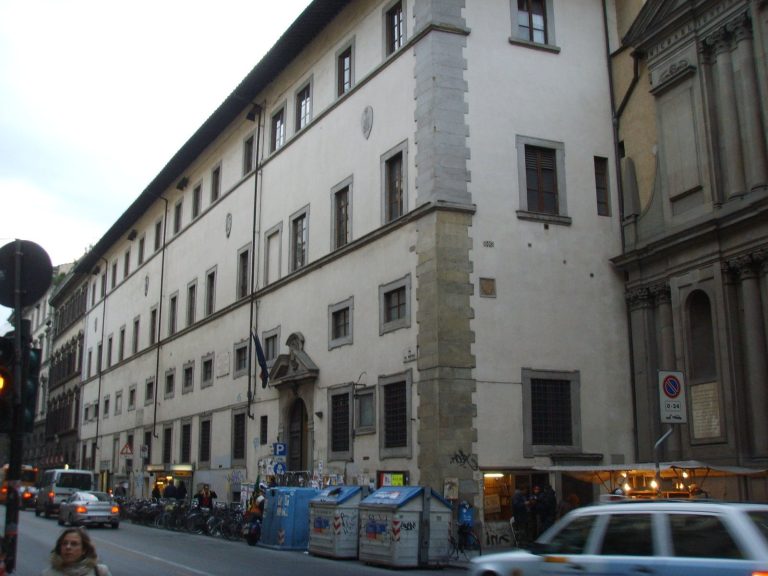
Palazzo Taddei is a palace on Via de’ Ginori in Florence, Italy, built for Taddeo Taddei by Baccio d’Agnolo, a Florentine Renaissance architect. Its façade follows fifteenth-century Florentine models, and its history connects Taddei patronage with later Giraldi and Ginori ownership.
Taddei patronage
Giorgio Vasari wrote that d’Agnolo built the house on land where the Taddei family already owned several homes. The family had grown wealthy through the wool trade in the early fifteenth century and was associated with the Medici, a powerful Florentine family active in the city’s politics and culture. Taddeo was a prominent family member with connections to Raphael, the painter, Pietro Bembo, a writer and scholar, and Michelangelo, the sculptor and painter.
Raphael appears to have stayed at Palazzo Taddei. In gratitude, he gave Taddeo two paintings: Madonna del Prato, now in Vienna’s Kunsthistorisches Museum, and The Holy Family, now in the National Gallery of Scotland. Michelangelo also made a circular relief for Taddeo, known as the Tondo Taddei. A plaque commemorating Raphael’s stay is on the house at No. 17, but it may be in the wrong location. That house and the adjoining building at No. 19, later Palazzo Tolomei-Biffi, had both belonged to the Taddei. The plaque and the later relocation of a Taddei family tabernacle contributed to confusion over the palace’s location in twentieth-century studies.
Giraldi alterations
The palace was sold in 1542 to Giovanni Giraldi, who was married to Argentina Guicciardini. During the seventeenth and eighteenth centuries, the Giraldi enlarged the building, particularly its piano nobile, the principal formal floor above the ground level. They added a terrace connecting the two wings. Interior rooms received frescoes in successive campaigns by Volterrano, Ranieri del Pace, Matteo Bonechi, and Giovanni Domenico Ferretti. The garden at ground level was converted into a carriage shed.
Later ownership
The Giraldi family line ended in 1789. The widow of its last member left the palace to her nephew Antonio Pecori, establishing the Pecori Giraldi family. His descendants owned it only briefly before it was sold to Levi, a wealthy Jewish buyer, in the first half of the nineteenth century. Levi moved a tabernacle commissioned by Antonio Taddei to the house at No. 17.
Lorenzo Ginori Lisci acquired the palace in 1847 to expand his family’s properties around Palazzo Ginori. The building remains in the hands of his descendants.
Remains
The three-storey palace is arranged around a spacious courtyard reached through an entrance hall. Covered walkways run along two sides of the courtyard, while the street-facing façade combines arched windows, plastered surfaces, and stonework.
Exterior and courtyard
Façade
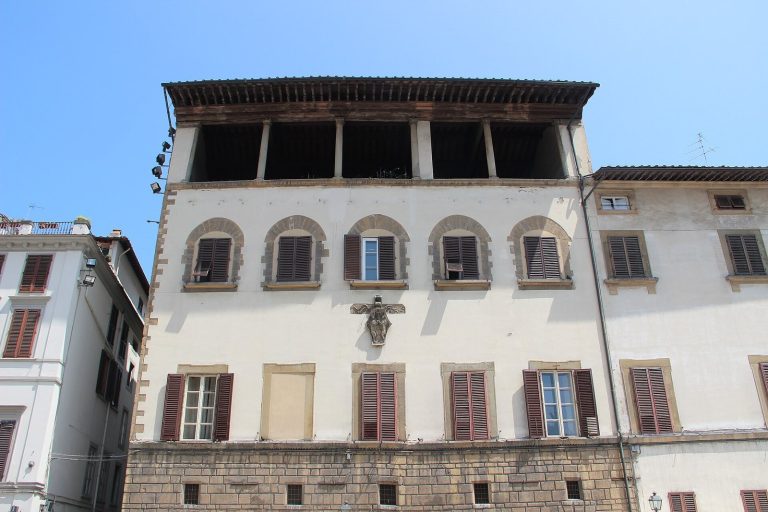
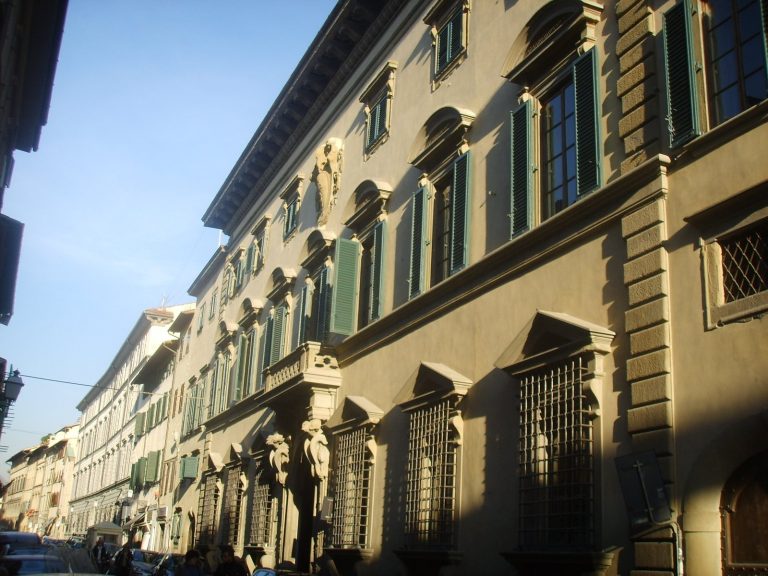
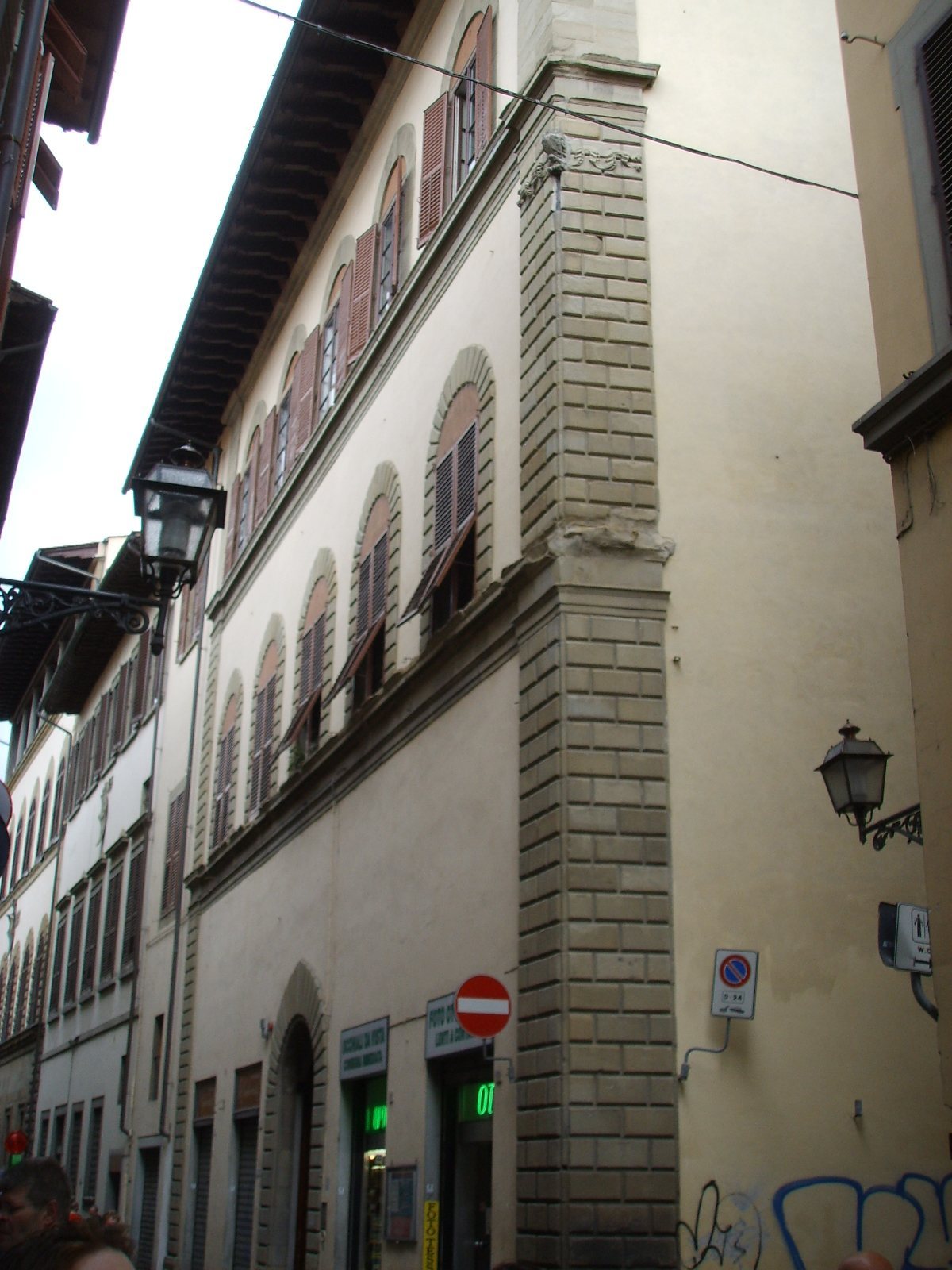
Two tiers of arched windows have stone frames formed from radiating blocks. Horizontal bands and stretches of plain plaster separate the window levels. At ground level, a central stone surround echoes the window frames, alongside rectangular shop doorways that may be later additions. Rough-cut stone emphasizes the building’s corners, becoming smoother, thinner, and more regular higher up.
Entrance and courtyard
An ironwork gate bearing the Ginori family coat of arms closes the entrance hall. In the courtyard, round arches rest on columns of pietra serena, a gray sandstone used in Florentine buildings. The columns have capitals decorated with simple rosettes. A glazed roof and glass panels now enclose the courtyard.
Courtyard features and present use
Artwork
A copy of Michelangelo’s Tondo Taddei hangs on a courtyard wall; the original is held by the Royal Academy in London.
Current use
Part of the courtyard’s ground floor is occupied by the publishing house Casa Musicale Ceccherini. Florence Academy, a music academy founded by musician and composer Eric Buffat, occupies the first floor.