Haus Uentrop: A Moated Manor House in Hamm, Germany
Site at a Glance
- Rating
- 4.5
- Popularity
- Very Low
- Country
- Germany
- Primary era
- Early Modern
- Eras represented
- Early Modern, Modern
- Civilizations
- Brandenburg-Prussia, Holy Roman Empire, Kingdom of Prussia
- Site type
- Domestic
- Remains
- Manor House
On this page10 sections
History
Haus Uentrop is a moated manor house at the Lippe crossing toward Dolberg in Hamm, Germany. Its present main house dates to 1713–1720. The estate’s history includes a defensive role, centuries of association with the von der Recke family, and an inheritance that brought it jurisdiction over nearby communities.
Border estate and family ownership
In 1198, Haus Uentrop and Haus Heidemühlen served the Counts of Berg-Altena in guarding their territorial borders against the Prince-Bishopric of Münster, a territory governed by a bishop with secular authority. Count Adolf I of the Mark, ruler of a Westphalian territory, founded Hamm in 1226. Members of the von der Recke family served in the castle retinue at Burg Mark and lived in a castle within Hamm before later acquiring Haus Uentrop.
Members of a knightly family called Uentrop appear in records from 1325 and 1380, though their connection to the manor is unclear. Dietrich von Grimberg held the estate in 1328. In 1393, Count Dietrich II of the Mark granted Haus Uentrop to Hermann von der Recke as a hereditary castle fief, land granted in connection with castle service, and included an annual amount of 10 marks. During the fifteenth century, the von der Recke and von der Mark families shared ownership.
In 1427, Alef von der Recke combined his share of Haus Uentrop with a share in nearby Haus Haaren. These interests passed through his son Goddert to Johann, Alef’s grandson. Johann married Rorich von der Mark in 1478. Her father, Everd von der Mark, transferred the larger part of Haus Uentrop to Johann for 1,000 guilders, with the remainder included as a dowry. In 1494, Johann’s younger brother-in-law Everd gave up his right to buy the property back. Johann had sole ownership by 1504, and the estate remained with his family.
The Recke estate and the new manor house
Johann’s son Evert inherited Haus Uentrop and served as Droste of Hamm, a territorial administrative official. In 1541, Emperor Charles V granted him the right to operate a mill in recognition of his service to the Emperor and the Empire. A later Evert died in 1560, leaving the estate so deeply indebted that his widow, Gertrud von Münchhausen, sold it later in the sixteenth century. The buyer, Dietrich XV von der Recke, acted for his brother Mathias, a commander who headed a commandery, an administrative house of a military order, at Doblen and held Neuenburg in Courland. Dietrich’s second son founded the younger von der Recke line at Haus Uentrop.
The younger line included Dietrich von der Recke zu Haaren und Uentrop, who died in 1693. He and his brother Johann were raised to the rank of imperial baron, a noble title within the multi-territorial Holy Roman Empire. In 1679, fire destroyed the old castle and farm buildings. Dietrich’s widow, Anna Magdalena von Bar, commissioned a replacement manor house, built in the early eighteenth century.
Inheritance, jurisdiction, and later history
The male line of the von der Recke family at Haaren ended in 1763. Engel Luise von der Recke zu Haaren inherited her family estate, Haus Haaren, and its jurisdiction, established in 1716, over the parish of Uentrop, Mundloh, and three farming communities in the Mark. Through her marriage into the Uentrop branch, these holdings passed to the Recke zu Uentrop. In 1764, the king granted Johann Matthias Dietrich von der Recke the estates. Haus Uentrop also took over Haus Haaren’s patrimonial jurisdiction, the judicial authority of an estate owner over a defined area, covering the parish of Uentrop and the farming community of Norddinker.
The von der Recke family and its descendants were associated with Haus Uentrop for more than 600 years. It was the only manor seat in the former Mark district of Hamm still managed by its resident noble family. Family members lived there until 1976. The last owner sold the estate in 1990; it is now unoccupied, remains privately owned, and needs restoration. Haus Uentrop has been protected as a historic monument since 1986 for its regional historical and scholarly value.
Remains
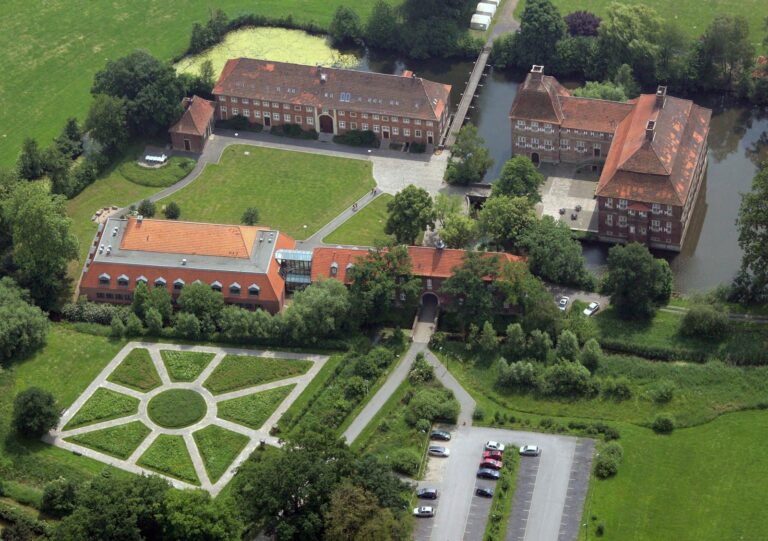
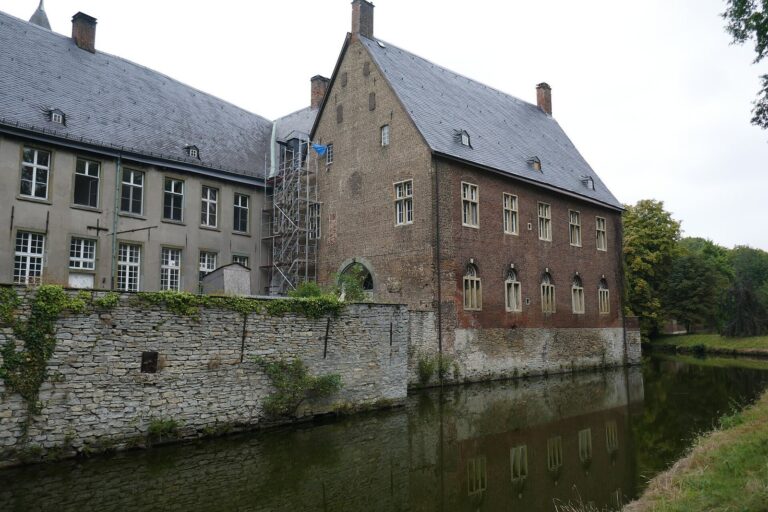
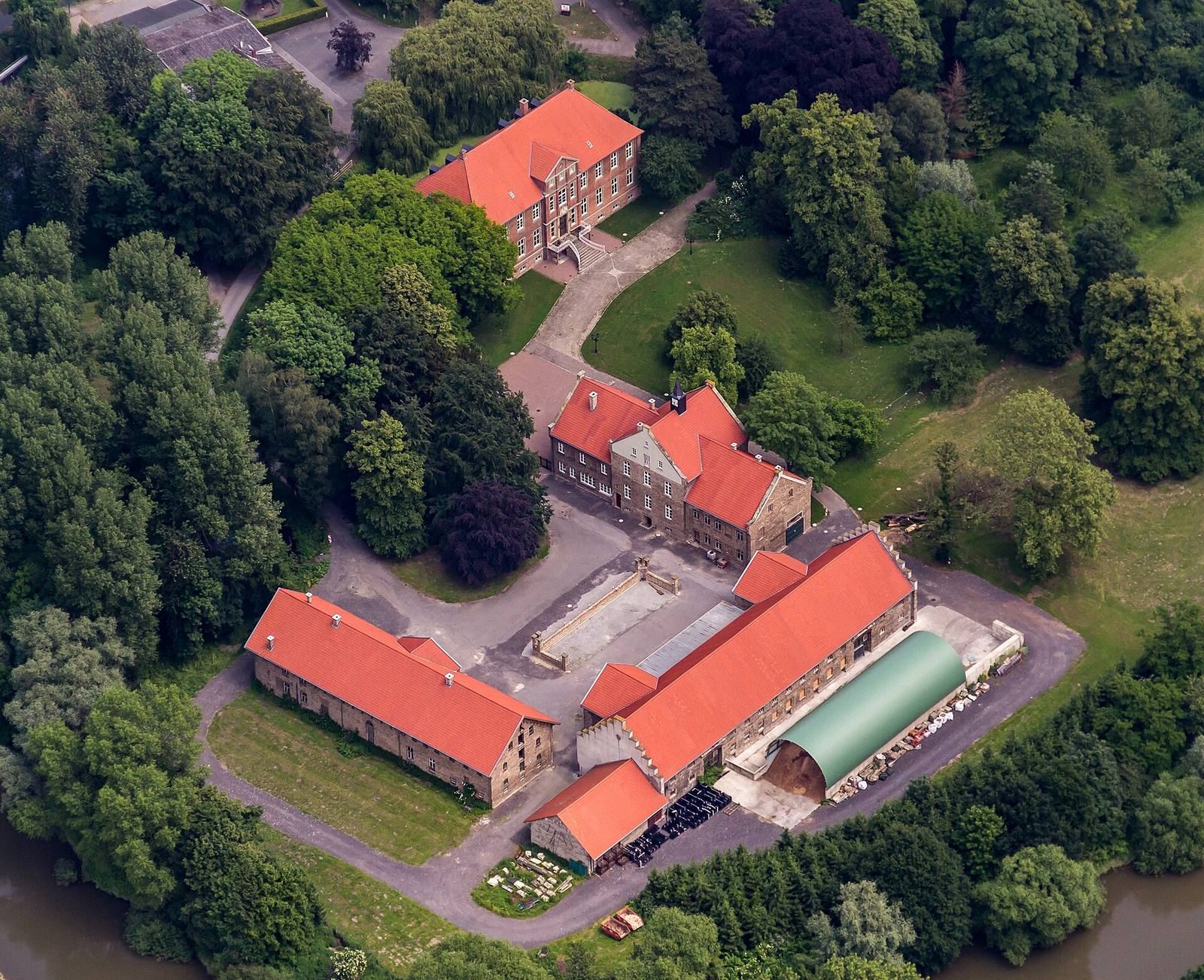
The estate stands beside the Lippe crossing toward Dolberg, with a park surrounding the buildings. Its surviving layout includes a two-storey main house and three two-storey residential and farm buildings. Brick is the principal building material, including field-fired bricks made in field kilns.
Main house
The plain brick main house has a narrow central projection, a part of the front façade that extends beyond its main surface, and a hipped roof that slopes on all sides. A paired von Reck-Baer coat of arms, dated 1720, is set above the main entrance. Inside, rooms are arranged in two connected sequences. The entrance hall contains an elaborate wooden staircase with intermediate posts and a baluster railing, whose shaped vertical supports form the handrail.
Residential and farm buildings
Servant’s house
The two-storey field-fired-brick servant’s house is dated 1849 and has a central projection.
Barn
The two-storey field-fired-brick barn, dated 1860, has a stepped gable whose outline rises in successive steps.
Horse stables
The two-storey field-fired-brick horse stables retain original interior fittings, including a wooden post forming part of the stalls, wall tiles, and a coffered ceiling divided into recessed panels. The horse stalls occupy the room behind the central projection. The estate’s farm buildings continue to serve agricultural purposes.